If there’s one aspect of a lens that is more discussed than any other, it’s sharpness. In wildlife photography, sharp photos are especially sought-after, with just a few exceptions. Fine feather detail in bird photography is one of the first things I look for in my own shots, personally. But how much does a lens’s sharpness really matter in wildlife photography?
Table of Contents
What is Lens Sharpness?
In short, a lens’s sharpness is its ability to resolve detail on the subject. But lens sharpness isn’t just a single metric – the same lens that’s sharp in some cases may be below average in others. For example, let’s take a look at our sharpness measurement from Imatest for the Nikon Z 50mm f/1.8 S lens:
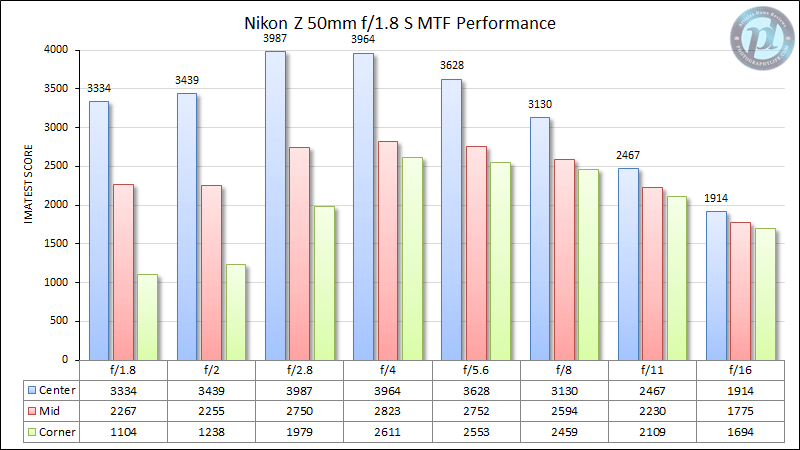
This is actually one of the sharpest lenses we’ve ever tested in the lab, but even so, you can see that the sharpness depends on the aperture and the portion of the frame that you’re considering. The Nikon 50mm f/1.8 S behaves like most lenses: It is most sharp in the center, and it has a “sweet spot” of the sharpest aperture values (in this case, around f/2.8 to f/5.6).
The sharpness or resolving power of a lens is dependent on the optical formula of the lens. More modern and complex designs often – but not always – result in better sharpness and fewer aberrations.
In general, expensive and exotic telephoto lenses (like 300mm f/2.8 lenses, 600mm f/4 lenses, etc.) tend to be among the sharpest optics of any lens today. But there are plenty of cheaper telephoto lenses on the market, too – some of which are not as strong optically. Does that matter? Well…
A Sharp Lens Does Not Mean Sharp Photos!
When people use the term “sharp photo,” they are actually referring to the presence of detail. This detail depends upon much more than just the sharpness of the lens.
In other words, don’t expect to pick up the latest 600mm f/4 and automatically get beautiful, razor-sharp wildlife photos. There are many other factors to consider first.
One of the biggest ones is subject distance. If the subject is closer, detail such as bird feathers will be larger relative to the frame, and thus you’ll capture more detail on them. Plus, being closer reduces the distortion effects from atmospherics.
There’s also the focal length of the lens. If your subject is far away, the world’s best 400mm lens will not compare to an average 800mm lens in the detail you’re resolving, since the 800mm lens magnifies the subject so much more.
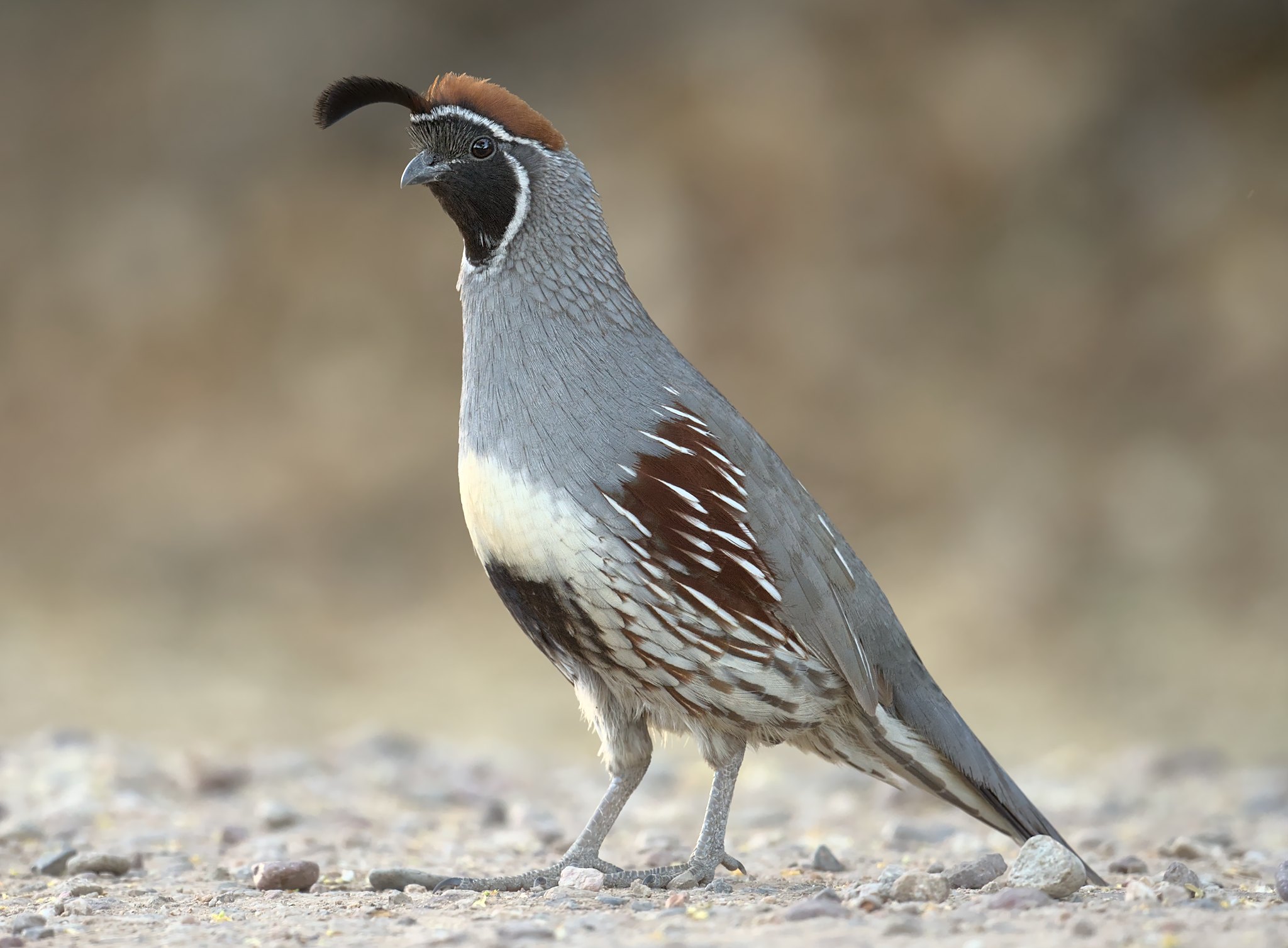 Here, I was at the near ideal distance to capture Gambel’s Quail. It nearly filled the frame as I was laying on the ground! (Nikon D500 + 500mm f/5.6 PF)
This is one reason why it is so dangerous to judge lens sharpness purely on sample photos, especially if you’re not seeing the original Raw files. For example, a nearby bird photographed with a cheap 70-300mm zoom will appear sharper than a bird far in the distance photographed with a high-end 300mm f/2.8.
There are other factors, too, including:
- Shutter speed and subject movement: Pick too slow of a shutter speed, and you’ll get motion blur – a huge culprit behind sharpness loss!
- Missed focus: Front-focus or back-focus can make a $10,000 lens look worse than a point-and-shoot camera lens.
- Sharpening in post-processing: This won’t magically create lost detail, but it can make existing detail more apparent.
- Image noise: Shooting in low light and high ISOs is a recipe for losing details. Proper noise removal can help, but overdoing noise reduction can make the problem worse.
In other words, the final level of detail present in your photo depends on a lot more than the pure resolving power of your lens.
 Nikon D500 + 500PF @ 500mm, ISO 450, 1/2500, f/5.6
A Below-Average Lens Does Not Mean Blurry Photos!
It’s obviously true that sharp lenses can resolve more detail (at least if you do everything else right). This helps for things like cropping your photos or printing a bit bigger.
But, if you’re filling the frame with your subject and you have plenty of light, you’ll capture surprisingly similar levels of detail with a budget telephoto compared to a super-sharp exotic lens, so long as your print size is reasonable. I’ll put it like this – if you’re getting blurry photos with any modern lens, it is unlikely that the lens’s resolving power is to blame.
Recently at Jardim Botânico São Paulo in Brazil, I managed to get very close to a Southern Lapwing with my Nikon 70-300mm AF-P DX lens. This is a $400 entry-level telephoto zoom, and although it’s perfectly acceptable, it’s not going to be in the same conversation as Nikon’s exotic primes. Yet because I had proper focus, a fast enough shutter speed, a low enough ISO, and a subject filling the frame, the photo is very sharp up close. The limiting factor for making a large print is my pixel count, not the lens at all!
 Southern Lapwing – NIKON Z6 + Nikon 70-300mm AF-P DX @ 260mm, ISO 720, 1/400, f/8.0
Granted, these were close to ideal conditions. For more difficult subjects or extensive cropping, the 70-300mm would have shown its weaknesses more clearly. But it goes to show that a basic – or even a below-average – telephoto lens is not a fatal blow to sharp wildlife photos. It’s better to fill the frame with a cheap lens than to crop extensively with something expensive.
Should You Upgrade to a Sharper Lens?
Whether you should upgrade is a tricky question. When you get a more expensive or higher-performing lens, sharpness is far from the only thing that will improve. For example, going from the Sony FE 200-600mm f/5.6-6.3 G to the Sony 600 f/4 GM does not just give you more sharpness, but faster autofocus and an f/4 maximum aperture. Frankly, these improvements matter more to the photo’s overall sharpness, compared to the difference in resolving power between the two lenses.
In my own wildlife journey, I used to shoot with the Tamron 150-600mm G2 lens and later upgraded to the Nikon 500mm f/5.6 PF lens. In this case, the faster autofocus and lighter weight of the lens were the most noticeable improvements, and both had direct impacts on the sharpness of my photos. Yes, the 500mm f/5.6 is the better of the two lenses in lab tests, and that shows up sometimes in the field – but it was the other features that made a bigger difference to me.
Not to mention that most of the time, the problems in a wildlife photo run deeper than sharpness (whether lens sharpness or otherwise). It’s much more important to focusing on lighting and composition (gasp!) than pixel-level detail. And even when the problem specifically is insufficient detail, the most likely culprit is that you need to get closer to your subject.
 NIKON D500 + 500PF @ 500mm, ISO 2500, 1/800, f/5.6
That brings me to another point: the degree of the upgrade. To bring up one common situation, if you’re currently shooting with a shorter lens plus a teleconverter, switching to a lens with a longer native focal length will usually be a nice upgrade in terms of sharpness (especially if it’s a prime lens).
On the other hand, the differences in sharpness narrow once you climb the ladder of high-end lenses. If you’re still not getting adequately sharp photos with some $2000+ telephoto prime lens, you better not be blaming the lens, unless you dropped it off the ladder.
I remember that Libor surprised a lot of people when he noted that the Nikon Z 400mm f/4.5 (a $3250 lens) is basically as sharp as the Nikon Z 400mm f/2.8 TC (a $14,000 lens). There are good reasons why pros will buy the f/2.8 prime – mainly the wider maximum aperture and built-in teleconverter – but sharpness measurements in the lab are probably not among them.
Finally, there is no doubt that lenses are getting better with time. Modern lenses, even the budget ones, are much better than a typical lens of ten years ago. I would have no issue using modern telephoto zooms like the Sony 200-600mm, Nikon 100-400mm, and presumably the upcoming Nikon 200-600mm. The sharpness of those lenses may be worse than a high-end prime in the lab, but in the field, those differences will often disappear.
 Common Redpoll. Reasonably modern lenses are sharp enough for most purposes — Nikon D500 + Tamron 150-600 G2 @ 600mm, ISO 6400, 1/640, f/7.1
So, how would I answer the question I posed in the title of this article? I’d say that lens sharpness doesn’t matter too much beyond a certain point, and we’ve mostly reached that point with modern lenses, even cheaper ones. But paradoxically, upgrading to a sharper lens can still be worthwhile for sharpness-obsessed photographers! That’s because the sharpest lenses on the market (usually the exotic primes) have other features that matter more. They have wider maximum apertures, faster focusing speeds, better image stabilization, and so on. Those features can directly lead to sharper photos. So if you switch from a 70-300mm f/4.5-5.6 to a 300mm f/2.8, you’ll definitely get crisper photos, but probably not for the reason you were thinking.
And as a final note, let’s all take a step back if possible. It can be kind of silly how much photographers obsess with sharpness these days – and I’m guilty of it too. I love prints that look razor-sharp up close. But some of the best wildlife photos I’ve seen still have a few issues when your nose is up against the glass. Before you spend a fortune upgrading your lenses, make sure you know what you’re gaining and exactly how it will help your photography.

About Jason Polak
Jason Polak is a Canadian wildlife photographer, and he's been interested in photography ever since he started with a disposable film camera. His former career as a mathematician led him to move to Australia in 2016. There, the amazing birds inspired him to give up math and a traditional lifestyle and spend more time in nature away from civilization. Check out Jason's work on his YouTube channel or his website.
Comments
-
I really enjoyed this article as it also cuts across the notion of sensor size and many others. We have professionals (full time photographers) and then the serious photographers with available money who buy the $6000 camera and the $15000 lens. These tools are capable of producing images not doable with lesser equipment. But then again in the hands of the experienced and skilled photographer, they produce top quality images with a small sensor system with mid level lenses and lower mp sensors. Today the technology is so good that budget becomes a major factor. And most important other factors such as size, weight, reach and always cost. There is also a lot of snobbery looking at equipment review comments, this new x plows, y out of the water. This system destroys that one. In the end make sure you learn field craft, know your equipment, avoid GAS and spend the money traveling and creating opportunities for great images.
- I agree. Most factors in wildlife photography are overblown. For example, animal recognition AF, ultrasharp lenses, fast buffer – all overblown. There are specialized situations where better equipment matters: complex and difficult bird in flight photography does benefit from the best AF, very low-light situations does benefit from faster lenses, and lens sharpness does matter a little in some cases. But by and large, you can produce world-class images with almost any camera as long as you have a decent lens. Like the Nikon 180-600, for example, and a Nikon Z50 – would be perfectly fine and not get in your way for many kinds of shots.
Reply 02. Hello… Quick (stupid ?) question here.
Looking at various lenses reviews I see that ‘sharp’ or ‘very sharp’ quality for a lens, per your measurements would roughly sit in the 3000+ range, but I’m really wondering how to interpret the number, and did not find an article defining it… Does it relate to some sort of “perceptive pixels” across the frame ? So, e.g., a 3000 would mean 3000 (long edge) x 2000 (short edge for a 1.5 aspect ratio), meaning 6 MP ? Or if pairs of “separated pixels”, so 6000 x 4000, giving 24MPix effective (or perceptive) resolution in the entire frame ?
I was not able to find a definition of it in the articles, nor in the reviews. One of the angles that make me wondering is whether the measurement (whatever its specific definition) is (A) “per physical distance on the sensor”, or (B) relative to the entire frame …
The difference between A and B definitions would matter when comparing DX and FX lenses scores. As the DX sensor is smaller, a finer (sharper) physical resolution is needed to separate as many lines or pixels along the frame. Maybe this is why scores exceeding say 2200 for DX lenses receive praise in your reviews : they may resolve less details across the entire (DX) frame, but still are very fine on terms of details per mm on the sensor ?
Could you please comment / correct or point me to a relevant link ?
Regards,
Vincent
- Hi Vincent, we now have an article on this exact topic: photographylife.com/how-o…-in-photos
Reply 03. I think the thing I wonder is these values sound good/poor when compared to each other but what do the values in Imatest actually equate to on their own. For an A3 print, is a value 2500 in the centre good? I’m trying to decide on the 24-120 4 and the 35-150 2/2.8 for a Z8, and the former is sharper and lighter, the latter a few more compromises a touch more reach, less sharpness… but maybe it’s enough at 45mp?
-
You take of cheap, and high price lens, but there are alot of variable to consider, weather, the person, and distant! I been taking some fairly sharp pictiure of a nest eagle with a nikon- 1000 with a mono pol, the nest is very deep in a restricted area , and l tried with trampon 150-600 len it can,t make, but other wise l ” would” prefer it!
-
I noticed that you completely ignore any references to any Canon products as being sharp.
- Canon has sharp and not sharp lenses just like every other manufacturer.
Reply 06. IMHO, topics such as this have no answer. What is sharpness? You claim It is the ability to “resolve” points. What we don’t see, we don’t know is missing. Edges can look “sharp” when really the lens/camera combo have obliterated subtleties that would otherwise make an image look unsharp. The original App Lanthar lenses from 40 years ago were extremely sharp, but not in ways that would appear so in this discussion. Their subtle contrast provided endless shadow detail without ever looking “crisp”. The feel was more three dimensional. At one point there was a classic Nikon look in black and white. It was really just a high contrast presentation that accentuated edges. Is sharpness an illusion created by the inability of a lens to resolve further at the expense of contrast and colour? If we zoom in to 800% will it still look sharp? It we look at the image as a billboard 60′ x 90′ from half a mile away, or as a 6 x 9 print, will it look sharp?
-
Recent Wildlife Photographer of the Year awards featured a photo by a 14 year old with a Nikon Z9 and the 400 tc version. See what $21,000 plus travel expenses can do! I love exotic birds and wildlife like anyone, but this exclusive equipment club gets a bit tedious.
- Yes, people with money to go to exotic locations have an advantage in competitions. For sure.
Reply 08. I found this article very interesting and the associated comments. Like most people I am obsessed with sharpness. I have 2 nikon p900 cameras which do have a long focal range although in practice I don’t keep many photos taken above 800 mm. I have got a Canon RB but i have not yet got a long lens for it. Compared with the p900 it does seem complicated to use. I think you develop a love hate relationship with a camera because it does produce variable results. My p900 photos are on my blog Birdwalkermonday.blogspot.com
-
I agree with the author Jason that sharpness need not be the be-all-end-all in wildlife photography. I feel the most important thing in virtually all photos is the emotional impact the photo has on the viewer. With this in mind I would say that getting closer to your wildlife subject to achieve sharper images often leads to the subject becoming wary of the photographer and ceasing its normal behavior as it either freezes or flees. While the frozen subject might make a good ID photo in a guidebook, it says little about the animal’s life, environment or behavior. So rather than filling the frame with a nervous subject, backing off with a longer lens (at the cost of some sharpness due to distance/atmospheric disturbance) can lead to more engaging images as the subject is free from fear of the photographer. And even if you don’t have a longer lens, backing off and showing the animal smaller in the frame and interacting with its environment included can lead to great photos as well.
- You need the Z9 or A1 (or Canon option) with the 600 or 800 mm equivalent to start. Then the gimbal, the monopod, the blind, the cammo gear, the nature specialist to guide you to the right spot at the right time. Ideally, another Z9 with a 100 – 400/tc as a backup too, don’t forget the CF Express cards, the extra batteries. Should be simple.
Reply 10. “, if you’re filling the frame with your subject ” “…you need to get closer to your subject.”
This glosses over one benefit of increased sharpness: cropping.
- Hey Bo, thanks! I did mention cropping as a benefit of sharpness in the article. Of course, getting closer still beats cropping if you can do it :)
Reply 11. As a wildlife photographer, I can say lens sharpness matters almost not at all in the field. Even if the animal is staying still, the furs are moving, eyes are moving, tail or wings can be moving in the wind etc. You are shooting a moving subject no matter what. Autofocus and shutter speed matters a lot more than lens sharpness to get a good picture.
The more I shoot, the less I care about lens sharpness. I don’t even care about sharpness loss with TC’s anymore, since the loss is mostly in the DX or FX corner, whereas the animal is 90% of the time in the center anyway.
-
Many years past I upgraded to a 400mm F2.8G Lens and was blown away in how it produced an image, when compared to images from other used lenses. The capability to isolate the subject left the added perception the subject was much improved as a sharp image.
Roll the clock forward and now a Z System only user and using a 400mm Lens, I have revisited images captured of same subjects in similar settings captured on the F Technology and compared these to my Z Technology images.
There is as a result of my skill set and my subjective assessment, very little, if any differences that can be detected in the sharpness of the subject where the focus point is optimised.
The idea of getting closer to the subject and increasing the frame fill has always benefitted me, to capture the sharpest images when all camera settings were correct for the capture.
In the past, as a Winter activity, I have worked with the owned lenses to learn where the focus is optimised for how I want to use the lens. This has enabled me to be confident with the lenses in the field.
I have used wide angle lenses at closest focal length, capturing Damson and Dragon Flies and do not see the need to improve on the image captured. The idea of a lens to produce more capture opportunities is the most desirable change for these subjects.
This suggests familiarising oneself with their lenses and learning where the lens offers a optimised performance has an importance. Using the lenses on subjects that are working with the lenses discovered optimised working parameters for producing a sharp image that impresses, will increase the success rate of captures and the users confidence.
How an individual produces a image in post editing takes time, I attempt to work on the basis less is more. This has been learned in the early days of post editing through working with a duplicated image.
One image edited with an over used tool, where the overall image is affected by the excess of tooling and the other just tweaked with the tool, to accentuate certain areas of the image. After a period revisiting the two images, the over used tool edited image has always been rejected by myself, usually due to how fake the sharpening appears.
- So basically, if a camera and lens were able to take good pictures 5 or 10 years ago, they should still be able to today. The advertisers and camera manufacturers want you to feel inadequate and deprived with your OLD, out of date, non current, gear. The beauty about cameras in the days of film was that they all did essentially the same thing and the film was really the greatest limiting factor, not cameras. A Minolta SRT 102 could easily accomplish the same task as a Leica, Nikon or anything else. Further obsolescence and product cycles were so much longer. It was possible to own and use a Hasselblad 500 series camera for decades without feeling the need to “upgrade”. The lifespan of a modern camera is years at best.
Reply 13. I think you just have to get closer to your subject and fill up the sensor no matter what lens you use. I just saw a picture of a Swallow sitting on a fence wire that was taken with a Nikon 800mm pf lens. It still looked over sharpened and blurry.
-
Some great points in this article. And I was glad to see Nikon’s lowly 70-300mm AF-P DX lens get a mention — I think that’s an amazing lens for the money (though if you shelled out $400 for it, you really overpaid). I’ve never had a real “wildlife lens,” just a steady diet of lesser 300mm and 400mm manual focus lenses, along with 70-300mm zooms. But I have sharp, close wildlife images on my walls — black rhinos in a field of flowers in Tanzania, punk zebra in Zimbabwe, grizzly in Denali, bison in Yellowstone. Patience and steadiness go a long way toward maximizing a lens’ capabilities. But that 500mm PF does look sweet …
- Thanks! I paid a lot less for mine though. I got it used at around $150, but we just use the MSRP to quote prices usually. But I agree with you — you can basically produce an endless stream of very high-quality wildlife shots without a dedicated expensive lens.
Reply 15. Beware the Grammar Grabbers. . . it’s “lying on the ground,” not “laying.” = :- )
-
I agree skill (or luck) is very important. I do however have several of really important moments when I knew that my lens was not up to the task. The chromatic aberration in my photos of a Respendent Quetzalis is a good example. Purple fringing, green edges. I wish I had the 500mm F4 prime I have now at the time. The same zoom lens was however fine up to 200mm for sharpness. I have a few really good shots where the lens has done a really good job. It was not quick to focus as you got close to its maximum 300 and image quality dropped. The rendering of the background and the ability to provide nice bokeh when I needed it was also a serious issue.
Sharpness is in summary, just one of the factors in deciding whether a lens is right.
RE Z series lenses: The S series lenses I have bought are very sharp and often excellent edge to edge at nearly all apertures(not all). That’s not however their only benefit. They tend to have nice colour balance, better control of chromatic aberration and good micro contrast.
That said the desire to overdo the post processing is not the fault of the lens. In my view lots of images I see on-line lack authenticity because the technology has been used poorly.It has nothing to do with mirrorless cameras or Z lenses. I would much prefer to see a lot less HDR, less use of dodge and burn, less saturation and less use of “enhancements”.
- I agree with everything you said! I also do feel that although lens sharpness is but one of many ingredients, having a very nice sharp lens adds a bit of extra magic that is hard to define. Chromatic aberrations is another thing I don’t miss with my 500PF!
-
I bought the 500 F4 a couple of years before the PF was released. They are both great lenses.
Reply 17. “There’s also the focal length of the lens. If your subject is far away, the world’s best 400mm lens will not compare to an average 800mm lens…”.
Some people say that cropping an excellent 400 mm lens is as good or better than putting a 2x TC on it to “make” what might be referred to as an average 800 mm lens. I know this sounds like I am just being nitpicky, but it would actually be instructive to see a well done and carefully controlled test of this.
- See the tests of some of the exotic prime lenses and compare the results with the TCs added in. The 1.4 TC results are often very good. If the lens is outstanding without a TC attached, you will probably get very pleasing results. If the lens is borderline sharp without a TC it’s usually not worth the trouble.
- Thom Hogan concluded in his tests that the 800mm f6.3 PF is sharper than the 400mm f2.8 TC with a 2x teleconverter. “Compared to the 400mm f/2.8 TC VR S with the 2x teleconverter: other than perhaps the center, the 800mm f/6.3 PF VR S wins, though perhaps not by as much as you’d expect. The 400+TC starts to show clear acuity loss outside the DX corners, and the extreme corners can have clear blur to them wide open. Not so the 800mm, which retains acuity well out to the corners, and extremely so at f/8. That said, the DX area with the 400mm+TC looks astonishing good for 2x teleconverter use when stopped down one stop. Still doesn’t quite match the 800mm f/6.3 PF VR S, but I find the 400mm+TC combination extremely usable.”
Reply 18. You said “the world’s best 400mm lens will not compare to an average 800mm lens in the detail you’re resolving.” What if the sensor’s pixel density is very high and there’s plenty of light, such that the limiting factor is lens sharpness? If I understand correctly, they would be comparable if the world’s best 400mm lens resolved twice as much detail (in terms of effective vertical pixels) as an average 800mm lens. Are you saying the world’s best 400mm today just isn’t that much shaper?
- The MTF tests in this site suggest that you might occasionally get into this realm when using TCs.
- On a 45 megapixel sensor, cropping a 400mm image to an 800mm equivalent will bring you down to about 11 megapixels. You’d need a pretty lousy 800mm lens to do worse by comparison. (A 400mm lens with a bad 2x teleconverter could maybe qualify as “pretty lousy.”)
-
Thanks for highlighting that we shouldn’t take pixel count for granted. But consider a 40 MP crop sensor (Fujifilm X-H2), which has the same pixel density as a 90 MP full-frame sensor, or consider a theoretical 100 MP full-frame sensor. With these sensors, a 400mm lens could potentially resolve comparable detail to a 800mm paired with a 24 MP full-frame sensor… if the 400mm is sharp enough. I don’t know whether to expect even an excellent 400mm to be sharp enough for that. I guess DxoMark tries to measure and explain this with “Perceptual Megapixel” ratings, but they haven’t published a lot of reviews. I’d appreciate any more insight on the relationship between lens sharpness, pixel density, and focal length.
Reply 19. What’s your view on the part played by processing software?
Are we getting to the point where you only need a relatively modest camera and lens (say D7500 or D500 and 70-300 AF-P or 300/f4 + 1.4 TC (around £800 used now)) plus modern software to produce results good enough to print to A3+ or even A2?
- Well, the D500 + 300PF + 1.4TC is already a pretty nice combo. However, regarding just a 300mm lens, I do not think software is good enough to make a 300mm lens look like a 500mm lens, so if you are in one of those situations where you are too far for 300mm but just right for 500 (or 600), software will not help you much (and yes, I’ve played around lots with all the latest software). Good fieldcraft and getting closer will help way more than any software.
-
Glad you said that …
Seeing as I’ve just bought a used 500PF.
(Tasty little number.)
Reply 20. I am glad that you brought up the subject of sharpness as not the be-all and end-all of good photos. I have been caused much doubt about my lenses by the emphasis here at PL on sharpness. In fact, one of the things that I don’t like about the z system is the excessive sharpness of its lenses. When looking at a landscape, I don’t think I should be able to see perfect outlines when an object is five or more miles away. The eye doesn’t work that way, and it doesn’t look natural. My favorite lens is the AF-S Nikkor 28-300 f/3.5-5.6 G ED. With that lens you basically don’t need any others. It has the reputation of not being that sharp, and yet I get great photos with it. And for its convenience, its sharpness deficits are well worth it. Yes, I wish it were a bit sharper. It has its sweet spot at f/8 and because of the above mentioned doubts I often stay with that aperture, but with the other factors that you mention I recall that I’ve gotten very good photos at wider f stops as well. So I think that this article is very well timed and badly needed to give all of us something of importance to think about.
- I think there might be a slight differnece about the sharpness of lenses and what you might be seeing in certain shots. A very sharp lens can still make a fairly natural picture (and I guess if you really wanted to you could stop down a little to get some diffraction). But on the other hand it’s more often the sharpening in post that gives on effect or another, especially since if you turn sharpening off completely, Bayer colour sensors tend to give some slight softness.
-
Well as a matter of fact, I never find that sharpening in post does me any good at all, though I often try it (and end up turning it off). I do find that the clarity setting helps me more. I upped the clarity in camera and found that it helps my lens do a better job. I almost always up the clarity setting in post. But I’m not sure you quite understood my point in my first post. I was illustrating that extreme sharpness is not necessarily always a good thing, but I certainly don’t enjoy not having enough of it. I almost never seek softness in a photo, unless you count bokeh as softness, and if I wanted it, it is easy to put in. I was agreeing with the idea that a lens doesn’t have to have total sharpness in every corner of the photo or every zoom position of a tele, to still be a good lens. I think that composition and intent can overcome a slight lack of sharpness to make a very good photo. I also meant that I believe this is a discussion that is long overdue.
Reply 21. Good artikel. My way was always towards sharpness ( and maybe even more for bokeh). I tried many AF lenses (incl “exotics”) in the past decades, but I was only stunned when switching to manual lenses (like Zeiss Otus). Taking more time, more support, more fine adjusting finally lead to the results I really was after. Glass was only half of the success.
-
Sharpness is one of the most overrated aspects in photography today imo and strongly driven by lens manufacturers. Sharpness is easy to measure and many people believe that sharper is better so it is good for sales. Many lens reviewers follow the sharpness hype so it strengthens the feeling that sharpness is everything. If I look in my portefolio and compare my photos taken with a filmcamera somewhere 30 years ago with those digitally taken with my Z lenses I can see the digital photo’s are sharper for sure but more beautifull or better? I don’t think so. On the other hand I see online so many photos that are so rediciclous sharp that it feels very unnatural. Modern lenses are sharper than our eyes! I do some bird photography and I know it is pleasing when the feathers and details are really sharp but in general every modern lens is more than sharp enough. I agree fully with you that skills as a photographer are far more important than equipment.
-
Good article. Should save people a lot of money. The only people who put their nose up to the glass are photographers. In the real world they don’t count . What counts is how ordinary people see the image at the proper viewing distance where you won’t see minor imperfections. Let’s remember huge outdoor posters have huge pixels or dots but we do not notice because of the huge viewing distances. The same applies to TV sizes there are recommended viewing distances.
-
Good article. The most significant improvement to my out-of-focus bird shots is using Topaz IA sharpening. It’s simple amazing.
Comment Policy: Although our team at Photography Life encourages all readers to actively participate in discussions, we reserve the right to delete / modify any content that does not comply with our Code of Conduct, or do not meet the high editorial standards of the published material.
Leave a Reply Cancel reply
Your email address will not be published.Required fields are marked *
Comment *
Name *
Email *
Δ