One of the biggest challenges in photography is sharp photos when hand-holding a camera. Many end up with blurry images without understanding the source of the problem, which is usually camera shake caused by basic improper hand-holding techniques or mirror and shutter-induced vibrations. The easiest way to compensate for this shake is to use the reciprocal rule, which tells you the minimum shutter speed that you should use.
That’s because the most common cause of camera shake is lower-than-acceptable shutter speed when hand-holding the camera. I will introduce and explain the reciprocal rule, which can help in greatly increasing the chances of getting sharp photos when you do not have a tripod around.
 Captured hand-held following reciprocal rule
Sony A7R + FE 35mm f/2.8 ZA @ 35mm, ISO 100, 1/40, f/11 © Nasim Mansurov
Table of Contents
What is Reciprocal Rule?
Due to the fact that we as humans cannot be completely still, particularly when hand-holding an object like a camera, the movements caused by our bodies can cause camera shake and introduce blur to images. The easiest way to counter this is:
The Reciprocal Rule: the shutter speed of your camera should be at least the reciprocal of the effective focal length of the lens.
For example, if you are shooting with a 50mm lens, use a shutter speed of at least 1/50. Or, say you are shooting with a zoom lens like the Nikon 20-120mm f/4S lens on a full-frame camera. Now the rule says that if you are shooting at 80mm, your shutter speed should be set to at least 1/80th of a second, whereas if you zoom in to say 400mm, your shutter speed should be at least 1/400th of a second.
Using such fast shutter speeds helps prevent blur by camera shake. Why? Because there is a direct correlation between focal length and the effect of camera shake – longer focal lengths magnify camera shake. If you have a zoom lens like the above-mentioned Nikon 24-120mm lens, you have probably already noticed how much more shaky and jumpy your viewfinder looks at 120mm, compared to 20mm. That’s because camera movement is magnified at longer focal lengths:
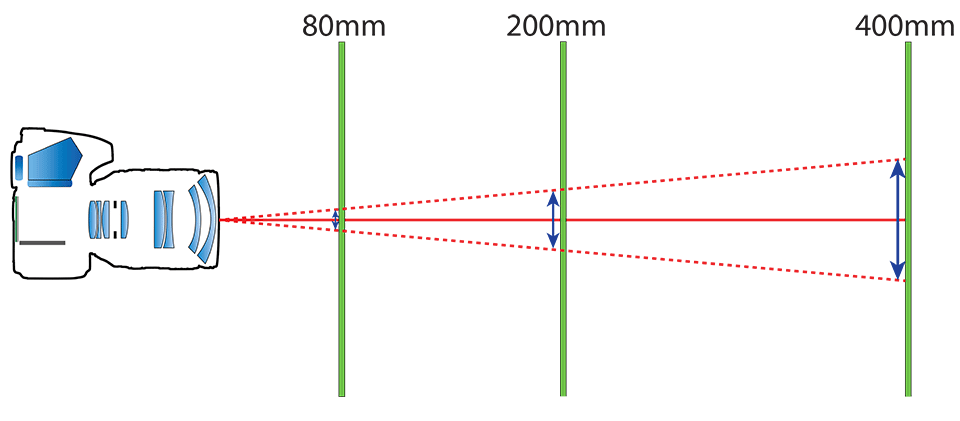 You can see how the potential for camera shake is increased with the increase in focal length. The red-dotted lines that represent the potential limit of how much the camera can shake when hand-held have a much shorter span at 80mm than at 400mm. That’s because camera shake is magnified with an increase in focal length.
The Reciprocal Rule and Motion Blur
Camera shake is not motion blur. In other words, blur caused by camera shake is very different than motion blur (where the subject is faster than set shutter speed).
Motion blur typically happens when your subject is moving. In this case, even if you use the reciprocal rule, you still could get a blurry shot because your subject is moving very fast. For example, most birds in flight need at least a shutter speed of 1/2000 on a 500mm lens, whereas the reciprocal rule only recommends a minimum of 1/500.
It is also important to point out that the reciprocal rule only applies when hand-holding a camera. If your camera is on a sturdy tripod, then it is not shaking and so the reciprocal rule isn’t necessary.
Effective Focal Length
Please note that I used the word “effective focal length” in the definition and gave you an example with a full-frame camera. If you have a camera with a smaller sensor than 35mm or full-fame, you first have to compute the effective focal length, also known as “equivalent field of view”, by multiplying the focal length by the crop factor.
Example. If you use the same 80-400mm lens on a Nikon DX camera with a 1.5x crop factor and you are shooting at 400mm, your minimum shutter speed should be at least 1/600th of a second (400 x 1.5 = 600).
This is just an approximate rule of thumb, and it is used because crop sensor cameras often have higher pixel densities than full-frame cameras, so they show camera shake more readily. Of course, if you have a 50MP full-frame camera, it will show more camera shake at the pixel level than a 24MP full-frame camera, so it might be wise to also apply this rule for high-density sensors if you are a pixel peeper.
Exceptions and Notes to the Reciprocal Rule
Although it is commonly referred to as “reciprocal rule”, it is not a rule per se but rather just a guidance for minimum shutter speed to avoid blur caused by camera shake.
In reality, how shutter speed affects camera shake depends on a number of different variables, including:
- The efficiency of your hand-holding technique: if you have a poor hand-holding technique, the reciprocal rule might not work for you and you might need to use faster shutter speeds. Gear and lenses vary in size, weight and bulk, so you might need to utilize specialized hand-holding techniques depending on what you are shooting. For example, check out this great article by Tom Stirr on hand-holding techniques for telephoto lenses.
- Camera resolution: Cameras today like the Nikon Z9 have more pixels crammed into the same physical space. Higher resolution cameras will show more intolerance to camera shake than their lower resolution counterparts. So, if you are dealing with a high resolution camera, you might need to increase your shutter speed to a higher value than what the reciprocal rule suggests.
- Lens quality / sharpness: you might have a high resolution camera, but if it is not matched by a high-performing lens with great sharpness, you will not be able to yield sharp images, no matter how fast your shutter speed is.
- Subject size and distance: photographing a tiny bird from a long distance and wanting to have every feather detail preserved usually requires faster shutter speed than recommended by the reciprocal rule, especially if the subject needs to be tack sharp at 100% zoom.
 The NIKKOR Z 100-400mm f/4.5-5.6 VR S lens has 5 stops of image stabilization © Spencer Cox
Do You Need the Reciprocal Rule with Image Stabilization?
Most mirrorless cameras today come with image stabilization. Even if you are using a DSLR, many longer lenses have optical stabilization built-in!
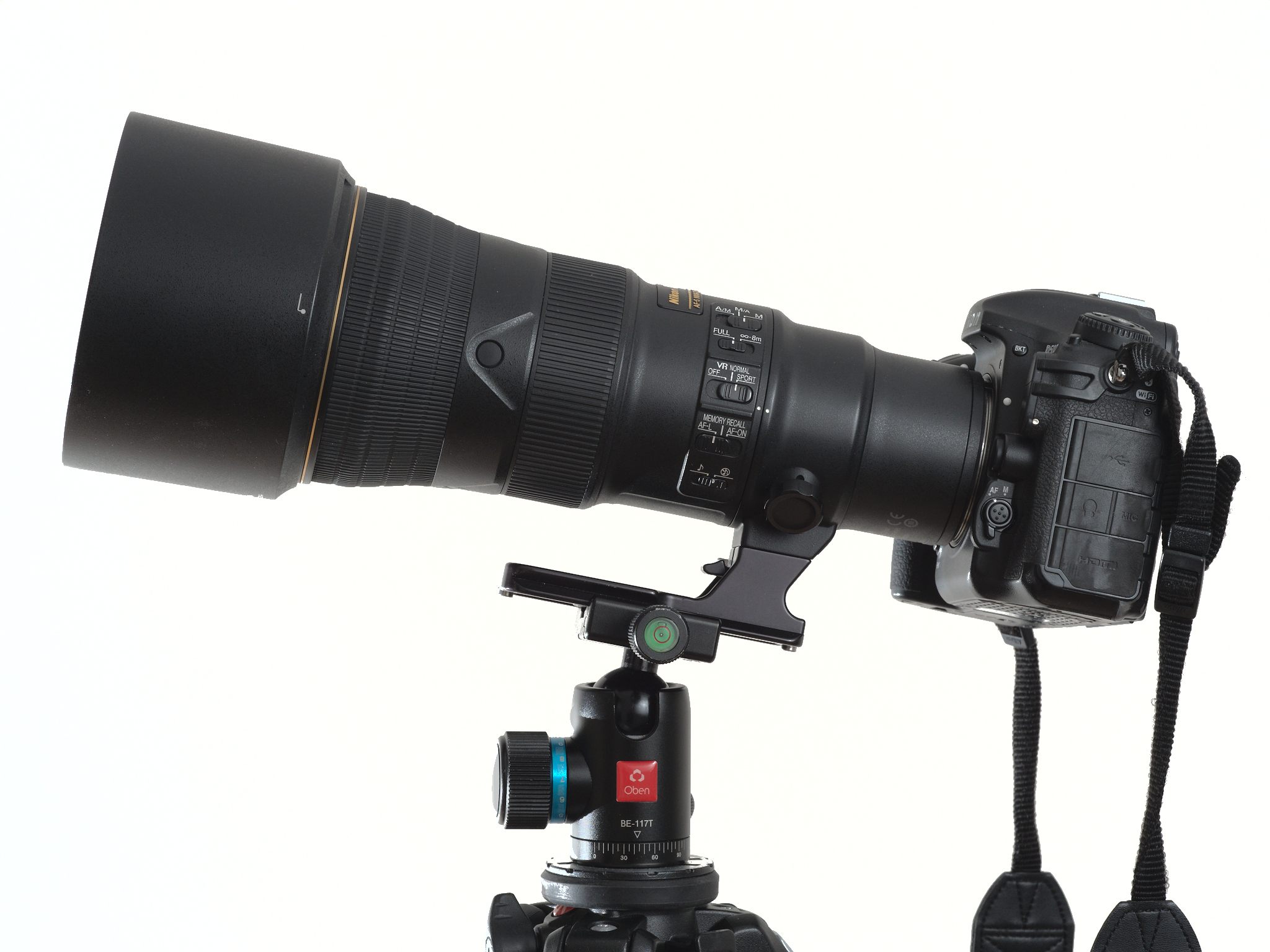 The Nikon 500mm f/5.6 PF lens for DSLRs has optical image-stabilization right in the lens
The ceciprocal rule is often too conservative if your lens or your camera come with image stabilization (also known as “vibration reduction” or “vibration compensation”), because it effectively reduces camera shake by moving internal components of a lens or the sensor of the camera.
Modern image stabilization systems these days give between 4-7 stops of stabilization. And if you’re getting say, 5 stops of stabilization, that means that on a 100mm lens, instead of needing a shutter speed of 1/100, you might only need a shutter speed of 1/3! Of course, that assumes that your subject isn’t moving, because even slowly-moving subjects like turtles will cause blur at such low shutter speeds.
 Image stabilization on my Panasonic G9 allowed me to capture this image at 1/6th of a second, even though I used a 14mm focal length (28mm FF equivalent) © Jason Polak
To take another example, the 80-400mm f/4.5-5.6G VR comes with image stabilization up to 4 stops of compensation, and so you could theoretically reduce the recommended shutter speed by reciprocal rule by up to 16 times!
So when shooting at 400mm, if your hand-holding technique was perfect and you turned image stabilization on, you could go from 1/400th of a second (reciprocal rule based on a full-frame camera) to 1/25th of second and still be able to capture a sharp image of your subject (provided that your subject does not move at such long shutter speeds and cause motion blur). In such cases, reciprocal rule simply does not apply.
If you’re relying on in-body image-stabilization (IBIS), remember that it loses effectiveness at longer focal lengths. So, if you are using a camera with IBIS but your lens does not have in-lens stabilization, then you might not want to forget the reciprocal rule so quickly.
Applying Reciprocal Rule: Auto ISO
Many of the modern digital cameras come with a really neat feature called “ Auto ISO“, which allows one to let the camera control camera ISO depending on light conditions. Some Auto ISO implementations are rather simplistic, letting the end-user specify only minimum and maximum ISO and giving little to no control on minimum shutter speed. Others will have more advanced Auto ISO features, allowing to specify not only ISO ceilings, but also what the minimum shutter speed should be before ISO is changed.
Nikon and Canon, for example, have one of the best Auto ISO capabilities in their modern mirrorless cameras – in addition to the above, minimum shutter speed can be set to “Auto”, which will automatically set the shutter speed based on the reciprocal rule:
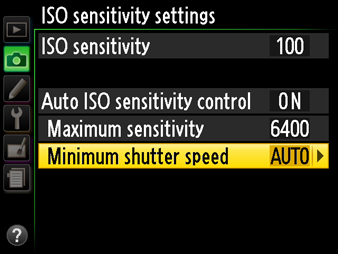
One can even customize this behavior further, by changing the minimum shutter speed relative to the reciprocal rule. For example, on my Nikon D750 I can set the minimum shutter speed to “Auto,” then set the bar once towards “Faster,” which will speed up shutter speed based on the reciprocal rule.
So, if I am shooting at say 100mm focal length, the camera will automatically increase ISO once my shutter speed reaches 1/200th of a second. And if I use a stabilized lens and want my camera to have a longer minimum shutter speed, I can move the same bar towards “Slower,” using a longer minimum shutter speed guided by the reciprocal rule.
Of course, if you have set a minimum shutter speed, make sure to turn it off or switch to another mode when you don’t need it, such as when you are shooting on a tripod.
The Reciprocal Rule for Different Genres
The reciprocal rule is useful, but there are certain genres of photography where you still have to be careful and use a bit more planning instead of just relying on the reciprocal rule for your photography.
Landscape Photography
Landscape photography is often done on a tripod, so in dimmer light, it’s much better to set your camera to its base ISO and let the shutter speed be as long as possible.
 If you’re shooting on a tripod, it’s much better to use base ISO and let teh shutter speed be as long as it needs to be. NIKON Z 7 + NIKKOR Z 24mm f/1.8 S @ 24mm, ISO 64, 8/10, f/5.6 © Spencer Cox
Even if you’re not on a tripod, landscape photography often uses wider focal lengths, which are especially effective with IBIS in mirrorless cameras. So in many cases, you might not need the reciprocal rule. If you are shooting handheld with a DSLR, it’s still good to use the rule, however.
Portrait Photography
The reciprocal rule works well with portrait photography, where you are using longer focal lengths and natural light. However, portrait photographers often use flash.
In this case, if the majority of your light is coming from flash, then you can shoot at whatever shutter speed is required for the effect you need: a much lower shutter speed to “drag the shutter” if you want background light in, or a higher shutter speed of 1/200 to use only the light of the flash.
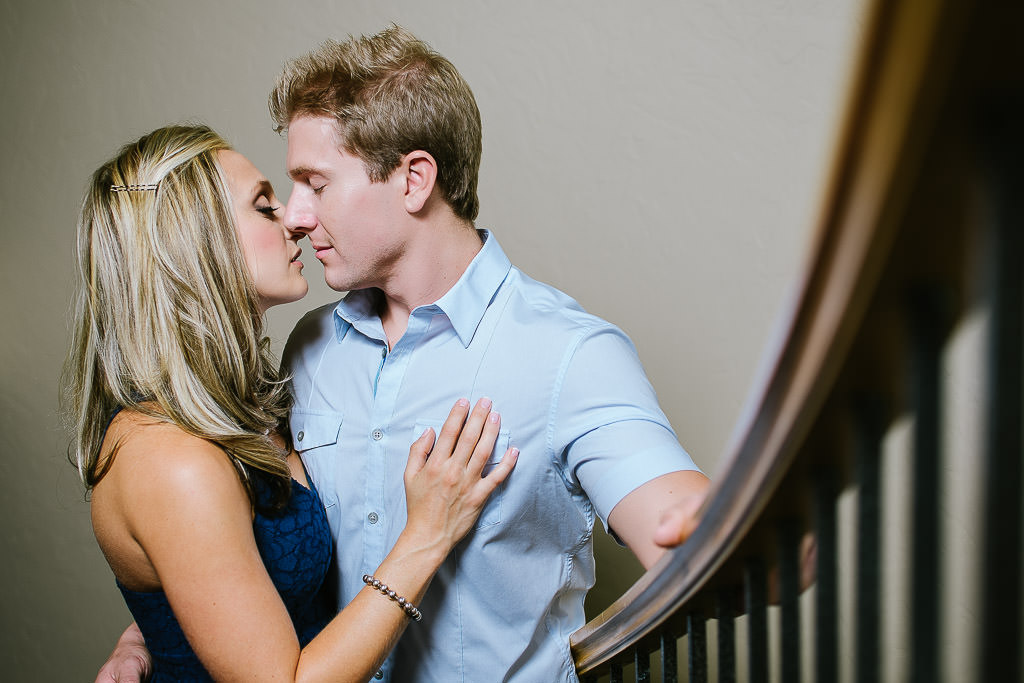 X-E1 + Touit 1.8/32 @ 32mm, ISO 200, 1/125, f/2.5 © Lola Elise
Wildlife and Sports
In wildlife in sports, your subject is typically always moving. In this case, you’ll pretty much always need to use a higher shutter speed than recommended by the reciprocal rule.
 Small birds move so fast that I needed 1/4000th of a second for this species! Nikon D500 + 500PF @ 500mm, ISO 450, 1/4000, f/5.6 © Jason Polak
Macro
At close-up distances in macro photography, forget the reciprocal rule. The high magnification simply…magnifies camera shake! Thus, even with short focal lengths like 50mm, you still might need a higher shutter speed than 1/50 to get sharp shots, simply because you are so close!
A lot of macro shooters use flash because of this. Even if you can handhold macro shots, it still might be better to use flash because there is so little light in macro.
Conclusion
Even with today’s advanced cameras, the reciprocal rule is still useful, especially in those cases where you don’t have stabilization on your camera or on your lens. Even if you do, there ar some cases such as very long focal lengths where it can come in handy. Finally, remember that the reciprocal rule just recommends a minimum. You may still need to use a higher shutter speed for other reasons such as moving subjects.
Do you still keep the reciprocal rule in mind? If so, let me know in the comments!

About Nasim Mansurov
Nasim Mansurov is the author and founder of Photography Life, based out of Denver, Colorado. He is recognized as one of the leading educators in the photography industry, conducting workshops, producing educational videos and frequently writing content for Photography Life. You can follow him on Instagram and Facebook. Read more about Nasim here.
Comments
-
Superb
-
Nasim, I have found your articles to be extremely helpful!
-
Re: “photographing a tiny bird from a long distance and wanting to have every feather detail preserved usually requires faster shutter speed than recommended by the reciprocal rule”. Not sure whether anyone has pointed this out, but that advice is totally backwards. For any specific focal length, the closer you are to the subject, any movement of the camera or subject cause the subject to move across more of the field of view during the exposure.
Frank
-
“how sharp images turn out at 100% zoom”
This. People tend to miss this. The idea that you need minute sharpness at 100% zoom on your computer screen is quite frankly ridiculous most of the time. People need to think more in terms of printed size or actual viewing size. Let’s say I photograph the same item using a 24MP camera and a 50MP camera using the same settings. At 100% zoom the 50MP picture might show more blur compared to the 24MP picture. But zoom out to have the same viewing size and they will be the same.
-
The sensor size does not influence the reviprocal rule. If camera shake gives a 1% blur on a Fx sensor, it will also be 1% on the center part or on a DX sensor.
Equivalent focal length is only a cropped field of view and has no pptical property as such.
Jacques
-
Hi. I’ve read a lot of this now and also about DOF and hyperfocal lenghts. All formulas designed for film and now we have DX and also smaller sensors. So I started wondering what is behind the formulas. I’m not so worried about camera shake, I want to figure out shutter speed for moving subjects.
Imagine a D7100 DX camera on a tripod with a 35mm. An athlete running at 20km/h (12,5 mph) passes from left to right 5m in front of the camera and you fire at 1/1000s. What happens if you see the picture at 100%. The speed of that light on the sensor, is 9700 pixels per second. With 1/1000s you get a 10 pixels blur! If you use a D40 (same sensor size, 1/4 pixels) the blur is only 5 pixels. So focal distance, subject distance, subject speed, angle, sensor size and pixel density all have infulence in 100% zoom pixels inspection.
Usually I would pan the camera following the movement, but the legs of the runner are still moving relative to the camera.
-
92$/hour@life
>/ < www.NetCash9.Com
-
Hi Nasim, I was just wondering what difference the use of a teleconverter would make with regard to this guideline? For example, if I have a 200mm lens and a 2x converter, would I need to set the shutter speed to 1/400 with it attached?
-
Oddly enough we learned different rule known as reciprocity. Reciprocity refers to the rule that an exposure is the same at say f2.8@1/1000th, f4@1/500th, f5.6@1/250th, etc. In the film days this was especially important to know if you did long exposures because films suffer from what’s called reciprocity failure. That’s a phenomenon where film looses its sensitivity in long exposures and that rule breaks down.
I think we learned the rule you refer to as the inverse focal rule. And that only applied to 35mm cameras- it would have made no sense back in the 1980’s with film sizes as diverse as 110 (13x17mm) up to the largest format I ever shot hand held 4×5″ (10x12cm.)
- The reciprocal rule is the reciprocal rule – and has always referred to the guidance about shutter speed when hand holding a camera. You may have known it as the ‘inverse focal rule’ but this is mathematically incorrect. I am no mathematician, but reciprocal means to divide by a number e.g. the reciprocal of 500 is 1/500 while the inverse (generally understood to be the additive inverse) is the opposite or negative of a number i.e.the inverse of 500 is -500.
The multiplicative inverse however, does corresponds to the reciprocal! i.e. 1/500.
Then there are reciprocal and inverse trigonometric functions – at which point my schoolboy math gives up and I am lost without trace!
There is an inverse square law, which is a law, (as opposed to a rule or guide), but which has nothing at all to do with camera shake!
Reciprocity failure is not a rule, it is a phenomenon.
It is the way film (and the human eye) behave when exposed to light and varies from film to film (and from person to person).
At ‘average’ values the curve describing the response is more or less linear = twice the amount of light twice the response. At the extremes however, it takes a disproportionately longer exposure to light (or higher intensity) to elicit the same response. Film response is a gamma curve. Digital sensor response is linear.
This is the basis for the gamma curve in photography and explains why we expose differently for digital sensors (ETTR- expose for maximum data) than we did for film (expose for preferred tonality).
The reciprocal rule does not, with respect, only apply to the 35mm format. There are just as many sensor formats today as there were film formats yesterday.
Camera shake is a function of magnification and for a given focal length, magnification is constant. Therefore the reciprocal rule is constant. Only the field of view changes with change of format, not the magnification. To make matters worse, most medium and larger format cameras suffer from horrendous mirror slap so there is an argument for increasing the reciprocal factor to take account of this negative feature.
-
FYI: I replied to you but needed to include a couple links to Wikipedia and Stackexchange which left my reply “in moderation.” Let me ditch the links and maybe my real comment will be approved eventually.
Here’s what I sent sanitized of links:
Hey Betty,
I think at least some folks see this as I do. As an example this Wikipedia entry on the subject: (search for Reciprocity (photography) on Wikipedia since I guess I can’t put links here)
As for the application to 35mm format in what I know as the inverse shutter speed, format would presumably be a logical measure. Because it would determine angle of view and as such magnification (at least at the same distance.) A super wide lens on 4×5 film like a 75mm (equal to a 24mm in 35mm) would be a moderate telephoto on 35mm or “full frame” digital, and equal to 150mm on 110 film. Obviously the resolving power of a 4×5 film image is immensely greater than that of 110. But all other factors (including resolution) being equal you could get away with a much longer exposure with a big piece of film than a tiny one. That inverse focal rule is truly just a rule of thumb.
Here’s a snippet from a similar discussion I found: “So, I don’t know exactly where it came from, but it’s definitely an idea for 35mm film, and it’s clear that in its early form, it was seen as a general guide, not a law.” (more info here: link removed just look at the search: stack exchange shutter speed focal length rule )
Cheers, -mike
-
Betty:
There is an additive inverse as you’ve mentioned x and -x;
And there is a multiplicative inverse, also known as the reciprocal as in x and 1/x.
So you’re both correct, just one a little bit more precise than the other.
- “The multiplicative inverse however, does corresponds to the reciprocal!”
Isn’t that what I said?
What a delightfully esoteric but irrelevant discussion this has turned out to be.. rather like how many angels can fit on the head of a pin?
Of absolutely no interest to anyone but the protagonists!
Reply 10. The Effective Focal Length chapter is wrong. I think I have told you this before Mansurov.
Consider if you take two images on a d800 and the only thing change is that you take the second one in dx mode. You are saying that the cropped image now magically needed a faster shutter speed. Which of course is wrong since absolutely nothing changed in the physics. Also, since shooting in dx mode is exactly the same as cropping an fx image in the photo editor, you are also indirectly saying that the more you crop an image in editing, the faster shutter speed you should have taken the image with to get the same motion blur as in the uncropped image.
Sensor size doesn’t change either motion blur or ‘reach’.
- Normally the whole image or nearly the whole image is used to make the finished photograph (otherwise we’re not optimally using the camera to get the best image quality). The significance of blur depends on the radius of the blur relative to the image dimensions. In most applications, because of limitations in the resolution of the presentation medium, the image is resized to a much smaller pixel dimensions than the original capture. Whether the image will appear soft or not it is usually not necessary to consider the pixel level detail but how easy it is to detect the blur in the final image at the size and resolution it is displayed.
The same is true of depth of field – normally the circle of confusion for DOF calculations is set according to the format size – using larger formats (sensor sizes), the circle of confusion can be larger before the area of the image considered becomes visibly blurry in the final presentation of the image.
Of course, if one is using a small part of the image only (heavy cropping) then the pixel level detail is important and the circle of confusion must be set accordingly, but in that case the image quality will be quite poor, whatever you do. Some don’t care, and that’s their right, of course.
- Actually Nasim has said “So if you use the same 80-400mm lens on a Nikon DX camera with a 1.5x crop factor …”,
He did not say ‘changing an FX camera to DX mode’, which, as you rightly point out, will not affect the ‘reciprocal rule’ simply because the pixel spacing (obviously) remains the same.
As Betty pointed out below, the main determining factor of ‘blur’ at the pixel level is due to the spatial distribution of the pixels.
A 24MP FX sensor will have a lower pixel density than will a 24MP DX sensor and thus not exhibit blur to the same extent when viewed at 100%.
Reply 11. Hi Nasim,
I’m very familiar with the reciprocal rule, or rather rule of thumb, from my film days, and I guess it’s the kind of thing that sticks with you and becomes second nature. My first two dSLRs were the Nikon D70 and D300, both DX cameras. I always applied the reciprocal rule without taking the crop factor into consideration, and I had absolutely no problem with this. It actually makes sense to me when I think about it: say I shoot with a 200 mm lens at a shutter speed of 1/200 on my D750. This satisfies the guideline and should thus be OK unless I’ve developed a bad case of the jitters. But consider this: inside my FX frame is a portion that’s the size of a DX frame, and that portion satisfies the requirements as well; after all, the reciprocal rule applies to the whole frame and not just the outer portion!
This reasoning breaks down when looking at far smaller sensors. For example, take the Panasonic Lumix DMC-FZ70. It has a sensor size of 6.17 x 4.55 mm, and its zoom lens goes from 3.58 to 215 (the adjusted equivalent is 20 mm to 1200 mm). I don’t think that the equivalent of 1200 mm can be handheld at 1/200 of a second, so there must be something else going on here. I believe that something is magnification.
I believe the reciprocal rule is perfectly adequate when dealing with DX and FX format cameras, but it’s really just a rule of thumb that has evolved over time based on 35mm film-based cameras and it makes little sens to apply it to very small sensors. Of course, erring on the side of a faster shutter speed is perfectly safe: if the subject is sharp at 1/400, it will also be sharp at 1/600 (disregarding possible depth of field issues arising from having to choose a larger aperture).
Cheers,
Daniel
- I’m not sure I understand your logic but if I do (a very big IF), you would apply the rule to the equivalent 35mm focal length. So, in your Lumix excample, you’d have to set the shutter speed to 1/1000 (close enough to 1/1200) of a second or faster.
-
I’m simply saying that in my experience, you do NOT have to adjust for the cropping factor when shooting DX. In other words, I disagree with Nasim when he writes that your shutter speed has to be adjusted by the cropping factor when shooting DX.
Let’s say I photograph a person with a 100 mm lens and that person ends up being 10 mm tall on my DX camera’s sensor. Well, on my FX camera’s sensor, shooting the same subject with the same lens from the same distance will yield the same result: a subject that’s 10 mm tall on the sensor. There is zero magnification! The only difference is that in the photo taken with the FX sensor, there will be more empty space around the subject. Why should this alter the required shutter speed?
Put differently: do you think I have to adjust the reciprocal rule when I switch my D750 to DX mode? Of course not! The cropping factor does not cause things to be magnified, and magnification is what accentuates the movement of a handheld camera, not the field of view. Nasim says that camera movement is magnified at longer focal lengths. He should have specified “at longer ACTUAL focal lengths” (not adjusted onces) for a lens’ actual focal length is the only thing that determines magnification. For this, the sensor size is totally irrelevant.
Applying the rule to the equivalent 35 mm focal length is Nasim’s idea, not mine. In fact, applying the reciprocal rule to anything other than FX probably doesn’t make much sense anyway; in the case of DX, we’re close enough that one can get away with it (after all, this rule is not at all based on any kind of physical property or law of optics: it’s just something that evolved based on experience of 35 mm format photographers.
- Naturally, the reciprocal rule is a generality and won’t apply exactly to everyone but the general theory is sound, if not the exact ratio for each individual. In your hypothetical example, you would have to change the distance from the subject in order to maintain a 10mm sensor coverage and that could (not necessarily “would”) explain your experience.
-
No! The same lens at the same focal length and at the same subject distance will represent the subject at the same size on ANY sensor. This is the entire basis of my argument: you don’t have to do a thing to obtain the same size. Therefore, you don’t magnify, and thus you don’t accentuate existing camera shake. ITN says you do magnify more when you print, but that’s not what the question is here.
- I understand your point but I think there’s more to it than that. Of course, I could be wrong and often am. The fact that “Betty” agrees with you kinda bolsters my POV! ;-)
-
Now, now, Patrick, you are in danger of hurting a lady’s feelings.
Going back to Daniel’s Lumix FZ70 example, I do not see why the reciprocal rule should change.
We should not get misled by the effective/equivalent focal length as opposed to the actual focal length.
The 215mm zoom still has the focal length of a 215mm lens and the field of view of a 215mm lens, so all the rules regarding magnification for that focal length still apply.
If the real magnification hasn’t changed, then the reciprocal rule for that lens doesn’t need to change either.
The only ‘variable’ that has been introduced is a tiny sensor with a very high pixel density (compared to full frame or even DX) and it is this which may justify the use of a higher reciprocal factor – just as it does for a DX sensor or indeed a pixel dense, full frame sensor such as the D800.
If the reciprocal of the equivalent focal length were the ‘right’ value to use, cameras like the Lumix or Nikon V series would become virtually unusable at their longer focal lengths.
Again using the Lumix example, having to use the reciprocal of the equivalent focal length at 215mm (FL=1215mm) would necessitate a minimum shutter speed of 1/1200sec and we all know that is not the case in practice. It would be plain ridiculous and would result in a barrage of complaints to the manufacturers.
A final thought.
The reciprocal rule is a photographic guide, not a law of optics.
A final, final thought.
If in doubt, use a faster shutter speed!
- I gave this thing a whole lot of thought and I think you’re right: “If in doubt, use a faster shutter speed!” My problem is being too slow to see past a few variables. I suck at chess too! :-) Your Lumix example is way too many steps to consider in my limited memory. There must be something to it though; I can’t believe so many people, who do this stuff every day, could be taking somebody else’s word for it. There’s gotta be some basis in fact.
Right now I’m kinda peeved that Nasim hasn’t jumped in to defend what is, after all, his assertion and left me dangling in the wind! ;-)
-
I think we all suffer from a need to have certainty, a hard and fast rule to follow which will guarantee success. But in this case we are dealing with an empirical rule, not something rooted in scientific fact. The reciprocal rule is just a rule of thumb that has been shown to work from experience for most operators, most of the time, but there are too many variables to be able to calculate a universal formula that will give us the certainty we crave.
Lenses, camera bodies (size,weight and balance) and sensor pixel densities are very variable from one system to another and one format to another – and all these factors have an influence on ‘hand hold-ability’. No doubt there is science behind it, but there is an overriding confounding factor – the operator. The bottom line, as I see it, is that we all shake differently and worse, we all shake differently at different times, and it is this which throws a spanner in the works!
Some photographers just have an inherent ability and/or good technique and get sharp images at very low shutter speeds while others seem incapable of ever producing a sharp image at any shutter speed.
Also, camera shake must be a lot less when one is shooting a calm landscape in a relaxed state after a good night’s sleep than when shooting a critical, fast moving assignment on a tight deadline with a double espresso doing its best to suppress the raging hangover caused by the alcoholic indulgences of the night before!
By the way, if sharpness is the aim, using a higher shutter speed is never going to hurt.
I think it was Jay Meisel who said, “There is no such thing as a shutter speed that is too fast.”
I suspect it is all more art than science.
- I guess Jay doesn’t like creamy water flow, etc!? :-)
It doesn’t really affect me because if it matters, I use a tripod. When I can’t use a tripod, I’ll lean my body, arm, or camera against something.
I’m sure it was Bill Fortney who says, ‘there are only two kinds of tripods: ones that work and light ones.’ :-)
- No, Mr Maisel was more into documentary, street and advertising photography. A very bold, colourful approach. No creamy, dreamy stuff for him.
I digress, and this may not be true, but I heard it said that in order to nail a shot and/or have duplicates/bracketed options he would hold down the shutter release on his motor driven Nikon F2 and rotate the aperture dial from wide open to minimum aperture and let her rip through a whole 36 frame roll of film.
This is a man who likes certainty and explains why he favoured high shutter speeds!
Notwithstanding, he is one of photography’s greats and to reduce the likelihood of being sued, I unreservedly apologise if the story is apocryphal.
-
I understand the duplicate/bracket rationale but I would think that method would decrease the likelihood of getting a sharp image. When I have to hand-hold, sometimes I’ll take three shots, at high speed, to increase my chances of getting a sharp image.
-
Well, maybe take a tip from Jay and fire of 36?
Just kidding.
-
This is probably good advice, and from the point of view of a beginner as myself, it can also make it less likely for other imperfections to ruin an opportunity, whether self-made mistakes or things out of your control (so useful not only for beginners of course, but in general), I think “dont put all of your eggs in one basket” (as in “dont put all your hopes on only one single photo if your have the opportunity to take more than one or unless you are absolutely sure it will be good enough” is very fitting, haha.
-
Betty, I think you hit the nail on the head; with this single comment. Perhaps had Nasim titled his monograph the Reciprocal Guide, much of this discussion would be moot.
All the comments about sensor size, crop factor or megapixels, has no more bearing then the photographic scene itself. As Betty, mentions in another comment when one member suggested the shutter speed should be 1.5 or 2x times the focal length, she commented that what would he do if the early morning light would not allow that. Thomas Stirr seems to be able to hand hold long lenses at slow shutter speeds I would never even give a thought too. He does it and does it well. I’d be on a tripod. As Betty so aptly points out in this discussion, the one single factor to all this is the photographer and what he/she/they are capable of doing in any given situation with any given equipment. It will always be the human factor which will determine how any equipment can be used, especially in photography.
The old computer adage: Garbage In, Garbage Out.
- Since I’m often use the same long lenses as Thomas Stirr I must admit that I envy him. My neurological status doesn’t allow my the long shutter speeds he is able to handle. I’ve had to adapt to this (e.g. increase ISO, use a monopod).
But Mike, please don’t call it garbage! There are basic factors that the photographer himself just can’t influence!
By the way, very wise and well explained comment from Betty! Thanks!
-
Rolf, please forgive the reference as it doesn’t mean what you refer to. What the intent of that phrase is when someone using a computer makes an err, it isn’t the computer but the person using it. With out a doubt, I too cannot shoot long lenses like Mr Stirr. I also have to use a tripod or monopod. The reference was just to the human component of any situation and that cannot be determined in advance. One of my new students is a man with Parkinson’s disorder. Certainly, there is no shutter speed he can use to make a sharp picture. He is always working on a tripod with any lens and cable release. Still, he has eyes that see things most of us will never see and makes fine photographs. .
-
Without having read the rest of the comments past this “I think we all suffer from a need to have certainty,” point, I can say that as someone who has not really thought about this rule (or guideline) very much as I am going through my beginner steps, I find that that finding a sort of general minimum shutter speed at which I can handhold without blur at one or two often used focal lengths and having the knowledge that setting a zoom lens to use a longer focal length will amplify any camera-side shake (as well as possibly even more-so if the lens becomes significantly longer physically and perhaps more unstable to hand-hold) and then adjusting accordingly (usually by going into Shutter Priority mode as I often use Auto ISO with a minimum shutter speed of around the lower limit of my hold-steady capability) and then just gain the experience by practical trial and error to be far more useful, and reading about this rule just now only serves to make me confused because it seems it feels like it is far too unreliable to be called or used as anything as a rule, and that it should at best be used as a starting point if completely new with camera or lens currently in your hands (and not enough time or energy to figure it out practically, because borrowing or renting gear perhaps).
I find that in the modern day, with modern day cameras it is usually faster (for me at least) to take a general test photo or two where I am using the settings whatever semi-automatic mode I am using wants me to use for a correct exposure as a baseline and adjust thereafter (significantly sped up as I gain experience with any one camera and lens and figure out my own limits of course), though as a disclaimer I should say that I have not yet been in a situation where doing test photos would not be possible or where any one opportunity could realistically appear at wildly different locations etc, so YMMV, as they say.
…I am not sure anymore what point I was trying to make other than that this rule only feels confusing and complicating to me as I found other methods to get similar results before I ever learned about the reciprocal rule proper. - Normally the composition is dictated by the photographer not the camera or lens. The photographer chooses whatever lens for the camera that they have that gives the desired composition. Thus there is no empty space around the subject (unless it is to be there in the final print); excusing here for small margins of error that are left there to be safe and cropped out in the finishing phase.
Similarly, the print size and viewing distance are dictated by the application, not the camera’s sensor size. Thus the DX image in the sensor plane is magnified by 1.5x more to achieve the same final print size as with making the same photograph using FX. This magnification brings out the camera shake if using borderline or too slow speeds. Thus when using the DX format you may need to compensate and use a faster speed, to achieve the same degree of sharpness in the final print. At the limit of pixel level detail, DX sensors typically have smaller spacing between photosites, so (correctly focused) they are capable of showing finer detail and as a result also smaller scale blur due to camera shake. For this reason faster speeds may also be required to make the most out of the sensor.
Personally I haven’t used 1/FL for ages, it has always been too slow. I normally use 1/(3*FL) or 1/200s (whichever is faster) as the slowest speed limit at which I will attempt hand holding. I think 1/FL is almost guaranteed to result in prohibitative blur, unless a tripod or VR is used. In situations where there is active subject movement if I’m feeling uncritical I might use 1/500s, but if I want to be confident I use 1/1600s or 1/2000s.
-
You are correct, but you’re redefining the scope of the original discussion. This has nothing to do with composition! If you zoom in or change lenses, then you’re no longer dealing with the situation that Nasim discussed. I’m only talking about on-sensor sharpness. Hypothetical print or display sizes are not relevant to this discussion because they apply equally to what shutter speed you would use in a consideration not involving DX vs FX. Nor is the type of sensor (except for its physical size) relevant: we’re not discussing what speed to use depending on whether we are shooting with a 6 megapixel D70 or a 24 megapixel D7200. This is a theoretical discussion for which you could easily use a hypothetical “perfect” sensor so the discussion is limited to circles of confusion. As for moving subjects, they are out of scope as well, but surely there has to be a difference between photographing a child on a tricycle and an F1 car during a race!
Once again, you make a number of very valid points, but none that have any bearing on the discussion, which is simply this: do you have to increase your shutter speed when you go from FX to DX under identical conditions? Nasir says yes, I say no. You say yes, but you can only make your case by introducing new elements that are not part of the original scenario.
Reply - I am with you on this, Daniel – mostly.
Whether FX or DX, it is the actual focal length which determines magnification and hence the effect of camera movement (and hence blurring) at the sensor.
However, we must apply the caveat that this will only be true for sensors with equal pixel density.
So yes, when changing from FX to cropped DX mode on a full frame camera, the 1/focal length rule holds good as the pixel density is not changing. However, when comparing an FX sensor camera with a DX sensor camera differences in pixel density will play a part and so, as DX cameras often have higher pixel densities (and so are more sensitive to camera movement) than their FX counterparts, there is a case to be made for for using a higher factor for DX sensors – and 1.5X is as good a starting point as any other.
So I believe you are right in saying that in principle, taken alone, sensor size is irrelevant, but in practice this may not hold true for DX sensors with higher pixel densities than their FX counterparts.
At the end of the day, this rule is, as you say, something that evolved in days of film as a rule of thumb based on experience and which does not transcribe to the digital domain very comfortably.
I think we all get to know what our own individual limits are for a given camera/lens combination and we soon learn what works and what doesn’t.
-
Yep, that I can definitely live with, Betty ☺
Reply 12. A while ago I saw a reprint of an old photo magazine article, in which it was suggested that you set up a board with tiny round lights, to test your ability to hand hold. Nowadays with free digital shots, and so many LED’s in the environment, this is pretty easy. Ii can just shoot at the little pilot light on my TV. The trick is that a light has to be small and round. A little blur can be hard to evaluate, but shake will elongate or ovalize the light. It can be a pretty handy way to determine what the limits are for yourself and your own rig.
-
Nasim, thanks for this and for clarifying that the “rule” isn’t a true rule but a guide. I’m sure many will find this information very useful.
- Thank you for your feedback Mike!
Reply 14. Oh, great I thought. Another rule from the old days I forgot about. Glad to see for once it’s not something I forgot, just that it had a name.
- Thank you for your feedback!
Reply 15. Hi Nasim, a relevant article as many people new to photography kind of miss the fact that a zoom lens varies the focal length in use, and thus the needs of a minimum hand-held shutter speed. I grew up on film cameras and zooms were frowned on back then on image quality grounds, so my first zooms were on my DSLR Nikons, and it took me a little while to wake up to the shutter speed issue, despite knowing it backwards for my film camera shooting days. It was further complicated by the 1.5x factor of the APS-C format, so using a lens at 400mm meant a shutter speed of 1/600th as a minimum.
As you say, the vibration control or VR found on most lenses over 50mm now complicate things even further as they have varying degrees of success in their effectiveness. I have to say, surprisingly, that the Tamron VC system in my SP 70-300mm VC lens is definitely the best and compliments the sharpness of the lens tremendously. I have only one Tamron lens, and was thinking about the 24-70 until your review put me off. I do shoot a lot of backlit / water included / landscape and the onion ring bokeh you found in that particular lens put me off it. That said, I would replace my SP 70-300mm VC immediatelly if it was lost, stolen or damaged as it out-performs the two Nikkor lenses I have owned, the 55-300 (obviously, as a cheap kit alternative tele zoom) but also, the semi-pro 70-300mm VR, which surprised me. It is not only the VC but the fundamental sharpness – I hope Tamron QA is up to scratch and that everyone gets a copy of this lens as good as mine is. My serial number is 163190 if anyone is looking to buy, if that helps at all.
When I saw the topic title, at first, I thought it was about reciprocity, which was to do with the old film camera’s fims’ ability to capture an image in low light. If I remember rightly, once you got down to about 1/4 sec, you had to double the metered exposure in order to get the image recorded properly.
- Thank you for your feedback and recommendations Ross! Tamron has been doing great with telephoto lenses lately, so it is great to hear that you are happy with their lenses.
Reply 16. The Reciprocal Rule states:
If you carry 10,000 grams of gear you will find 1/10,000 interesting motif.
If you carry 0 gram of gear, you will find 10,000 interesting motifs.
- Haha, I like that! :D
Reply 17. Interesting Nasim. A question regarding VR please.
I have both a D800E and a D7100 with the AF-S 80-400mm G lens and tend to use the following rule as I did in the pre optical stabilisation days. If my focal length is e.g. 400mm on a full frame camera I use 1/600sec that being 1.5 times the focal length, with an APS-C sensor I would use e.g. 1/900sec i.e. 400×1.5= 600×1.5= 900sec. At these speeds I always have VR off as my understanding is that at speeds over x1.5 the focal length VR is unnecessary and can course problems in image quality.
What is your opinion please, as I am always concerned that VR is often wrongly used in handheld situations? After it is designed as a low light, slow speed tool.
Thanks. Richard
- The sampling rate of the VR system is important here. On longer lenses VR helps to hold the image steady in the viewfinder and will help improve hit rate on sharp images at slower shutter speeds. Anything over 1/500th, it’s pointless having VR on as that’s about the same as the sampling rate. Some would say anything faster than 1/250th is a waste of time. Generally, I turn it off when using flash or when using faster shutter speeds.
-
This is not necessarily true. In general having VR off and a faster shutter speed begets a sharper image than having VR on with a slower shutter speed, but there are minimum speeds that need to be exceeded in each case to get a sharp image. IMHO the old rule of 1/focal length is too low for the current high res sensors. The easiest thing to do is shoot a distant subject (like a license plate on a parked car 5 blocks away) without VR and vary the shutter speed. You will easily see that at 100% crops on this distant object the 1/focal length shots are not sharp and higher speeds are required. I paradoxically find VR on to be useful at around the 1/focal length, but repeat the above experiment with VR on and see for yourself.
- “IMHO the old rule of 1/focal length is too low for the current high res sensors. ” As I stated I believe and have always up held the focal length x 1.5 e.g 400mm without VR should be at least 1/600sec.
-
I go for 2x focal length.. :) Mind you, running around at a wedding, one’s hands tend to be shakier than things like landscapes.
- simon, richard & manhattan boy, I think you are right about the high res sensor cameras being more demanding on shutter freezing speeds appropriate to focal length. I would have mentioned it in my original comment above but am glad you brought it up. It must be true, as, one of my lenses was not yeilding great images on my 12mp camera but when I upgraded to the 24mp model, it was like I had gone out and treated myself to a new lens. That, oddly enough, was the Sigma 10-20mm f/4 – 5.6.
With my GORGEOUS Tamron SP 70-300 VC Di the problem is far more pronounced at lower speed, and gets complicated when used as, eg, a wildlife lens. VC, or IS, or VR (all the same thing) works on the basis of sorting out camera movement, so if your subject is moving, such as water, or an animal or bird, it won’t do a thing. So the hard work begins….
You have to factor in what kind of subject, and if it is a moving one, then you need to hike the shutter speed, which often means putting the iso up higher than you would like. So what is the shutter speed needed? This is where, in practice, it becomes a real problem. With a wide-ranging zoom lens you are changing the focal length between shots, and with it, the minimum shutter speed required. Also, as stated by your posts, this means that VC is not needed, as the shutter speed is appropriate to freezing action anyway!
I think the main lesson we learn from Nasim in this post is that the minimum hand held shutter speed for a given lens is not constant, but varies with the zoom, as you actually use the zoom in the field. It is easier with a prime lens, since it won’t zoom, and retains a constant minimum shutter speed requirement.
I feel quite privileged to use the tripod, as a landscape photographer, and just switch off VC completely, and use whatever speed I like, as the camera is stabilised anyway. I do use shutter delay and a cable release, and for extra special care, sometimes move to live view too, so that there cannot be any mirror-slap vibration.
That said, we don’t live in pigeonholes and we all try different kinds of photography, which is why I love the VC in the Tamron – it transforms what is already a super sharp lens (QC permitting, but mine is fantastic) into something weird, when you get 1/15th sec sharp shots at 200mm you begin to wonder how long before robots will go out and take the photos for you! Let’s hope that never happens. Isn’t photography challenging though? that is one of the ‘joys’ which keeps me coming back, and I guess most who love reading this forum too!
Reply - I think you’re agreeing with me. I have my minimum shutter set for 2x focal-length on the auto-iso setting.
Reply - The sampling rate for Nikon cameras is 1Hz – 1000 samples per second.
Stating that VR is “a waste of time” at shutter speeds greater than 1/250 or 1/500 sec is a statement fraught with uncertainty about which there has been a great deal of mostly inconclusive and ill informed, debate.
The Nyquist theorem states that to be effective the sampling frequency has to be at least double the frequency of thing being sampled (the ‘signal’).
Shutter speed has nothing to do with camera shake and 1/500sec appears to be a pretty arbitrary figure plucked out of the air presumably on the assumption that we shake our cameras 500 times per second.
Who says so and on what basis?
There is no evidence for this – especially as 1/500 sec is into the acoustic frequency range. A lot of appliances buzz or vibrate at twice the line frequency (50-60Hz). Do you think that your arms and body vibrate at three or four times that rate? I think not – unless you are a fly or a humming bird.
There is no correlation whatsoever between shutter speed and VR sampling via Nyquist.
This may be a good subject for an article and/or debate to debunk some of the nonsense being purveyed about VR.
- Hi Betty,
Agreed, it would be an interesting article. You misquoted me slightly and I’m all for evidence to support a position. I think I’m understanding the 1/500th shutter speed in a different way to you. The shutter isn’t fully open at faster shutter speeds (typically above 1/250s) and the camera doesn’t need to be vibrating, just moving, for 2 consecutive samples to be offset at the 1/1000th second sampling rate. Clicking the shutter could well cause a fast camera movement, it doesn’t need to vibrate, just move.
For myself, VR and flash together is now a no-no. I find that I get a double image at slower shutter speeds, one one VR-held ambient exposure and2 the flash exposure. If I turn off VR, I get the sharper flash exposure with a blur for the ambient, which looks better.
All best
Si.
-
Whether the shutter is fully or partially open is, with respect, irrelevant as is the 1/500sec shutter speed itself. The shutter speed has nothing to do with VR sampling – and I only said “vibrating” to give a sense of the very high speed shaking movement that a 500Hz frequency would imply. The human body simply does not move that fast and the movement you describe would, in this context, be described as rather slow. Remember camera movement is ‘damped’ by the hands and body of the photographer and so is of relatively low frequency. I repeat, the shutter speed is a very different thing from camera angular rate motions.
If the camera were to be moved very fast (say rapidly panned past a static subject during the exposure), VR would not help and the image would be unsharp even at high shutter speeds.
If you use very slow shutter speeds with flash you will practically always get a double image unless the camera is on a tripod and the subject is static. Incidentally, if the shutter speed is really low, hand held VR again becomes useless as it cannot cope with the range of motion involved.
At normal sync speeds, VR is irrelevant as the sharpness and exposure are governed entirely by the flash speed not the shutter speed. And at any shutter speed the sharpness of the flash exposures will be the same irrespective of VR. Whether you prefer a blurry ghost image without VR or a sharper one with VR is of course a matter of personal preference. I prefer not to have double images at all.
I would be really interested for someone to demonstrate, in a well controlled test (say shooting a static test target in good light with a 300mm lens) that at high shutter speeds (say 1/2000sec) that there is any discernible/statistically significant/practical difference between 25 shots taken with and 25 shots taken without VR engaged.
I will concede that theoretically, in a small percentage of shots, the VR element might be ‘caught’ by a fast shutter speed in a decentred position (before it has recentred itself) resulting in a slightly unsharp image. I have however, never seen this. In my view, this small risk of an occasional unsharp shot is more than compensated for by the image stabilisation imparted to tracking and keeping ‘in frame’ a moving target like a bird in flight.
Shooting wildlife, shutter speeds around 1/500sec are pretty routine. If I had to remember to turn VR off every time my shutter speed rose above this value and then remember to reengage it when it fell below, it would not only drive me stark staring mad, it would mean losing a high percentage of shots while fiddling with the camera. I see more shots lost by fellow photographers through indecisive fiddling with camera controls than through any other cause. I leave VR on for all but those shots taken on a locked down tripod or gimbal. When I get an unsharp frame, it is invariably my fault not the fault of the camera.
- Just before the shutter opens, the VR group is centered and then it begins to correct for movement during the exposure. So the pre-exposure VR operation (or the group’s position) during the optical viewfinder use has no impact on the VR element’s position or action during the exposure. High shutter speeds are implemented by the shutter being a narrow slit (progressively narrower as the exposure time gets shorter) instead of being fully open during the exposure. As this slit moves across the sensor area the VR action can cause discontinuities in sharpness across the direction of travel of the shutter (depending on how precisely the VR has managed to correct the camera shake at different parts of the exposure). This has been documented when using the 80-400 VR AF-S, for example. I guess it just boils down to how well the angular movement is measured and corrected, how much residual blur there is during exposures made with VR on. Another problem may be that bokeh is affected by the off-center position of the VR group. I have not seen any clear image quality problems with 200/2, 70-200, 300/4 PF at fast shutter speeds with VR on, but when I know I’ll be using those speeds I typically turn VR off just to be sure. I agree that it is a pain to have to remember that, but the penalty for forgetting VR on at fast speeds is not all that great. Personally I think that with most lenses the issues caused by VR use at fast shutter speeds are insignificant and the benefits of a stabilized viewfinder image (helps with keeping the AF sensor quarely on the subject, leading to better focus tracking) and the fact that when the shutter speed does fall below the range where camera shake is an issue, VR is already on, usually outweigh those disadvantages, at least for hand-held use.
-
Thank you.
Probably the shortest and clearest explanation I have ever read of this technology.
Given the fuss that has been made in some circles about the purported ‘loss of sharpness’ with VR engaged at high shutter speeds, it is odd, is it not, that in their instructions for the correct application of the various types of VR, neither Nikon (nor any other manufacturer as far as I know) gives any warning or makes any mention of any potential ‘problem’ with its use at high shutter speeds.
Those with a more cynical viewpoint might claim that they don’t want to draw attention to the ‘fact’ that VR is ‘useless’ at higher shutter speeds. Higher shutter speeds are what buyers of long lenses predominantly employ, so this news would put off potential buyers especially as the cost of a comparable, second hand, non-VR lens is quite low compared with the corresponding VR model. Why pay a premium for a feature which you have to switch off for probably most of the time?
My view (and clearly yours too) is that they say nothing because either there is no problem or it is so insignificant that it is not worthy of mention.
Reply 18. Nasim, can you explain this? “For example, on my Nikon D750 I can set minimum shutter speed to “Auto”, then set the bar once towards “Faster”, which will double the shutter speed based on the reciprocal rule.” Because I can’t understand where do you change smth to acheive more appropriate shutter speed? I have D750 but just don’t catch that :(
-
One of the earliest rules I learned. Now that we have VR, which is great for static subjects, I still stick to that rule with non-static subjects and try to double when I can to freeze or “stop” fast moving subject where I am not panning. I think there must be a fair few who think along those same lines. It works for me.
-
Nasim, you have steady hand in that desert shot with 1/40 :-)
-
Great article – I pretty much shoot 95%+ of the time in the manual mode with an auto ISO set up – getting use to D750 ergonomics (still hate the AF button where it is and the small bottom dial – thankfully I usually do Ch). I always had a steady hand, so never had a issue with hand held shots)
-
Hi Nasim,
Another great article!
If I may put an additional thought on the table….another factor to consider is the size and weight of the gear that someone is using to shoot hand-held. For most of us using a smaller, lighter set-up is much easier to shoot at slower shutter speeds than using a bulky, heavy camera/lens combination. For example I find a Nikon 1 V2 with the CX 70-300 VR is much easier to shoot at a slower shutter speed than a D800 with the Tamron 150-600 simply because the physical demands are much less i.e. hand-holding 1.5 lbs compared to over 6 lbs.
Tom
- Tom, I did point out about gear size and weight, but did not expand on it, so thanks for doing that. Yes, lighter gear is always easier to carry and shoot with, but it also comes with its own set of compromises. Some camera bodies are too light for lenses, while some lighter lenses don’t have the performance of the high-end super teles…
On another note, the Tamron 150-600mm is excellent overall, but it has no weather sealing – mine accumulated dust pretty quickly and John Sherman has already sent his to Tamron several times with some other issues.
-
I did not experience any seal issues with Tamron yet (used it heavily all winter on the snow) – so far so good. :)
- Jacek, good to hear that – mine did not do so well in dust…
-
heh – I can see how the dust may be an issue – actually, thanks for the tip – I will buy, or make a protector for it… snow/water was not an issue…
-
did dust affect IQ? From what I understand most non internal zoom lenses will “suck up” some dust, but it rarely affects IQ. From what I did learn Tamron does free cleaning as part of the 6 year warranty service. I forgot to mention that most of the time I lock mine at 400mm (since it is a sweet spot of this lens) – but again – it is difficult to collect dust on the snow :) – I will see how it will hold up after my moab and Arizona trip…
Reply - Hi Nasim,
I agree totally with your comment about some bodies being too light for some heavier lenses. I find this to be the case with my Nikon 1 V2’s when I use them with heavy FX glass…it is simply very difficult to get a ‘balanced’ feel with some set-ups. For example, I find the Nikkor 70-200 f/4 is easier to hand-hold with my V2 than a Nikkor 70-200 f/2.8. It is just much harder to get a balanced feel with the heavier lens.
So far I’ve been lucky with my Tamron 150-600 and haven’t experienced any issues with it (touch wood). In terms of ‘balance’ I find that I like shooting the Tamron much more with my D800 than with my brother-in-law’s D7000 even though the D800 is heavier. The heavier body on that lens just seems to feel better balanced to me.
Tom
- Balance wise Tamron is amazing (used with my D750) – really like this lens (will look into dust seal as dust is worse to seal against than snow/water)
- I have used the Tamron 150-600 mm for a couple of month now for wildlife basically on Canon EOS 1DC and EOS 7D MkII (with a def. higher pixel density). So far I’m very satisfied with the lens and like you I haven’t experienced any issues with it. Of course it’s not as sharp as my Canon EF 200-400 mm, but the Canon lens cost 10-12x more than the Tamron. On the other hand I can use the Tamron for a longer period of time than the Canon lens.
The “issue” of balance is perhaps not so much recognized and I’m glad this question was raised here. For me both EOS cameras (battery grip on 7D) gives an acceptable balance, the Sony a7S does not (not to mention Sony NEX7 on the EF 200-400!!!).
Nice article Nasim, and this time also a lot of interesting and explanatory comments!
Reply 23. Thanks Nasim for this article. Is there any technical reasons the setting in doesn’t automatically adjust for a lens with VR beeing or ?. I read a few years ago an article claiming for a DX camera to get the same sharpness and resolution as using an excellent tripod using MUP we have to use a min speed of 1/(5 X focal length), what is your opinion on that ?
regards
- Luc, that’s a good question and it is something I really wish Nikon incorporated in their future cameras. I think the technical challenge is identifying what lenses to compensate by how much, because VR effectiveness is not the same on all Nikkor lenses.
Who said 1/5x focal length on DX? That’s a pretty ridiculous statement in my opinion. Yes, higher resolution sensors require faster shutter speeds to have good sharpness at 100% view, but not by 5x – that’s way too much.
- So, with a 300mm lens this advisor would be recommending a minimum shutter speed of 1/1500sec?Open up one stop and you have 1/3000sec, etc.
I presume this genius only shoots images at noon in the Sahara desert.
I suppose though, that in his way, he is right – if you use extremely high shutter speeds, everything will inevitably be crispy sharp.
But what does he do on a cloudy day?
Good idea about linking auto ISO with VR setting.
Sometimes we get more headroom with auto ISO + VR than is strictly necessary and saving on some noise and/or shutter speed would always be welcome.
-
Betty
I can’t remember on what site I read that, all I remember it was a pixel peeping discusssion . I now it sounds crazy, but they were a few buying that , trying to say nothing beats a huge tripod for image resolution. Using handheld is loosing a bit to a lot of resolution. depending on the rule we follow for speed. I always follow the rule using the reciprocal of 1,5 X Focal length for DX cameras with no VR ON.
-
“I presume this genius only shoots images at noon in the Sahara desert” How disgustingly condescending.
Comment Policy: Although our team at Photography Life encourages all readers to actively participate in discussions, we reserve the right to delete / modify any content that does not comply with our Code of Conduct, or do not meet the high editorial standards of the published material.
Leave a Reply Cancel reply
Your email address will not be published.Required fields are marked *
Comment *
Name *
Email *
Δ