There are two ways that cameras can stabilize themselves so that lower shutter speeds can be used: lens stabilization and in-body image stabilization, also know as IBIS. These technologies are very useful if you can’t use a tripod, but what are the differences between these two?
Table of Contents
Lens Stabilization
Lens stabilization works by moving the glass elements within the lens to counteract camera movement. Lenses with this technology use sensors inside to sense how the camera is moving, and they adust their elements accordingly.
Lens stabilization is refered to with different terms depending on the manufacturer, but despite these differences, they all work the same way:
| Manufacturer | Name For Lens Stabilization |
|---|---|
| Nikon | Vibration Reduction (VR) |
| Canon | Optical Image Stabilization (O.I.S) |
| Sony | Optical SteadyShot Image Stabilization (O.S.S) |
| Fuji | Optical Image Stabilization |
| OM System/Olympus | Image Stabilization (IS) |
| Panasonic | POWER Optical Image Stabilizer |
In-lens stabilization or optical stabilization has traditionally been the most common in the DSLR days when most DSLRs except Pentax did not have any form of in-body image stabilization or IBIS.
Such systems can be quite complex and on higher-end lenses, there is often a switch for various modes of stabilization. For example, on many longer lenses, there is a mode for panning and a mode for holding the lens still.
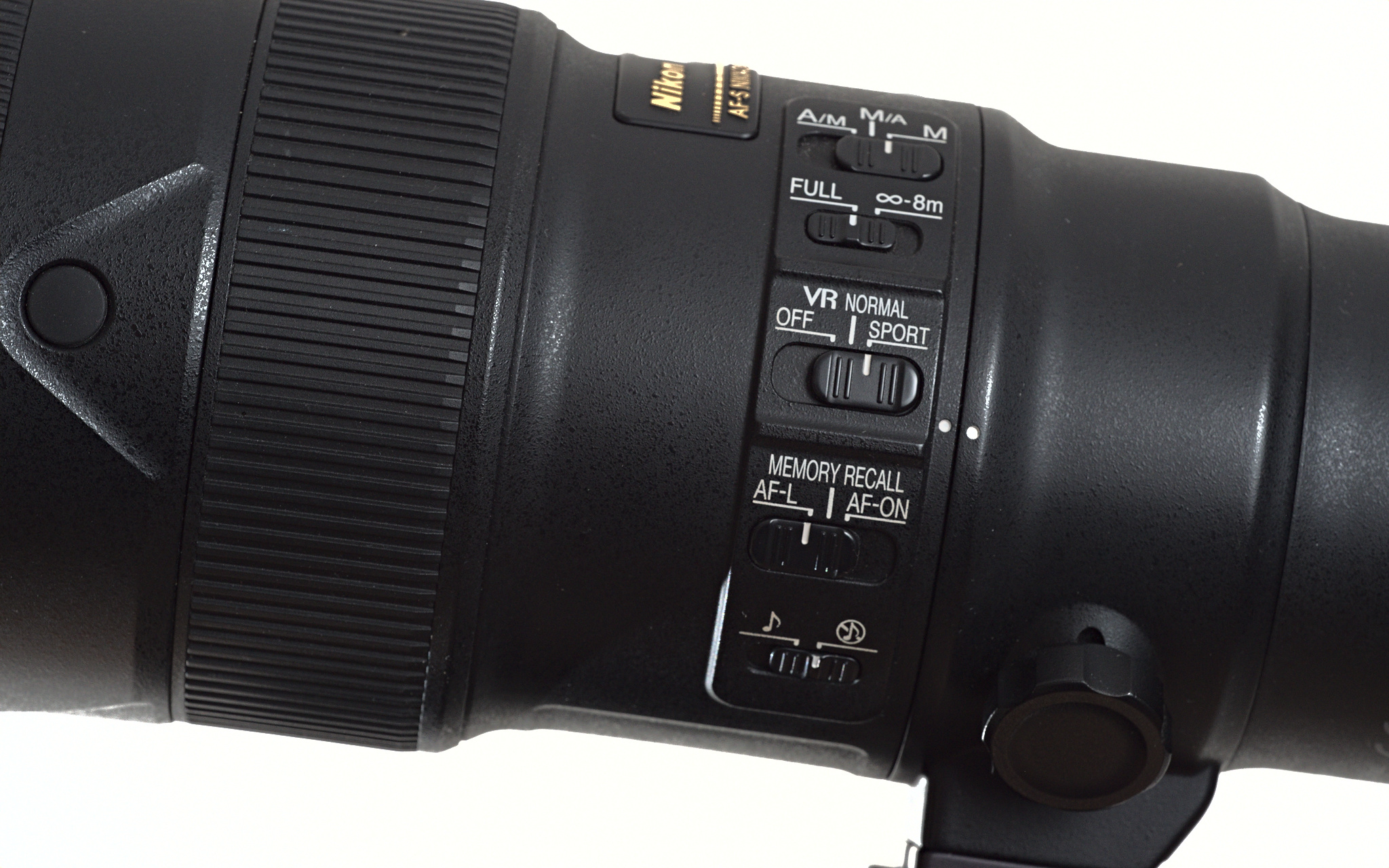 The 500mm f/5.6 PF lens has a VR switch that allows you to control it stabilization system
How effective are these systems? Quite effective. Most modern lenses claim approximately 4-6 stops of image stabilization, which means that instead of shooting at 1/500th of a second, you can use 1/15th of a second—assuming of course your subject remains still as well.
Lens stabilization has another benefit: it provides a calm view through the viewfinder without much shakiness. This is especially useful on DSLRs that do not have any stabilization built in.
Should You Buy a Lens with Lens Stabilization?
Lens stabilization is effective, but often it makes a lens more expensive. Sometimes, you will be faced with a choice between two similar lenses, one with stabilization and one without. This often occurs in choosing between a firsty-party lens and a third-party lens, or an autofocus lens and a manual lens.
 The VR of a long lens helps me get sharp shots at slower shutter speeds. Nikon D500 + 500PF @ ISO 900, 1/320, f/5.6
The truth is, you may not need lens stabilization, especially if you’re always shooting in good light or on a tripod. If your camera has in-camera stabilization or IBIS that I explain below, then you also probably won’t need lens stabilization.
However, if you are shooting in dim light and your camera does not have any sort of stabilization, it’s really worth it to get a lens with stabilization because it will allow you to shoot at much lower shutter speeds, giving you much better image quality.
Sometimes, you might not even have a choice. This is usually true if you’re buying a longer lens, because almost all of such lenses have lens stabilization.
In-body Image-Stabilization or IBIS
On the other end of the spectrum, we come to in-body image-stabilization, or IBIS. Unlike lens stabilization, IBIS moves the sensor along various axes to compensate for camera movement. IBIS systems can be quite advanced and often have separate modes for video and photography.
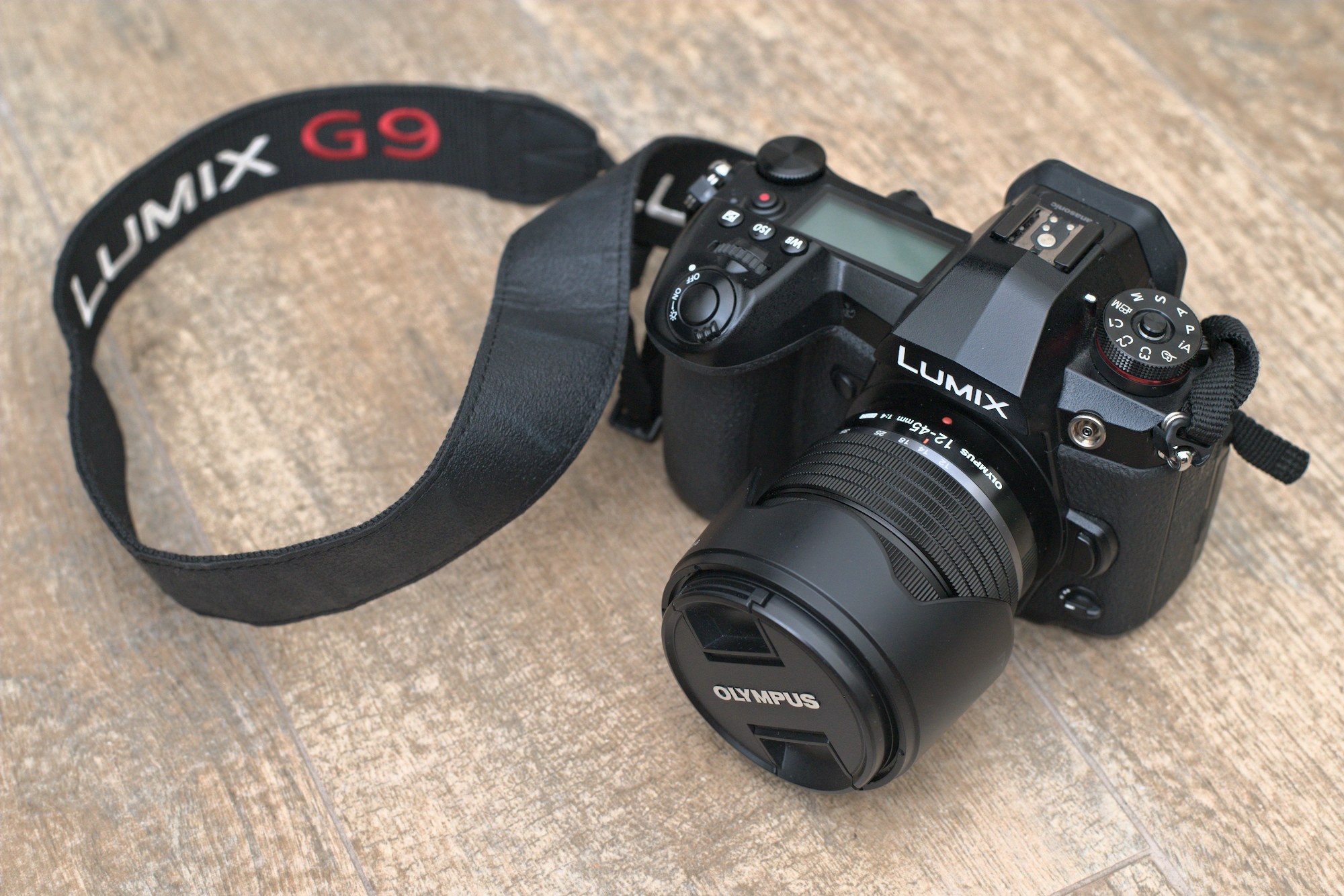 The Panasonic G9 has an effective IBIS system that has several modes for video and photography, including a I.S. Lock feature that simulates the camera being on a tripod for video
These systems are quite effective, and typically give about 5 stops of image stabilization, with the latest cameras like the Sony a9 III promising up to 8 stops.
Not all cameras have IBIS, including some modern mirrorless cameras like the Canon R8, though all Nikon and Sony full-frame mirrorless cameras do have IBIS. IBIS is also present in almost all Pentax DSLRs as well, including their latest model, the Pentax K3 III.
Like in-lens stabilization, IBIS can usually be turned off when necessary.
Should You Buy a Camera with IBIS?
Ideally, you should get a camera with IBIS unless you will be only shooting lenses with lens or optical stabilization. Even if you do plan on shooting only with stabilized lenses, the syncronization function with first-party lenses will give you even more stabilization.
 Without IBIS, I doubt I could have achieved the lower shutter speed of 1/13 that I used here. Panasonic G9 + Olympus 12-45 f/4 PRO @ 37mm, ISO 640, 1/13, f/5.0
That being said, there are some other cases where you may prefer to get a camera without IBIS. Obviously, if you’re buying a DSLR, it probably won’t have IBIS. Moreover, some Canon cameras don’t come with IBIS like the Canon R8. Yet, these cameras will still work fine even with lenses lacking stabilization, as long as you are more mindful of your shutter speed or you use a tripod.
Personally, I’ve only ever shot a lens and camera combination without any form of stabilization. It was the Nikon D500 with the Nikon 50mm f/1.8G, and wow, the experience without stabilization was so strange! Nevertheless, millions of amazing shots were taken without any stabilization so I guess it is possible.
Nevertheless, there is something magical about just walking around with a wide angle lens and shooting landscapes at 1/5th of a second and have them be sharp!
Which is better?
Both in-lens optical stabilization and in-body image stabilization have their own strengths. Lens stabilization systems are built specifically for the lens, and so they are most effective. This difference is mainly noticeable on longer focal lengths.
On the other hand, IBIS works at the level of the sensor. Due to this, longer focal lengths do not work as well with IBIS. Thus, if your camera promises 5-stops of stabilization with its IBIS, then you might experience only one or two stops of stabilization if you’re shooting with a really long lens of a focal length of 400mm or more.
This is in fact why most long lenses still come with optical stabilization, even when camera IBIS systems have gotten very sophisticated. There’s just no substitute for stabilization on the lens.
 There is really no substitute for lens stabilization when using long lenses. Nikon Z6 + 500PF @ 500mm, ISO 1100, 1/125, f/5.6
IBIS has a huge advantage that it works with any lens. Many DSLR users found new life with their DSLR lenses mounted to mirrorless cameras, because they could now shoot at much lower shutter speeds than ever before.
This means that you can adapt old, manual lenses to your camera as well and get pretty good stabilization with them. IBIS also means that shorter focal length-lens designs can be simpler and potentially lighter, since the lens stabilization gadgetry does not need to be incorporated into the lens.
With first party lenses that do have lens stabilization however, they can often work with your camera’s IBIS to provide even more stabilization.
Should you always use stabilization?
Believe it or not, there are actually cases where it’s better to turn off all forms of stabilization, whether it be lens or in-body stabilization. For example, if you’re on a tripod, it may be better to turn off lens stabilization and IBIS.
That’s because there are some cases where stabilization can actually make shots worse while on a tripod. Now it is true that some stabilization systems are meant to work on a tripod, but even when so, it might be better to turn your stabilization off if you’re trying to take shots with exactly the same framing, such as when you are focus stacking.
 I turned IBIS off for this shot because I wanted each frame to be perfectly aligned. Panasonic G9 + Laowa 50mm f/2.8X Macro @ 50mm, ISO 200, 1/200, f/5.6
You might also want to turn stabilization off when you are shooting video on a tripod. In that case, the subtle movement of stabilization systems can also appear, making your video definitely worse than if you had not used stabilization.
Conclusion
At one point, lens stabilization systems were the dominant form of stabilization. With the rise of mirrorless cameras, in-body image stabilization or IBIS became much more common, especially since such systems work so well with shorter focal lengths. Nevertheless, it’s unlikely that lens stabilization systems will go away due to its superior effectiveness with longer focal lengths. In any case, you don’t have to decide between one and the other because both can be used at the same time, and they often work together!
Do you use any form of stabilization? If so, let me know in the comments!

About Nasim Mansurov
Nasim Mansurov is the author and founder of Photography Life, based out of Denver, Colorado. He is recognized as one of the leading educators in the photography industry, conducting workshops, producing educational videos and frequently writing content for Photography Life. You can follow him on Instagram and Facebook. Read more about Nasim here.
Comments
-
Sony (and Nikon, according to other comments) certainly do IBIS + lens OS/IS combined at the same time, to greater effect, and have been doing it for years. You might want to amend the article.
-
I think while lens and body stabilization is good for shooters, for when they have to shoot in low-light conditiosn for example, or with longer lenses, nothing trumps good technique. Photographers have been getting sharp images for decades with film and WITHOUT lens and body stabilization. You might have to increase your ISO, but with cameras these days, most cameras can support ISO 3200 for the most part without too much noise. Use IBIS and VR as an aid for the “just in case” my shutter speed was a little too slow, not a crutch for good technique (shooting at faster shutter speeds and higher ISOs).
-
I guess you missed the R6, R5 and R3 me3mo on combined IBIS and IS by Canon that smokes Sony to oblivion. Especially on long lenses but Canon also includes IS on super WA lenses that combines to work with IBIS again leaving Sony in the rear view mirror and fading fast. Many comparisons showing the lame IBIS of Sony vs Canon IBIS and IS combined looking like a perfect stabilized video gimbal vs Sony with Parkinsons.
- Completely false (from IBIS efficacy to WA lenses with IS on Sony). Please take the Canon propaganda fanboyism to the Canon forums.
Reply 04. Sorry, but information regarding two stabilization systems canceling each other out is not right. There are plenty of test showing that they work perfect together. For Sony 7 series its really impressive.
- I can say the same for Nikon Z cameras with Nikkor Z-lenses that has VR.
Reply 05. HI, I’m looking to replace my old Nikon D5000 with VR lenses. The options that I consider are:
1. Panasonic G85 with 12-60 mm lens, plus 45-150 mm lens. = $ 950
2. Sony Alpha 6500 with E 18-135 mm lens = $ 1500
3. Sony Alpha 6400 with E 18-135 mm lens = $ 1300
I’m not a professional, but for my vacations and day to day activities I like good pictures.
What do you guys think about it and please explain me why.
Thank you very much.
-
siting in my living room with my Canon 24-105 IS lens, my brand new sony A7R lll, and a kenyon KS-8 gyro stabilizer i use for aerial work. I found with all three systems on it was difficult to keep the cross hires on a target, So the manual says the camera will pick the best method for stabilization, it cant know i have a external stabilizer mounted so maybe that accounts for the drifting. I found or it appeared to enhance stabilization having both the optical and the body stabilizers on. as for the KS-8 it appears rock solid with either lens or the body stabilization on but not all three.
-
I am relatively new to the photography world so let me know if I am really off base on this comment.
It appears to me that if one wants to move into a 40-50 meg camera with some really good lenses the choice is a camera with internal stabilization. Then you can buy lenses without the stabilization at a much lower cost. Since I have been told that having stabilization in both the camera and the lenses would require one or the other to be turned off.
Speaking of off, how about some comment on my thoughts. I could be way off on this idea. Help!!!
-
My another theory about Lens VR/IS/OS is as follows:
1. Lens stabilization needs a floating element or elements to compensate lens movement. This makes a lens less precise, because the lens designer needs to include all the cases that the floating element displacement. This is not exactly same, but a similar effect can be found between Zoom and Prime lenses. A simpler lens is easier to make. Thus, when a same level of technology and investments are applied to a lens, a lens without stabilization will be better.
2. Recently, we all start to see some 3rd party companies, notably one company, significantly sharper lenses without lens stabilization than Nikon/Canon at much lower price. This could be an anecdotal evidence that all of us can clearly see.
3. If this observation is true, in future, we will see more and more highly performing lenses from 3rd party companies than Nikon/Canon. This will make these major companies into a dilemma. Such a major camera company will no longer produce a set of excellent lenses at a reasonable cost (I mean at pro level, and also applicable to pro-consumer level) due to spending their precious resources to lens stabilization rather than spending on improvement of optical performance of lenses.
4. What good for a camera company that can no longer deliver a really optically superb lenses?
My humble plea is for Nikon/Canon to create a simpler and better lens that does not suffer from a compromise due to the extra complication of lens stabilization. If not, soon both companies realizes that they are only producing lenses that are either less performing or overly expensive, which is a really pity.
-
GO OLYMPUS!!
-
I owner of Olympus M5 MarkII.
For having good result with IBIS with Wide angle or Télé, Ishould use the electronic shutter. If I use the mecanical shutter gain speed shutter of IBIS is only 2 EV.
When the Olympus company write in the spec of M5 MII that the gain of IBIS is 5 EV, they don’t specify if it was with mecanical or electronic shutter.
Can you clarify please?
-
Many thanks.
The GREATEST article I’ve ever seen on this topic.
-
Is it better to get XT10 or EM10 Mk 2 when using a 14-150 lens?
-
Canikon gets away with it because Canikon users are stupid.
- Not really, If you grew up on 35mm film cameras like I did you inevitably end up with a collection of lenses. All my old lenses work perfectly on my Nikon. Manual mode no problem. Most cameras from most of the manufacturers are excellent these days and image stabilization technology is splitting hairs. It is still the person behind the lens that makes or breaks it, Photography is an art and the beauty of digital photography is you can take a sequence, look at them and then adjust and improve. The processors and metering on any modern camera are pretty good, but sometimes you just imagine how a picture should look and adjust accordingly. Its the art, the electronics can only do so much. I love the flexibility and control of a Nikon SLR, it’s what I grew up with, but that is subjective. It’s just what I know, as you can do the same on any camera. If you’re happy with your results it is what counts and I get great results on my low end Nikon kit, old lenses, VR lenses, you just have to know what you are doing. One more point, the original poster said that image stabilization will mess up your bokeh, you are aware that whether it is in the lens or in the camera you can simply turn it off.
Reply 14. Is it worth getting the Sony A7R ? and just get lens with stabilisation?
-
Beginner here. When I am choosing a camera, should I not worry that in the specs do not tick the Image Stabilizer box? Currently looking at the Nikon d5500 v d5300 v Olympus OMD EM10.
-
What happens when the cameras IBIS stops functioning and leaves the sensor stuck at an awkward angle?
Can you just change lenses and continue on?
Wide angle lenses, need stabilization less than a medium to long telephoto lens. General rule of thumb that most so called photographers forget is the shutter speed is the inverse of the focal length used…24mm = 1/24th of a second for a shutter speed. Good technique will decrease your shaking and you can get a slower shutter speed. Most times you use a faster shutter speed, usually the wide angle lenses are faster lenses ex 2.8 or wider aperture.
Why are there no FF IBIS cameras? Are they more expense to make or are the lenses more expensive to make?
We do know that APS-C and FF sensors are better than 4/3 and 1 inch sensors.
Every body has their opinions and sad stories that they heard from their friends friends 40th cousin 100 times removed ‘my lens broke I hate lens stabilization/my camera broke I hate IBIS’.
Let’s argue about something important…Canadian JTFs are better than US Navy Seals and British SAS…HAAA
- No FF IBIS cameras? The Sony A7 II and the Sony A7R II are both amazing, with very effective IBIS. I have been using the A7 II since it came out and IBIS never froze or malfunctioned.
Reply 17. You forgot the main advantage of sensor based image stabilization. Pentax in camera stabilization can rotate the sensor. Lens based optical stabilization can do NOTHING if you accidentally rotate the camera slightly during a shot.
-
i just purchased the Panasonic 4-3 GX7 camera and also the lumix 14-140 lens. Both have image stabilization, is the best thing to have both on? Or should I set “shoot w/o lens” in the menu? I am very new to all this and I’ve not had any luck trying to find the answer thru Panasonic site.
- The GX7 camera’s on-board stabilization turns itself off automatically when it detects that the attached lens has image stabilization, i.e., it defers to the attached lens’ stabilization.
Reply 19. Hi Mr MANSUROV ! I got into digital photography a few years ago, and my first camera was a Nikon D3000. I bought Photography magazines and read everything I could about photography. Your article discusses the differences between Lens or Sensor based stabilization, in exactly the same way I’ve read about from my beginnings with a DSLR. This is the exact same mantra/propaganda the photographic industry imparts, and its all a load of nonesense, and extremely misleading.
My VR in my D3000 was absolute rubbish, and VR is rated at a maximum of 3 stops of stabilization. It worked well at first, and over time it wore down, and was almost useless after a few months. In full sun @ ISO 100 (auto ISO) I was constantly getting blurry pics. Another major problem is that that VR (and the others) will rotate through a third axis, which has a “focus shift”-like effect, blurring up the pics. VRii has now got up to 4 stops of stabilization.
I then switched to a Sony A65, and entered a new and vastly superior world of reliable stabilization. I was and still am blown away by its sensor stablization after 2 years of reliable service. Sony’s stabilization is rated to 4.5 stops of stabilization.
I have also acquired a Pentax K-5 and SR is rated to 4 stops of stabilization. The stabilization can automatically level the sensor (Horizon Correction), Tilt – for tilt shift photography, widen a scene (Perspective Control), track the stars for bulb photography so you don’t get star trails (Astrotracer) …plus for cleaning …. plus anti-aliasing filter simulator (K-3 only). The K-3 has an improved SR, perhaps up to 5 stops or more.
I will never go back to a lens based stabilization cameras or brands – because it is inferior. And I’ve gone back to stores time and time again to test them out, to check if I’ve made the right decision – and I most definitely have.
The bottom line is this: Canon and Nikon IS and VR operate at 2-3 stops. Vrii is at 3-4 stops. Sony’s Steady Shot is 3.5-4.5 stops. Pentax’s Shake Reduction is at 3-4 stops, and the K-3 may be up to or exceeding 5 stops, because the 3-4stops cannot cope with a 24mp crop sensor and Pentax has improved the SR. This is the issue with the Nikon D7000 and D7100, where the D7000 is sharper hand held than the D7100 because the pixels are too dense and sensitive to the slightest movement, and current VR or SR and SS cannot keep up. (the same with my A65 and my K-5 is sharper hand-held).
In heading 3”Advantages and Disadvantages” you’ve stated that lens stabilization is “more effective” to sensor stabilization – and I’ve shown above, that that is completely untrue, and you yourself can’t site the REAL independently tested figures.
The argument “for” in telephoto, in that lens stabilizers have a greater throw than sensors – please show the throw (oscillations) in millimetres. The “arguments” for, are just arguments – heresay and conjecture. Please back up with verifiable statistics.
The “argument” that lens stabilization is “more effective” in low light is again baseless. The argument that the image is stabilized through the viewfinder is inconsequential and again just a silly argument – the difference is minuscule, compared to having a whole host of non-stabilized lenses stabilized.
Plus, as sensor stabilization is faster, naturally it is better with telephoto lenses. Plus you are forgetting the third axis of rotation (pitching) in VR and IS which causes a “focus shift”. 2 axis is all it needs.
You should re-do this article – all the best !
- Rubbish? Here’s rubbish:
“I will never go back to a lens based stabilization cameras or brands – because it is inferior.”
You say this without the slightest indication that you have ever used Panasonic (to name but one). I shoot everything hand-held, stills and video, often with 300mm lens (600mm eq.) and also with sensor crop video (GX7) which increases this by 2.4x (to approximately 1400mm eq.). No problems. You need to know what you are talking about before you talk about it.
-
I have bought a Fujifilm camera. Within 2 weeks, the lens stabilization broke. The rear element was flopping around, because its a cheap lens, and they don’t give a hoot about the quality of the OIS.
Now when you buy a camera with sensor stabilization, its built right.
I shoot stills, and not video, and Sensor stabilization is far better than lens based stabilization. I’m not interested in Panasonic, it looks real good for video, and if it works for you, then all the best, there’s no need for name calling.
- Sorry, I was just quoting “rubbish.”
To judge all lens stabilization lenses and cameras based on one bad experience with one brand (an apparently with a P&S camera?) is just plain silly.
To say or imply that all cameras with sensor stabilization are “built right” is just a silly.
Your lack of interest in Panasonic is beyond irrelevant. You made a sweeping claim about a certain technology, I refuted that with a specific brand example, and you dismiss the refutation by claiming lack of interest. Serious flaw in logic and critical thinking.
To say that “Sensor stabilization is far better than lens based stabilization” is an unsubstantiated, simplistic assertion.
Here’s what Photography Life has to say about the two systems:
Advantages of Lens Stabilization:
–Optically-stabilized lenses are more effective – both Canon and Nikon argue that image stabilization can be fine-tuned and tweaked on individual lenses, which would make image stabilization more effective when compared to generic
in-camera stabilization. Tuning image stabilization based on lens features such as size, weight and focal length can provide the benefit of enabling different options for image stabilization. For example, some IS systems feature an “Active” mode for situations where the photographer shoots from a moving car or a boat. Some newer image stabilization implementations are smart enough to detect the type of movement and can automatically enable or disable image stabilization when the lens is mounted on a tripod. Such specific customization is not possible with in-camera stabilization, unless each lens is programmed into camera’s firmware.
–Lens stabilization is more effective on long telephoto/super telephoto lenses – the main argument is that long lenses require much bigger sensor movements, which cannot be accommodated
with in-camera stabilization.
–Lens stabilization is more effective in low light conditions – because the image already comes stabilized from the lens, the camera metering/AF sensors can provide more accurate results in low light situations.
Advantages of Sensor Stabilization:
–Works with all lenses
–One time cost
–Camera upgrade vs lens upgrade – if a newer, more efficient way of image stabilization is invented, you only need to upgrade the camera, rather than updating all of your lenses.
–Smaller, lighter and cheaper lenses [This depends – some stabilized zoom lenses are lighter than their non stabilized counterparts.]
–Less fragile lenses [Don’t mistreat your equipment and this is a non-issue]
–No negative effect on bokeh
–No annoying loud lens sounds – some optically-stabilized lenses
produce high-pitch sound that can be annoying. Lack of IS means that the only sound you will hear from the lens is its autofocus motor. This is an advantage for recording videos without an external microphone. [Since you don’t care about video, this is a non-issue for you anyway.]
But what do they know; they are just professionals.
You got a lemon, so you decided to brand the entire technology as rubbish. That is, well, rubbish. (No personal insult; it’s a comment on the comment.)
-
Sony SLT 4.5 stops of stabilization.
Sony A7ii sensor stabilization and lens stabilization.
Pentax SR 3.5 stops of stabilization (up to K-3). Includes horizon correction (levels the sensor).
Pentax SR (K-3ii) 4.5 stops of stabilization. Horizon correction, panning correction.
NIKON LENSES WITHOUT VR …… 0 stops of stabilization (which is 80-90% of its range).
Nikon VR 2.5 stops of stabilization.
Nikon VRii 3.5 stops of stabilization.
Nikon Pro lenses, 3 to 4+ stops of stabilization (additional features depending on the switches on lenses, panning correction)
CANON LENSES WITHOUT IS …. 0 stops of stabilization (which is 80-90% of its range).
Canon IS 3 to 4 stops of stabilization
Canon Pro IS 4 stops of stabilization (additional features depending on the switches on lenses, panning correction)
Sigma OS 3 to 4+ stops of stabilization (I’ve heard of up to 6 stops on telephotos)
As it stands, the Pentax K3ii has one most advanced stabilization set ups – for use with any lens.
The advantage of IBIS over OIS – wide angle, fisheye, primes, tiltshifts, telephotos etc ANY lens that hasn’t got stabilization will have stabilization.
No list from ANY photographer will deny the fact that they haven’t researched each individual systems specs, and are generalizing. Or they provide opinions from Nikon or Canon that falsely represent Sony or Pentax’s specs. If building up a bogus story to justify something in their minds works for them, then thats fine. I go off and in 5 minutes find the specs that show the truth.
If YOU want to be a sucker, and PAY for OIS EVERY time you buy a lens, then be my guest. If you want to use un-stabilized lenses on un-stabilized camera bodies, then be my guest – and if you resolve that this is the best set-up …….. then be my guest.
I own a camera with IBIS and OIS. IBIS is the best, and OIS is rubbish.
- How much of that 4.5 stops of stabilization (measured with a short focal length lens) from Sony and Pentax IBIS systems do you get with a 300mm lens when the amount of sensor movement needed for 4.5 stops would put 3/4 of the sensor outside the image circle cast by the lens?
Reply 20. I have mostly Nikon equipment and most of my experience is with Nikon so cannot really speak to other makes. Given current technology I simply do not understand why Nikon does not have at least one body with sensor stabilization. It would be a simple matter to have the body system turned off when a VR lens is mounted yet for that huge base of non VR Nikon lenses out there they would get the benefit of stabilization even if not as good as lens VR it beats nothing. Nikon has literally millions of 80-200mm f2.8, 85mm f1.8/1.8, 105mm f1.8/2.5, 180mm f2.8, 300mm f4 and many thousands of the super teles out there that are still very good sharp lenses – some as good as any produced today. It would be a big marketing leg up to Nikon and might actually lead to more lenses sales not less – after seeing what the 80-200mm f2.8 or the 300mm f2.8 of the 400mm f3.5 does with stabilization they may be more likely to pop for the latest and greatest new version and would be an additional reason to chose Nikon system over Canon or Pentax or whoever.
-
Which one is better: Panasonic Lumix DMC-GX7 or Olympus OM-D E-M1?
- “Better for what” is the real question. EM1 has better still IQ, but very poor video. GX7 has OK still IQ, great video. Panasonic seems noisier (I have both GH3 and GX7; had EM1 but sent it back due to poor video since I shoot a lot of video).
Reply 22. I’m not hung up too much on AF. My mission rarely needs speed or the convenience. I’ve been using valuable AIs primes since FM3a and Olympus E-1 days, then later used them on a Nikon D7000. That was about as close to film shooting as I could get and it was enjoyable but curiosity added an Olympus OM-D and I have to say that the D7000 will be used less, as much as it still offers. The OM-D IBIS in a mirrorless body with a stabilized EVF and a focusing zoom aid for critical focusing (with focus peaking on the E-P5) is sensational with the classic MF film lenses and more fun than I could have ever imagined. I believe Canon and Nikon are overly confident that past DSLR success will continue while mirrorless with IBIS seems to have more frequent improvements that already match most of their attributes. Focusing speed, EVF qualities or optional optical finder, phase vs contrast updates? I have no doubt that mirrorless will end up developing much of it if not already here. I can still use lenses from long past with all the new advantages of body stabilization and important operating controls and options I’ve not had before. So I now get even more out of a focus improved, stabilized MF lens. I’m sorry Nikon doesn’t share the same enthusiasm about its best history which, I sense, could have been part of its future. I’m sure it’s all about bean counting. At least they offer non-CPU lens calibrations but very little more… and they won’t unless they adopt an IBIS option and improved focus confirmation in the D series body but I think they’ll be into mirrorless before that happens.
I do have VR zooms but the D7000 body is already too large for all day outdoor compared to an OM-D with its 14-42mm kit lens that’s so much smaller and can go on an even smaller MFT body. The VR zooms are way too large to justify stabilization.
I like Panasonic’s optical stabilization lenses being used on the OM-D while IBIS is turned off. Again, more choices. I think I can see the limits on DSLR. I can’t see them on mirrorless and body stabilization is certainly a key difference.
-
the Sony A99 is a mirrorless camera — so is it right to say — the inbuilt image stabilization will be great for sports and wildlife photography?
-
nikon D5100- or Sony slt a37– is better for video recording, and who is with less audio noise during video record. thanks
-
Hi,
I want to know that is the optical image stabilization is possible only by rotating the lens in yaw or pitch direction to encounter the rotational vibration effect, instead to move the lens vertically or horizontally
as normally done by NIKON or CANON.
Thanks.
imran
- Hello Imran
The sensor shift mechanism used by Pentax in their dSLRs can move the sensor horizontally/vertically and can also rotate the sensor (clockwise or contraclockwise). In some Pentax dSLR bodies the sensor rotation can even be used to automatically compensate for a slightly tilted horizon.
As much as I know the sensor shift mechanism used by Sony in their SLTs (they no longer manufacture dSLRs) can only move the sensor horizontally and vertically (no rotation). Please note that recent Sony SLTs use sensor shift for image stabilization only when in still image (photo) mode, in video mode image stabilization is accomplished by software.
None of the above mechanisms can tilt the sensor forward/backwards.
There are other companies using sensor shifting to achieve image stabilizations, Olympus says that the mechanism they are using on their m4/3 OM-D E-M5 is revolutionary but I don’t know details.
Please also note I’m writing about my experience with Sony and Pentax dSLRs and additional information I’ve found in documentation from both manufacturers and in reviews. If the exact capabilities of a certain image stabilization mechanism are of importance to you I strongly recommend you do your own research about it and, above all, always try before you buy.
Best regards,
Flores
-
The Pentax SR tilts also. Its available in perspective control to mimic a tilt shift lens. Plus when the GPS unit is fitted, and astrotracer engaged, the sensor is maneuvered in ANY plane – thats what the SR does.
Reply 26. Nasim Mansurov I have a querry for u.
if you had to choose between d5100 and pentax K30 WHAT WOULD YOU DO?
-
I am going to purchase my first non-point and shoot digital camera. I have a point & shoot, as well as my trusty work horse Minolta SRT-201 which as been me since my father passed it down to me. I am interested in doing extreme close ups (Macro) on bugs eyes, lizards skin etc. due to their texture any recommendations on which route to go for that line of photography?
-
About movie mode image stabilisation in newer Sony DSLTs:
To Rahul and Zoltan: as much as I can understand (and read from owners reports) newer Sony DSLTs (A65, A77 and A37) use software based IS when in movie mode, meaning the camera crops the image and displaces, by software, the crop window to achieve IS.
The reason why I’ve said above that as caused some grief is because the crop factor gets bigger for movies than for stills and, at least on A65/A77, you cannot preview exactly how the image is going to be cropped until you really enter movie mode… Operation gets a bit trickier than it needed to be…
I hope that helps, regards
Flores
-
Electronic View finders have some disadvantages left out.
1. They use up battery power. I can look through my optical view finder as long as I want and it will never use up any battery power unless i hold down the shutter button. Then it will only use battery power to focus and power the IS.
2. Not all camera’s with electronic view finders offer the option to disable exposure simulation. What happens when I am shooting in a pitch black room with an electronic view finder camera and non-compatible strobes? There’s also the issue where sometimes I can see better with my own eyes then the camera can.
3. Resolution. So far the cameras with electronic view finders that I have used have sub-par resolution.
-
Very interesting article regarding IS but except nikon and canon wanting to make more money over is or vr lenses i dont see a reason why they dont put in camera IS that turns off when you mount a vr lens so you get vr for ur telephotos and in body stabilization for ur primes and ultra wide! Shame on nikon and canon :(
-
Thanx a lot Zoltan.How is your experience with the movie mode of SLTA77 especially at long focal lengths?..Does the Electronic stabilisation work Ok ?..
- Rahul, you did not mention if you already have this camera or just planning to buy one. Have you used this model yet? To tell you the truth, my A77, being a HD 1080p/60 or 24fps with a large 24MP chip is quite different than the Sony video camcorders using MiniDV tape and only 720 res. My 2000 3CCD chip camcorder has an optical Super Steady Shot and a very large zoom range, especially using the digital 2X, and I found that since it does not have a ROLLING shutter such as the A77 and (A37), the image stabilization was much better on the optical camcorder.
Using the movie mode in the A77 even at full wide angle setting exhibits a wobbly, jiggle and jello effect which the IS does not correct or lessen. Any sudden hand movement ever so slight back and forth is transferred faithfully into the image, hence I found the use of a tripod to be a necessity for absolute smooth pans, zooms and camera movement in movie mode.
People keep telling me that with the large sensor it’s a different ball game with IS, but I find it to be useless pretty much when handheld. Now if you are planning to use this camera with a full motion picture steady cam, jib or crane rig, and shoot scene by scene, then you can get around the problem. But for family type use and everyday moving around kids, dogs, vacations where you have to hand hold, when you play it back on a big LCD panel (32 inch diagonal or bigger) be prepared to use barf bags !!
-
Zoltan, I have a SONY HX100V , am thinking of upgrading to a DSLR.I am quite satisfied with the movie mode in the HX100V with its carl zeiss lens and lens based stabilisation , works fantastically well even with handheld 810 mm shots.That is why I had queries about the software based stabilisation implemented in Sony SLT’s..But Now that you have given your first hand account I am quite sure that without tripod the sony SLT movie mode will not be as effective in controlling camera shake although nobody can beat its fast Auto focus I think…My mind is switching between the SONY SLT 37, NIKON 3100 and CANON 550 D.. :)..Any comments?..
- Rahul, I am not familiar with th Nikons and Canons .. nor the models you have listed, perhaps Nasim would like to comment, or you could search his site on whether or not he reviewed those models. The Sony A37 is basically identical to my A77 (transluscent mirror, inbody IS, etc.) .. so I would imagine the IS would be the same as mine. You are correct about the autofocus accuracy and speed, although I really did not think my Sony VX-2000 (2100) was a slouch in that department, if you plan to go fully automatic on that aspect. Even in pretty dim lighting the old MiniDV camcorder was very reliable in focus speed and accuracy.. of course if you want to be really ‘professional’ then you can use a focus puller, and do everything manually. That’s what I did when doing critical work with my MiniDV cam .. manual exposure, focus and audio settings using high quality external wireless mic inputs, not that the internal camcorder stereo mic was not very good, it just had it’s limitations like all built in mics. By the way, speaking of built in mics, the A77 (A37) is nothing to brag about, for one thing it is in total AGC mode, hence limiting the loud inputs and bringing up the low levels along with background noise (and preamp noise) but the worst case on the A77 is the fact that it has NO WIND SCREEN, hence any sligh breeze will render the audio useless, even with the so called WIND REDUCTION setting in the menu (cuts a lot of bass off, so is you are doing an outdoor ‘concert’, the audio will suffer badly).
As far as you switching to DSLR based ‘movies’ for HD work, sad to say most new video camcorders also come with a ROLLING shutter and CMOS based chips rather than GLOBAL shutter and CCD image sensors, so be prepared for some nasty ‘bending’ of anything moving horizontally such as fences, lightpoles that are vertical, hence skewing the image. This was no problem with the old camcorders, but now it is an epidemic. SO … S L O W movements are the key, and planned shots in advance (sort of like motion picture making) but I would not rely too much on the built in IS. So for gaining HD, there is a sacrifice, at least for the time being.
If I compare the ‘rock steady’ images I got in the past with the MiniDV cam and this new HD DSLR, it’s a big disappointment using it hand held !
-
Zoltan, thx for your feedback on SLT, From The homework that I have done using the internet it seems that Sony SLT’s seem to be a excellent technology for DSLR movies and the sensors of SLT’s are being given rankings at par or sometimes better than the comparable price(or even costlier) canons and nikons.The Alpha lenses too dont seem to be lacking far behind.Yesterday I tried cropping few first hand full size images downloaded from imaging resource ,shot with the SONY SLT A37.It seems you can easily crop atleast to the extent of twice the focal length of the lens without losing clarity .These were 200 mm(350 mm equiv) images and I could get good clarity after cropping to 400 mm(700 mm equiv).Ofcourse this may be true for the canons or the nikons also , but I could clearly see that the ISO 800 images had less noise on the SLT A37 compared with the NIKON 3200 or 3100 thus the cropped and magnified images looked very clean, and I guess for amateur wildllife photos (which would be shared on the net or displayed on 32 inch HD TV) , would certailnly come out clean even after cropping.
Reply 32. Hello Nasim, Very nice review,I was going through the specs for the new SLT A37 and it said the image stabilisation during movie mode is “electronic” .I wonder what that means and is it effective?.
- If I may answer your question, I do believe that what you are refering to, Rahul, is ‘electronic’ in the sense that the sensor is being manipulated or the ‘image on the sensor’ is ‘electronically’ stabilized as opposed to a true ‘optical’ gyro stabilization of the image. Since both systems require ‘electronics’ of one sort or another it is a bit ‘vague’ if that is the term used on your camera, but in all probability it means a ‘sensor’ based image stabilization, and not ‘optical lens’ IS system. If you look at the specification for your Sony SLT A37, it says the following:
Image stabilization
Sensor-shift
Image stabilization notes
SteadyShot Inside
which clearly indicates it is not an optically stabilized IS system, but SENSON based image shifting, inside the camera body itself. www.dpreview.com/revie…-slt-a37/2
-
Hi Zoltan, I went through the specs published by sony store on the net and they have specifically mentioned this in their steady shot specifcations : For still images : Image sensor shift mechanism For Movies : Electronic.That is why I wondered if “Electronic” is different than sensor shift mechanism, then how is SONY achieving it?, using software?…
- Well, Rahul, I went to this web page: www.sony.com/all-e…ifications and NOWHERE I can locate what you are refering to.
What I did find was: Advanced Features•Advanced User Interface : Easy-to-understand Graphic Display and on-screen Help Guide User-friendly function menu
•Anti Motion Blur : 6-image layering
•Auto High Dynamic Range : Yes, (Off/On, Auto Exposure Difference, Exposure difference Level (1-6 EV at 1.0 EV step)
•Sweep Panorama : Yes (2D/3D)
•Face Detection : Off, Auto, Child Priority, Adult Priority (up to 8 faces detectable)
•Smile Shutter™ technology : Yes – Off, Slight, Normal, Big
•Tracking Focus : Yes
•Image Stabilization : SteadyShot INSIDE? in-body image stabilization
SteadyShot® INSIDE™ stabilizationImage stabilization reduces blur by compensating for camera shake. Typical DSLR systems build image stabilization into selected lenses only. SteadyShot INSIDE™ image stabilization is built into the camera body itself. You’ll reduce blur with every a-mount lens, including macro and wide-aperture standard zoom lenses.
So under which section exactly on this Sony Store page do you see the statement that you claim says “Electronic” .. I went through every section and do not see it.
-
Please visit this link and see the last page. www.sony.co.in/produ…lt-a37.pdf
Thx
Rahul
- Rahul, hi .. I got in touch with Sony directly (luckily it was an 800 toll free number, cause I was sitting on there for almost an hour) .. first the online chat that you see below, was no help, so I called the toll free number given in chat.
11:29 AM Connecting…
11:29 AM Connected. A support representative will be with you shortly.
11:29 AM Support session established with Jen – (C2AK).
11:29 AM Customer:
Hello
11:29 AM Jen – (C2AK):
Welcome to Sony Online Support.
11:29 AM Customer:
thank you
11:29 AM Customer:
did you get the question?
11:29 AM Jen – (C2AK):
According to the problem description, you have questions about the Steadyshot function on the SLTA37, is that right?
11:30 AM Customer:
yes and also the same for the model SLTA77
11:30 AM Customer:
what is the difference listed for picture taking mode and movie mode .. one says .. sensor image shift for pictures, for movies ELECTRONIC .. what is this meaning?
11:31 AM Jen – (C2AK):
Alright. Please allow me a minute to check on this.
11:31 AM Customer:
ok
11:36 AM Jen – (C2AK):
This is taking a bit longer than expected, may I ask you to allow me some additional time?
11:36 AM Customer:
sure
11:45 AM Jen – (C2AK):
I am still researching for the information. I am sorry for the long wait. Please allow me another minute or two.
11:45 AM Customer:
go right ahead
11:49 AM Jen – (C2AK):
Thank you for waiting. The camera has a built-in steadyshot in the camera body. There are motion sensors in the camera body that when it detects a movement in the body, those motion sensors will send signals to the sensor to compensate for the shake and produce a steadier shot.
11:50 AM Jen – (C2AK):
The image stabilizer in the camera works the same in video and still pictures mode.
11:51 AM Customer:
yes i understand that .. but why do they differentiate in the brochure and the owner’s manual between the still image mode and the movie mode..
11:51 AM Customer:
[SteadyShot]
For still images System: Image sensor-shift mechanism
Effect: Approx. 2.5 EV to 4.0 EV in shutter speed
(depending on shooting conditions and the attached
lens)
For movies System: Electronic
11:51 AM Customer:
See? It says ELECTRONIC for movies ..
11:51 AM Customer:
and image sensor shift for still images ..
11:52 AM Customer:
what does ELECTRONIC mean ???
11:52 AM Customer:
and why is it differently stated?
11:52 AM Customer:
in other words .. why is MOVIE mode singled out as a different method of IS ??
11:54 AM Jen – (C2AK):
I was able to see that information as well in the Instructions Manual under the specifications. I am also checking on it as well.
11:54 AM Customer:
thanks
11:57 AM Jen – (C2AK):
You are welcome. I have tried to research on the information regarding the different steadyshot systems being used in Still Image mode and video record mode, but I was unable to get you the information. At this point, it will be best to contact our next level of techical support at 800-222-7669.
11:57 AM Customer:
ok i will thank you ..
11:57 AM Jen – (C2AK):
You are welcome.
11:58 AM Jen – (C2AK):
Thank you for contacting Sony Support.
11:58 AM Jen – (C2AK) would like you to complete a brief Customer Survey. Open Customer Survey
11:58 AM Jen – (C2AK) has ended the session
.. So talking with a guy named Glen, I posed the question about the image sensor shift for photos and the ‘electronic’ IS for movies (I have the SLT – A77) which by the way, looking at the owners’ manual specification states the same thing (funny I didn’t notice it till now :) ) .. he finally came up with an answer that follows:
During picture taking the image-sensor shift is used for IS, but while shooting movies, if the image-sensor shift method was used, the camera would OVERHEAT beyond acceptable limits, hence a ‘proprietory method of electronic image stabilization is used for movies’ .. he would not divulge the method used except it is camera internal software based stabilization. I hope that settles your curiosity (and now mine too I guess!)
Zoltan
- PS. In case you don’t have this info, here is the manual in PDF for your A37: docs.sony.com/relea…SLTA37.pdf
- Hi Zoltan.
See my post to you and Rahul about software IS in movie mode on the latest Sony DSLTs
Reply 33. Nice article. I have used the sony a900 for a couple of years and went back to Canon. and now Nikon D800. The In camera stabalization works great upto 200 mm and you can effectively shoot at 1/200th and be equal to a tripod(sonys IS off gives me 1/600th for equal) However the 70-400 sony, a really sharp lens gets no help from image stabilization at 400mm.
In lens IS or VR helps with your movement or bird movement from mis-matched panning. I shoot from a plane and find Canons, and Nikons VR superior in that situation over Sigma’s OS. And sonys image stab does nothing from a plane.
-
Hello Nasim.
This is the first time I´m posting in your site so let me begin by thanking you for sharing your knowledge.
On this particular subject I can tell you that at least some in body stabilization mechanisms also produce audible noise. I own a Konica-Minolta 5D and a Sony A-700 and in both models the stabilization mechanism produces a high pitch, nerve breaking noise (I thought my camera was broken the first time I’ve noticed it… LOL). I suspect the noise is produced by the piezo motors used to move the sensor in those bodies. My daughter owns a Pentax K100D, where the sensor shift mechanism is based on magnetic motors, and I don’t notice the same kind of noise.
The reason why one usually does not notice the stabilizer noise in my cameras is because stabilization only works during exposure and so, most of the times, the noise is very short and disguised by shutter and mirror movement noise. Additionally the user guide advises to turn stabilization off when using a tripod, so the noise can only be heard when using long exposures hand-held. The motion sensors do engage as soon as one half-press the shutter button but they do not activate stabilization until exposure.
I cannot comment on noise level compared to VR lenses because I’ve never used a VR lens (shame on me ;-) but I can assure you the noise would be recorded on video, if my cameras recorded video…
I don’t know if Sony managed to decrease the audible noise for video on SLT-A33 and A55 (and A35). On A65 and A77 that’s not a problem because, as Mihai as already pointed, those cameras use software stabilization when on video mode (something that as caused some grief to some videographers, but that’s another story).
I also have some doubts about EVF image stabilization on Sony SLTs. I’ve played with an A55 for some minutes and the image on the EVF didn’t look stabilized at all. I guess the A55 only activates stabilization during exposure but I’ve only played with it indoors, on a very poorly lit shop, and the EVF refresh rate was very slow so I might be wrong. Anyway I’ve read some A77’s owners reviews and most of them also say stabilization by sensor shifting only works during exposure so if you have the opportunity to do some further testing with an A65 or A77 your comment would be most welcome.
All the best
-
Hi Nasim
I would like to point out a few things
The Sensor stabilization can very well stabilize long focal lengths. It was calculated by Michael Hohner that for a 600 mm the movement would be ~ 1mm on the sensor under extreme conditions.
Some old Minolta documents state that the system cam move 11mm on diagonal or ~4mm on each axis, so more than needed. Some claim that the system is not as good as lens IS because the camera should know the focal length of the lens. But all Minolta lens report their focal length even the first auto focus ones, one simple test for this is to look in the picture extif.
The same goes for focusing distance that is important for macro lens.
So the argument that Sensor IS is not capable of stabilizing long focal lengths is a myth.
I would also point out a deficiency of the Sensor IS that was not mentioned.
Sony has bought types of stabilization Sensor IS for the Alpha SLR and Lens IS for the NEX.
The reason for this is that the Sensor IS can not be used very effectively for movies. It is technically possible as you can see in A33; A55 and others but it heats up quite quickly. This is the reason the A77 uses software stabilization for the movie mode at the expense of a slightly increased crop factor.
The bottom line is that I don’t think there is a big difference if at all, for photography between the two systems as some suggest.
But for movies the lens IS is better.
-
Hi Nasim!
Thank you for another very informative article! I have also seen that the bokeh from my Nikkor VR 24-120mm /4 and my Nikkor VR 70-300mm/4.5-5.6 includes fine parallel lines when the VR is turned on. I did not previously know that the image stabilizer could have this effect. Therefore it’s important that the image stabilizer is used only if it is really necessary.
- Carmelo, absolutely, IS should be used with caution, only when necessary.
Reply 37. All i want for christmas is just a simple entry level SMALL LIGHT (not a PRO) mirrorless compact camera with:-
1) IN-CAMERA stabilization FULL FRAME sensor
2) a wide and fast zoom lens 24-70mm constant f2.8 attached to the camera
3) with focus points that u can control with your thumb (like using a mouse on a pad) on the back of the camera, while u look through the hybrid electronic viewfinder to compose a picture. Then once the focus point is selected, u can press the shutter to take the picture. I think this is important where u can precisely select any focus points on the screen and do your composition, instead of being bound by 9 focus points or 51 focus points of 61 focus points, or what if all focus points are all concentrated in the centre.
4) AUTO precise and accurate EYE-detection.
Hope some camera companies would come out with such camera.
and lastly,
1) Maybe establish a single GLOBAL standard mount. (i know is wishfull thinking)
- So did you buy your Sony A7 meanwhile? ;)
Reply 38. PSS… The VX-2000 and H9B has CCD image sensors and the A77VQ has CMOS .. if that might make a difference …
-
PS, Both of my cameras with lens Super Steady Shot, do NOT exhibit any whine during filming with audio, or decernable sounds during picture taking, even with onboard microphone….
- Zoltan, that’s good to know, because Nikon/Canon cameras do make audible noise when IS is engaged.
Reply 40. Hello Nasim,
Great article. Wanted to chime in here on the video and still stabilization issues. I have be using a Sony VCR-DX2000 MiniDV Camcorder for over a decade .. yes I know .. outdated a bit by now, but still great low light level capability and is a good standard definition videocamcorder. It has a broad 12x, F1.2 optical zoom range with even a 4x digital extension making it 48x with minimal artifacts. My previous point and shoot Sony DSC-H9B has an optical 15x F2.7 to a 2x digital extender making it a whopping 30x times zoom lens. My most recent camera is a Sony SLT-A77VQ DSLR with the 16-50mm F2.8 zoom lens.
What I would like to point out is, that both the video camcorder and my ‘Cybershot’ has OPTICAL what Sony calls ‘Super Steady Shot’ LENS and not image sensor ‘Steady Shot’ stabilization as the newer A77.
I can vouch to the fact, that even though my A77 with sensor image stabilization, which is capable or recording still shots of 6000×4000 pixels, and HDTV video in 1920×1080 pixels, 60i, 60p, 24i and 24p modes .. is ONLY slightly less than 3x zoom, and is NOWHERE near of a steady image as my 30x and 45x images at full zoom with the VX-2000 or the H9B.
So to answer your questions about whether in camera sensor or LENS stabilization is better, I could give you examples of how at even such high magnification, hand held the older cameras out perform the new in body A77. And this is both in still shots, and using the video mode on all three cameras. (The H9B also can shoot videos but at standard definition vs HD for the A77) Also the H9B and VX-2000, run circles around low light capability in VIDEO mode around the A77).
- Zoltan, I understand what you are trying to say about lens-based IS versus sensor-based IS, but I believe you are comparing apples to oranges here. First, you are trying to compare extreme zoom levels on a video camera to a 16-50mm lens on an SLT camera. As I have already stated in the article, one of the disadvantages of the sensor-based IS is inability to compensate for movements when using long telephoto lenses. Long lenses require more space for sensor to move around, plus a much bigger image circle. That’s where optical IS clearly wins. Second, you are comparing a low-resolution standard definition video to a high-resolution camera. As you may or may not know, higher resolution sensors show more signs of camera shake at 100% view – that’s just the nature of higher pixel density. The same reason why some D7000 owners that upgraded from older generation cameras like D40 were disappointed with their purchase when they started pixel peeping their images at 100% view.
To make a fair comparison between sensor-based and lens-based IS, you would have to take two cameras (one with IS and one without) with identical sensor size and resolution, and compare them with lenses at the same focal length (one with IS and one without). I doubt you will see much difference at short focal lengths between the two…
-
Nasim, I realize what you are saying about comparing higher resolution sensor to a lower one is not a fair test, but what I was trying to point out that the lower resolution CCD videocamcorder and the Cybershopt with optical IS even at strong zoom magnification is more stable, than my CMOS sensor A77 with 24 MP is at full wide angle lens setting with the sensor IS on.
Another thing that really disappointed me with the A77, and I am not sure if all the new CMOS sensored HDTV camcorders have the same issue, but the rolling shutter artifact with just a slight movement of the camera in VIDEO mode exhibits a horrible jiggle, skew and jello effect even with IS enabled. It is very annoying, and I cannot see it being useful in any hand held mode, unless one shoots everything from a tripod, in motion picture scene by scene mode, with a very smooth pan and tilt head. The IS built into the sensor does not seem to do much at all to minimize the slightest movement back and forth, side to side or tilting of the camera without adverse image effects.
Reply 41. Nasim:
Nice article on an important topic that doesn’t get much coverage.
One small comment on your statement, “Since all current mirrorless cameras and some SLR-like cameras offer electronic viewfinders (EVF)…” It is true that the EVF display will be stabilized; however, the image that is used for phase-based AF is still unstabilized, so AF performance is likely to be compromised with in-body stabilization. Once mirrorless contrast-based AF is feasible in the image sensor (a LONG way off for state-of-the-art sensors, but starting to show up, e.g, in the V1), this advantage will go away. Even the Sonys still use phase-based AF for good reason.
One more important distinction that I’m not certain about is that in-body stabilization by moving the sensor plane can only address left/right and possibly up/down lateral (translational) motion (e.g., what an accelerometer measures), and not twisting/rotational motion (e.g., what a gyro measures). I don’t think there is sufficient data about the operating modes of in-lens VR/IS systems, but they are gyro-based, and it is quite possible that they provide partial compensation for this motion. I do know that translational motion is MUCH less significant vs. rotational motion in terms of causing image blur (because a tiny rotation has a huge effect on the image location on the sensor AND it causes significant distortion. From this point of view, moving the image plane vs. moving optical elements is a much poorer solution in theory, but what happens in practice is harder to assess. More to the point — sensor-based solutions can NEVER compensate well for rotational/twisting motion, which is by far the most significant source of motion blur (counter-intuitive, but true).
This MAY explain why lens-based IS/VR systems consistently out-perform sensor-based solutions in existing products.
There are other advantages of lens-based solutions as well. The mechanism is GENERALLY moving a smaller and lighter object in response to motion perturbations (lens element vs. the whole sensor), and (more importantly), I believe that a SMALLER physical motions of the lens element will have a bigger compensating effect for various reasons (or, conversely, you would have to move the sensor more to compensate for the same rotational motion). Additionally, the lens maker can design the VR/IS system to be tailored to the unique mechanical/weight/balance/use cases for a particular lens, and then built the VR/IS feedback system to compensate accordingly. On the downside, I’m guessing there is some negative IQ impact for a VR mechanism and additional optical and mechanical design impacts are significant (thus we see no IS/VR even today in Nikon and Canon’s best 24-70 normal zoom products, where stellar optical quality is the most important factor.
An advantage of in-body stabilization is that bodies are essentially disposable and are thrown away much more frequently than lenses. It’s nice to NOT have complicated electro-mechanical systems in a lens that you would like to last for many years (and at least Nikon’s VR, and AF-S for that matter, are the most likely failure points in my experience).
Doug
- Doug, thank you for your long and comprehensive comment!
Yes, as I have stated in the article, any sensor-based IS will have more AF and metering issues, because the image is not stabilized when those sensors are hit.
I did not want to get too technical in this article, but the statement about lens-based IS being able to compensate for roll, while sensor-based IS cannot (and vice-versa) is actually not true. There are many different articles you can find about this – this one explains everything in detail pretty well.
I agree with you on a smaller piece moving faster than the whole sensor – that could be an advantage, but more testing needs to be done to see what the actual differences are in modern sensor-based IS systems. I have already written about VR/IS being specifically designed for each lens in the article as an advantage to lens-based IS. I disagree about negative IQ impact for VR mechanism – the best Nikon/Canon telephoto lenses (70-200mm, 300mm, etc) do not seem to be impacted by IS at all…
Reply 42. Hi Nasim. I just discovered you and I want to thank you for all the information you share. Your articles are great and your photography is even better.
I just bought the D800 from B&H which should be delivered in about a month. I am thinking about updating my glass and jumping to the PRO series. I was wondering if you know Nikon’s design cycle frequency. I would like to purchase the 24-70 mm f/2.8 G ED (released over 4 years ago) but I can wait if Nikon will add VR (VRII) to this glass sometime this year.
I also saw very nice pictures taken with the 24-120mm f/4 ED VR.
Any thoughts?
Best, Ernesto.
- I have a D700 and 24-70mm f/2.8. I’m thinking of getting a 24-120mm f/4 with the D800 to have a lighter kit when hiking during daylight hours when f/2.8 isn’t necessary. I REALLY enjoy VR on my 70-200mm and wish I could get it on my 24-70mm! :-)
-
Here’s a return comment for yours…Thanks.
I bought the 24-120 about 2 months ago because that’s the range I generally shoot in with my D700.
I love it. When I go out on a shoot, and I’m not sure what I’ll find, this is my main lens.
I have a 17-35, 35-70, 70-200 +extender, 20, 50, 105. But I love the 24-120…maybe I’m getting old, but I see no “real-world optical differences”… save Nasim showing his test charts!
If someone put a gun to my head and said “choose to keep and use 1 lens and only 1 lens”, I’d take the 24-120.
- Peter, I’ve heard a lot of people say they don’t notice a practical image quality difference between the 24-70mm f/2.8 and 24-120mm f/4, under normal shooting circumstances anyway. I wonder if the D800 will reveal more optical differences, but at web resolutions they wouldn’t be visible anyway.
-
Remember though that there is more to a lens than just resolution. I have both the 24-70 and 24-120f4, while they are about as sharp as each other the 24-70 seems to give much better contrast and saturation to the images (not something that would be immediately obvious looking at black and white test chart shots).
- Yes, that is very true Ryan, but I wonder if you are talking about the older 24-120mm f/3.5-5.6 or the newer 24-120mm f/4 VR? I’ve heard the newer f/4 model with “Nano Crystal Coat” has about the same contrast and saturation as the 24-70mm f/2.8, much improved over the older 24-120mm f/3.5-5.6?
Reply - Aaron, I agree! I wanted to get the 24-120mm VR as well, but given how much I abuse my gear, I do not think it would live long in my hands…
- I bet you left your toys out at night when you were a kid, too. Shame!
-
LOL Peter :D
Reply - Yeah, for bad weather like snow, rain, cold, I’d use the more rugged 24-70mm for sure. As far as beating things up on rocks, door frames, etc., I have a pretty decent R-strap and Cotton Carrier that keep the camera from knocking around too much when carrying it, and Think Tank Photo’s stuff keep things nice and cushioned when climbing and hiking. I’ve yet to put much of a scratch or dent on most of my gear in years of use. I have broke a tripod leg before, and crushed the cheap lens hood on the 18-70mm DX lens I used to use, so accidents do happen of course! But I think a 24-120mm would hold up well to the lighter use I’d give it. I’ve had a first gen 70-300mm for 8yrs or so and it still looked pretty new when I gave it away to a relative. I only do photography part time these days though, and I don’t use my gear every day any more.
-
Aaron, in that case the 24-120mm would do very well for you!
Reply - Ernesto, I do not think Nikon has any plans as of yet to update the Nikon 24-70mm f/2.8G with VR, which is pretty sad, since this lens really could use it. The Nikon 24-120mm VR is a great performer on DX and lower resolution FX cameras (as I have shown in my reviews), but I cannot speak to its performance on the D800. Looks like I will have to retest all lenses with the D800, since it will be a very demanding camera!
-
Nasim, the 24-120/4 is one of the lenses recommended by Nikon for use with the D800e “for enhanced sharpness”. See page 16 of the D800/D800E Technical Guide available here:
www.nikonusa.com/en/index.page
That’s why I’m confident that it’ll perform great on that camera. But I agree with you, we have to wait till we can do real-life tests. I’m looking forward to your reviews of the D800(e).
Reply 43. Nasim, great article.
Could you point me to empirical evidence to support the assertion that stabilization negatively impacts Boké? I’m interested in how much of a factor it is.
- Daniel, please see this article for details on why bokeh is affected by VR/IS.
-
As I suspected. It takes a long lens (e.g., 600mm) for it to be noticeable. Not one that I use on a regularly, but nice to know, nonetheless. I doubt it degrades bokeh by any appreciable amount for lens I carry. Thanks for the link.
Reply 44. I think stabilization is overrated – mainly because I’ve never used it ;) When I bought my D700 with 24-70 2.8 and SB-900 in august 2008 I never even thought about stabilization. Later on when a few friends mentioned that they bought an IS (Canon users) lens and that it was awesome, I just told them that they should learn to hold the camera still and just compensate with ISO or aperture :)
But a few months ago I tried a Sigma 70-200 2.8 OS, and I have to say that I discovered something that day. When I hit the focus button and everything that was shaking suddenly was shaking a lot less, then I understood that IS/VR/OS is a great and invaluable function for tele lenses.
But since I’ve managed so well without VR on my Nikon system, that’s just not something of a deal breaker for me. If the lens that I want has VR, great! If it does not, oh well :) I guess I just don’t need it for my kind of stuff that I shoot.
- Vincent, I use the 24-70mm lens as well and I can tell you that I really wish it had VR. Try out the excellent Nikon 24-120mm f/4 VR and see how it fares against your 24-70mm in low-light situations. You will quickly realize how much you needed VR all these years :) It is awesome to be able to shoot at half a second to full second exposures hand-held!
-
Phat, I gotta check that one out then :) But there is a 70-200mm 2.8 with VR II, I’m going to buy that one I think for my tele purposes ;) Thanks for the input! :D
- Vincent, I got that lens for my D700 last year. You won’t regret it! It’s heavy and balances a little better with a vertical grip on the D700 in my opinion, but the VR II is very impressive and the focusing is scary fast on the D700, especially in low light. It also works very well with teleconverters in daylight, even the TC-20E III (although not so much at infinity focus for me at f/8 or wider, closer subjects are just fine at f/5.6). Just my experience…
Nasim, I’m pondering getting a 24-120mm f/4 for a lighter travel kit when hiking, especially if I’m not using a tripod and I can ditch the D700 vertical grip and L plate. I don’t usually lug the 70-200mm around on hikes, so then I’m stuck with a 70mm reach with my 24-70mm. None of the newer f/4 VR lenses were out yet when I started getting my f/2.8 zooms, although I don’t regret any of the lens purchases I have made. I’d LOVE VR on a new generation 24-70mm.
-
Aaron, have you tried renting a lens before? Perhaps renting it for a day or two would be a good idea to see if you want to buy the 24-120mm or not?
In my opinion, the 24-120mm is optically as good as the 24-70mm, except for the build.
- Yes, actually! I rented a 14-24mm f/2.8 several times for real estate projects before I decided I must own one, and found a good used one on eBay. :-) Renting is a very good way to test a lens, especially where I live in the sticks as there are no local camera stores.
Reply 45. Nasim, another question. Is there any advantage to either lens or camera stabilization when shooting video, or is it the same as with stills?
Thanks, WEJ
- William, great question – I should have included that in the article (will be updating it shortly). In short, in-camera stabilization is better than lens stabilization for shooting videos. Lens VR/IS produces high pitched sounds that are recorded by the camera, while in-camera IS does not have the same problem. Of course this can be eliminated if an external microphone is used, but for those of us that shoot occasional videos, this might be an important difference between the two.
As for the VR technology itself, optical stabilization is better on long lenses for videos. Other than that, there are no other advantages in my opinion.
Reply 46. Very interesting article.
All my VR Nikkor lenses have an “ON – OFF” switch. Obviously, when you’re using the lens you put it ON. Does that imply that when you’re not using it or storing it, you turn it OFF? Does it matter if you keep it ON all the time even when storing or when walking around looking for shots?
- Nope the VR is only activated when you press the shutter button half way down, for all intents and purposes it is off at all other times. So there is no disadvantages to leaving it set to on if you want VR active for every shot.
-
Fully agree with Ryan!
- hey nasim and ryan thanks for your explanation! I have a question for you: with stabilised lenses sometimes it needs a short time after focusing half way before the IS is fully effective (especially on tamron seems..) what about sensor stabilisation, is it effective immediately?
Reply - Peter, read the manual for your VR lenses. Nikon says you should turn VR off BEFORE turning off your camera; otherwise the lens structuce is more prone to damage if subjected to sudden movement. As long as your camera is on, you can leave VR on. So for your on sake, get in the habit of turning on the camera, then turn on VR; and reverse steps when turning camera off.
-
Actually, IMO, I believe this refers to not turning the camera of while the VR motor is running. IT takes about 1 sec for the motor to stop after you stop pressing the shutter button. There really is no need to turn the VR switch to “off” for storage or before turning the camera off.
- Thanks for all the on-off input. Excellent.
Here’s what I’ve decided to do (this makes sense to my simple mind):
Step 1-When lens is in storage – keep OFF.
Step 2-After attaching lens to off camera – turn ON and leave it ON during the entire shoot.
Step 3-After the shoot, turn lens OFF then turn camera off. Store lens.
Now, the lens will be ready for attaching next shoot as in Step 1.
-
Yes, this is more about turning off the camera or removing the lens while VR is still active, not necessarily set to on/off with the switch. It parks itself when it is no longer active, whether the switch is on or off. I tend to let the meter and back light time out before powering off the camera or removing a lens, flash, or other accessory. I rarely turn off the camera before swapping lenses or flashes and have yet to have a problem with that, although as I said, I don’t do that immediately after half-depressing the shutter.
- Aaron, I agree!
Reply - Peter, I personally never bother turning VR off when storing lenses either. VR cannot be engaged without a battery-powered camera. If you are transporting a VR lens, it is a different story – that’s when I would recommend to turn VR off.
Reply - Peter, here is a direct link to the page about VR for the Nikon 70-200 lens. Please note the fifth bullet point on page 18, under the heading: Notes on using vibration reduction.
Link: cdn-10.nikon-cdn.com/pdf/m…(80)05.pdf
This same point applies to all VR lenses. It may NOT cause you a problem, however it can’t hurt to follow their advice, since they are the manufacturer (could even void a warranty).
WEJ
- William, here is what the text in the manual says: “Do not turn the camera power OFF while the vibration reduction mode is in operation. Otherwise, the lens may emit a chattering noise if the camera is shaken. This is not a malfunction. Turn the camera power ON again to correct this.”
What Nikon means is that you should not turn the camera off while VR is actively engaged. Make sure that VR is not active (wait a couple of seconds after half-pressing the shutter button) and then you can turn the camera off.
Next: “If the lens is removed from the camera while the vibration reduction mode is in operation, the same thing may happen as stated above. Mount the lens and press the shutter release button halfway to eliminate the chattering noise.”
Again, Nikon means to say “if VR is actively engaged”. If you did not half-press the shutter button to engage VR, you do not have to worry about anything.
Reply - William, you must have misunderstood the manual or the manual is wrong. It would be very painful having to turn off VR before turning off the camera. I could be shooting on location and turning the camera on/off a number of times. Cannot imagine having to change the switch every time I did that.
I believe Nikon recommends to disengage VR or turn it off when changing lenses. You definitely do not want to change a lens while VR is actively engaged.
Reply - Peter, I never bother turning VR off on any of my lenses, unless I am transporting/shipping them to a different location.
-
What about shooting with tripods? VR can actually make photos less sharp when the camera doesn’t vibrate.
Reply 47. Actually VR is not as useful for sports as it would appear. The sampling frequency used to reduce movement means it is much less effective at speeds faster than 1/500 sec, which is the typical range you need to stop/freeze action. There is a very good article on this subject here. www.bythom.com/nikon-vr.htm
VR however is exceptionally useful in street / event shooting and I agree it would be very useful on the 24-70 2.8 and the 85m 1.4
- Ryan, I disagree – you could say the same thing to wildlife photography, especially bird photography where very fast shutter speeds of 1/1000 and over are used (and VR is basically useless in those cases). Why is VR desired by sports and wildlife photographers? Because it gives them the option to hand-hold lenses and use slower shutter speeds. Sometimes you want to use a slower shutter speed on purpose – for example for panning motion or to capture a perched bird with a small aperture for larger depth of field, etc. Photographers put IS to many good uses. If it was not something effective, all sports and wildlife photographers would be staying away from IS lenses and buying older/cheaper lenses instead. I personally would not want to use a non-stabilized lens above 300mm, especially for wildlife photography.
Reply 48. Another excellent article Mr. Mansurov. Above you point to the bokeh problem.
“Image Stabilization can degrade bokeh – this one might be a surprise for you, but it is true. Because the light that passes through the lens is shifted from its optical path when image stabilization is engaged, it can negatively affect lens bokeh.”
This is one of the stated disadvantages I find hard to see. Looking at my own VR “on” VR “off” examples, I see no discernible differences. Could you please point to some examples as I’m interested in the topic. From my own exploration of the topic….In rare instances there may be a discernible difference when shown side by side, but no negative impact if I only showed you one image at a time. What I’m using a lot of words to say is that the bokeh is quite acceptable for either one, IMO. That assumes VR on vs off comparison vs a comparison of a Non-VR lens to a VR equipped lens (optic design differences would be to great to make a apples to apples comparison).
Again, thank you very much for the article.
- Mako, IS definitely does affect bokeh on long lenses – see this article for more details on why it happens.
-
Thank you for the link. A very interesting article. I noted the effect seemed magnified in very long lenses and the author noted that “the same principle works for those with in body stabilization.” Worth investigating further to simply increase ones knowledge. Thank you again for your time.
Reply 49. Nasim,
Excellent summary of the two image stabilization approaches. When I first got back into photography in 2007 and purchased a Pentax K10D, one of the main concerns and debates at the time was the potential negative impacts of jostling the sensor around so much and the potential for the connections and motor driving its movement to fail. This was considered a concern for the lens-based stabilization as well, but rightly or wrongly, people seemed to attribute much more of a concern to the sensor-stabilization than lens-stabilization. And the notion of sending one lens back certainly trumped the idea of shipping what was likely to be your only DSLR back to the manufacturer and not being able to take any photos!
The heightened fear regarding the sensor shifting probably has to do with our perception that the sensor, with its thin connections to the other portions of the camera body, seems much more fragile than a hunk of thick glass that might have to move in the lens barrel. Certainly the rapid and widespread adoption of sensor-based stabilization in commodity point and shoot cameras has alleviated some of these fears. But anyone that has worked with computer chips or other sensitive technology for any length of time still probably gets a a bit queasy at the thought of a sensor bobbing around for very long inside a high end DSLR costing $1,500-$2,500! ;) Despite such concerns, I can’t say that I have heard an inordinate amount of sensor-stabilization horror stories. It would be interesting to obtain some objective data from the various companies employing each method and compare the failure rates, but suspect this data might be hard to come by from the manufacturers however for obvious reasons.
I have to admit that my K10D did a very good job keeping up with my crude attempts to get back into photography. My technique was a bit rusty, and I am sure that I made that little sensor dance around much more than it should have! With a bit more experience under my belt and having switched to a Nikon D300 in 2009, I can see that some of my early images taken at relatively lower shutter speeds with my K10D, despite my lack of focus on proper shooting techniques at the time.
There is something comforting about Nikon’s VR lenses showing you a stabilized view of what you are photographing. This gives you a sense for how well your shutter speed may be matched to the amount of movement you see through the viewfinder and enable you to make adjustments. As you point out, the sens0r-based stabilization does not provide that same benefit and you cannot accurately gauge how well the sensor shift will handle what your eye tells you is bouncing around in the viewfinder, until after the shot is taken.
Between the sensor-based and lens-based stabilization approaches, I find that I am more partial to the lens-based approach, despite the cost factor. I like being able to see the image stabilized through the viewfinder, would rather send a lens in for repair rather than my camera, and I am somewhat comforted that I am not making my fragile sensor bounce around the inside of my camera! ;)
Bob
- Bob, with the latest cameras coming with EVF, the viewfinder issue is no longer a problem, as I have pointed out in my article. I think that for any product with EVF (especially the mirrorless market), in-camera IS makes a lot more sense than lens stabilization.
Reply 50. First, I was not aware of the affect of VR on bokeh, so thanks for the update. I seldom use VR, but will keep in the back of my mind for when I do.
Second, if using in-camera VR, to solve the metering problem and AF problem, use the half-way process with the button. VR is not engaged until the final push. Half-way, image is “jumpy”, however focus and metering is as always, past half-way they are “frozen” as last values and image is then stabilized. Unless you are shooting in a strobe-light environment, then metering should be okay.
Third, Cannon introduced IS versions of 24 and 28 mm lenses (link: www.dpreview.com/artic…8-is#press ). It will interesting to see the sales on these, and if Nikon will then be forced to respond. Could start a “Lens VR War”.
WEJ
- William, the metering and AF issue do not really get addressed by in-camera IS, even when IS engaged. The problem is not related to IS. It is the fact that the image coming out of the lens is shaky when it hits the metering/phase detect sensors. The image stabilization happens on the sensor level, but neither the metering nor the AF modules compensate for the shake.
As for recent Canon lens announcements with IS, I very much hope that this starts the “Lens VR War” – Nikon desperately needs to add VR to some of its lenses. I hope lenses like the Nikon 300mm f/4 AF-S get updated with VR very soon…
Reply 51. Do you think that the sensor stabilization of the new Olympus has some advantage over other systems ?
Thanks
- Dasar, which Olympus camera are you referring to?
-
The new EM5 has a completely new 5-axis inbody stabilization system.
-
Olympus OM-D EM-5
-
Thanks Nasim for yet another interesting article. Something surprises me though. I was under the impression that m4/3 cameras like the E-P series from Olympus did not show the effect of the image stabilization in the viewfinder, because it only engaged at the moment of capture and not half pressing the shutter button.
At the final official OM-D EM-5 release I remember reading on several sites that the EM-5 is actually the first Olympus camera where the effect can be seen in the viewfinder. One place where it is mentioned is here:
robinwong.blogspot.com/2012/…sions.html
Is Robin wrong (no pun intended)?
Cheers,
Karspoul
Comment Policy: Although our team at Photography Life encourages all readers to actively participate in discussions, we reserve the right to delete / modify any content that does not comply with our Code of Conduct, or do not meet the high editorial standards of the published material.
Leave a Reply Cancel reply
Your email address will not be published.Required fields are marked *
Comment *
Name *
Email *
Δ