
One of the things that makes photography frustrating is softness and blur in pictures. Sharp photos are much more appealing than soft images. It is very disappointing when you take a picture of a special moment and images come out soft/blurry or out of focus. So, in this chapter of Photography Basics, I will go through the techniques I use to make sure that my images always come out tack sharp.
Let’s start with some of the reasons why an image might come out blurry:
- Too long of shutter speed can capture camera shake, which would produce a blurry image
- Your subject could be moving and causing motion blur, made worse by a long shutter speed
- Poor focus acquisition would result in a soft image
- You might have a bad lens or a lens that is not capable of producing sharp photos
- Your ISO could be set to a very high number, resulting in lots of noise and loss of detail
In order to resolve these issues, you need to address them all at the same time, which will help achieve optimal sharpness. There are a few other causes of blurry photos, too, which I will cover below.
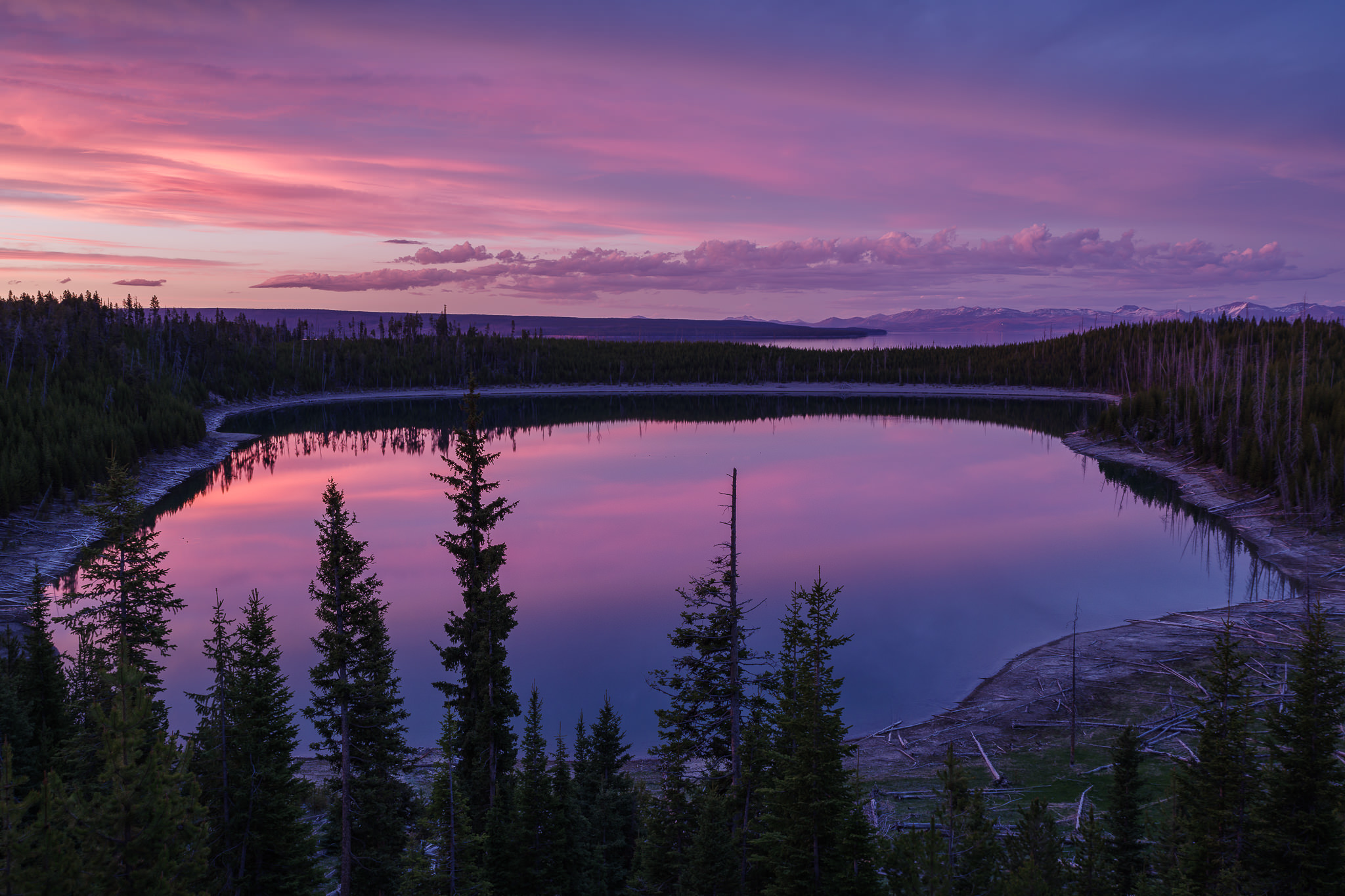 Sunset at a Lake in Yellowstone
1. Set the Right ISO
Start with setting your camera to the lowest ISO “base” value (in my Nikon camera it is ISO 200). Remember that the camera base ISO will produce the highest quality images with maximum sharpness. The higher the ISO (sensor sensitivity), the more noise you will see in the image. I suggest reading my article on understanding ISO.
2. Use the Hand-Holding Rule
If you are shooting handheld, I would recommend applying the general hand-holding “rule,” which states that the shutter speed should be equal to the focal length set on the lens, or faster. For example, if you have your lens zoomed into 125mm, your shutter speed should be at least 1/125 of a second.
Keep in mind that this rule applied to 35mm-format film cameras and older full-frame DSLR cameras. A couple of factors can make it harder to apply today. First, if your camera or lens has a good image stabilization system, you may be able to shoot at a longer shutter speed and still get sharp photos. Second, if you are shooting with a crop sensor camera (such as a Nikon/Canon/Sony/Fuji APS-C camera with a 1.5x crop factor, or a Micro Four Thirds camera with a 2x crop factor), you must multiply the focal length by your camera’s crop factor before applying this rule. Here are some examples:
- 50mm on APS-C camera: 1/75 (50mm x 1.5)
- 100mm on APS-C camera: 1/150 (100mm x 1.5)
- 50mm on Micro Four Thirds camera: 1/100 (50mm x 2)
- 100mm on Micro Four Thirds camera: 1/200 (100mm x 2)
Also, remember that this only affects blur from camera shake. If you are taking pictures of a fast moving subject, you very well may need a quicker shutter speed than this in order to get a sharp picture.
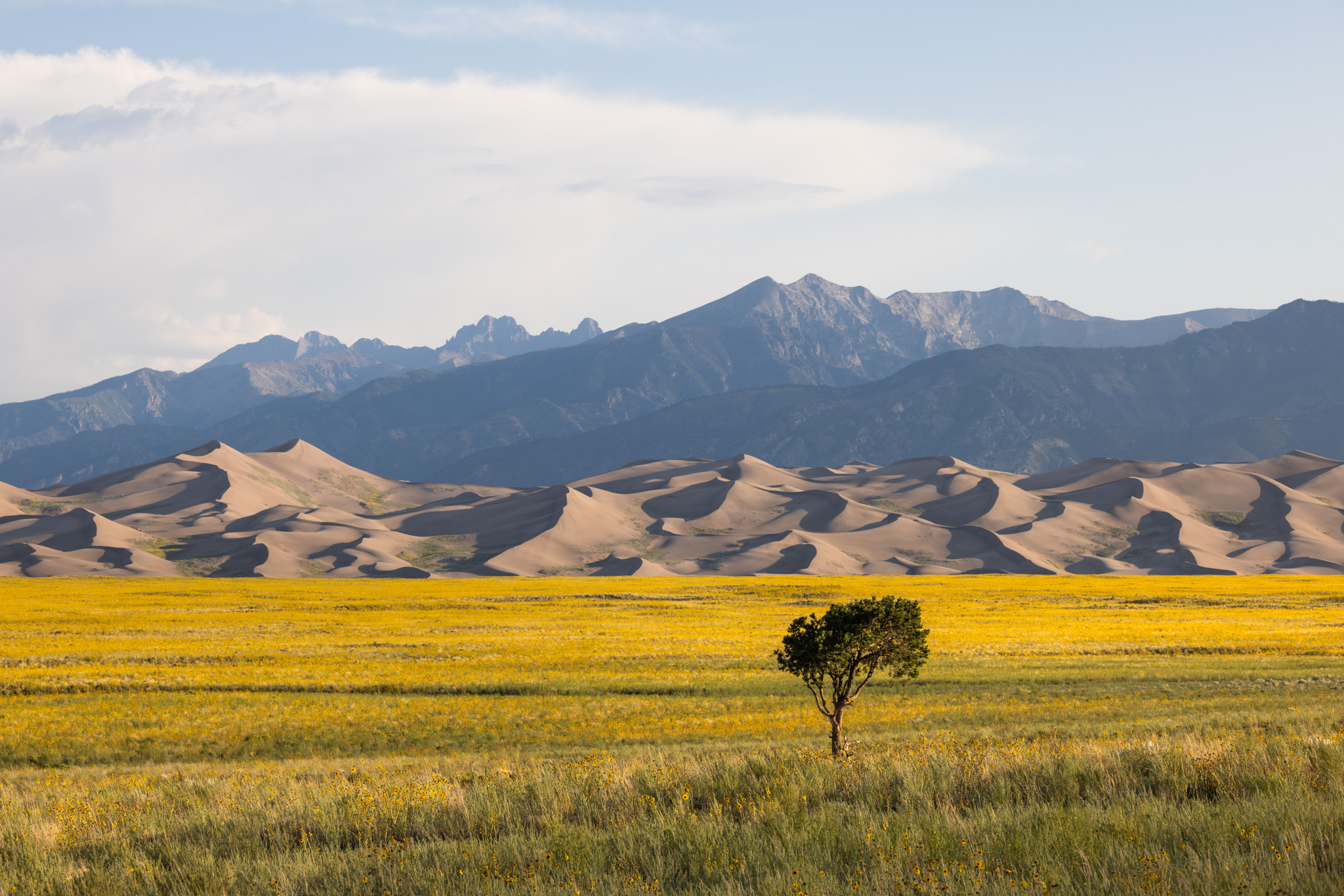 Taken handheld at 100mm and 1/100th of a second on a full-frame camera
3. Choose Your Camera Mode Wisely
When I’m taking pictures in low light, 99% of the time, I shoot in Aperture-Priority mode and set aperture to the widest setting on my lens – the maximum aperture, AKA the smallest f-number. This is usually in the range of f/1.4 to f/5.6 depending on the lens. (For example, with the Nikon 35mm f/1.8 lens, I will set the aperture to its maximum value of f/1.8.) The camera automatically meters the scene and guesses what the shutter speed should be to properly expose the image. You can easily adjust the camera’s guess with exposure compensation. So, set your camera to aperture-priority mode and set the aperture to the lowest possible f-number.
Set your metering to “Matrix” on Nikon or “Evaluative” on Canon, so that the whole scene is assessed to estimate the correct shutter speed.
4. Pick a Fast Enough Shutter Speed
After you set your camera to aperture priority and pick the right metering mode, point it at the subject that you want to photograph and half-press the shutter. Doing so should show you the shutter speed on the bottom of the viewfinder.
- If the shutter speed is showing 1/100 or faster, you should be good to go, unless anything in your photo is moving quickly (or if you’re using a long telephoto lens; remember the hand-holding rule). Snap an image or two and see if you are getting any blur in your image. I typically review my images on the back of the camera at 100% and make sure that nothing is blurry. If anything in your photo is blurry – the entire image, or just one fast-moving subject – use a quicker shutter speed like 1/200 or 1/500 second.
- On the other hand, if the shutter speed is below 1/100, it might mean you simply do not have enough light. If you are indoors, opening up windows to let some light in or turning the lights on will help to increase your shutter speed. It is still possible to capture sharp photos faster than 1/100 second handheld, but it becomes increasingly more difficult the longer your shutter speed is.
5. Use High ISO in Dark Environments
If you are still getting blurry images, try to hold the camera steady without shaking it too much and take another picture. If that doesn’t help, set a fast enough shutter speed to capture sharp photos, and raise your ISO instead. You can do this via Auto ISO (described in the next section) or manually increasing ISO. In dark environments, it is not unusual to use quite a high ISO in order to get a fast enough shutter speed. Although this adds more noise/grain to a photo, that is usually better than capturing a blurry image.
 Canon EOS Rebel T7i + EF-S18-55mm f/4-5.6 IS STM @ 18mm, ISO 1600, 1/10, f/4.0
6. Enable Auto ISO
Many cameras today have an “ Auto ISO” feature that is very useful for capturing sharp pictures. So, set it to “On.” Set your Maximum Sensitivity to ISO 1600.
If you have the option to select a minimum shutter speed, set it to “Auto” as well, which automatically applies the hand-holding rule! If you don’t have this option, set “Minimum shutter speed” to 1/100 second.
This is a useful feature because, if the amount of light entering the lens decreases and the shutter speed goes below 1/100 of a second, the camera automatically increases ISO to keep the shutter speed above 1/100 of a second, or above the hand-holding rule.
If you have shaky hands, I would recommend bumping up the “Minimum shutter speed” to something like 1/200-1/250. Or if you have the “Auto” minimum shutter speed option, prioritize it toward “faster” just to be on the safe side. Also see our separate article on how to hand-hold a camera as stable as possible.
Some cameras don’t have an Auto ISO feature. In that case, you will have to adjust ISO manually to do the same thing. Just raise your ISO in darker environments to keep your shutter speed at a reasonable level. I don’t recommend raising the ISO above ISO 1600 or perhaps ISO 3200. Why not? Quite simply, anything higher than that in an entry-level DSLRs produces too much noise, which has a negative impact on overall image quality. On older-generation DSLRs such as Nikon D90/D200/D3000/D5000, you might want to keep the maximum ISO to 800.
7. Hold Your Camera Steady
While hand-holding a camera, factors such as your stance, breathing, camera hand-holding technique all play a huge role in stabilizing the camera and producing shake-free images.
Think of it as holding a rifle. You wouldn’t want to move around while trying to shoot – you need to stand as steady and stable as possible, pull the stock tightly into the shoulder, exhale, and then shoot. The same technique works great for your photography, especially when you have to deal with long shutter speeds.
I recommend holding the camera just like you would hold a rifle (except your right hand goes on the shutter instead of the trigger), with one of your legs out in front, and your body balance spread across both legs. I personally exhale when I shoot long shutter speeds handheld.
If your camera or lens has image stabilization, and you employ good handheld technique, you may even be able to shoot at 1/10 second without introducing camera shake. But only use this in a pinch. Most of the time, you will not be able to get reliably sharp photos at these shutter speeds. And be sure to turn on image stabilization when shooting handheld!
 NIKON D800E + 105mm f/2.8 @ 105mm, ISO 450, 1/800, f/4.0
8. Focus Carefully on Your Subject
Learn how to focus correctly and deal with focusing issues. This one is very important, as your camera focus directly impacts image sharpness. The first thing you need to learn is how to differentiate between a camera shake/motion blur and a focus problem.
If the subject in your image is blurry, but something closer to the camera or farther away is perfectly in focus and sharp, it is most likely a focus issue. If the whole image is blurry and nothing is sharp, it is generally due to using too long of a shutter speed handheld. And lastly, if a fast-moving object in your photo is blurry/streaky in the direction of travel, then your shutter speed is not fast enough to eliminate subject motion. That isn’t a focus problem; use a faster shutter speed.
If you are having problems acquiring a good focus, here are some things that I recommend:
- Make sure that what you’re seeing is a focus problem, not a shutter speed problem. If the wrong part of your photo is sharp, it’s a focus problem. But if the whole photo is blurry, you may have simply used too long of a shutter speed. Or if a fast-moving object in your photo is blurry in the direction of travel, you need to use a faster shutter speed.
- Lack of light can cause autofocus malfunction, resulting in inaccurate focus acquisition by the camera. Make sure there is plenty of light for your camera to properly focus.
- The center focus point is generally the most accurate in cameras. If you are having problems acquiring focus because your focus point is elsewhere, I recommend moving it back to the center, focusing, and recomposing.
- Use back-button focus. I already talked about this in the chapter on focusing, but I will mention it again here. With back-button focus, your camera will only reacquire focus when you press the AF-On button, rather than every time you take a photo. This is very helpful in dim environments where the focus works sometimes, but not always.
- Put your focus point over a higher-contrast subject. For example, if you try to focus your camera on a clean white wall, it will never be able to acquire focus, because the camera will not see any areas of contrast. Examples of good subjects are: edges of objects, lines separating different colors, numbers and letters printed on objects, etc.
9. Reduce Motion Blur in Your Subject
If you are photographing a person, tell them to freeze and not move while you take their picture. When you work with long shutter speeds, even if you do everything right, your images might still come out blurry just because your subject moved while the shutter was open. This is called motion blur.
Sometimes people like the effect of the motion blur, especially for high-speed objects like cars. In that case, feel free to set whatever shutter speed gives you the right amount of blur. You can even pan along with a moving subject to blur the background behind it and emphasize the subject’s speed! Usually, a shutter speed of 1/15 second is a good starting point for panning photos.
 NIKON D3S + 70-200mm f/2.8 @ 98mm, ISO 400, 1/160, f/8.0
10. Turn On Vibration Reduction
Make sure that your vibration reduction (VR on Nikon) or image stabilization (IS on Canon) is set to “On” on your lens, if you have it. Many of the consumer zoom lenses have some sort of anti-shake/vibration reduction technology in them, allowing one to shoot at lower shutter speeds and still get sharp images. If you have one of those lenses, go ahead and try lowering your shutter speed to a lower value. You can even lower down the “minimum shutter speed” in your Auto ISO settings to something like 1/50 of a second and still get sharp images.
11. Use a Faster Lens
Get a good, fast lens such as an f/1.8 or f/1.4 lens. A 50mm f/1.8 lens should not be too expensive, and even a 50mm f/1.4 will often be reasonable.
Generally speaking, fixed lenses (known as “prime lenses”) are going to have brighter maximum apertures compared to zoom lenses. A prime lens also tends to have better sharpness and image quality. Although you lose the ability to zoom in and out, prime lenses are excellent choices for handheld photography and working in low light.
When I got my hands on my first prime lens, I just could not believe how much of a difference it made in terms of sharpness. If you have never used a prime lens before, give it a try, and you will not regret it.
 NIKON D7000 + 50mm f/1.4 @ 50mm, ISO 720, 1/160, f/1.4
12. Shoot RAW, not JPEG
If you want the best image quality and detail, it is best to shoot RAW rather than JPEG. While JPEG photos can be plenty sharp, the problem is that they are not very flexible files. As soon as you open them in post-processing software and start editing the colors, contrast, or brightness, you will start to get ugly artifacts in small details of the photo.
This is not the end of the world if you only print your photos very small or display them online, but it is a big problem if you want to make a large print or crop substantially. A RAW file with good sharpening technique in post-processing will bring out the maximum level of detail in your photos.
13. Use Depth of Field Strategically
When photographing people or animals, you should almost always focus on the closest eye to you. This is very important, especially when dealing with large apertures between f/1.4 and f/2.8, because your depth of field will be very shallow. As long as the eye of the subject is sharp, the image will most likely be acceptable.
Likewise, if you are photographing a landscape, use a narrower aperture like f/8, f/11, or f/16. These apertures will give you a sharp photo from the foreground to the background. Close-up photography also requires narrow apertures if you want enough depth of field.
Avoid super narrow apertures like f/22 and f/32 if possible, because they will lose some sharpness due to diffraction.
 Sony a7R V + FE 70-200mm F4 Macro G OSS II @ 90mm, ISO 100, 1.3 seconds, f/16.0
14. Clean Your Lenses!
An amateur photographer approached me once and asked for advice on what he could do to bring more contrast and sharpness to his images. When I saw the front element of his lens, I immediately made a suggestion to clean his lens. It was so dirty that I couldn’t believe he was still able to take pictures. A dirty and a greasy front element of the lens is a guarantee to inaccurate camera focusing and poor image contrast. If you don’t know how to do it properly, check out my article on how to clean DSLR lenses.
15. Use a Tripod
Get a tripod if you can. It is essential for shooting some subjects like lightning storms, fireworks, city lights, and other cool stuff at night. Even during the day, I like to use a tripod whenever possible, because it almost completely eliminates the variable of camera shake. (See our article on how to choose a tripod)
Don’t buy a cheap tripod designed for point and shoot cameras. Instead, invest in a heavy duty, sturdy tripod that can handle your advanced camera. Likewise, using the self-timer mode or a cable shutter release on your camera is also very helpful to minimize camera shake.
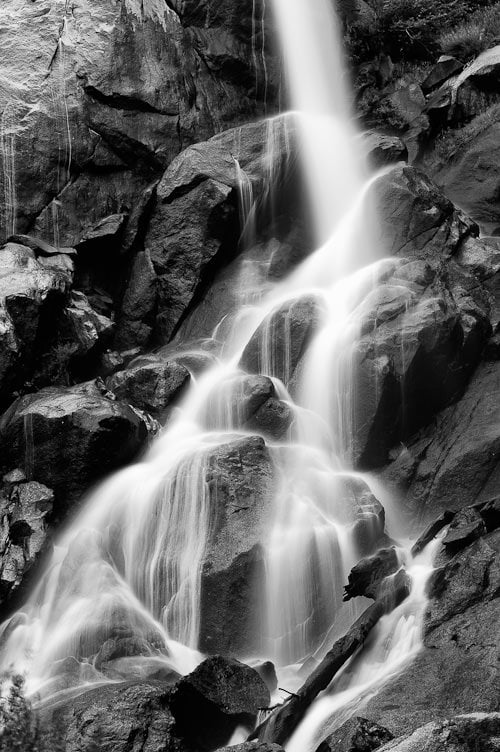 NIKON D700 @ 40mm, ISO 100, 5 seconds, f/16.0
16. Shoot a Burst of Photos
If you’re taking pictures of a difficult subject or are right on the edge of a safe shutter speed, I recommend setting your camera to a “continuous shooting” mode (also known as burst mode). Then, photograph your subject in bursts by just holding the shutter button.
Especially if you are photographing a moving subject like wildlife or sports, using the burst mode helps improve the odds that you’ll get at least one sharp photo. With a bit of panning to follow along with your subject, you can get sharp photos even when your subject doesn’t stay still!
Conclusion
You’ve almost made it through Photography Basics! Just one chapter left. You can go there or jump to any other chapter below.
Take me to Chapter 13: Photography Tips
- Photography Basics Introduction
- What is Photography?
- Camera Equipment
- Shutter Speed
- Aperture
- ISO
- Composition
- Metering
- Camera Modes
- Focusing
- Flash
- How to Take Sharp Pictures (You are here)
- Photography Tips for Beginners
Download as an eBook
I’ve received many requests over the years to download Photography Basics for offline viewing. As of 2025, I’m excited to announce that I now have a dedicated eBook version of Photography Basics! The eBook covers the same information but is optimized for offline reading/printing, with a beautiful design and updated text. Photography Life community members get this eBook as part of their membership ($5/month, cancellable any time) alongside many other benefits, including seven photography tips every week. You can read more information about joining here. After joining, you can download the eBook for free in our shop.
 A screenshot from the “Photography Basics” eBook!
Disclosures, Terms and Conditions and Support Options
Comments
-
Hey,
While the theory about low ISO is logic I wonder to which degree we still must keep a low ISO?
The new cameras and their sensors manage the unwanted noise much better then older cameras did.
It appears, at least on the Canon’s R-series cameras, that a higher ISO contribute to better colours.
The latest version of various softwares for the post work allow us to control the noise reduction much better then previously versions.
Thanks,
Dennis
- I’ve never seen high ISO contribute to better colors, just the opposite. It’s true that today’s sensors and post-processing software are better than ever at minimizing noise, but it’s still better to shoot at lower ISO values when possible. 002. Your articles and videos are so informative! Please keep them coming. The whole team does a great job simplifying, even demystifying, photography!
-
Very informative. Thank you
-
Very great insight.
Bless you
-
Very useful article – Simple, organized, and to the point. Will follow all your points here. Thanks for sharing.
-
Very nice and simple way of delvertion of article।
-
what is a good beginner DSLR camera that is inexpensive but has some options for taking good high quality photos, and that you can control and set the mode and learn how to use a camera?
- Nikon D3500 is the one I use. Quite beginner friendly, and the image quality is amazing. 008. Hi
Thank you for this article
I have a question and i will be happy if you could help me
I have 50mm 1.8 nikon lens and just like number 12 in article i have problem with focusing
Every where i focus my camera focused on the back of it
Fo example if i focus on eye, the hair will be focused and if i focus on nose the eye will be focused
And i do not know why this happen?
- you need to calibrate your lens also called lens micro-adjustment. Most cameras have this option in settings. Google for your specific camera model. Hope this 009. Thank you very much for this very informative information!
-
hi there,
I do a lot of solo fishing excursions and most of my photo opportunities occur at night with hardly any background light. I can’t seem to get my camera to trigger or take wall worthy photos. I’m shooting with a canon 80d with a kit 18-135mm lens, what should I be doing to 1) get my camera to even take a photo at night without me providing some sort of background light 2) then get the most clean and crisp images of myself and the fish. Feel free to shoot me an email
-
Thank you for this helpful article. However it would have better to discuss different focus mode and how to chose focus point and focus lock and recomposing on this same article. For example there is moment in wedding when we need to shoot subject moving or standing and we need to recompose locking our focus on the subjrct. Please direct me to an article on focus mode. I think it’s critical for better focus technique. Thank you.
-
Hi Master of settling cameras l am so glad for reading your article becouse its very understandable the way you explaining in details. So my question is goes on how do i know my center focus in D3400 Nikon ,becouse i only saw auto servo, single servo,continue servo and manual focus?
-
Hi Sir,
Can you please suggest me for fireworks videography settings in Nikon D 7200.
Regards
ROOPESH KARUVANTHIRUTHY
-
Well say and advise. I have done a lot of experimenting and looks like l am also having the same experiences as mentioned. Thanks for reinforcing my knowledge in photography
-
I know you’ve heard this a thousand times, but I must say this article is great! It answered all my questions on achieving crisp shots.
Thanks for putting this together.
I’m sort of at an intermediate level of photography so I want to know what you think about the best lens to acquire. I have a Nikon D3200 and the normal 55-18mm lens. Would a prime lens be a better option or a zoom lens?
I prefer shooting people/events for now.
Thanks again.
-
Sir, I have Nikon d5300 Dslr. Please tell me the best lens to get the sharp photos. I have nikon 18-55mm and 70-300mm VR lens with it.
-
Hi I am doing jewelry product photography. Using 4 elinchrome light. I have Canon 550D camera and 100mm macro lens. I shot at shutter speed 1/250, f/22,ISO 100. Manual focus lens and using tripod . but for My small bangle has diameter of 2.3 inches is not coming sharp. Stones completely getting Blur. Any suggestions. And not getting depth of field. Half Bangles comes clear and half gets Blur.
-
I am so sorry that I am late to the party. I think that this is the second writing of yours that I have found and I loved both. I look around for advice whenever I question my approach to photography. You validated many concepts for me that I had to learn by trial and error (not too much error) regarding sharp photographs. I think I tried a focus test that you posted. Great job.
-
I think three most valuable tips I picked up from your article are:-
My recommendation is to place the rectangular focus area to an area with the most contrast.
When photographing people or animals, always focus on the closest eye to you.
Clean your lenses!
-
you say at least 1/125 when I think you mean at most 1/125
-
Just new to photography and bought d5200 with different lens… Ur article is very useful. My pictures were at a point annoying,an event photos were blurry . I Av to learn the golden triangle rules nd I shoot with majorly manual… U Av to set ur camera to suit what you want. Thanks
-
Great article for newbies like me! Thank you for the hard work.
-
Really an excellent article for beginners. Well explained about the basic concepts.
-
This is great. I’m just learning photography with my Nikon D3200. I have a 35mm lens and have had a few blurry images and this has helped a lot.
Tobi
-
Keep up the good work brother ! I always learn something new in your articles.
-
i buy a new nikon D90 Model camera,but i have a problem with take a sharp photos and Micro Photos please help me to solve these problems with picture
Regards
Basavaraj
-
I have a question. I’m having issues with my pictures being grainy. It’s heartbreaking getting a really good shot, and then you view it and it’s very grainy. I don’t know what I’m doing wrong. Is there any way you can help me?
-
Not sure if youre still reading these comments, but wanted to say thank you for this easy to understand piece! I am a novice and acquired a D200 years ago, along with a DX 18-70mm lens and didnt realize what an undertaking it would be! This is the first article i’ve come across that helped me get a handle on this camera and I’ve had it for several YEARS!
I shoot clothing on a mannequin with a simple grey backdrop with 3 lights. I have the hardest time getting consistency with my pics. i made some of the changes above and I hope this will make a difference. Any suggestions on shooting black? When I shoot black clothing from a distance its fine. When I get close up the image gets washed out and blurry and way too bright. I dont know how to fix this. TIA
-
Is it a good idea to use the “tracking” focus feature on the Nikon in order to take sharper/better focused pics of toddlers and animals that are moving frequently? I am going to take some photos of a friend’s one year old this weekend and wanting to know what the best techniques is for focusing.
-
I use Nikon D7000, it used to be more sharp but now, I don’t like the results I am getting like before, the focus isn’t as satisfactory as it used to be , do you think it’s a matter of cleaning issue, or my settings went wrong somewhere?
-
I have a Nikon D5200. I am using a 18-55mm lens and when I am in aperature mode, it doesn’t matter what F-stop I have, my shutter speed will not go above 13. How do I get a faster shutter speed so that I do not have blurry pictures? Also, When I am in the shutter speed mode, it doesn’t matter what I set it on, the camera always says that the subject it too dark. The pictures always turn out too dark and I can’t get them to look like natural lighting. I end up using the flash and the pictures look a little harsh. Please help if you can. Thanks.
- Amy,
When you are in shutter mode, does the shutter adjust normally (even though the pics are too dark)?
Also, have you had your sensor (and lens) cleaned?
Sounds like something’s wrong with your camera, although someone else may chime in who knows more about something like this.
- I played around with it a little last night outside and when in aperature, the shutter does change, but not enough to get a clear picture – the most it went up to was 100 but that was rare. When I was in shutter mode, if I changed it to 200 or under the message went away, but anything over 200 and it kept telling me the subject was too dark. It was clear skies here and somewhat sunny at 6pm. I am new to this, so maybe I do not have something else set right. I just bought this camera at the end of November, so I have not had anything cleaned on it. I took a class that said on a sunny day you should be able to set your camera to manual mode – use shutter speed of 500/F16/ISO400 and should give you a nice quality picture. I tried this last Sunday afternoon and it was dark. Thanks for your quick reply. 032. i enjoyed this article,it cleared so much air.
-
hello! I got my Nikon d5200 on july 2013 and just few days ago I copied pictures to the laptop.I found a small spot on same pictures,not on all, just on those when the sun was in pictures and focal length is 18 mm.what is the problem? : lens or the sensor or what else can be?..please help me!
-
I have a D90 Nikon, and love it. I takes LOTS of photos–lately, (all summer) the brightness on the photos is horrible. I have had it back to the camera shop, and they say nothing is wrong. I usually shoot in automatic, but they suggested program. Yesterday, I shot in a park. Light was simply filtering through the trees. I changed lenses. Used another NIKON, and still bright, bright, bright. Can it be the SD cards? I am totally at a loss. I am not very camera setting savvy. I’d appreciate any help you could provide.
- i can understand your situation, i recommend you to keep you shutter speed to a value more than 1/250, you can keep it from 1/500-1/800, or you can use aperture value of f/8-f/20, or you can also lower the iso to 100 keeping other things same……try these things n let me know 035. thank you so much for posting information and answer questions without making everyone who asks the question seem like a moron. I’ve been on other sites and I’m so tired of the pompous attitude of the know-it-all who belittles anyone who doesn’t ‘get’ the DSLR. You have a very ‘human’ and ‘real’ approach to the average, novice like myself and you make it easy to understand. I’ve learned so much from you!!
-
thanks for the info..i just got a nikon d5100…and working on getting cleaner sharper images..i’m a Graphic designer so it annoys me when i see blurry images.
-
Hello!
I am taking some maternity shots for a family member and was considering upgrading my camera (currently using a Canon Rebel XS) but am now considering getting a new lens instead. I loved your article and tips, and would like to seek your advice on this. I currently have the kit lens the camera came with, a Canon 55-250mm, and a Canon 50mm. I was thinking of purchasing a 17-50 Tamron. Can you advise me, please?
-
Thank you so much for acknowledging the possibility of a bad lens!
Too many forums simply conclude that people simply do not know how to use their cameras,
when this is not necessarily the case.
-
Thanks a lot for this article. It’s really help me.
-
Thanks most helpful explanation I’ve read. I have an M9 and it is a challenge at times. This will help enormously!
-
Cool ,very well narrated
-
Thank you so much for taking the time to explain this in detail (D7000 user/lover). I wasn’t sure if it was the operator (me), a bad lens, a bad sensor, or all of the above! I was getting nervous! But it as the operator. I’ve used Manual so much that in the past few years that Aperture Priority was not even a thought. But this will definitely free up more time to actually photograph my subjects and get sharper images instead of constantly changing my settings as you have to do in Manual! Non people subjects I will use Manual!
Thank you so much! Great site – has all the answers to all my questions
-
This article.. correction this WEBSITE offers the absolute most beneficial information for me as a beginner. I refer to your site just as much as (okay, more than) my camera manual! Thank you so much for sharing this information!
ps. I NEVER EVER take the time to comment on websites, this may be the first I ever have and it’s because I find it that useful I feel it’s only necessary to pay it forward by letting others know!
-
This is very useful to me! Thanks for sharing this. :)
-
Shooting in bursts, of course, means that there is no leverage-vibration from pushing the shutter button, on the second or third shots. I shoot in Slow Continuous mode, at 3 fps, and nearly always the second shot is a little sharper than the first, even with the fabulous assistance of Nikon VR2. A tripod does not suit every situation…
But how ridiculous not to be able to combine Mirror Up with delayed release or Live View (on the D700)! Wish one could simply screw-in an old-fashioned cable release. Why ever not?
-
Absolutely awesome article with lots of great reminders!!! Thank you!!!
-
sir,
i had nikon d90 & DX 18-105 VR (ED) lens.
my problem is some time i got very noised photos on it …. if there is in auto mode or manual mode.
some times i got well photos but also there is noise on my photos…
on one month back it had a excellent result but now a days i cant get the better result on it.. i don’t know what happen to it .
is that lens fault or camera fault?
which is the better lens for my cam?
-
Hi,
I’m a novice in photography and I’m having a Nikon D5000 DSLR right-now. I’m looking for a good lens which can be used for both landscape photography and portrait photography, and provides better result.
Thanks,
Ketul
- If you want to combine these (portrait/landscape) and you are under a budget have a look at the Tamron 28-75/2.8: a very capable lens for a very reasonable price. 049. What is your focus set up on the D800 when shooting birds with the 300mm f4 AF-S?
-
Hello friend
Thanks for your answer can I put the aperture to F18 or F22.?
- As I told before, noone can tell you which settings to use exactly. Day can be vright sunny or cloudy, two different light amounts!
What is your problem? Cant you just shoot and look at the photo you just took? And if its too bright try playing with increasing shutter speed or reducing aperture or both. Shoot, look at your photo again, if it is too dark then try increasing the aperture or reducing the shutter speed or both. If you want to capture the motion then you better use more than 1/250.
If you are struggling using M mode, then use Auto mode camera will do everything itself.
if you want to have control, then use A – Aperture mode, where you set the aperture and camera will decide what Shutter speed to use, that worksy excellent!
Cheers
Mazdak
-
Hi
So which lenses are good for the nikon d7000 for making portraits of womans .
I am looking for lenses that can make sharper colour pictures for my nikon d7000
Or I have to go for the canon eos 5 mark 11 which make better pictures than the nikon d7000 051. Hello Mister Mansurov
I explain better so you can see if i do something wrong with the settings
My camera is a nikon d7000 and canon eos 7d
I need to know this manual focus settings for summertime for outdoor shots for making portraits off peoples
Is this settings correct for outdoor shots
Iso 100
aperture F 4.8
shutterspeed 1/250 sec
whitebalance auto
Thanks
- noone can tell you what settings to use since there are many other factors affecting the quality of photo. Only one word Outdoor means nothing. Your camera is digital where you can immediately see your photos after shooting. You can shoot and check if is good.
1) for outdoors if there is sunlight available then iso100 will do well.
2) If you want to shoot many people and probably in motion then they will most probably be at different distances from you/camera therefore you will need smaller aperture(large f number) for wider depth of field.
Finally, you must experiment and experiment and again experiment as many times as it will take untill you get what you want. Another point of exeprimenting is that when triying different ways you will get different ideas and that is the only way everyone learns! Good luck! 052. Hi,
I see pics on the web that have captured the light contrasts of scene brilliantly…like the blue of the sky and the setting sun…the orange looks as if its painted. Similarly with other scenery pics. Are these done in post processing softwares? What impact do lens filters have on photo?
For a novice what are basic filters I should have?
-
Thanks Mansurov for a to the point article, full of many vital and much needed tips. keep the good work up!!!
-
Hi Nasim
It was good article ,it cleared a lot of things/concept, recently I brought canon 5d mark 3 with Ef 70-200 mm f/2.8 is 2 l lens, I was not satisfied with my picture quality and was probably blaming that my lens is not sharp or camera is not perfect , but ur article has cleared my vision and I think I should be patient enough to learn the trick of shutter speed and ISP, thanks for the article
,
Good job
Thanks
Regards
-
Hi Nasim
Discovered you recently. Great reviews and advice. Thanks. Will follow keenly. Hoping to improve my pics. Am a novice. Have a D300. Want to move to D800. Can you please recommend a starter lens for non-specialised everyday family and holiday use. Have a Nikon 70-300 4.5-5.6 ED VR; not great in my hands.
Should it be 24-120 0r 28-300?
Best wishes
Tanvir
-
18-200mm VR will do a great job, but you ll need speedlite for indoor use when no sunlight. But you can probably afford yourself more expensive 24-75mm F2.8 which is much better great lense!
-
Thank you very much indeed. Got 24-70mm f2.8 – very pleased.
What is your advice re: 70-200mm f2.8; specialist lens or useful for a hobbyist too?
Just beginning to understand photography.
Regards
Tanvir
- 24-70mm is an amazing lense!
70-200mm is also very sharp and fast lense, probably the best lense in its range of functionality so if you get, it will bring you big joy and happiness I am sure :)
One very imporant suggestion: If possible get another SLR body, so that you do not keep swapping lense on same body. By that means you prevent any accidental damage to your lenses and prevent dust particles entering the camera sensor chamber.
-
Thank you for your helpful advice.
Best wishes 056. Hi,
I am complete novice with my Canon 1100D with 18-250mm Sigma lens. One of the main questions I have been trying seek answers for is sharpness. I see such incredible pictures on the web and wonder, how? This article has helped me understand some basics and prompted me to try your suggestions.
Thanks for the simplicity to explain the concepts. I would like to know more, maybe you can post something on vivid/colorful pics, lens filters, etc?
Looking forward to more inputs/articles.
BTW: added this page to my favorites :)
-
-
Hi Nasim!
thanks for all the informations and i really appreciated, can i ask you some favor as i am new hand on camera, i bought a d3100 with regular 18-55mm lens which comes with it, so now i want to upgrade with better lens, specially to take a sharp pics as u have shown above, so i have no idea which nikon lens should i buy, i was thinking 55-200 mm according to my budget which is around $200 -250, so what would you recommend the best lens for my case, two things 1. soft background or sharp pic 2. good length of zoom.
thanks for your sharing.
- Hi Kalsang,
I would suggest that you extend your budget a little bit more and go for 55-300mm instead. 058. Thanks for the tips about Taking Sharp Photos.
I have Nikon D60 & having Noise Problem in Image as i Set the ISO high, specially night time when I take photos it shows me so much noise can you suggest me any setting for Nikon D60 for night Photography.
I have 70-300 mm lens & 18-55.
-
Great article! Thanks for putting a lot of piece of a puzzle together, I think sharpness take more than just one thing to do, just as you wrote about all of these.
-
I just bought a Nikon D5100. If I use the center focus point to focus in single-point AF and press the shutter button half way down, can I recompose the picture and still have the subject in focus when I press shutter button all the way down?
If I press the shutter-release button half way down, does that also lock in the exposure if I recompose my shot?
-
I did everything in this article but there’s one slight problem….my images come out very dark. Can you please tell me how to fix this.
-
Hi Nasim,
I have been reading your articles for a while, and I must say I love them, especially considering the details on the things you pay attention to.
I am planning to buy Nikkor 35 mm 1.8 lens. I already have 18-55 kit lens with me. I know shooting at aperture 1.8, the DOF will be too narrow so to get things in sharp (esp. group photos), I will end up choosing an aperture around 5.6. So, my question is: Will it make any noticeable difference between shooting with a prime lens at f5.6 and shooting the same thing with kit lens with focal length set at 35 mm and aperture at f5.6?
-
hey nasim,
If you could reply early, it would be of huge help.
I am planning a wedding photography for my friend…
i had inspected the site beforehand….its a bit low lit…now, i have a nikon d3000 and a d3100.
the lenses i have is a 18-55 and a 70-300, i have a flash too.the nikon sb800
can you suggest me the lenses i would need for a marriage ceremony..considering few closeups and few long shots capturing some candid moments???? i am not going to use my 1.8d.
and i am due to buy strobes for the marriage….which i am going to focus on the podium where the bride and the groom would stand on….so every time i click, the strobes would fire for better lights…it that a good idea??
please suggest soon…please
-
hi Nasim
nice article and very interesting!
can i ask which settings can i use for my nikon d90 when shootin in a room with a lots of children?
it seems that everytime im firing, not all children is focused some are blurred…
how can i take picture to show all children in the frame to be equally sharp?
is there any focus setting to be used?
please advise.
thanks!
-
Recently I came across an article in which the writer suggested that we not use the extreme distance on a lens in order to get the maximum sharpness of a picture. For example, you don’t use 200mm on a 70-200mm lens, but rather a 180mm. Likewise you would use 85mm instead of 70mm on the same lens. I’ve never heard this before. Your thoughts?
-
nasim mansurov
nice article. liked it. when doing candids, i prefer to use wide primes and do zone focusing (shooting from the hip sometimes :-) … it also pays to know the sweet spot (in terms of optimum iris) of each lens we own … cs
-
Hi Nasim,
Thank you for such a wonderfully informative article. I am planning to buy a Nikon D5100 but most of the reviews say that the images are little soft direct from the kit lens (18-55mm). Is it possible to take sharp images with the kit lens using your techniques? It comes with an aperture range of f/3.5 – 22 (W), f/5.6 36 (T). Many thanks.
Arijit
-
I find your advice very helpful. Got a D5100 for Christmas 2011 AND am loving it.
Appreciate your help.
Thanks
-
Thanks for the insights…I must admit, I learn some new tricks. Now, I notice my shutter speed is fixed at 1/60 after setting my camera on the aperture priority mode. I also recall you recommended shooting at speeds of 1/100 or higher. how do i overcome this challenge this please?
Please note my ISO is on auto with 200/800 (minimum/maximum) values.
I will appreciate your help.
Regards.
-
Very informative article. I will definitely use some of your techniques. I am going to be taking pictures at upcoming graduation events and mostly held inside. What should I do? Use a tripod? What should I set my camera settings to as far as ISO and Aperture? I have a NIKON L120 and i don’t know what setting to use.
Thanks so much for your knowledge in cameras and photography.
-
I really appriciate your insites.
I have been picking at photography for a bit. But I have a very long way to go. One of the things I have been taught in landscpe photos is the f22 rule and also to find the sweet spot for your particlular camera. Mines seems to be about f16.
So do you think I would get better results with your suggestions?
I am using a Sony A700 with a zeiss 16 – 80 lens for most of my landscapes.
I have been using most all of your sugestions for quite sometime even before I found your site.
I have a good trypod and use it most of the time.
I like shooting flowers too, but not people so much.
But I really like what you have to offer us amatures – well me anyway.
-
simple yet so informative..I have set auto-iso off on my d3100 because i mostly shoot in Manual mode..
But i think i need to set it to on when i switch to Aperture priority.
-
Wow! Thanks so much! You don’t even know how grateful I am for this info. I’m just starting out and I’m starving for knowledge and experience! God bless you :-)
-
Hi Nasim,
I was wondering if you could tell me why when I take a photo of say my son and his prom date, one of them is in focus and the other is a bit blurry. How do I get both of them to be clearly focused?
Thanks for your help,
Michelle
-
Hi Nasim,
Could you please answer my question.
I use D90 and 85mm 1.8 lens. I have been shooting single object till now and it works fine.
I want to use it for group shot and I am really struggling here. I do not know how to foucs all 5 person in my shot.
Could you please explain this to me.
Many Thanks,
Muhammad Arif
-
Hey Nasim, I am glad that I could come across your articles. It has cleared loads of my doubts about photography.. You are truly a great photographer i have ever come across.. Keep up the good work. And God bless you, your family n your team members. All the best.
-
My name is Kelly Jo and I just wanted to say thank you so much for this article. It is written in terms that us beginners can truly understand. I passed it on to other amateurs. I have learned more from you in 20 minutes than I did with 6 weeks of the New York Institute of Photography. Your site is amazing and I am looking forward to following you and your posts.
-
Hi Nasim – my question has to do with focus and/or sharpness. I am using a Nikon D50 with either a Nikon 18-55mm 1:3 506G lens, a Nikon AF Nikkor 28-8omm1:3.3 5.6G lens or a Sigma 70-300mmD 1:4 5.6DG lens. I am a furniture maker and my subject matter is pieces of furniture that I have done. I have set up a ‘studio’ in my basement. When I shoot with either the Nikon 18-55 or the Nikon 28-80 lens, I am about twelve feet from the piece to frame it and the focal length is about 28 – 30 mm and the image is not sharp – I am comparing it to an image that was done for me by a professional using a very expensive camera. When I shoot with the Sigma lens, the focal length is 70mm and the image is remarkably better for focus. I had to get back about 17 feet from the piece and still could not frame it all. I also shot a picture of a small wooden bowl I turned from about three feet away. The focal length was 35mm and the image was very sharp. I need to figure out what to do to improve the images as they will be representing my work to clients. I use three 30w 5000K flouresent lamps with umbrellas for lighting. I have tried a lot of different settings on the camera including, of course, the ones you recomend. At this point I am wondering if I need a new camera, new lens(s) or new lighting. As usual, my buget is limited! From this information, do you have any opinion as to where I would be best spending my money first? Is there any more information I can give you to help you advise me? Any help would be greatly appreciated! Thank you, Bill
-
Hello Garygs
i do apologise if you think my post is a bit patronizing..my post says at some people its not directed at a individual so take yourself out of the equation.its great you shoot in manual its seems probably the problem you r having is you need to get your lens checked or calibrated this has happened to me about 5years ago. i get my lens checked and serviced once a year.i do a lot of sports photography.
-
Hi Everyone
I’am reading some of the comments on here with some people having problems with blurness and
not getting good sharp images… there is a easy fix to this i’m going to disagree with Nasim
To take good photos you must learn to shoot in manual mode and understand the the rules of the
golden triangle which is shutter, aperture and iso if you don’t then you will be for ever taking bad photos
and having the odd luck of some keepers…the problem shooting in auto or other modes is when you
run into problems you dont know how to fix it why because you have not learn the 3 most important
fundamentals of photography which is shutter,apeture and iso..dont blame your camera blame yourself
for not learning the rules…so forget the modes on your camera and learn to shoot in manual
-
A little partronising I think. I do shoot in manual and understand how to. I still have a focus issue though. Gary
-
Thankyou for your post Paul. This is where I am now shooting in Manual Mode, I have been on various courses and have agree with you its about understanding the golden triangle. I am still battling like hell to get the perfect shots but I am also a perfectionist and will continue until I shake off the blur from my images. I know I am also having problems with poor focusing and know I’m doing something wrong but its to pinpoint what that something is… just gotta keep reading and practising :-) 081. Hi Nasim. Great article. I Hope you have a little time to help me. Im shooting interiors and wondering what is the best approach for getting as much in focus as possible. I use Nikon D700 7 Nikkor 14-24mm 2.8G lens. I have been trying to shoot at the hyperfocal distance so for 24mm, F/8, (ISO 200) I attempt to focus at 2.4m (measured using a tape measure) but not getting the best results especially if something in the foreground is within the 0-1.2m range. I use a shutter release, on a tripod shooting bracketed exposures for exposure fusion but the originals, not just the composite suffer from focus issues, particularly in the foreground.
Is Hyperfocal distance focusing suitable for interiors? If so should I forsake some of the distance focus by focusing closer to the camera?
As i’m not sing flash I can afford a smaller aperture & longer shutter speed so going to F11 will help me but I think its more than that? Any further advise?
Many thanks, G
-
-
A week ago I handed my D40 to my sister to take a photo of me and 2 others. Flash on, in Auto with a 35mm 1.8 prime. When I downloaded the pictures only one closest person was in focus. At a Distance of 6 ft the camera choose f 2.8. ISO is auto (400) shutter speed is 60.
Is my only option aperture setting or can the camera some how choose a higher f number?
- Rick the answer is simple according to your lens set the aperture t0 3.6 or 5.6 set the shutter to 80 or 100
iso keep it at 100 unless its in a dark area pump up the iso go as far as 800 only if u have to or compensate
with your flash keep flash on manual mode and adjust accordingly..the rule of thumb stand 1.5 t0 2metres
from your objects make sure your objects are standing next to each other in a straight line all facing you
snap away..good luck 083. Hi I have a sony A500. I could not get sharp pics with my cam though I usually put it on an auto mode. I also have an entry level lens 18-70mm which costs $150 which I often use (I have 2 other lenses). Has it something to do with the lens? Do I need to adjust settings? If I put my pics side by side with pics taken by Nikon D300 I see such a huge difference. It is very dull and does not show any vibrance and crispness. I am thinking of switching to a different brand but I already invested so much on Sony for me to do so. I am really confused.
-
I was just wondering is a Pentax K-x a good cameras ? I’m thanking about buying one.
-
Dear Nasim,
Thank you very much for your article. I just changed my camera settings following your instructions.
I have a doubt. If a choose manual mode to photograph a waterfall using a very slow shutter speed, must I change my “auto ISO” minimum shutter speed ?
Other thing. If I’m doing hand held photos with a 70-200mm, must I reset my shutter speed every time I zoom in or out ? If that is the case, I’m not going to lose pictures while reseting my camera every time I change the focal distance ? Many greetings, Jorge.
-
Awesome note !! really appreciates detailed explanation.
-
Sir your suggestions r terrific, jus want to know wt does exposure mean in photography
-
Good one Nasim. Can you shed some light on some of these below –
1. How to take a sharp photo of a child(with their abrupt, unexpected movements), especially indoors with not so much of surrounding light.
2. Also what should be the most basic things that we need to consider while photographing a group of people , again indoors with not much of light around. We have a Nikon D3100 and we always have difficulty trying to bring the subject in focus, using lens ring from a viewfinder. Never get to know what is the best focus setting. Shall I use LCD for this sake to have a better view of the in/out focus things.
-
Hi, I just have one question, i never get both the eyes sharp. I try to keep spot focusing on my Canon 500D with a 2.8L lens, and aim the “red spot” between the two eyes but sill no sexy effect that I aspire for.
-
What a wonderful article Nasim so informative and well written. I own the D7000 and really enjoy shooting Landscapes. I am always looking to take my photo’s to the next level and this article will lead the way. Thanks for taking the time to author such an informative article.
-
Hi,
I really loved your article, but i am quite new so i won’t really understand what shutter speed and aperture is. My basic need is to click my daughters image. I have Nikon P500 which has almost same as SLR features. Can you help me how do i make more focus on my daughter and keep the background as blur. I don’t wan be best but i wan click my daughter photograph such a way that i can make those larger. If i keep background as more focused those picture doesn’t really look good. I saw your son’s picture, where background is not clear but your son’s image is pretty clear. Can you help me to achive this
-
Thanks a lot for this article.. I am new to photography.. I have a cannon 1100d with a tamron 28-300mm lens.. I am interested in taking photos of moving objects.. I have photographed birds in flight.. I was successful in capturing them in mid air but sadly most of them are out of focus.. how do i focus an object that is moving very fast? and since I am using a high iso 3200 with 1/3000-4000 shutter speed.. when I try to zoom in on my photos the photos have a lot of noise.. how do I avoid noise in high ISO’s?
Thanks a lot.. Very Good Article.. I will try all your tips.. I hope It will improve my skills..
-
Hi
why is it when i take a photo on a bright sunny day my photo comes out dark and lack colour
-
Awesome tutorial . Really you are genius in photography. If you dont mind can add me in ur facebook so that i will get some useful comments from your side for my photos. I want to learn more from this genius..
-
Your tips are excellent: I recently upgraded to a Nikon D7000 from a Canon PowerShot 30 with the goal of shooting tack-sharp photos. Your most excellent tips have helped me towards that goal. I’ve set my camera according to your instructions and see an immediate difference. Thank you so much!
-
Nasim, My new Nikon D5100 refuse to focus against white wall. BUT interestingly, my Canon G10 has no issue focusing white wall?
Can you please help me understand why G10 has no focus issue same time D5100 refuse to focus?
Thanks
Rakesh
- Sorry, I forgot to mention that I have Nikon 18-55mm VR lens mounted on SLR 097. Hi Nasim,
I need to take sharp pictures of stock items to post on line. kindly advice me what kind of camera (multi purpose use) should i purchase.
-
Great tips. We need to pay attention to each tip and figure out how it affects image sharpness. I am learning and practising.
-
hi nasim
i own a nikon d5000. recently i had covered an engagement. the photos did come out well but they could have been better. i find that the viewfinder of the camera is very small. i have difficulty in focussing often. though i wear glassess, my vision is good. i got my eyes chekced very recently. i tried the various settings by moving the lever near the view finder, but of not much use. in one of the photos of the girl, her face is focussed perfectly, but the beads on her necklace are out of focus. is there any attachment or some sort of contraption that can be attached to the view finder that can enable me to focus better.
-
@cytus
try to help, increase your apperture to f8 or f11
@RD
try to answer, at night … when the light is minimum hitting the camera sensor … shake is not an option to get sharp image. so try to increase iso to 200 and try to fill in the situation with flash … make your shutter speed maintain at 1/200
-
Hi Nasim,
got question 4 u..actually i wud like to know ,
i have nikon d700 with 50mm lens..and when i take a picture, background comes blur so what i want is i don’t want to make background blur.like u know with some digital camera we can get without blur while taking pictures..but i dn’t have idea in DSLR & i’m new in slr…so what settings i have to use to not make the background blurr??
Waitin 4 ur ans..
Thnx…
Mr.Cytus…
-
hi,
i have a Nikon S9100 camera. During daytime it captures amzing sharp images. in case of outdoor imagesin night times, images are very blurry. I have tried various ISO settings, but it hardly improved the sharpness of the image. Also changing the ISO increased the sharpness but degraded the contrast of image.
Please suggest the right settings.
Thanks !
-
Hi Nasim – great to see your valuable comments here. One question for your advice pls: how to take sharp portrait photos with also sharp background? Is it sth possible on a dSLR? I used to get it with my P&S cam (Canon S95) but can’t do it with my 60D as when people gets focused, the background gets blurred. I know bokeh is good for portrait most of the time but in some cases we’d also need to see a family sharp face together with sharp background of place we travel to. Your advice, much appreciated.
- Decline,
What lens are you using on your Canon 60D? Try to use smaller apertures (f8 >) and see if that helps. 104. It helped a lot……thanx a ton :)
-
Hi, I dropped my Sony slt camera to concrete floor while it was power off. now, it can take pictures but the corners of every picture are blurred, the center looks fine. the pictures taken before the drop were perfect. The len looks fine by naked eyes. Do you think this is a Len problem? Or is it a fixable problem? Thanks!
-
He there, glad I found your article to know that I’m not the only one having problems. My problem is the same as Melissa’s. When I take a shot with more than one person someone is always out of focus. How do I correct that problem? Is it simply raising my aperature to a higher number?
-
hi, I was wondering what I’m missing…I have a Nikon D80 and just got my first prime lens (50mm) which I love. I am having tremendous trouble with the focus if there is more than one subject, one is sharp and beautiful and the other is blurry? I have a great bokah effect but I want both people in focus. I shoot in either manual or aperture priority. Is there some basic thing I am missing? I love shooting with my 18-135 but I dont get nearly the bokah since I can only get to f5.6 with that lens.
-
Nasim,
It was a pleasure finding your website I’ve made it a point to add it to my favorites.
I have a website (www.Guerreisms.com) and am among one of the most popular street style websites. I focus on details (such as shoes, rings, pocket squares). I enjoy trying new things with the camera (Nikon D300s and the 50mm f1.4) I recently purchased the 80 – 200mm lens (f2.8). My problem is that I find the shots are very soft and blurry. I read this post but feel that I’m missing something, most likely my settings are off for detailed shots…but after reading all the reviews I was under the impression that if this lens was ideal for sports, I’d be able to use it with ease for catch people walking and/or simply standing stil. What do you suggest as to the correct setting for day time outdoors? Please send the response to guerreisms@gmail.com.
Thank you in advance.
Continued success with your site and all your endeavors.
Guerre
-
Thank you for such a wonderful article!
-
thank you so much for very informative post regarding clarity..I did it and now most of my photos look good than before….thank you
-
Well am so happy about all these post. I have a Nikon D3000 and am enjoying my work with all the tutorials been applied on. Thankz to you all.
-
Hi.. can you please suggest me some general settings and lenses… i want to take sharp pictures at night ( both indoor and out door) without using the flash or auto settings.. i’m a beginner and using Canon EOS 1100D (i’ve 18 to 55mm lens and 75 to 300mm lens)
also tell me how to take pictures of an event with all the lights and motions again without using my camera flash as it leaves some really dark shadows on the faces or leave them blank and over exposed..
-
Hello Nasim,
You suggested using the “separate” focus button to lock focus in low light situations, then recompose, rather than using the shutter button to lock focus. How is that any different than just pressing the shutter button half way to lock focus then recompose? Thanks you.
-
Can you point the problem? I am standing just below the tube light in the room with enough brightness. Now I set my camera to Text(Macro) mode and I try to focus on the image. After some time I am able to obtain a correct focus but as soon as I click the taken picture turns out to be completely blurry. aaaaaah..
-
Thank you very much, I run a lot of marathons with my camera and (obviously) am out of breath whilst taking most shots. This has really helped me understand some ways to ensure I capture sharper photos. Will make lugging round my Canon G12 more worth while! K.
-
Hi
I came across your website accidentally, while I was looking for some articles about how to take sharp pictures in low light. After reviewing your website I found it very interesting source information with great details and examples for each specific lens or camera. But what surprises me most that I couldn’t find any review about Nikon only mid-range zoom lens 17-55, F2.8 on your website!! I hope one day you review this great lens!
Question: I have D90 camera with 50mm/f1.8D, and I am missing a good lens for taking pictures of children in low light condition. I have done lots of research and I even tried Tamron 17-50/ F2.8, but it was a disappointment. The lens was not fast enough and some compatibility issues with Nikon cameras in imo.
I have read lots of good article about Nikon 17-55 and I was wondering if you suggest this lens for my needs (photography of moving objects in low light) ? I know that the price of the lens is HIGH ($1400), but what other options do I have? Thanks in advance for your replay.
-
Hi Nasim,
I have had my Nikon D90 for about a year now. I am still not happy with the sharpness of the pictures. I went through your article and changed all of my settings. It did help, but I am wondering if it might be my lens. I have the manufactuers lens that the camera comes with as well as the 35mm 1.8G. I really want my pictures to pop. I do alot of outside pictures of families and children. Do you think that investing in a different lens might work. If so what lens would you recommend? Thanks for your expertise.
Jennifer
-
Hi Nasim, do you have any suggestion for D90 on the ISO sensitivity and active D lighting, Thanks
-
hello, i would to ask where can i see the page that you talked about your lens in wedding photography and some sample shots.. thanks
-
Hi Nasim
I have started using Sigma 50mm f1.4 HSM EX DG lens with Canon 500D body recently. What I realize is that the AF at times acts funny and its not on the spot (like eyes,iris,edge of flower petals)or not producing a very sharp image even if I manually select the AF point. I would like to understand from you that from your experience,what would you recommend to get the focus right on a prime lens and get a very crisp shot.
-
I always have it set at 200 iso with a low aperture and fairly fast shutter speed. Could it be my equipment? I have a d90 and mainly shoot with my 35mm. I’ve been following a lot of photographers and notice they all use D700 or higher (full frame) and have atleast the 1.4 versions of lenses if not better. All my lenses are 1.8s right now. I”m saving up for the d700 but dont want to be disappointed if there is a setting or something I’m doing wrong. I’m just frustrated bc my images aren’t as sharp as I know they can be. Any words of wisdom?
- Mallory, there is absolutely nothing wrong with using f/1.8 lenses. In fact, some f/1.8 lenses like the Nikon 50mm f/1.8G are sharper and better than their f/1.4 counterparts in many ways. In 99% of cases, it is not the gear, but the photographer that is the problem :)
D90 is a phenomenal camera and I have made many great pictures with it. In fact, Nikon D80 was my first DSLR. 122. Hi, I seem to get blurry/grainy pictures when there is too much light. Even when I have my subjects in the shade but the sun and/or sun bouncing off other surfaces causing my images to be bright. I try to adjust but my subjects still look washed out and grainy? Please help. Thanks
- Check your camera ISO setting and set it to a lower number like 100 or 200. 123. Hello Nasim….
I just found your website and found it very helpful. This is the problem I have.
When I have a group of people 4 and above I have a hard time getting everyone focused.
I always have a few of the people on the sides that end up slightly blurry.
-
Very informative.
-
Thank you so much for this. I have been having such trouble with focus lately and your specificity on the subject will really improve my work. Thank you for taking the time to share… my life-long memories will always be indebted to you.
-
Hey Nasim,
Blog is EXCELLENT!!! Can you help me with this, I need to take some VERY GOOD snowboarding pics nect week. I have Nikon D3000 camera, need help with settings while shooting snowboarding pics.
Thanks!
-
Hello, thank you for the tutorials,
I have Nikon 200, and I occasionally take pictures of my family’s events, mostly in hotels, indoors, use external flash, But most of the photos comes out dark, so all time I have to sit down on the computer and use photoshop and one by one make them light, I use P, and I know I have to learn my camera , but I am scared. anyway each time i have to do hunreds of photos, mostly it seems , my flash is not enough and also photos are not sharp enough If i am not close to the subjets
-
Hi Nasim:
I thought at one point you had written an article of back/front focus and how to determine if that’s the actual problem. Did you write such an article? I’ve experienced a few issues with my D7000 and 50MM 1.8D lens. Anyway, i you have a procedure you like to use, please pass it along. Thanks…nice website by the way!
-
Anyone can help me how to take a sharp picture from Nikon D5100 with 18-55MM. I have purchase this camera in Oct’11. and take atleast 500 picture but still i have not taken any sharp picture with this camera
as shown in this site. Is there any other lense i have to purchase.
Pl. help me or give some tips
- Ganesh, I was given my D5100 for Christmas 2011. I must say that I got a lot of sharp pictures. My advice to you is
1) use P mode (I see Nassim also recomends it)
2) Take lots of different shots @ different settings!
Must add that I love my D5100. Also I’ve just bought myself AF-S nIKKOR 55-200MM 1.4-5.6g ED It’s a nice lens to have. 130. Dear Nassim,
Thanks for your input on camera technique. I’m amture photographer and bought Nikon L120. Motion pictures are very blurr. I did shoot in Auto and Auto Focus mode. As you said for motion picture ISO need to keep as low as possible, even though ISO-AUTO Mode is available.This camera sport continuous mode having only 3MP features which also seems to be very low quality.
What is opinion on this product or can you guide me?
Regards
Nitin
-
Hi Nasim,
I notice, why are you ignoring some people’s questions while attending to others’??? My question is at No. 117. Can I have please an asnwer to it?
Please take note to disregard the 3rd pharagraph question. It’s a mistake of mine.
Thank you very much.
-
nazim….
i have a canon 1100d…im plannin to buy a sigma 70 300 wid it coz im goin 4 a wildlife phottigraphy………i need sharp photos wid rich colours….what should be de settings……zoom nd normal nd portraits……..
-
Please inform, what camera gives the sharpest image ?
Please consider for film and digital set up ,can digital beat film 100 asa provia slide results ?
I get many different opinions B/H Photo in NYC said Slides are best
I assume you have to used both equal optimum set up and compare ?
Every one has different eye values of judgments, that play a big part in the final judgments
I Think this question would be very informative to many.
Demetri
PS ” You didn’t answer before ?
-
Please inform, what camera gives the sharpest image ?
Please consider for film and digital set up ,can digital beat film 100 asa provia slide results ?
I get many different opinions B/H Photo in NYC said Slides are best
I assume you have to used both equal optimum set up and compare ?
Every one has different eye values of judgments, that play a big part in the final judgments
I Think this question would be very informative to many.
Demetri
-
This is excellent! Probably the best tutorial I’ve read yet… and I’ve been reading a ton since I’m just starting out. You are so precise. Thank you for taking the time to post so much detail!
-
You are most welcome Aubrey! 136. Could i send you directly a photo this evening and see if you can tell what is going on with my focus on my D300S with 24-70 mm lens?!
-
Emily, use the case study form and attach your image. 137. Thanks for your tutorial, great info. I find you speak much about the Nikon brand, i use a Canon 40D, It does well, i am planing to Upgrade soon. Thanks for helping us, it is true getting images sharp is crucial.
-
-
Hi Nasim,
First of all thank you for the wonderful article! It was very informative, I loved it! :)
I need your help! I own a Nikon D90, lens Nikon 35mm 1.8. There was a post by Anne-59, I have the same dilemma with blurry pictures and it’s driving me nuts! The background is in focus while the object is out of focus. I shoot in M mode, the lens is in AF mode. For eg. I had my camera on the tripod on self-timer, and of course the background was in focus while my face was out of focus. At times I get the same results through hand held. Could you please tell me what I’m doing wrong? Should I have my lens on M mode?
I would really appreciate your feedback!
Thank you,
-Sana
-
Sana, in this case you have a focus problem and changing your camera mode is not going to affect the picture. You need to learn how to focus with your camera + lens properly. I have plenty of articles on Autofocus – check them out and see if you can get better at that.
-
Hi Nasim,
Thank you for your response. After doing more research I think I know what the problem was, there is a feature called-Mirror lock-up (often abbreviated to MLU) is a feature employed in many Single Lens Reflex (SLR) cameras. It allows the operator to reduce vibration-induced motion blur during exposure.
In my case my Nikon D90 unfortunately does not have that option, however I do have Exposure Delay Mode-“In situations where the slightest camera movement can blur pictures, Exposure Delay Mode On can be selected to delay shutter release until about 1 second after the shutter release button is pressed and the mirror is raised”. 139. I think ISO 50 setting w/ digital camera with a tripod in good lighting and required screens
will give you the sharpest picture, if you can find a camera with 50 ISO setting.
Also 35 mm Film camera shot with 100 ASA Provia slide film, can’t be beat with any digital camera You just have to know what your doing.
- NASIM
What don’t you answer my question
Charles
-
Charles, I did not see your question?
-
LOOK AT DEMETRI QUESTION # 128
THANKS
- Charles, I did not realize that it was a question – I thought it was more of a statement. If you want my opinion, it all depends on the camera sensor. Sensors have the highest dynamic range and lowest amount of noise at their base ISO. Different cameras have different base ISO. Most companies have DSLRs with a base ISO of 100, while Nikon’s is at 200. It is not true that by finding a camera that has a base ISO of 50 that you will have the sharpest or highest quality image.
Remember, digital sensors work completely differently than film cameras. There is no such thing as ISO in reality – it is just a number that manufacturers set in the past to make digital easier to transition to from film. Camera sensors do not change sensitivity like film does… 140. Great article. I really learnt a LOT! Thanks :)
-
-
Hi! Thanks fot the information! I am 13 years old, i have a Nikon D60 camera with 18-55mm linces, and 18-270mm. I love to take pictures, but i dont feel like i have a real portrait lens. I takes portrait pictures of dogs all the time! But.. I wanna by me a new lens, for portrait.. something to recommend?
– I have taken pictures in 3 years now, and I live in norway if you noticed my bad English.
Astrid :)
- Best, Nikon DC 135 mm 142. I have a question regarding extension tubes.
I find that when I attach extension tubes to my lens, the Depth Of Field becomes very shallow and even the object Im trying to focus on is blurred except for a few parts.
1) I can’t change my aperture size
2) Manual Focusing doesn’t solve the problem too much
How do I still get up close to the subject like in Macro Photography, but get sharper focus on the subject?
- I would rather advice do not use tubes, move closer to the subject or use Macro lens, it is meant for Macro photography. There is no other alternative for better photographs. However you can still get lucky and get one or two good pictures sheer out of luck because there are so many factors play a role when you use tube for Macro photography 143. Very helpful article. I took down notes while reading everything.
I’m using a 50mm lens on my Canon and sometimes I envy the pictures on the Internet which are really sharp. Does the type of lens also matter? Like what lens can outrun the 50mm when it comes to sharpness? Or does it not matter at all?
Thanks a lot.
-
Hello! Great articles!
I have 35mm nikkor af-s, but have been reading that 50mm one is much better. But something I want to understand is 50 mm is narrower than 35, so to shoot faces-shoulders of 2-3 people standing[or sitting] together you have to be at least 2 meters away, and further you are from the object less sharper the image is, ist it? but with 35 mm you can stand closer[closer you are to the object, better the image sharpness], am I right?
Or Simply, If you capture the same are with 35 and 50mm lenses[standing closer and further respectively], then which image will be sharper?
The other question I have is did you retouch photo of Osman the sweety or waterfall?
Cant wait to get the reply.
regards
mazdak
-
The best article about sharpness and focus I’ve ever read.
God Bless you my friend.
-
wow! tq 4 the info..please feel pleasure to be your trainee…i’m own a d90 but mostly blind bout the functions..please helpme sifu,huhuhu
-
Hi Nasim,
That was enlightening. I guess i am a much better photographer now. By the way i use a Nikon D90 with a Nikor 50mm f/1.8 prime. It is interesting to know how you focussed on your son’s eyes and got a better picture. But my question is how to focus on a subject’s eyes? I do a bit of portrait photography and i do get clear sharp pictures. But i dont make any extra effort to focus on my subject’s eyes. I guess i got lucky with all my snaps. But i would love to know how to focus on the eyes of the subject so that i know what i am doing. By the way i use the Af-A. Should i select face priority mode? Please throw some light on this.
-
Hi Nasim, great job! Thanks I came across this website.
Sorry, but I have too many questions to make. I have a Nikon D5000 with 18-55mm lens. Photography has been always my real passion the reason why I bought this cam. But the thing is, I think I never yet learned how to take pretty sharp pictures. I always ended up with soft and underexposed or overexposed photos.
In Aperture Mode, the smallest number it could get is only at F5.6 for Aperture. I cannot lower it further. In Shutter Speed Mode, I cannot increase the Shutter Speed more than 1/200. Why is that???? Is that only what Nikon D5000 can offer?
I am more into landscape and group portrait and portrait. Please give me special tips on how to get my subject sharp at both daylight and low light.
I always use Direct Sunlight for WB. Am I choosing the WB? And I always set the D-Lighting to Auto. Is that correct sir??
THANK YOU SO MUCH!!!!!
-
Does Olympus SP800 ZU Digital camera 50 ISO setting in good lighting , with tripod give the best
sharpest image over most cameras , when their lowest setting is 80 ISO ?
-
Thanks, helps me a lot. Cleared me many questions. (Brazil)
-
Hi Nasim,
As a newbie, i salute you for created such a wonderful site for people like me to pick up the basic photograhic knowledges and tips so easily . Thank you for being a wonderful teacher…
question : taking landscape which lens serve better, AF -S 18-55 mm VR or AF 50mm f/1.8D.? Thanks in advance.
-
Hi Nasim,
Your site is GREAT! I enjoyed reading all the articles and learned a lot as newbie. This is the best site I have seen and most of my queries are answered. Thanks for sharing your knowledge and experience and hoping more tips to come.
-
Hi
Great tutorials/tips. I have a challenge, which is the following.
In shooting a person carrying a shoulder bag (shot from the side), how can you create an image where the person is blurred as if walking, and the keep the bag on their shoulder in focus?
Your replies appreciated.
-
Hey,
Thanks for the write up, I am new to photography. I am having a Nikon D40, how can I capture a picture like the waterfall, where the water is flowing like effect. Any points on that will help me out :)
- Hi Natz.
If you have TV mode on your camera then use that, otherwise it will be best to enter BULB mode on your camera, set a slow shutter speed of a few seconds, use a wireless/cable remote, tripod, and shoot just before the sun sets or sun rise. Otherwise you will have to buy ND Filters.
Google “Long exposure photography” 155. i have fujifilm finepix s5000. when i take pics on m mode first it comes so dark and blury too. how can i handle this situation plz . i set iso 200 .
-
Hi! Thanks for the useful information for a beginner like myself.
I have one question. I own a Nikon D90 with a 55-200mm VR lens and I am trying to take indoor photographs. I know that it isn’t the best lens for indoor photographs, but I chose that over the kit lens. Is there any great lens you can recommend for low-light or indoor photography? I like to take pictures of my kids, pets and my husband and I. The 55-200mm VR isn’t working for me : / .
Anything would be most appreciated!
Thank you!!
-
Hi ,
I have a Nikon D 5000 with 18mm-55mm(f/3.5-5.6G) and 55mm-200 mm(f/4.0 -6.0 G ) lenses.
Its been an year that i have been trying to practice photography but till date am unable to get a crisp /non blurry picture.
When i take out a picture especially a portrait using one of my above lenses it comes out pretty simple.
it doesn’t look that they have been taken out using such a good lens. My pics seems to come out as though it has been taken out from a 50$ camera and not from such a high end lens. I feel I am not doing justice with my lens.
IS there a problem with my lens or the way that I am shooting.
Most of my problem is with the focus. i use a tripod most of the time but end up getting a blurry or a lost focus kinda photographs.
Please help !
-
thanks for the very helpful tips. just had a nikon d5000 and cant wait to apply your tips. hoping to hear from you more often.. good luck to you and more power…
-
I am getting motion blur in my photos (mostly children). I use Aperture mode, have ISO between 200 – 400. What should i be doing in order to not to get this blur.
-
WOW WOW WOW…im speechless! Im so glad i ran into this. You have answered more questions in this small article alone than all the books i’ve been carrying and hauling around recently. Very simple, and straight to the point. Just how i like it. Great job Nasim, much blessings to you and yours bc you have certainly blessed mine. : )
-
Hi, Tx for e reply. Currently I am using aperture mode. I’m Just curious to know why
Is e auto mode pictures so much difference from d3000. Even when taken outdoor with sunlight e pictures are quite dark n color dull too. For pictures that are taken using dslr is it most of them we need to edit the color n exposure? As
I noticed those pictures that are taken by other people using e same model camera are so much nicer I can only achieve the same effect if only I edit the pictures.
As I’m new using dslr hope you don’t mind answering my questions.
-
Hi, for nikon d5000 is it normal that pictures taken using auto mode will be under exposure n color tends to be more dull n dark? My brother is using d3000, his pictures r so much brighter n color more vibrant when used auto mode. That makes me wondering whether is my camera faulty. Tx
-
Viviane, it is normal that colors are off in low-light conditions – this happens even with the most expensive cameras. Learn how to shoot with your D5000 in aperture priority mode and use exposure compensation when images come out dark.
-
Hi Sir hope u r doing well.I have a question and i am very confuse u said that u r using center focus point sir i also always use center focus point but at the time of taking portrait the image should be so sharp specially the eyes but at f 2.8 when i aim my center focus point on his or her left or right eye his 1 eye is sharp but its 2nd eye is not too sharp what should i do to sharp both eyes at center focus point.reply me as soon as possible i will wait for ur reply thanks alot. 163. Thank you for sharing your articles – I have enjoyed reading them.
I have a Nikon D300 and have been asked to shoot some pottery photo’s for a local guild.
I haven’t had the camera long and have a lot to learn.
Do you have any suggestions?
- Jane, if they asked you to photograph pottery for showcasing images, you will need some studio equipment. 164. Hello…
Great site!
Can you recommend any good resources covering the D3 for beginners besides the eye straining manual ?
How about one on one training or mentoring? Location Berthoud Colorado.
I know the learning curve is wide but I’m looking to hit the fast track.
DJ
- DJ, I apologize for a late response. I am thinking about putting together a free workshop sometime in March when it warms up. If you are interested, subscribe to my blog so that you don’t miss it. 165. Sir,
I enjoyed reading ALL your articles under “Photography Tips For Beginners” because it’s written in plain, simple every-day English.
You should seriously consider writing a book for us newbies :)
Anyway, I was wondering if you could do a simple writeup on understanding Histograms, how to interpret it and effectively use of it to produce better exposed pics.
Thank you again!
- DSLR Newbie, thank you for your feedback!
Believe it or not, but I never use histograms and rarely look at them…if you are just starting, don’t waste your time with histograms and learn how to shoot instead :) 166. hi, great article.
1 question, though?
why do we have different modes when same result is going to be acheived. i mean wether we use aperture mode or shutter mode if either way camera is going to get the same exposure then why do we even have these two modes? must be me only but honestly i have not understood the point of this, yet. maybe you can make me understand since you are good at it. thanks in advance
- Aqib, please read some basics of digital photography and you will understand why there are different modes. See my “ understanding digital modes” article on this. 167. Hi,
I came accross this article while seeking ways to insure photos that are in focus. I am suer that my first session with the swans this week wsa ruined dur to camera shake but I cana;t use a tripod for the waterfowel. My next days shootings were entierly out of focus. Your hints have helped significantlay and I will learn how to seet my AF. I just got the Olympus E5 but also use the E1.
I am sure my eyesight is going fast and I wonder if you have any hints on how to shoot when you have poor eye sight,> You did cocmment on this in your article. I thoguht I saw specialk diopter adjustment pcs somewhere but am not suer they exist. It may be my imagination but I thoguht Olympus had them on their site. I do nt see them today. :( I would be most appreciative3 if you have time to provide hints for those of us who are aging or have existing poor eye sight. I need three different prs of glasses, one for reading, one for tv and one for the pc. I don;t know what to do as far as photographing. I am primarily a nature photographer eg water folw but also am a macro photographer etc.
I can’t affrod any lenses until I laern how to sell existing photos. I just won a macro photo contest at Hunt camera and video and was asked to do 4 portfolios of 25 photos eaq on their site. That is when my desktop crashed so that project is not completed but it should help with exposure of that kind. :)
Thank you so much for your articles. I do not use Facebook or any of those but I will keep accessing your homepage for your written articles. Thank you so much.
I did no tenter a website as do not know of a good one; I am definaetly in need of a web site to put my photos on that is very ecconomical if you have an article on that I would look forward to reading it.
Cher Boston MA USA
- Cher,
Diopter Adjustment is a simple feature that exists on most modern DSLRs, including your E5. Just use the diopter adjustment to correct for your vision and you should be able to see well.
As for uploading images online, just use Flickr.com or Smugmug.com – they both work great for online galleries. 168. good day ,
thank you for the amazing tips :)
i have the nikon d90 how do you get that pictures so sharp , amazing ,
pls give some info
ps ,dont realy no anything about camaras lenses :(( thanks
lindsey
- Lindsey, have you had a chance to read the above article? 169. Nasim,
WOW!
Thank you so much for providing these helpful tips! I can truly say that they are the best tips I’ve ever read on-line and even How to… books! My pictures are a lot more “professional looking”. My friends and family are very impressed!
J
-
-
Spent 5 minutes reading and i think i’ll spend another hour reading your other posts.
Thanks for the wonderful information you have here Nasim.
It’s a great help for amateurs like me.
-
sir is it worth to invest for the yung nuo 467 flash for nikon or should i settle for the sb 600?
-
Cian, settle for the SB-600 – you won’t regret it :) 172. Nasim, thank you for the valuable article.
-
You are most welcome Jan! 173. I just came back from shooting photos.
But then, I found out few of my photos look blur.
Two same pictures with same setting, position, angle, time (few seconds diff.) but the latter looks obvious blur. So frustrated I still dont know why its happening.
Im using 500D with tamron fast lens 28-75/f2.8.
ISO setting have been set to 100 before I started the shooting.
Before this, like you, most of the time I use AV mode.
But right now Im learning to use TV mode and keep the shutter at 1/60 to make sure enough light entering my lens as Im shooting in a jungle. Moreover, Im shooting still objects.
Then I found this article and Im agree with all the suggestions. And some extra that I never know before. Thank you very much for the postings.
I believe that, based on your article, camera shaking is the most troublesome and it is highly related to posture and grip technique during shooting.
Looks simple but actually very important.
-
Thank you for your feedback Azanhk, I’m glad you found the article useful! 174. This absolutely fantastic 4 me.Infact it’s like a soothing relief.Thanks such much
-
You are most welcome! 175. This is a great article and I have read the comments. I also have a Nikon D3000 and just got a 70/300 mm lens. Most of the pictures are sharp and clear, but I am trying to take pictures of wildlife – ie birds in trees – some at a distance, and the pictures and not as sharp and clear as I want. I have adjusted the ISO but wondered what to adjust to get the pictures sharper?
Thanks
- Billie, if your exposure and technique are right, then the softness is the result of your lens – you might need a better and sharper lens for those long shots. 176. Hi,
Can I know how to get sharp picture with 4 to 6 person..
For single person, you can focus on the eye…. how about 4 to 6 person, where do you focus to get sharp
picture?
Thx.
- Mazlan, when you photograph groups, try to put them on the same plain and then use a larger aperture like f/8.0. 177. Hi, i am using a Nikon d5000, and i am trying to figure wether to buy the 18-135mm lens or rather proceed to 18-200mm since i am taking potraits shoot more…any suggestions?.. And also i have a speedlight sb600, what do i need so that i can use it as a off camera flash?..
Your opinion and suggestions will be much appreciate… thanks!!
- Gonzalas, I would personally go with the 18-135 over 18-200mm and buy another smaller lens like 35mm f/1.8G.
In terms of off-camera flash, you will need a flash commander, either the SU-800 unit or something like SB-800/SB-900. 178. Thanks for the great and useful tips :) … I find it hard to get sharper images on my dslr lately.
- Lenard, you are most welcome! 179. Nasim,
It’s a wonderful article.It is really very commendable how you have penned down the instructions step-by-step and how you have replied to each of the comments.
I am just a beginner and started photography wih my Nikon D5000.Your site is really very helpful.
Thank you again!
-
Sourav, you are most welcome! Good luck with your photography. 180. hi, i’ve a nikon d5000. Tried taking night scenary with a tripod but most of the pictures turned out to be out of focus and colour not right, I’m using the m mode, smallest shutter speed 1 second n aperture at f3/5. Would really appreciate if u could tell me what went wrong. tx
-
Viviane, it is always difficult to focus with a camera at night, simply because there is not enough light for camera to use. The color changes are most likely due to White Balance – I would try to change it manually next time, or you can shoot in RAW mode without having to worry about WB.
-
hi,
tx for the replied. 181. This is an amazing article, I have not read an article on photography with such depth of information. Thank you for taking the time out of your valuable schedule to inform everyone on the internet about photography. Greatly appreciated.
Few questions:
I have always shot in Av or aperture priority with F1.8 and it is producing very soft edges for my portraits. Now I want to shoot my subjects in a very sharp, crisp look. I have been told that changing the F-stop to f4.5 – f5 will do so, any ideas on what are good settings to make my shots less soft and more sharp edges.
Your reply will be greatly appreciated! =]
Also, most of the time I will be shooting outdoors with great natural sunlight. ISO @ 100 or 200 will be no problem.
Thanks again!
- Thank you for your feedback Casey!
In terms of shooting sharper portraits, try bumping up the aperture to f/2.8 or even f/4.0 and see how you like the results. You will have a little less blur on the background, but your subjects should be tack sharp! 182. This has to be one of the most in depth articles I’ve ever read!
Thank you so much for sharing your knowledge and expertise. I will be putting into practice lot of the topics you touched on.
Once again, thank you.
- Ojo, you are most welcome! 183. Dear sir
I have learned so much reading your articles and I thank you for sharing. I asked this question before and didnt get a reply. I hope it isnt one where the pros are snickering and laughing at mt me.I got a D3000 this christmas with the 18-55 lens. for all around use what lens would be my next move up lens.PS: I need to stay less than the price of the kit if possable.also what is DX-FX. I found a 70-300 I think it was, For like $349is that moving up or moving over?. Thankyou so much for helping us newbes
thanks David M
- David, I am very sorry if I missed your comment or email, sometimes it just happens due to volume :)
In terms of your next lens, what are you planning to shoot? If you need a good portrait/general lens, then I would suggest the Nikon 35mm f/1.8G – it is a great little lens and it is one of the cheapest Nikon lenses out there. If you need the reach for wildlife and other purposes, the Nikon 70-300mm you looked at is not bad, but I believe has no VR at that price. I would definitely get the VR version of the 70-300mm lens…
Hope this helps, let me know if you have any questions.
-
Thank you Mr.Nisam, I have learned so much from you even when you answer others questions.Idont know why butI tried that 70-300 in the dept. store and it looked very very dimI left there and went to a all camera shop and tried a zoom lens not the same exactly but the same lens but the mag. and speed were close. looking back I think the 70-300may have had a protectant or static cover over the glass. I know from telescopes that the more you mag. the darker the image is. just the nature of the beast.
I do have one more questionif I may.i have seen the mirror type that have no adjustment there eather 300- 400-500I think I woult use itas a little weaker than going prime focus on my scope its at 2055mm @f10 or simply using my scope as my lens.
. Sir if you wouldnt mind answering 1 more question. some times when im tryimh to get a picture of like the milkyway .Iand it wont fire says not enough light. sometimes it will. am I missing another setting that would stop that and actuate every time thank you for your time so very much
David.
- David, are you talking about mirror lenses? Those should be fine for astrophotography…
In terms of “not enough light”, just put your camera in manual mode and shoot in manual instead. That way, you should not get any errors. 184. Thanks for the wonderful information. I just got the Nikon D5000 and a Tamron 10-24mm lens to shoot real estate photos. I’m using this with a Promaster 7400edf speedlight. I’m having a terrible time getting sharp interior photos. I need everything in the room to be in sharp focus, so I’ve been setting the aperture at f22, but then the shutter speed drops down to nothing and the photos are still dark. To get an image that is bright enough, I have to set the ISO to 3200, which I’m sure is what’s causing the noise, but I don’t know how to fix this and get images that are both bright enough and sharp. Do you have any tips?
-
Jodi, I would not recommend to set the aperture to f/22 – your images will suffer from diffraction (which basically degrades image quality). Just stand a little further away from the closest subjects, then use apertures between f/10 and f/13 to get the most depth of field. If you shoot at 10mm, you might not need to move too far back.
If you are getting dark images at f/22, it means that the interior is pretty dark. Your exposure stops by default at 30 seconds, which is the maximum amount of time the camera will expose for when shooting without a cable release (in aperture priority, shutter priority, auto or manual). So, try lower aperture and stand further away from the closest object then try again. If your exposure is again 30 seconds, you can get a cheap infrared cable release and use shutter speeds longer than 30 seconds.
Hope this helps.
-
Thank you so much, Nasim, for your advice. I have only had the camera a few days and I’m just starting to get things figured out (obviously). I reshot the photos at f10 amd f13, with the ISO on auto. The camera chose shutter speed 1/60 and ISO 1600 (I set that ISO as the limit, as you suggest above). Both new photos are a little sharper, but there is still a lot of softness. I already have the camera on a tripod, so I will probably try using the timer next to see if camera shake is part of the issue. I was also thinking of taking back the Tamron lens and exchanging it for the Tokina 11-16mm, f/2.8 to see if that would help since low light seems to be a major issue here. If you have any additional thoughts, please let me know, otherwise, thank you so much for your help and expert advice.
-
Jodi, if you can’t get sharp images at f/10, then you might want to try another lens and see what happens. I’m afraid you might have a bad lens there…
-
Thanks again! I really appreciate your response and advice.
- Jodi, you should get that ISO down further. Its probably not as useful to you now as this has been a while since your post but can i suggest Scott Hargis ebook which you can find on . In addition, if you can stretch to it he also has an online video selection but its a little more expensive. hope this helps. 185. Thanks Nasim…keep up the good work..
-
-
You are most welcome Kay, thanks for stopping by and dropping a comment! 186. Nasim, I’ve bought the 35mm f1.8 as you suggested and its very sharp thanks. What do you think of the 60mm f2.8 AF-S Micro as a good family/portrait/general lens as its 90mm on my D90?
Lastly I’d like to use a prime for landscapes as a zoom will make me lazy, what do you recommend thats sharp and good colors etc etc?
- James, what is your budget for the landscape prime? As far as a good family portrait lens, why can’t you use the 35mm? Is your idea to get better bokeh? 187. HI! I just bought a new nikon d90 and I’m a newbie in DSLR thing, just love taking pictures that’s why I bought one.
I’m just wondering,in my view finder I noticed there’s a little rectangular black image in the upper left when I look into my view finder when focusing an image. But it does’t show when photos are taken already. I just want to know if it is suppose to do that?
thanks and hoping you can help me out..
- Kay, nothing to worry about – it just means that you have a dust element on your DSLR mirror. If it bothers you a lot, you can simply blow it off from your mirror using Giotto’s Rocket Blower after you take the lens out. But be careful, as you might introduce dust into your sensor, which is much harder to get rid of… 188. Nasim, you must be busy ;)
what do you think of the Nikon 35mm f/2D and also the newer 35mm f/1.8DX? for use on my crop body D90?
-
If you are looking for a good 35mm lens for the D90, get the Nikon 35mm f/1.8G DX instead of the f/2D – it is faster, sharper, lighter and cheaper.
-
Hi Nasim,
I want to find out would 35 mm f/1.8 for D5000 or would you recommend another one sharp portrat pictures. I have one lense 18-55 (kit) and 18-200 f/4-5.6. I am also looking for suggestion for wide angle lense (not a fish eye) that I would like to use for landscaping, interior design, high rise Manhattan buildings and artistic look of the beach or couple on the beach with clouds in the unusual dimension. I was looking for 10-24 from Nikon or sigma 10-20or tokina 11-16 f/2.8. 189. np Nasim, I bought the 16-85 which has quite good reviews, just got it so reserving judgement, basically I was hoping to get something similar in focal lenght but super sharp like the canon L lenses, I dont mind not having great reach as I grew up with film and primes and my feet were the zoom. Thanks for any advice.
-
James, I apologize for a late response, been super busy lately. I have not used the 16-85 yet, but I do have it now and I will be performing some serious tests with it within the next few weeks and will eventually write a review on it, so stay tuned :)
The 16-85 is a very good focal length on the D90 both on short and long side, so I am sure you will enjoy it! 190. Hi Nasim, nice informative info for us aspiring photographers, I like the fact you actually answer people unlike so many out there, well done.
I recently bought a D90 after having a Canon 450D (rebel) and its a superb camera, however, main thing I want is crystal sharp images and the Canon 450D and basic lenses were ok but I want WOW if you know what I mean? what Lens would you recommend as tack sharp bearing in mind my main pics are my family and landscape? I’m looking to have one lens all the time.
Thanks
- James, sorry for a late response! Although I do respond to comments, sometimes it takes me a while to catch up :)
In terms of your D90, what lens did you purchase it with? Or is it a body-only?
It is hard to find just one lens that “does it all”, because there are different kinds of lenses for different needs. For example, a portrait lens will make your subject sharp, while blurring the background, while a wide-angle lens will make everything look sharp for landscape photography, architecture and other needs.
Let me know what lens you have now and we’ll go from there. 191. Yup…. Sorry…. The correct words are grainy/noisy…. When I shoot in a low light environment most of my pics turn to iso 1600 which I set for the max iso in my setting… currently I set the max iso to 800 and I haven tried to used it in diff. environment… maybe later I can tell you the result I get… btw… no hush for the late response…. Thank you for your advices… I’ll keep it in mine…
- Farid, did lowering down ISO to 800 help in getting better results? If you are getting too much blur due to slow shutter speeds, it might be best to get a flash or a faster lens… 192. hello nasim, a’kum w.t.w
I’ve my d3000 set like what u recommended in your post….. as a results I get more faster shutter speeds…. means more convenient for me to take pictures that before which I set it at manual setting to fix to iso 100…. the things that bothered me was… the quality of the pictures…. seems that most of my pictures now auto set to hi iso…. the pictures looks breaking up compare to my last picture set to iso 100… the question is, how can i get a a very good picture’s quality using the auto setting..?….. tq bro…
- Farid, are you saying that after you turned on Auto ISO your images all seem to be very grainy/noisy? If yes, what is the maximum ISO that you set on your camera? If you are not comfortable with too much noise, just decrease the maximum ISO to a smaller number and you will see less grain. The only problem is, as you lower your ISO, your shutter speed will also drop and it might drop to a low level where you will introduce camera shake to your images.
Hope this helps. 193. Very nice tutorial …
i’m not photograph, but i like to go out to take a picture :)
i use Canon 7D, i got it on my birthday :) with 18-200mm og macro 150mm-F/2.8 sometime, i cant get a sharp image, i dont know why …
sorry, my english is very poor :)
- Martin, thank you!
That’s a nice birthday present! As far as getting sharp images, are you saying that you have not captured a single sharp photo with your camera? If that’s the case, then there could be something wrong with it…
If you can’t get sharp photos occasionally, then it is nothing to worry about – you just need to learn how to use your camera and in what lighting situations. I would recommend to read photography books and go out and shoot more and you will certainly learn a lot. 194. Awesome tutorial…really learned a lot…
another tip from my own personal experience on my D90…stay away from the 11 point 3D tracking until you very comfortable with you camera…I just stick to single point focus ….
- Belthur, thank you for the tip! I agree, I never use the 3D tracking on my camera… 195. Hi, I am also using a D3000 and have started to get more involved in portrait photography. I’ve been using the kit lens for a while and after some other reading decided that a fixed lens might help me achieve better bokeh and make the sharpness of the subjects a little better. The most bang for the book that I’ve found is the Nikon Nikkor 50mm f/1.8 AF; for only about $140 it is right up my financial alley. Do you think this would be a good starting point for stepping up in portrait photography? Most of it is official functions like dinners, promotion ceremonies, and other places where I can get pretty close to the subjects.
On another subject, shooting moving objects like cars and sports whats a good start for that? I end up usually using shutter priority and it ends up taking a while for me to find the right shutter speeds, do you have any good “starting points” like you do for when you shoot “99% in aperture priority?”
- John, do not buy the Nikon 50mm f/1.8 – it will not autofocus on your Nikon D3000. I would recommend the Nikon 35mm f/1.8G instead…
In terms of moving objects, it all depends on the amount of ambient light. When you set your shutter speed in shutter priority mode, pay attention to the camera meter inside your viewfinder – it will be a good indicator of what your shutter speed should be. If the image is heavily underexposed, the meter will be on the minus side.
Hope this helps. 196. i using the nikon D3000 model DSLR camera, my lens is f3.5-f5.6 with length 18mm-55mm (kit lens), now the question is, is there any difference if i using f2.8 with focus length 70mm-300mm when we consider the sharpness of the picture?
i understand when we using smaller aperture is shooting we will get the clear background and when i using bigger aperture the foreground is more clear and the background will blur.
another question is, if i want to upgrade my lens, what aperture i go for? f/2.8, is this lens can make my picture more sharp and clear depending with the f/3.5 lens?
- Raynolds, yes, the larger the aperture (or smaller f number), the softer the background will appear in your pictures. If you have a really long lens above 100mm, you can stand closer to the subject and make your background look very smooth. The softness of the background also depends on the subject distance, so try to stand closer to your subjects to obtain the maximum bokeh.
What specifically are you trying to achieve by upgrading your lens? Sharper images? Softer backgrounds? Let me know.
- I’m using the D3000 Nikon DSLR, only 10 megapixel, if i want to shoot the wildlife like (birds, animals) and i would like the foreground and background sharper and clear, what lens should i upgrade or i need a higher camera set? 197. Wonderful article =)
Just wanted to share a technique I read from another site/blog quite some time ago about increasing your chances for ‘keepers’. Using the ‘Continuous’ or ‘burst’ mode when shooting moving subjects (especially children) helps improve the odds that you’ll get a shot that is spot-on. Firing off 3- or 5-shot bursts can also help freeze the motion of your subject, especially when with a bit of panning. Sometimes you’ll get just enough of the face (of say a happily-running kid) in focus then everything else gets blurred because of the motion, leaving you with a nice isolation that highlights the emotion of that moment =)
(And in this digital age, a few more shots are relatively free, right?)
- Eric, what a great tip, I completely forgot about shooting in burst! :)
Thanks for contributing, I added your suggestion to the article! 198. Hi Nasim,
Very informative site!!! I have two cameras, a Nikon D200 and a Nikon D300. I can’t seem to get very sharp images like I get on my strictly digital Nikon 8800 which I use for my website. I’m using an autofocus Nikon lens that is 75-300mm (I think) and can’t believe I’ve spent so much money to get the lousy shots I seem to keep getting. Enlarging the photos beyond 11×17 produces nothing but “noisy” images. I’ve “reset” the camera by pressing both the green reset buttons at the same time, but for whatever reason the photos are too dark or not in focus. I’ve been told to buy an F2.8 lens, but don’t want to spend a fortune if I’m not going to get nice SHARP photos. I do get a FEW nice shots every now and then (get lucky maybe??), but not very often for the money nor quality Nikon is known for………….. HELP!!!
Thanks in advance. karl
- Karl, can you send me an example shot to take a look and see what might be the problem? Your DSLR photographs should always be better than point and shoot, unless you are doing something wrong.
Are you comfortable with using your DSLR cameras? Do you know how to control ISO, Shutter Speed and Aperture? 199. “WOW!” is all I have to say after taking a look at your website. And you have kids too! Where on earth do you find the time?
-
Robert, thank you! Well, time is my biggest problem :( I wish I could write and post more here… 200. In my Nikkon D 5000 i tried in shooting men Auto-ISO” feature in your camera, set it to “On” , this i did but i canot do ISO sensitivity auto control: “On”, when i try then it says , this operation is not available in the creent setting.
-
Happy Cook, you are probably in some sort of automatic camera mode. Try switching to Aperture Priority mode and it should work…
-
Thankyou for the reply, will try . And i might be back again for asking you more questions as i am new to all this. 201. Thanks for your advice on using exposure compensation and checking to see if my camera is set to matrix metering. I am using a Nikon D80 and my daylight pictures come out too bright when I use the Auto Mode You explained exposure compensation but this does not work in Auto Mode could you please explain how to use the Program mode it seems that you can select aperature in this mode. I ‘d like to use it with flash both indoors and outdoors thank you. Myron.
-
You are welcome! If you already have your camera set to matrix metering, then, you should definitely check out your exposure compensation. If your D80 does not let you adjust exposure compensation in Auto Mode, then I recommend shooting in a different camera mode. If you really want to stay with an automatic mode, try “Program Mode” instead. Program Mode is very similar to Auto and it will also pick the combination of shutter speed and aperture for you.
While in Program Mode, you can press the exposure compensation button and see what it is currently set to. The camera default setting is “0”. One thing that I remember was a problem in my Nikon D80 before, was that it always overexposed images by about half a stop. If your exposure compensation is 0, change it to -0.7 and try it out – you should get more accurate exposure after this change. The new Nikon D90 and all other cameras do not have this problem, although I prefer to leave my exposure compensation at -0.3 on the Nikon D300 and D700 as well.
As far as Program Mode, when you switch to it, you can change the shutter speed and exposure by simply rotating the rear dial. If you rotate it to the right, the aperture will decrease and shutter speed will increase, while rotating it to the left will decrease the shutter speed and increase the aperture instead.
I personally never use Program Mode and prefer to use Aperture Priority, because it gives me more control over lens aperture.
I highly recommend to read my Understanding Digital Camera Modes article that I wrote a few weeks ago – I explain what each mode does in detail there.
Hope this helps. 202. Your tips very helpful
thanks..
-
Amat, thank you! I’m glad you liked them! 203. Thanks for the great article. I came back from holiday having taken lots of photos only to be disappointed to see they mostly lacked the sharpness i hoped for. Thanks for the insight. Very helpful.
-
Donald, are you using a DSLR or a point and shoot? Can you try the above instructions and settings and see whether the sharpness improves?
Also, some lenses have a “backfocus” problem – it is when you focus the lens, it focuses either in the back of the subject, or in the front, but not on the subject itself. If you cannot get any sharp photos on your camera, you might need to look into the focusing issues on the camera and lens.
-
“Unfortunately” its a point and shoot camera – the Canon SX200 IS. I think it may have been a “backfocus” issue with my wildlife holiday. Most photos looked rather soft. I have seen sample images on the internet taken with the same photo and they are very sharp, so not sure why I dont produce the same. I doubt its a camera issue though. I used to get really sharp images with my older Sony Cybershot P&S camera. Your articles here are providing priceless insight into photography basics. Thanks
- Donald, the SX200 IS is a superb camera! It supports all camera modes, including my favorite aperture priority and full manual modes. Having image stabilization also helps a lot, especially in low-light situations.
Bear in mind though that in low-light situations, most cameras (including DSLR) have a hard time focusing, especially on moving objects.
-
I own a Nikon D80 and rely on the auto features. When shooting daylight photos even at 100 ISO using auto and a Nikon 28mm 2.8 lense some of my photos always come out bright an overexposed. Can you provide any solutions for this. When I used program on my old Nikon 2020 camera and used program photos always came out perfect program on the D80 does not produce correct exposures. Also your website is very helpul and appreciated thank you Myron.
-
Myron, can you check what metering you have set on your camera? The metering is a button located on the bottom left of your shutter. Press that button and make sure that it is not set to a single dot – it needs to be set to a dot surrounded by four squares.
Basically, metering controls how your camera evaluates light. If you have your camera set to “spot” metering (dot), then what happens is that if the subject is dark compared to everything around, the camera will try to expose the subject correctly, while blowing out everything else.
Another thing to check for is exposure compensation. It is the other button close to the metering button. Press and hold it and make sure that the display shows “0”.
Hope this helps.
-
Nassim……your tips are just terrific and very useful….really enjoy your posts.
-
I agree, I have just purchased a Nikon D500 and to begin with was disappointed with the fact it did not create any better sharpness in images compared to my old D90, especially of wildlife. I will try these tips but already feel they will benefit my skills! Thank you so much. 204. Hi Nasim thanks for the valuable information.
-
-
Harman, you are most welcome! I’m glad you found it valuable :) 205. Nasim, that's a very informative tutorial, thanks a lot for sharing it!
-
Muhsim, thank you! Are you buying a DSLR yet? :) 206. this was wonderful, thanks for all the help :]
-
Randi, you are most welcome! Please let me know if you have any questions.
-
Question: Do you know what I need to set my Nikon on so that if I want to blow a picture up really large it will not be low resolution. Like for example, if I am ordering pics online and try to order a picture to even a 16×20 it pops up a warning that this pictures resolution is too low. I would appreciate your help. please email me at lindybrooke26@yahoo.com
Lindy – low resolution problem
- Hello,
I am having the exact same problem as Lindy. Can you please e-mail me at irenesimages@live.com with a solution on how to fix this problem when ordering large prints? I use a Nikon D5000 camera. Thank you!
-
Can you post the response for this issue? I have the same problem. I think my issue may be due to the size that I “export” my image from LR4. Currently I export it as a 1200×1800 JPEG.
Thanks!
-
I am really thankful for explaining every thing in detail. It is so useful for a beginners and rarely you can get it from your friends or others. I will try to get the maximum benefit from it.
- Nasim Mansurov, i am a new user to dslr cameras and got “NIKON D5100”. I haven’t tried your steps yet but the sound good. Actualy i want to take picture like usulay we see in professional shoots of models etc…are these steps enough to do so,or…..??? Plz help if u can.
Thanks in advance… - I followed your recommendations for the Auto ISO and shot on A mode. However, I’m still getting blurry pictures. Well, the background isn’t blurry but the person (subject) is. What am I doing wrong? Also, you can’t adjust shutter mode while shooting in A mode so what would you recommend when this happens?
-
Anne, seems like I did miss your comment, because it was on the top. If background is not blurry, but the person is, your focus is not on the correct subject.
Do you know how to get correct focus on your subject?
-
When I take a pic of one person, pic is very sharp and clear, but when I take a pic of two or more, one person is in focus but the rest are blurry. Where do you put the focal point if there is more than one person. I use a Canon 50mm 1.4
-
I have the same problem as Tina… Two or more subjects and there goes my image. I am also successful with my fairy light backdrop creating nice soft Bokeh with one person in the image but the moment I have another subject the lights are not blurred. I usually increase my Aperture between F5-8 and neither my 2nd subject is in focus nor is my background blurred. I am using a Nikon D7000 with a 50mm Lens and shoot in Manual Mode. ISO lowest setting, Shutter speed Between 1/150-1/200th. Would appreciate your comments and advice.
-
I have the same problem with my NikonD600, with my Tamron 24-70 F/2.8 lens! I cannot seem to get both subject in focus, if I get one, the other is slightly fuzzy and so on! I use spot metering and my shutter speed ranges from 80-200. I try to keep my ISO as low as possible to avoid noise. I am doing portrait photography, so the subjects may move slightly from time to time, but for the most part they are posed. I feel like I am trying hard to focus on a more central specific point, like the first subjects eye closest to me, or between their nose. It would seem that if my subjects are technically standing parallel, but one is shorter than the other, if my aperture isn’t say 1.4 or 2.8, I should get close to sharp! HELP!!!!
- Why you best the top of the range if you have not even basic understanding in photography?
Check the hyperfocal distance it will help - I would suggest you try to focus somewhere between the two subjects. Also, in order to have enough depth of field to have both subjects in focus, your aperture would need to be at least at f11 or more (up to f20?), but then you will end up with more background in focus as a result as well, which you may not want.
Maybe using a telephoto would help you blur the background a bit more, but not certain about this, maybe someone can help with this?
Lastly, look up the term Hyper-focal distance. - This has been a wonderful advice I have ever came across for my Nikon D5000. Just when I was about to give up on it. The Google website must have known what I’m going thru with this Nikon and suddenly I came across this information that clearly explains all the great details about my camera. I would like to thank you for making it easier to understand these features for the Nikon.. THUMBS up!! ~ BRAVO
-
-
Hi Nasim!
thanks for all the informations and i really appreciated, can i ask you some favor as i am new hand on camera, i bought a d3100 with regular 18-55mm lens which comes with it, so now i want to upgrade with better lens, specially to take a sharp pics as u have shown above, so i have no idea which nikon lens should i buy, i was thinking 55-200 mm according to my budget which is around $200 -250, so what would you recommend the best lens for my case, two things 1. soft background or sharp pic 2. good length of zoom.
thanks for your sharing.
- What is the point of shooting with a f 1.4 or f 1.8 if you are going to use it at f 10 anyways? I don’t get it. What is the point of the low f stop if you aren’t using it? How does that help the photo at f 10? What am I missing? Load +290 More Comments
-