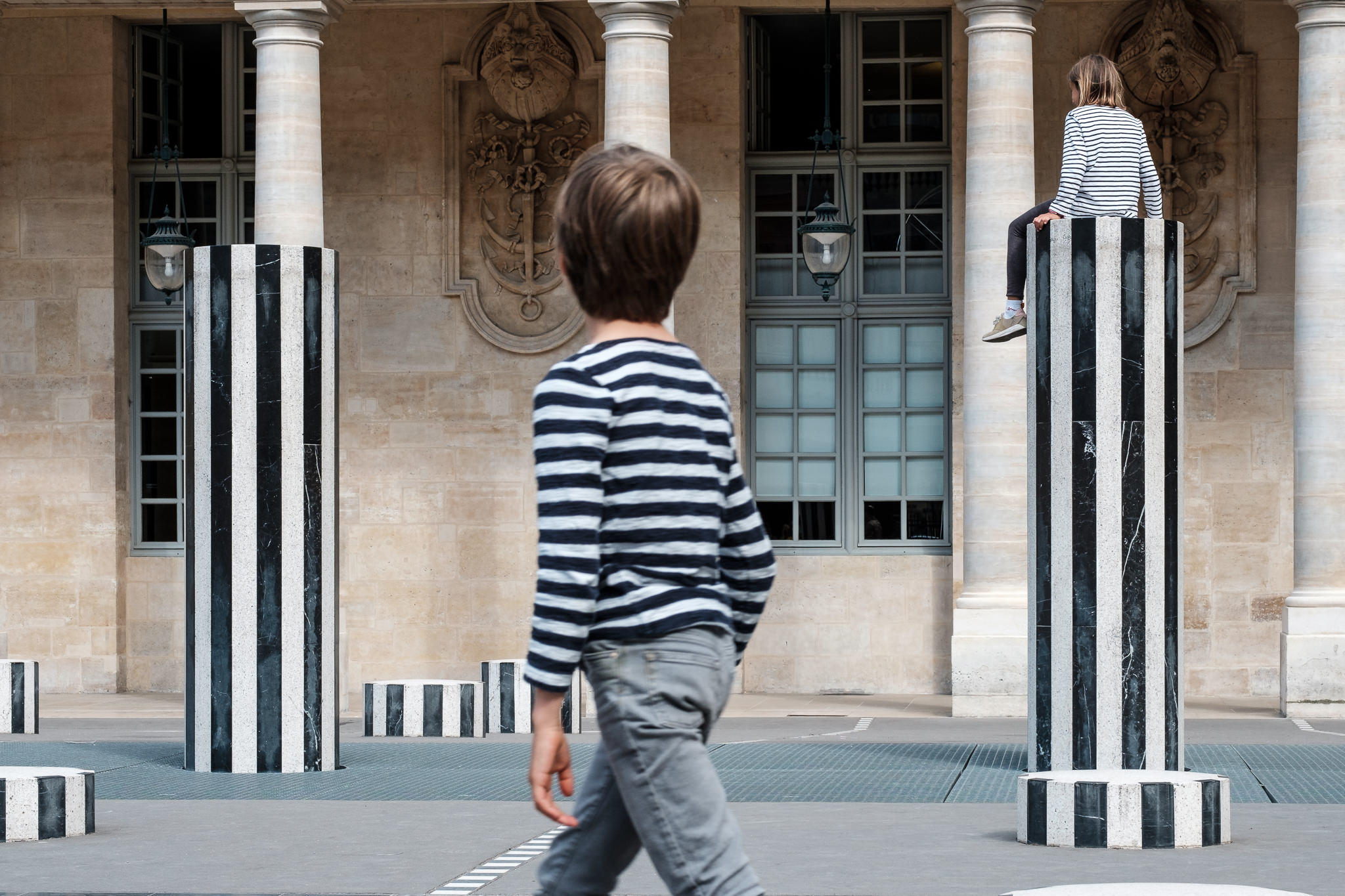
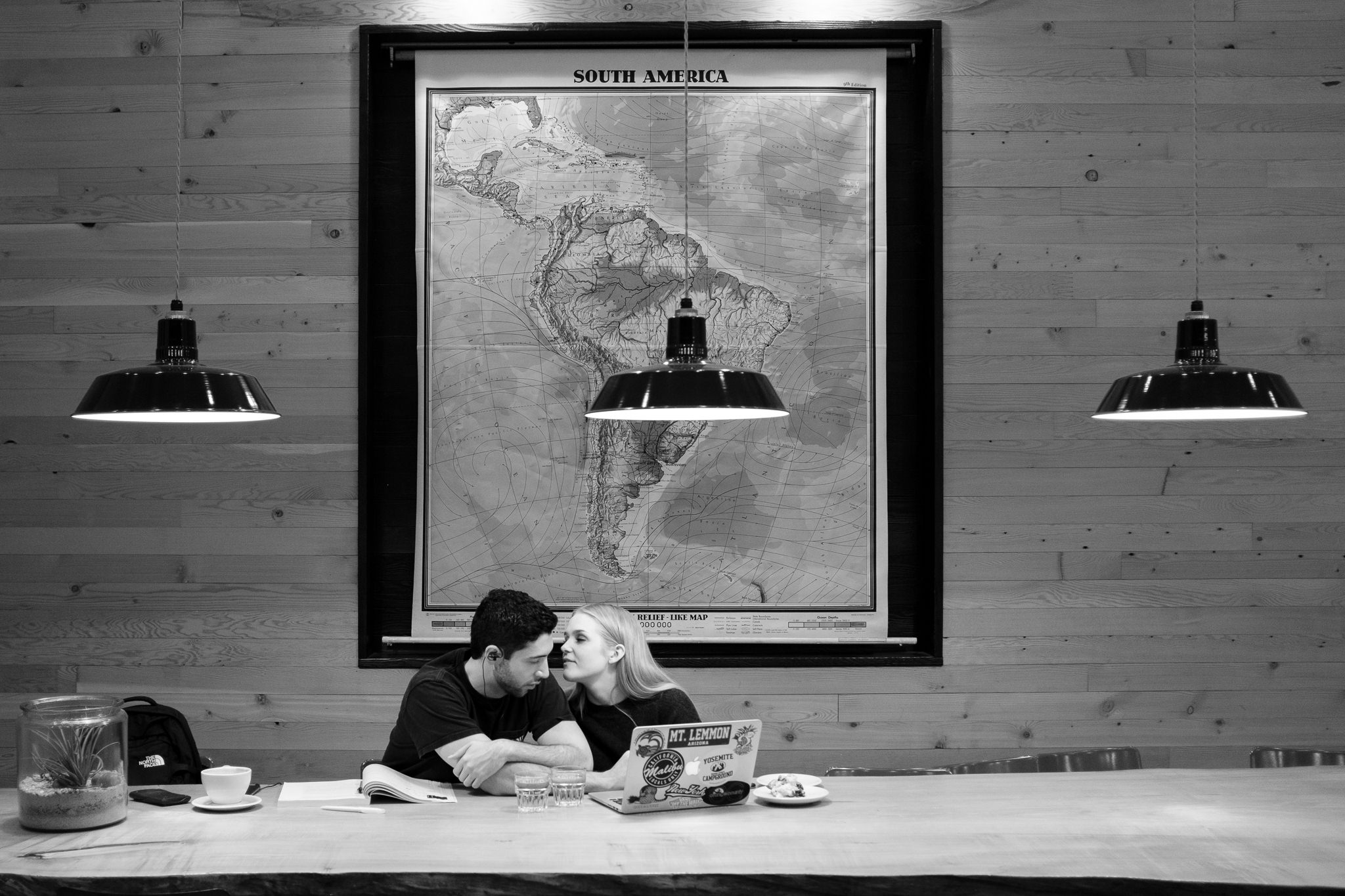
 X-T2 + XF50mm f/2 R WR @ 50mm, ISO 200, 1/220, f/9.0
Street photography is one of the most challenging but at the same time one of the most rewarding genres of photography. Documenting people in their everyday environment is not easy – it requires patience, hard work and sometimes even some bravery to be able to approach and photograph complete strangers. In this article, we will take a close look at what street photography is, how it differs from other genres of photography and provide some helpful tips to get you started.
Over my photographic journey, I have shot wildlife, travel, landscapes, and even some sports. However, for me, street photography is the most challenging and satisfying genre. Why? Because street photography requires patience, persistence, and luck, like in wildlife photography.
You need to have quick responses and react intuitively as you would shooting sports. Just like travel photography, you must master storytelling. And also, you must be able to thoughtfully and creatively compose a compelling shot that draws in your viewer, just like in landscape photography. If you think you might be interested in this type of photography, read on.
Table of Contents
What is Street Photography?
Street photography is a photographic genre that documents candid everyday moments of life in public areas. Contrary to its name, street photography does not have to be done on the streets. You can do street photography anywhere.
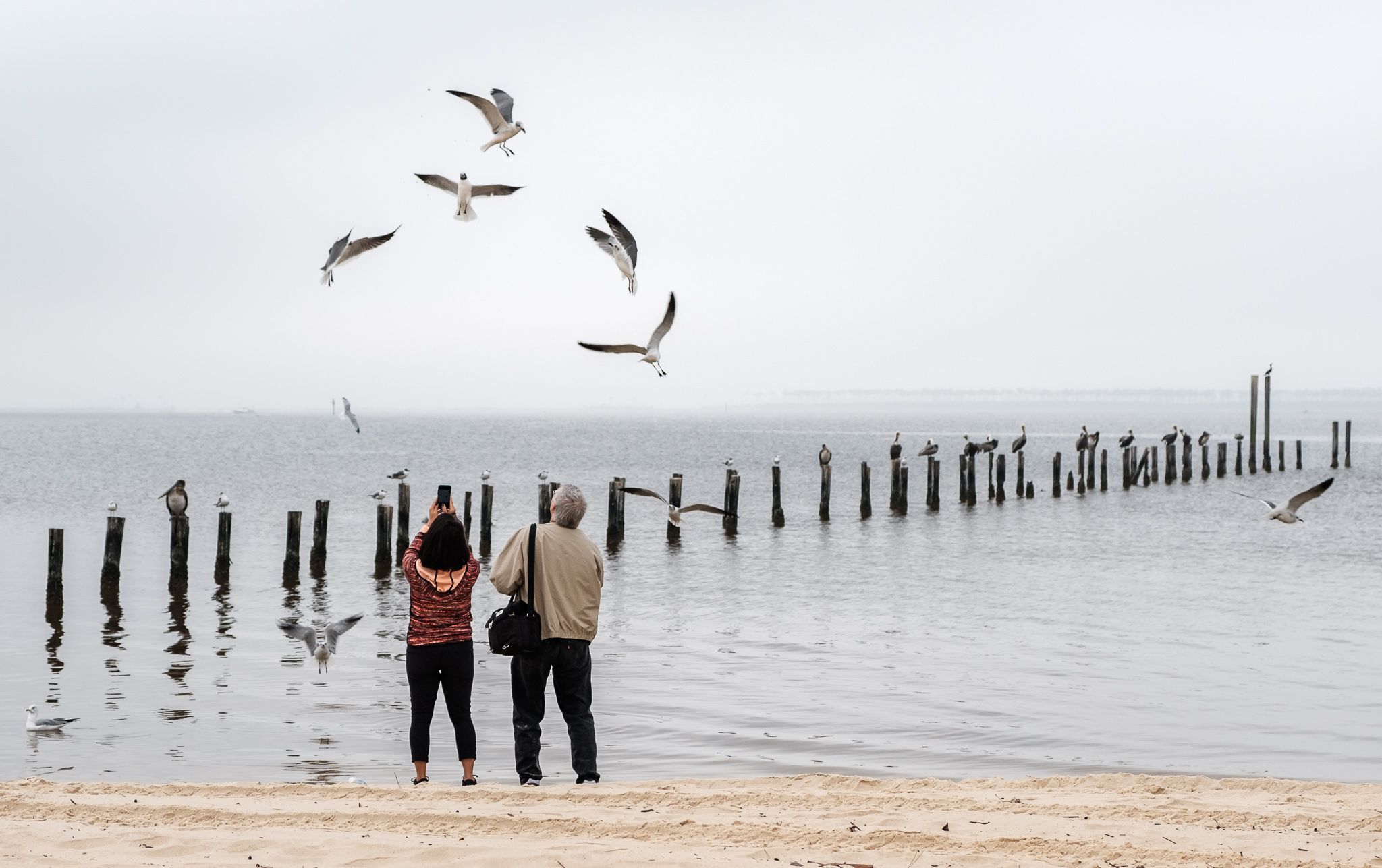 X-T2 + XF18-55mm f/2.8-4 R LM OIS @ 42.5mm, ISO 200, 1/340, f/4.5
For example, when I lived in small-town Mississippi, I spent a lot of time at the beach. On rainy days, I often gravitate to museums, coffee shops or even the mall. One of my favorite places to shoot is on public transportation. You can always find great subjects on buses and trains.
And, don’t discard rural areas. Even if you don’t live in a big city, that shouldn’t hold you back from starting your street photography adventures.
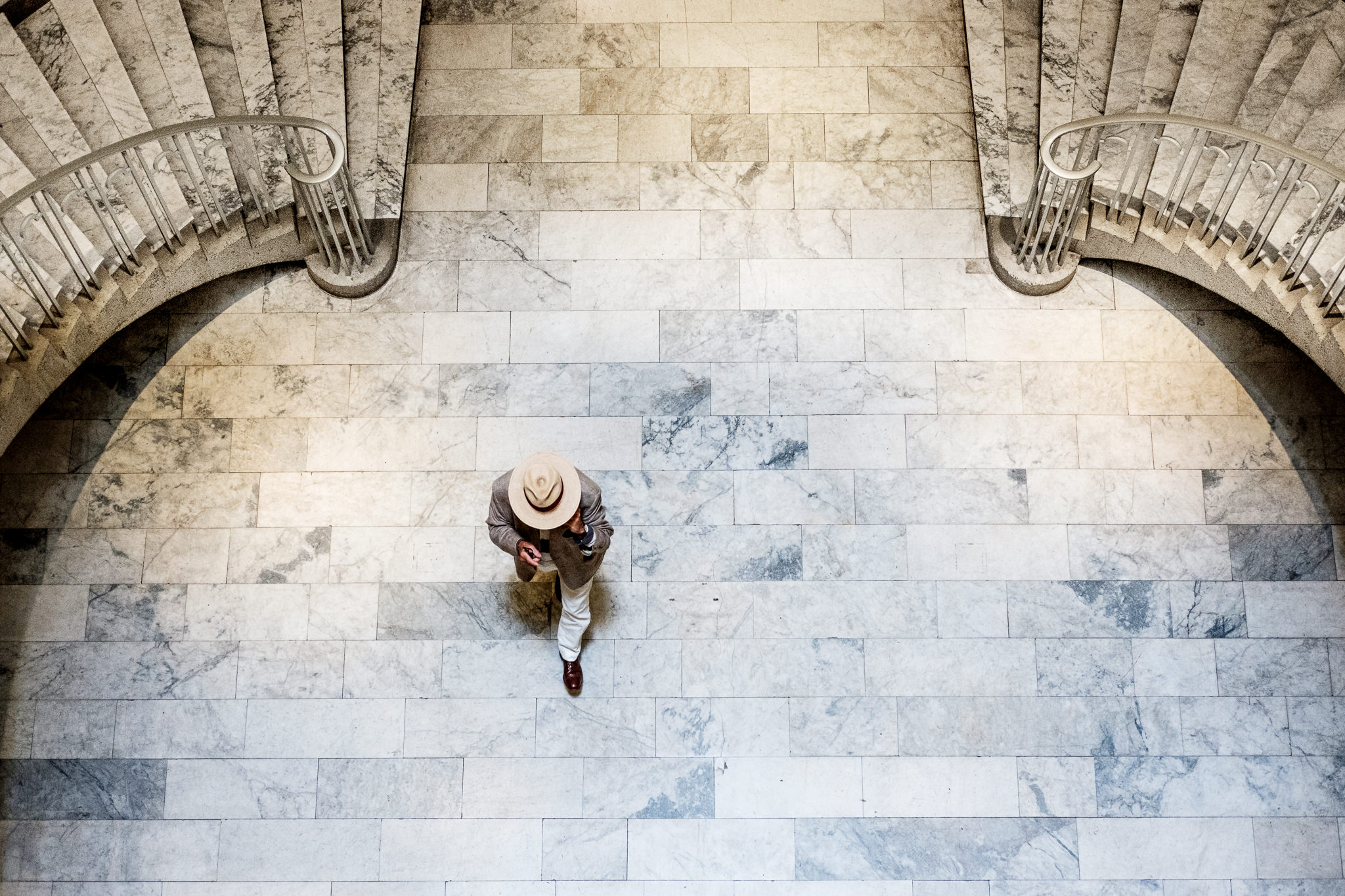 X-T2 + XF35mm f/2 R WR @ 35mm, ISO 2500, 1/125, f/5.0
What Makes a Good Street Photograph?
Right now, social media is flooded with mediocre and subpar street photography. Just pointing your lens in the direction of a person on the street does not qualify as street photography. As in all photography, how you compose your image will make or break your photograph.
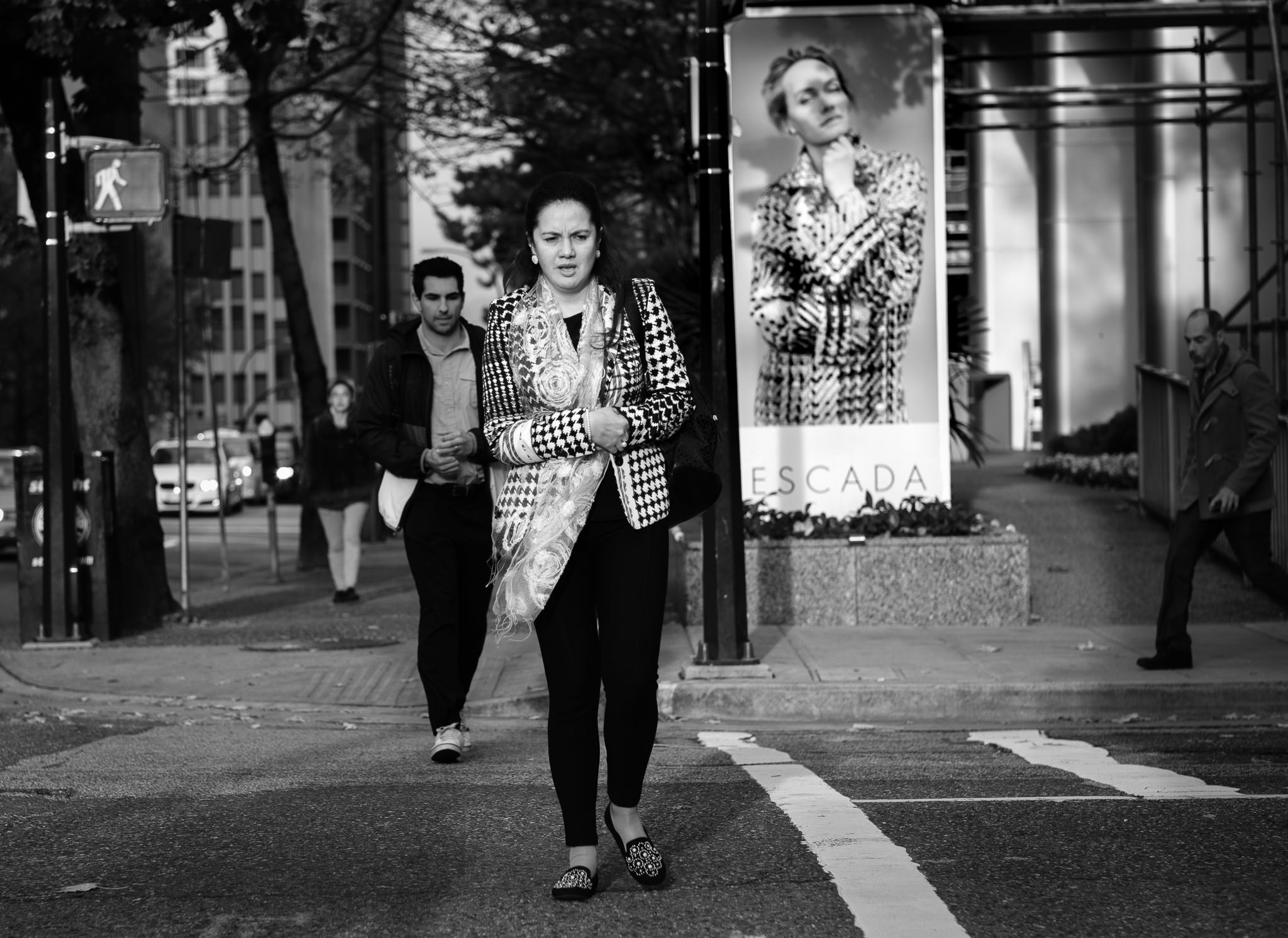 X-T3 + XF56mm f/1.2 R @ 56mm, ISO 160, 1/500, f/2.8
A good street photo needs a clearly defined subject. All the rules (and I use that word loosely) of composition, such as rule of thirds, leading lines, use of negative space, symmetry, frames, etc. still hold. Try and tell a story with your images. Create photographs where the viewer pauses and asks questions.
These are the signs of good street photography!
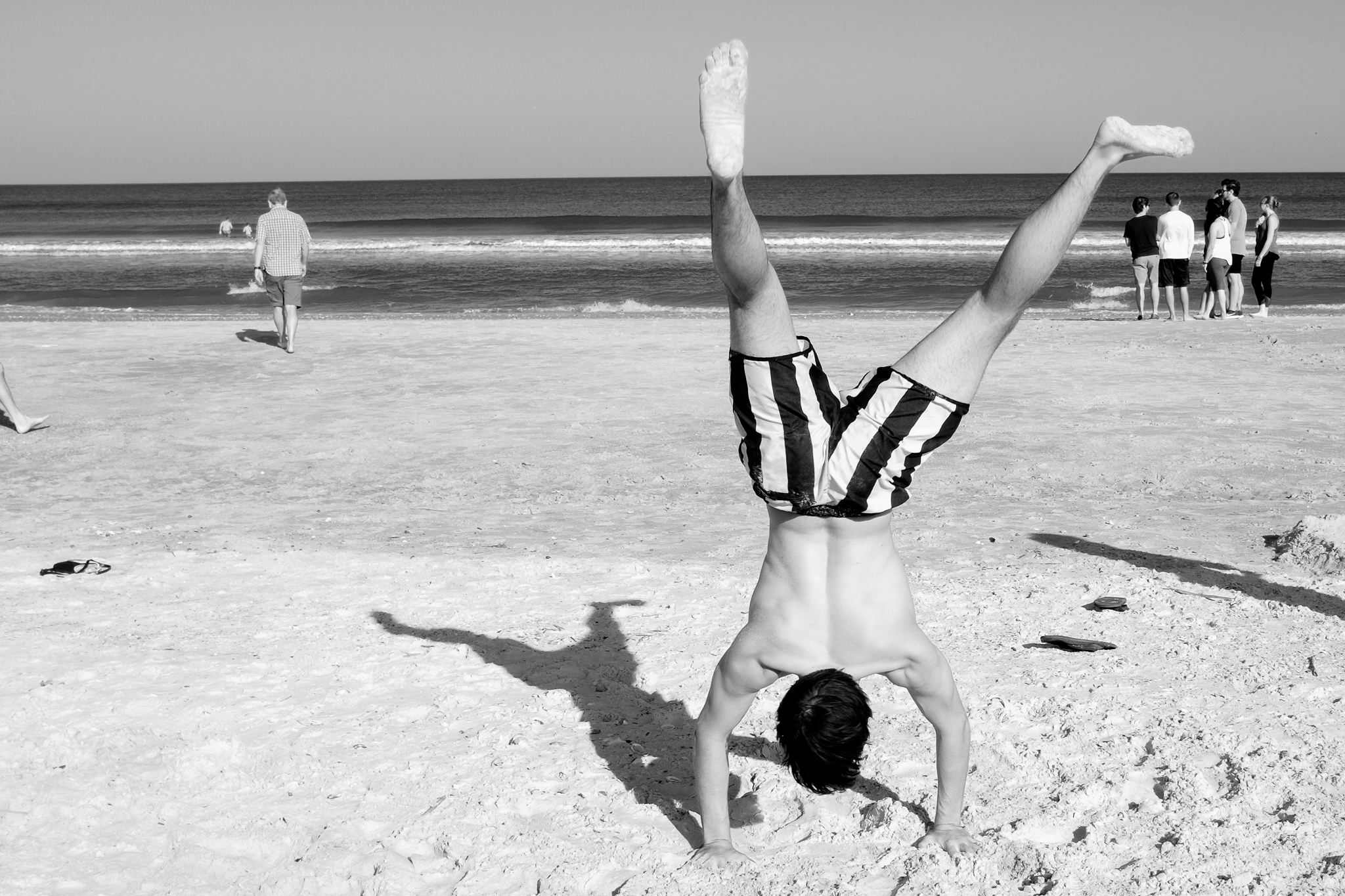 X100T @ 23mm, ISO 200, 1/280, f/11.0
Do Street Photos Need People?
Whether or not street shots need people in them is up for debate. Sticklers say that all street photographs must contain people. However, I take a more laid back approach. While I believe that street photographs do not need people, they do need the suggestion that someone was there.
For example, shadows can be used to capture thought-provoking shots, even if you can’t see the humans casting them. I also like to photograph things left behind by people. These images leave the viewer wondering what the story is behind the discarded objects.
 X100F @ 23mm, ISO 200, 1/210, f/5.6
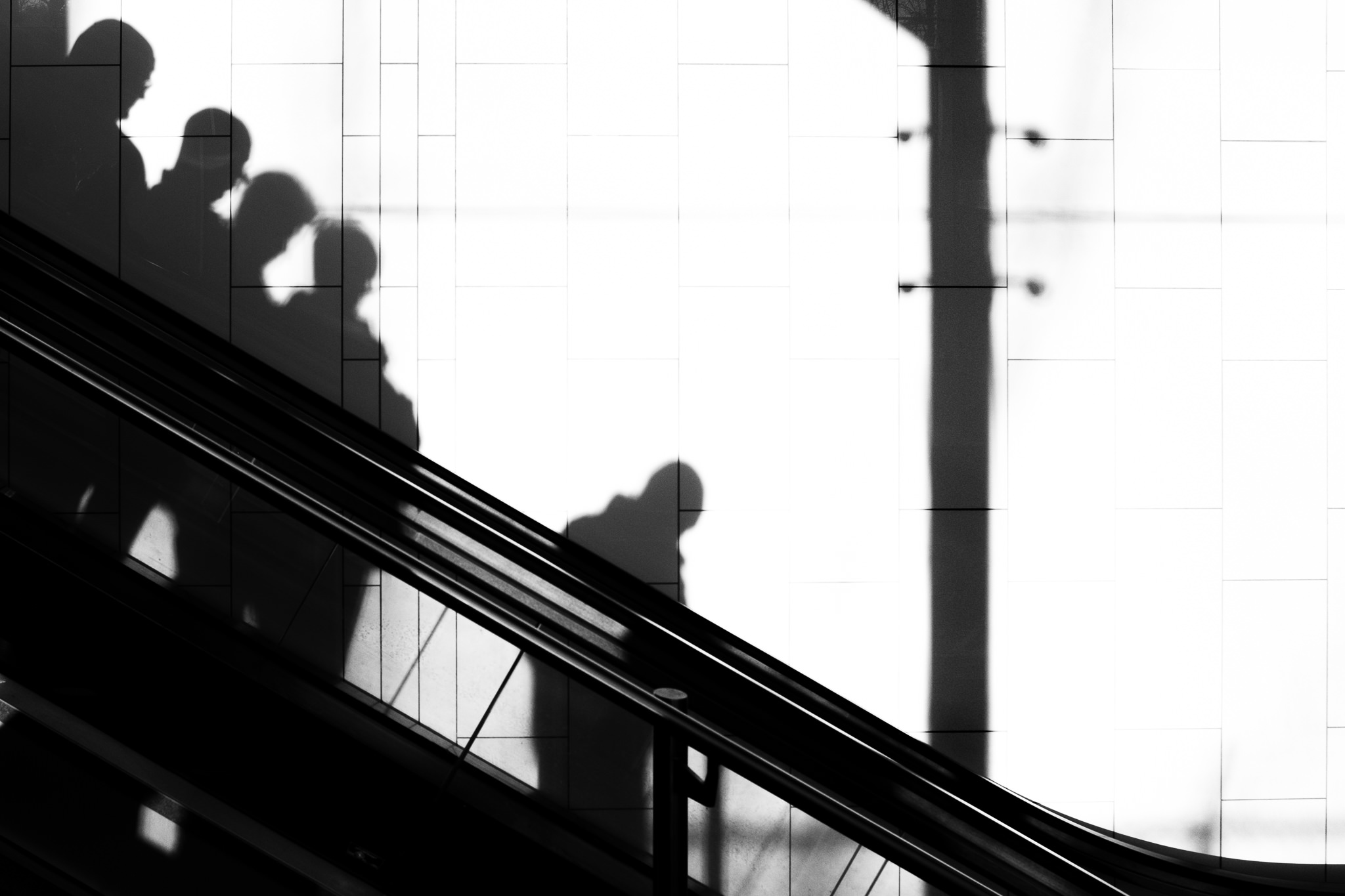 X100F @ 23mm, ISO 200, 1/420, f/8.0
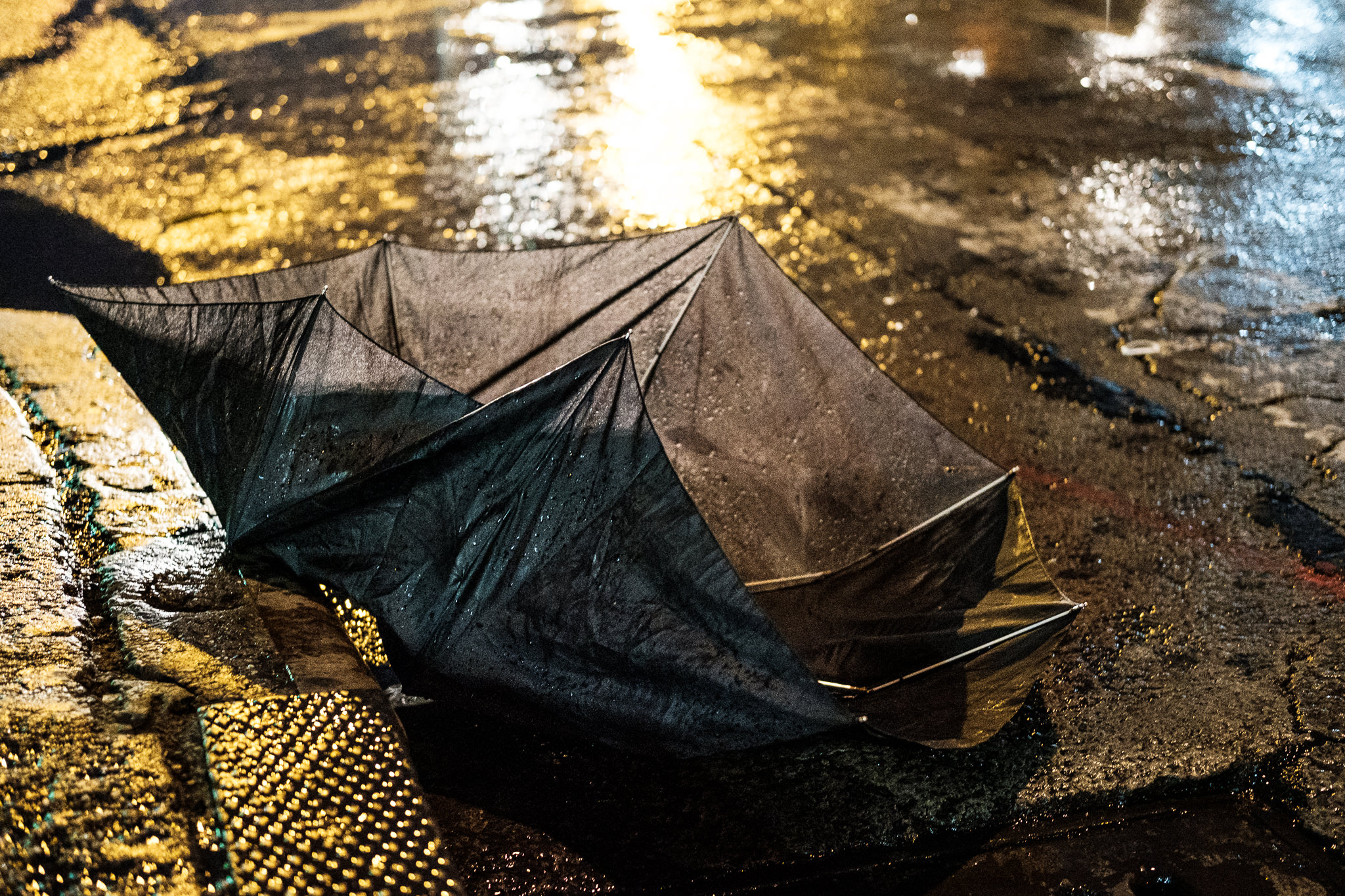 X-T2 + XF35mm f/2 R WR @ 35mm, ISO 5000, 1/125, f/2.0
Should Street Photography Be Candid?
Again, the sticklers out there will say “yes,” you must shoot street photography candidly. Still, I disagree. While some folks say that street portraits are another genre of photography, I lump them under the street photography umbrella.
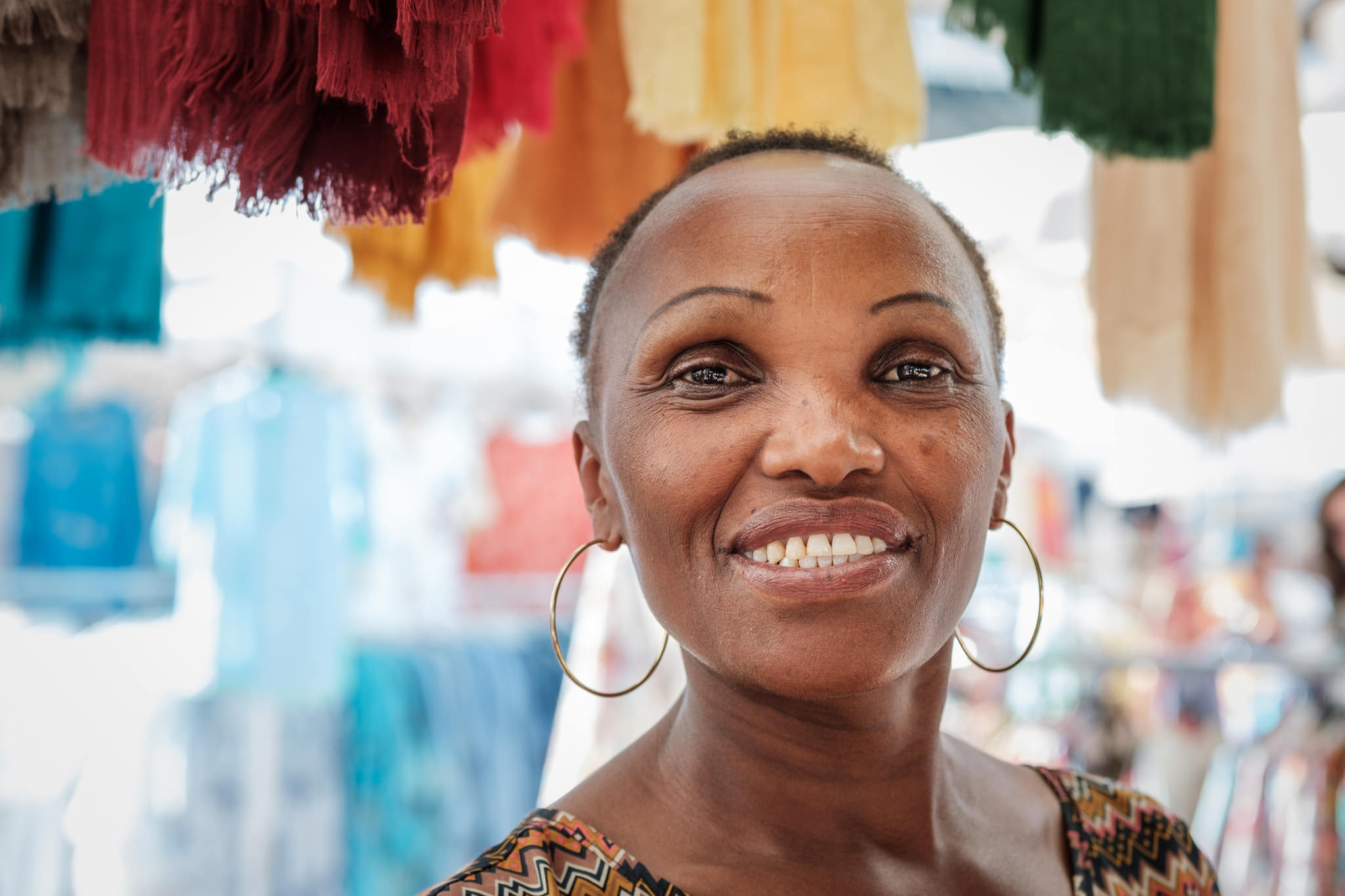 X-T2 + XF50mm f/2 R WR @ 50mm, ISO 200, 1/125, f/3.6
A street portrait requires you to interact with your subject. Interacting with a stranger may strike fear into those just starting. However, I have met some fascinating people this way. I will talk more about getting over that fear in a bit.
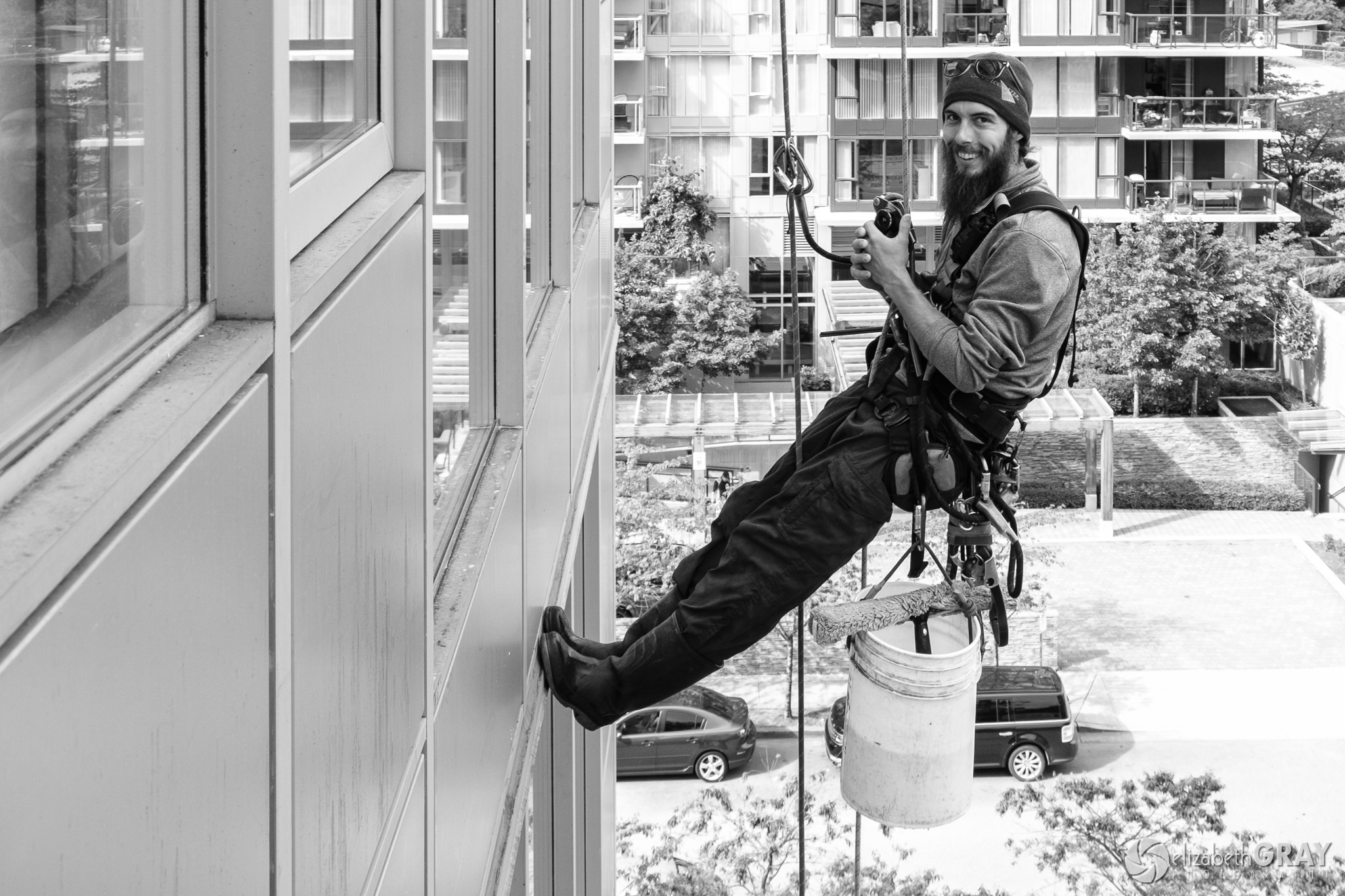 X-T2 + XF18-55mm f/2.8-4 R LM OIS @ 18mm, ISO 200, 1/180, ƒ/6.4
Another type of non-candid street photography occurs when you make eye contact with your subject. Purists will say that eye contact takes away from the spontaneity of the moment, and thus alters the scene. I make it a rule never to initiate eye contact by hovering over a subject.
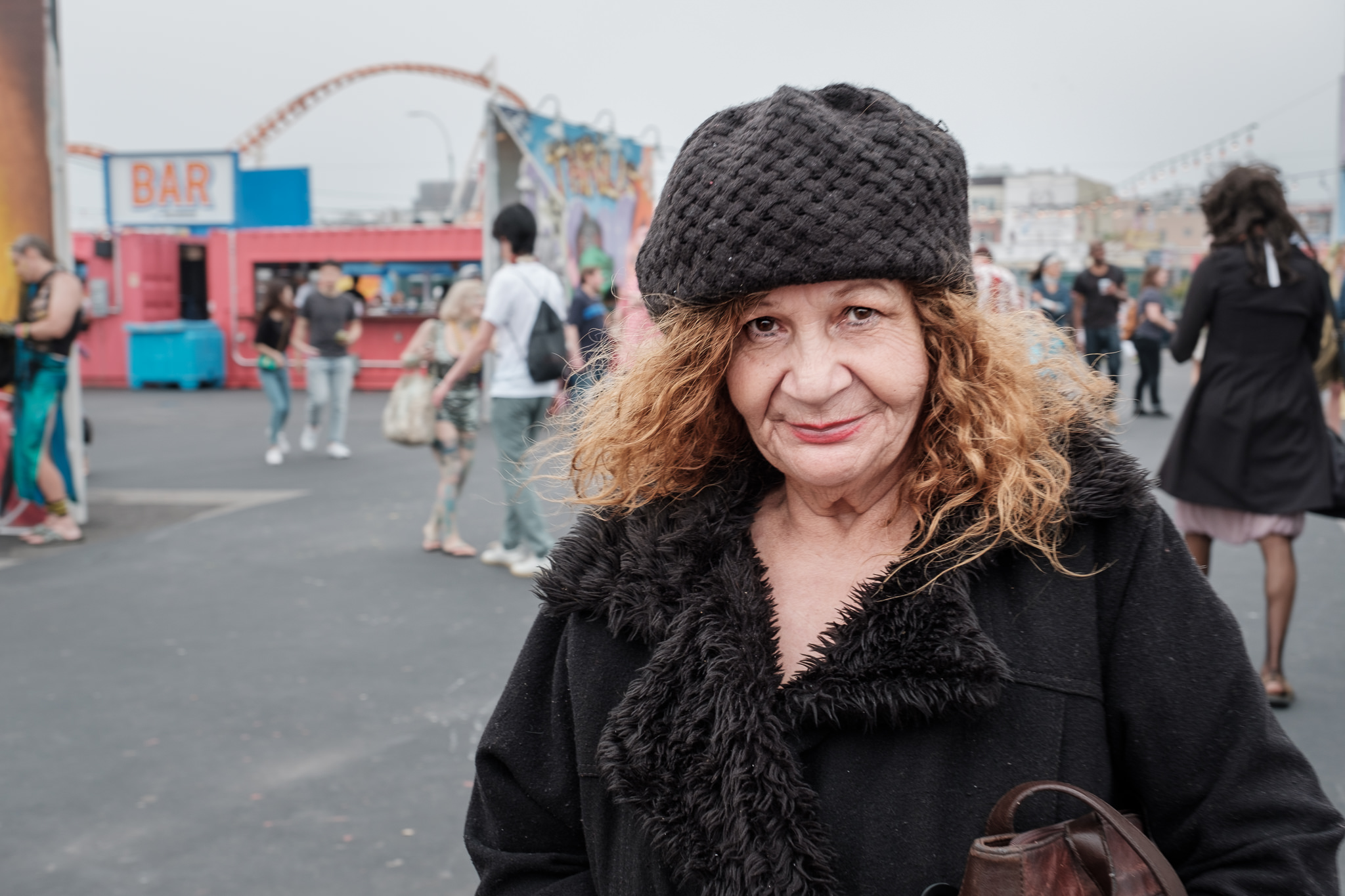 X-T2 + XF16-55mm f/2.8 R LM WR @ 28.3mm, ISO 200, 1/160, f/5.0
However, if my subject notices me and looks up just as I snap the shutter, I don’t disregard the shot. These chance encounters often add a bit of humor to the image. And eye contact often makes an image more intimate.
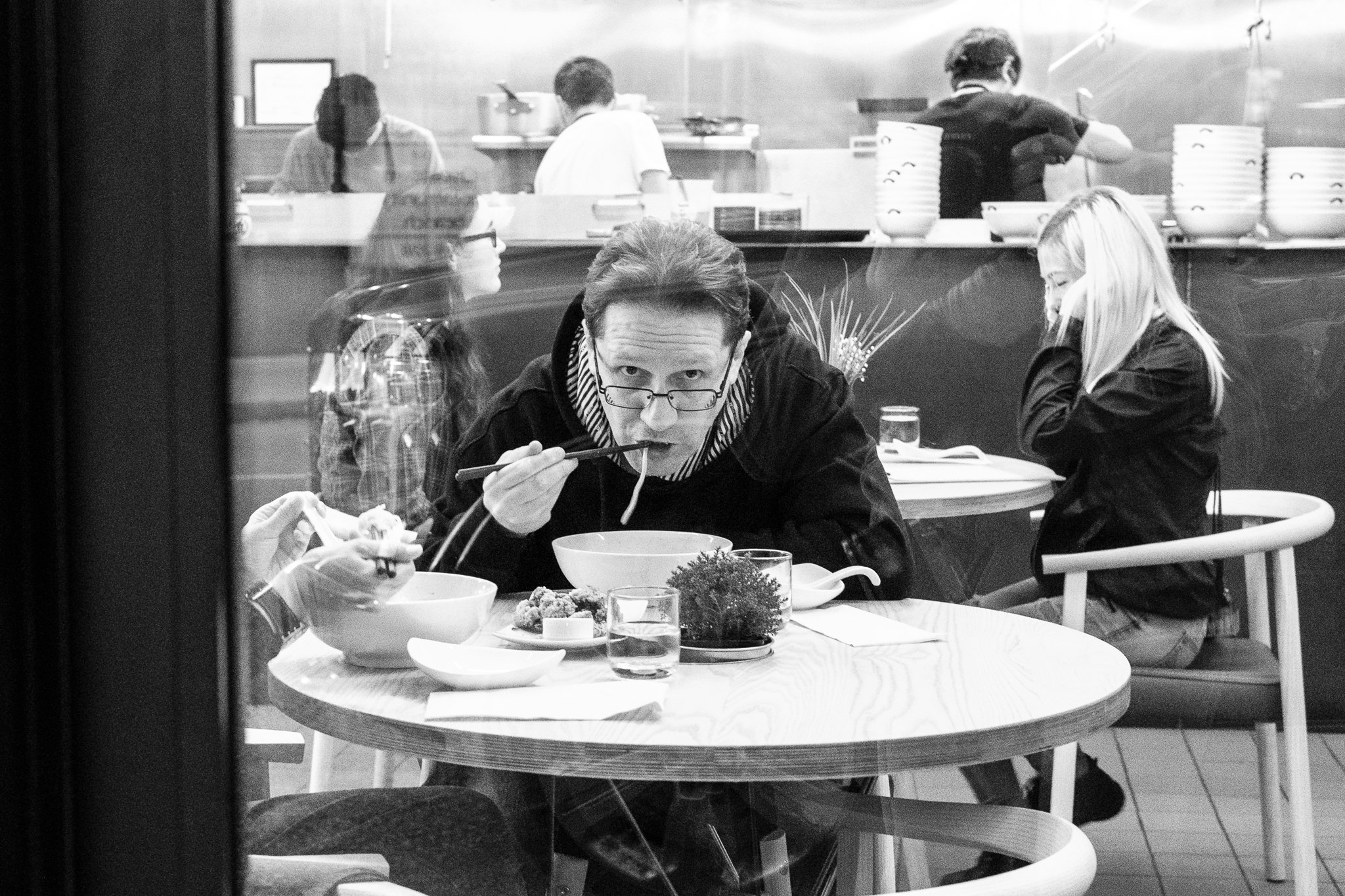 X-T2 + XF35mm f/2 R WR @ 35mm, ISO 6400, 1/55, f/4.5
Camera Equipment for Street Photography
In terms of street photography, less is more. You want to become invisible when you are on the streets. Using a small camera makes this much easier to do.
Smaller camera systems are less obtrusive than big and heavy DSLRs. They are easier and less painful to carry around, especially when taking long walks. They also do not have the same psychological effect on people as big cameras – most people are used to seeing small cameras that look like a tourist point-and-shoot, so they do not feel as intimidated. Lastly, some mirrorless cameras have a silent shutter mode, where you won’t even hear the shutter firing. Those could be great for documentary-style photos and candids.
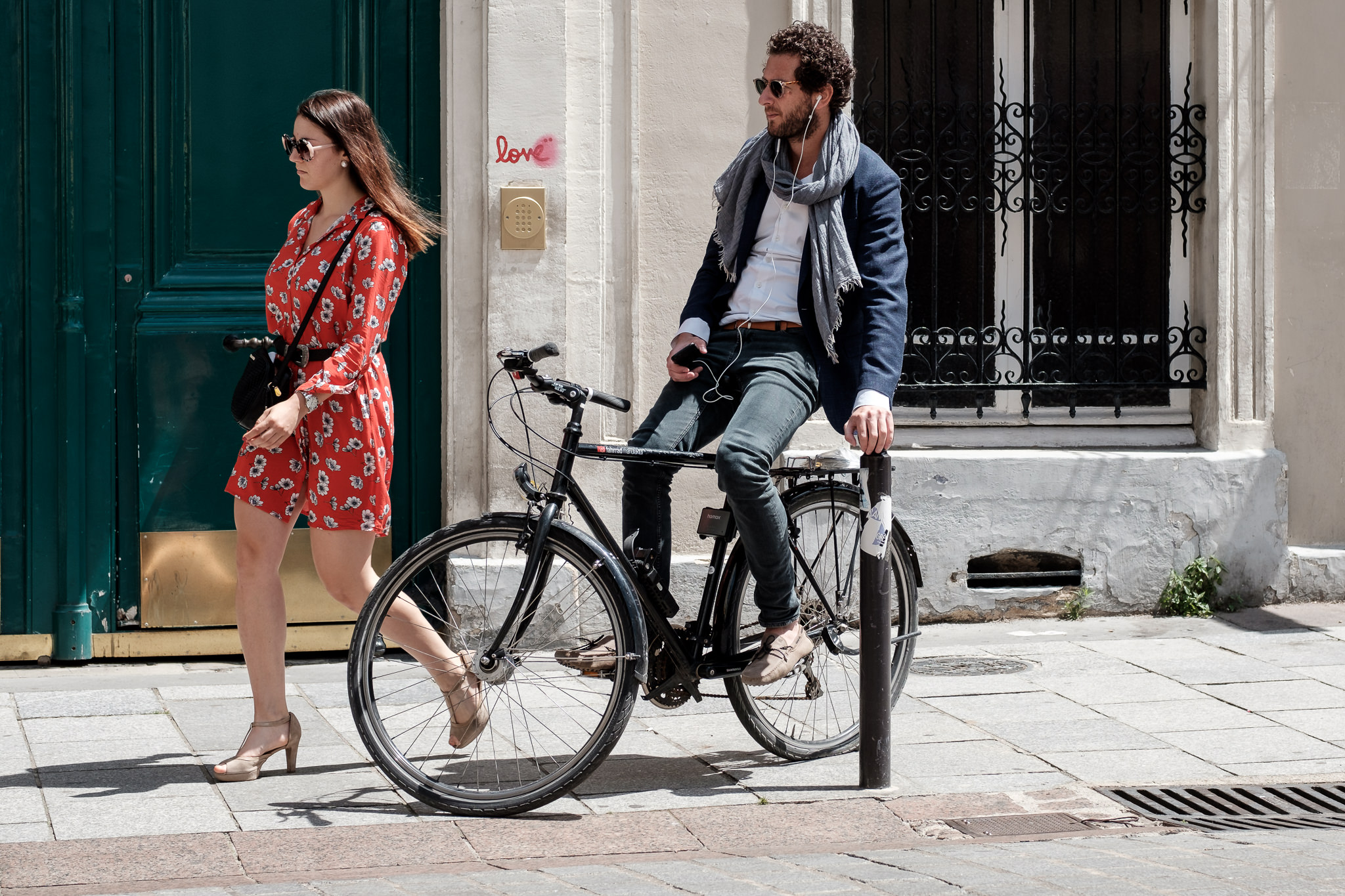 X-T2 + XF50mm f/2 R WR @ 50mm, ISO 200, 1/640, f/4.5
I like to use prime lenses. My favorite two focal lengths are 23mm and 50mm on my cropped sensor cameras. Prime lenses tend to be smaller than zooms. But more importantly, when you consistently use the same focal length, you become aware of what your frame will look like even before raising your camera to your eye. You learn where to stand to frame your subject. Action on the street can happen quickly. By taking the zoom variable out of the equation, you will be more prepared to capture fleeting moments.
When I’m out for a day of street photography I bring one small sling bag with me (the Peak Design 5L Sling). In it, I bring extra batteries, business cards, my phone and ID. If I’m using my Fujifilm X-T3 and 50mm f/2 combination, I carry it on a light-weight sling strap. When I shoot with my Fuji X100F, I use a wrist strap. I don’t ever bring extra lenses with me. That complicates the decision-making process. I zoom with my feet, usually get close to my subjects and don’t think about “what if” I had a different lens with me.
Comfortable shoes are almost as important as your camera gear! In a day of street photography, I can easily cover 10 to 15 kilometers. The last things I want are blisters and sore feet. I also dress to fit in. I don’t want to draw unnecessary attention to myself.
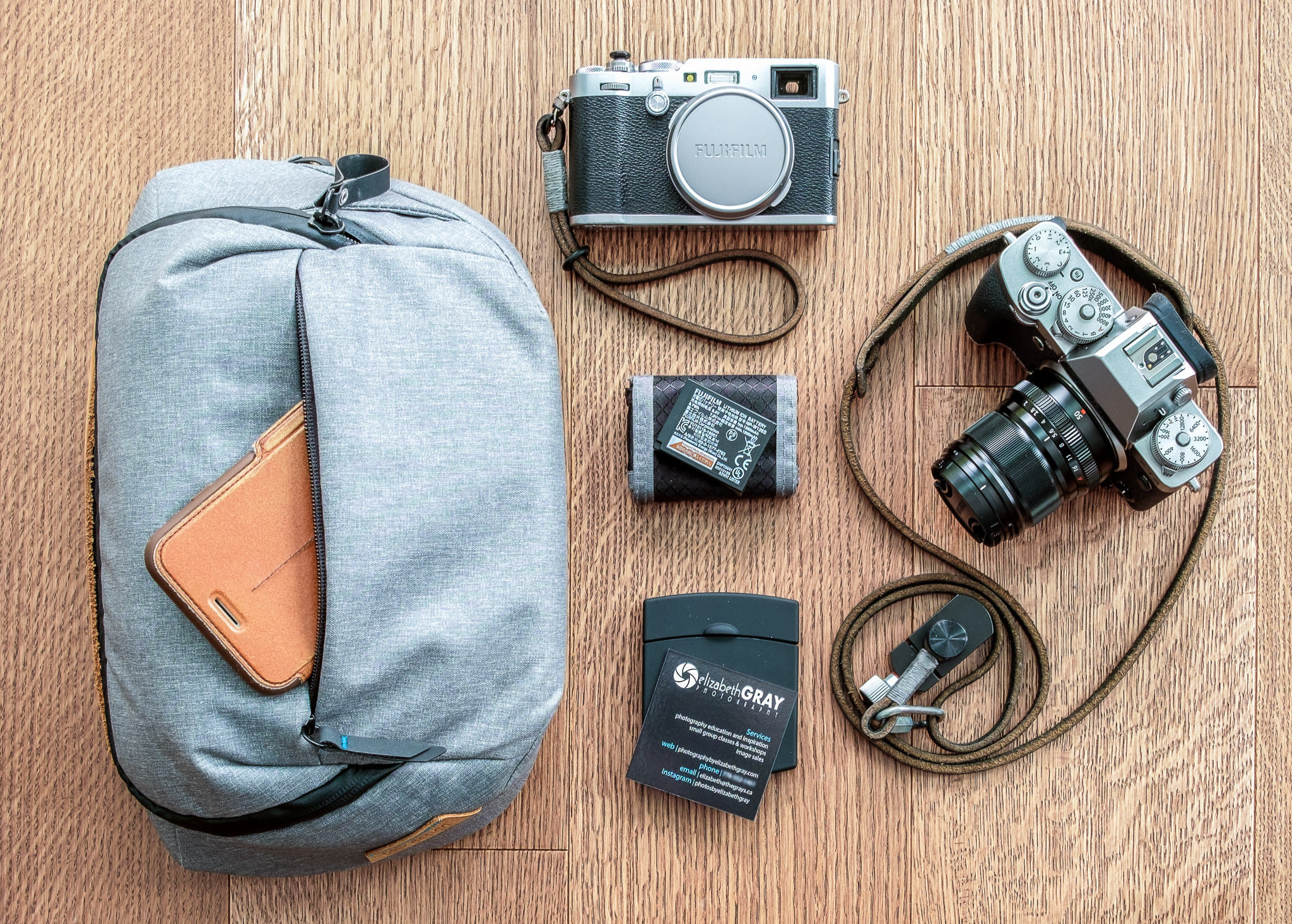 Street Gear
Code of Conduct
Taking photographs in public spaces is legal in “most” countries. In both Canada and the United States, this is true. If you are in a public area, you are well within your rights to take pictures. However, it is important to realize that even if you are shooting in a public space, you must exercise a reasonable expectation of privacy.
For example, photographing into someone’s bedroom window from the street is unethical, and probably illegal! If you are unsure, make it a point to do a bit of research to become familiar with local privacy laws where you will be shooting.
Respect and Smile
Respect goes a long way in street photography. If someone does not want their picture taken, apologize and find another subject. The streets are full of interesting people, and another is sure to come along shortly.
A smile works wonders. If someone notices you after you have captured an image of them, smile and nod a thank you. Most likely your subject will smile back, and you will both go on your way. I have never been asked to delete an image. But, if I were, I would certainly do so. No shot is worth a confrontation in my opinion.
In the image below, my subject noticed me just as I was pressing the shutter and shot up his hand in front of his face. I immediately lowered my camera and apologized. I then showed him the image I had captured, at which point he laughed and told me I could keep it!
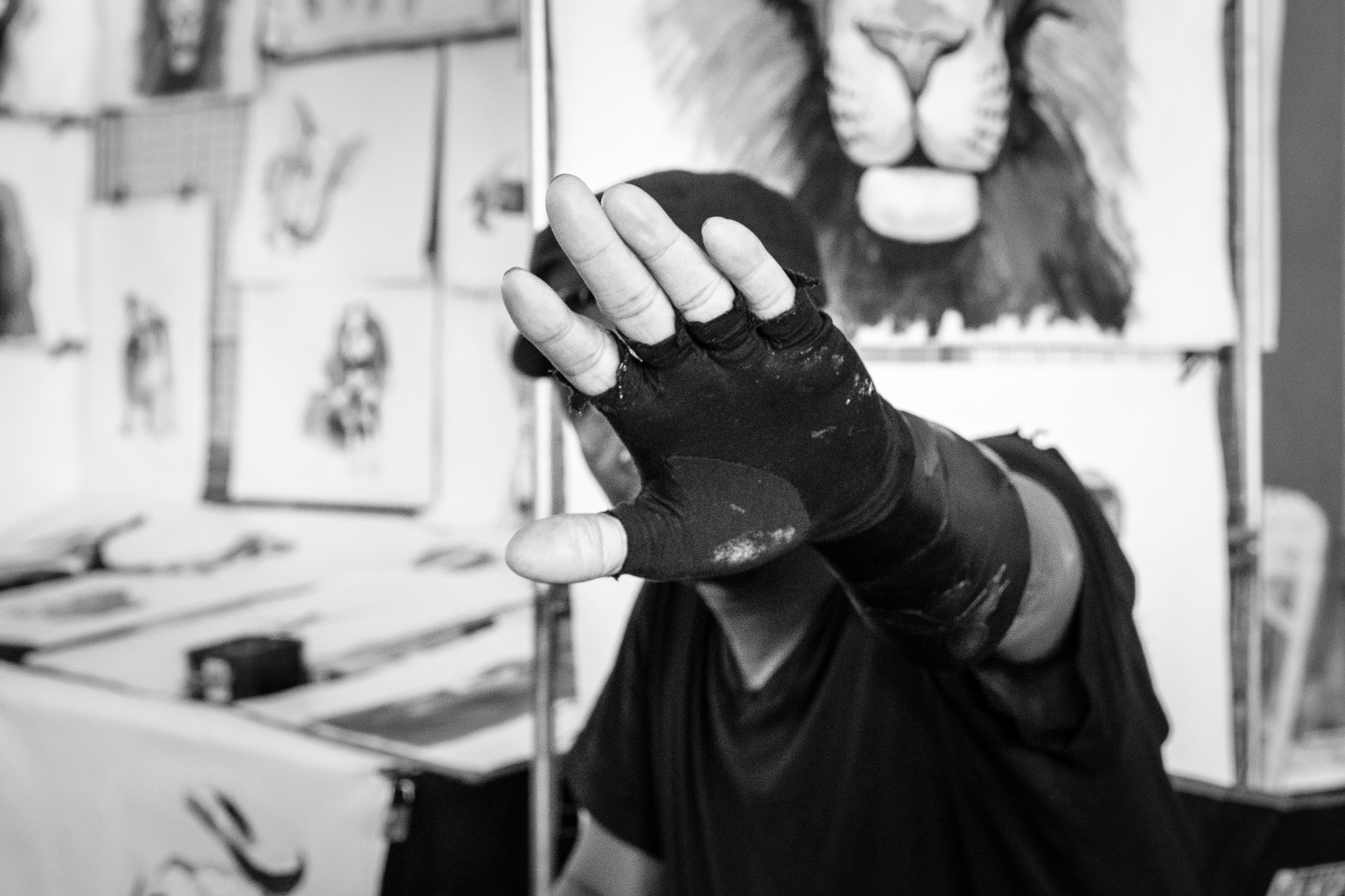 X-T2 + XF16-55mm f/2.8 R LM WR @ 55mm, ISO 6400, 1/110, f/8.0
Photographing Children
The ethics of photographing children is a tricky one. Parents get very protective of their kids. In order to avoid getting into an altercation with an angry parent, do not forget to get permission from them before photographing their children. This should be an absolute no-brainer.
If you see a great opportunity for an interesting photo that involves kids, ask for permission from their parents/guardians, and give them your contact information. Many parents will be grateful for the beautiful pictures of their children since they do not get to photograph them every day with professional equipment.
If you cannot see the parents or guardians around, my recommendation would be to conceal children’s faces in your composition. That’s what I sometimes do, although my preference is to always get approval first to avoid any potential conflict.
This past summer I was in Normandy, France. Now I do not speak any French. So when I noticed this young boy making a sandcastle, I motioned to the boy’s grandmother, pointed to my camera and then to her grandson. She was so excited and nodded yes right away. Then she ran up to the boy. The next thing I knew she was posing with the child and I was photographing both of them! We all had a good laugh. I was lucky enough to capture this candid shot after the family portrait!
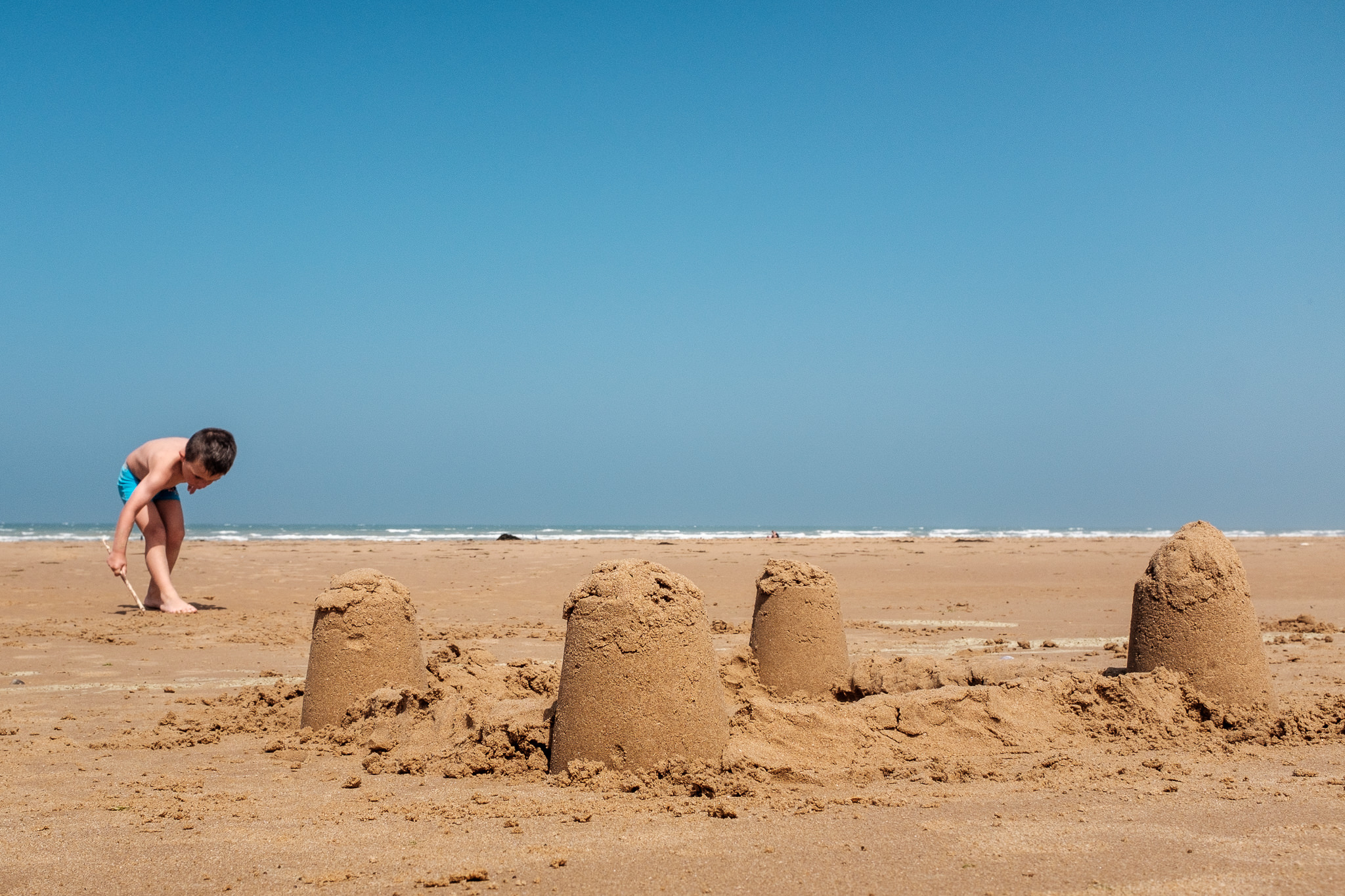 X100F @ 23mm, ISO 200, 1/800, f/11.0
Photographing the Less Fortunate
I make it a point not to shoot the homeless or those in compromised situations. For me, it is a case of putting myself in my subject’s place. If I were in their shoes, would I want to be photographed? If the answer is no, then the image is off-limits.
Street Photography Tips and Ideas to Get You Started
Photographing people close-up is a little different than photographing street architecture or doing documentary-style street photography. While the main reasoning behind street photography itself is to get away from posed, artificial and repetitive, photographing random strangers provides a great opportunity to work with raw beauty.
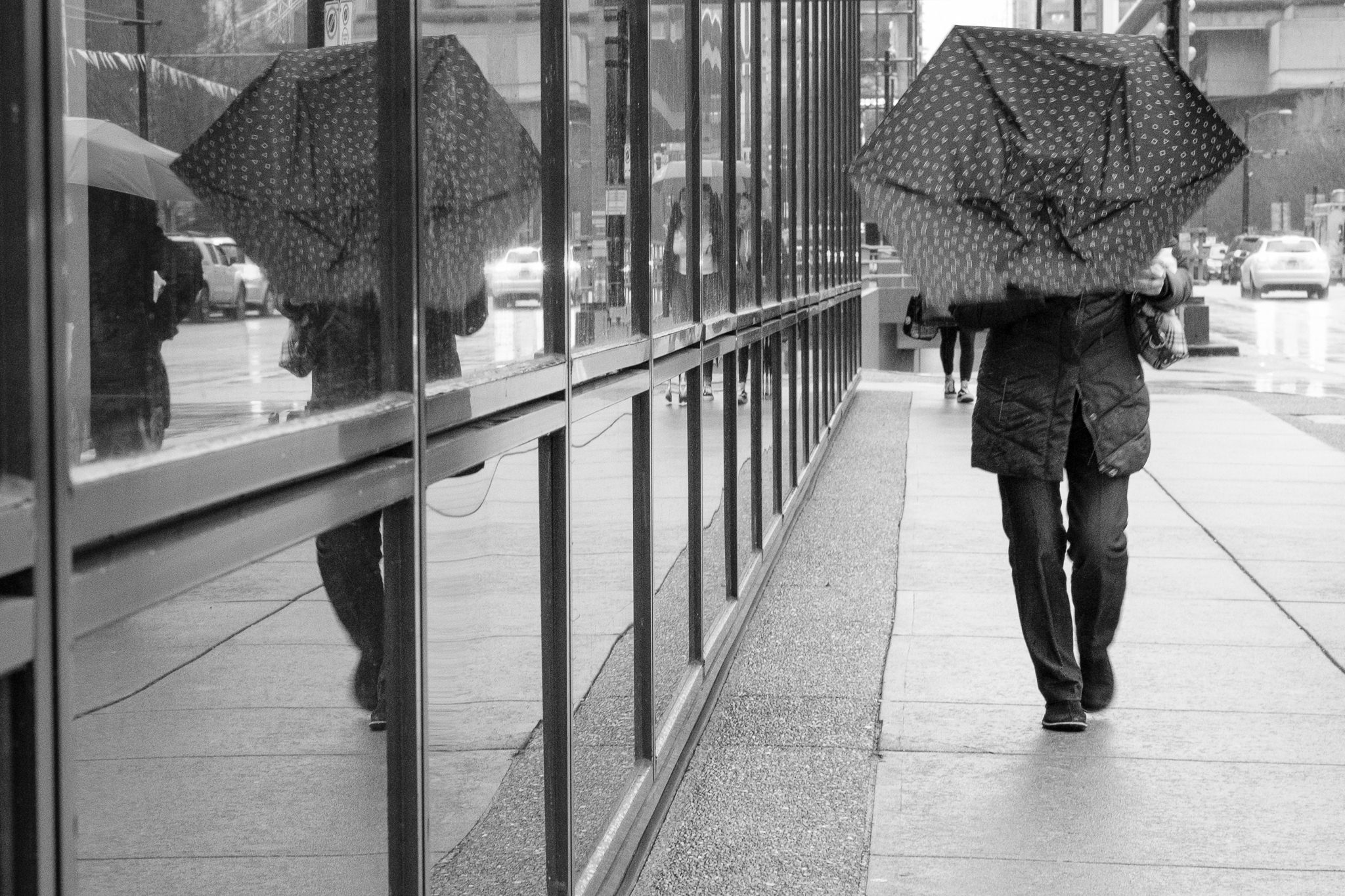 X-T2 + XF50mm f/2 R WR @ 50mm, ISO 6400, 1/60, f/8.0
But it is a challenging task for many of us – those people on the streets are not your paying clients, they do not know who you are, and most of them do not wish to be photographed at all!
Without a doubt, photographing strangers can be a little intimidating at first. Here are a few tips to ease you into street photography.
Know Your Gear and Have the Right Settings
Before approaching people, it is essential to have the right settings in your camera. Remember that a moving subject is not going to wait for you to adjust your settings.
For street portraiture, aperture priority mode is pretty much ideal for me. In addition, I use Auto ISO to make sure that my shutter speed is fast enough. This way I know that if anything happens suddenly, that my camera will be ready. Capturing a subtle gesture, like a gaze or hand movement can be the difference between a good street photo and a great one.
 X100F @ 23mm, ISO 200, 1/125, f/8.0
I leave the rest of the settings at default values since I shoot RAW and most other settings generally do not matter. If the occasion calls for it, having a speedlight may be useful, but I generally do not like the look of artificial light and flashing people with it. Still, if the subject is OK with it, having fill-flash can be helpful in some situations.
Shoot from a Distance
Until you are more comfortable getting close to your subjects, shoot from a bit farther away. I do not mean pull out your telephoto, though. Instead, look for environmental scenes with interesting characters and take a documentary approach. Shooting from across the street can make you feel more at ease.
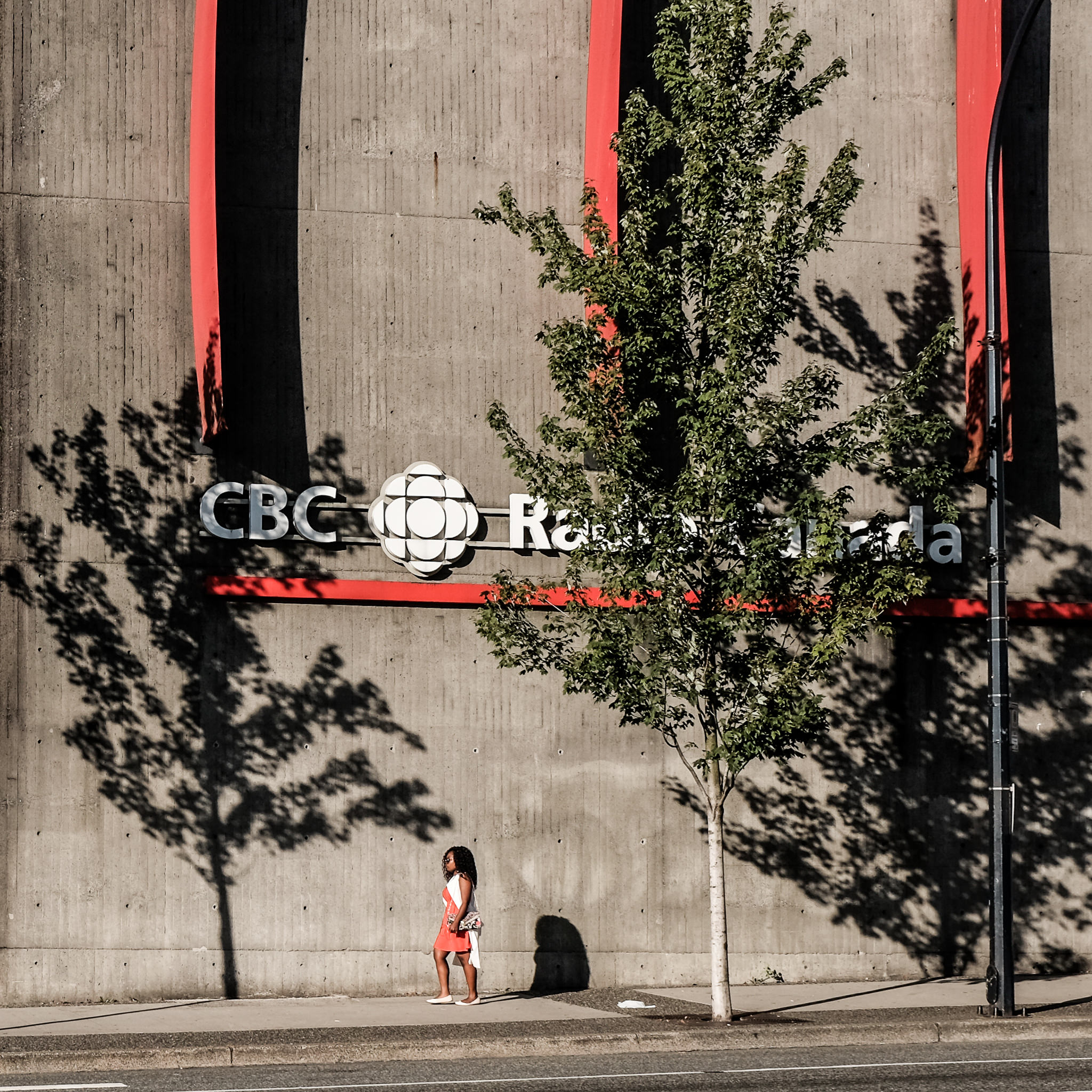 X100T @ 23mm, ISO 200, 1/480, f/8.0
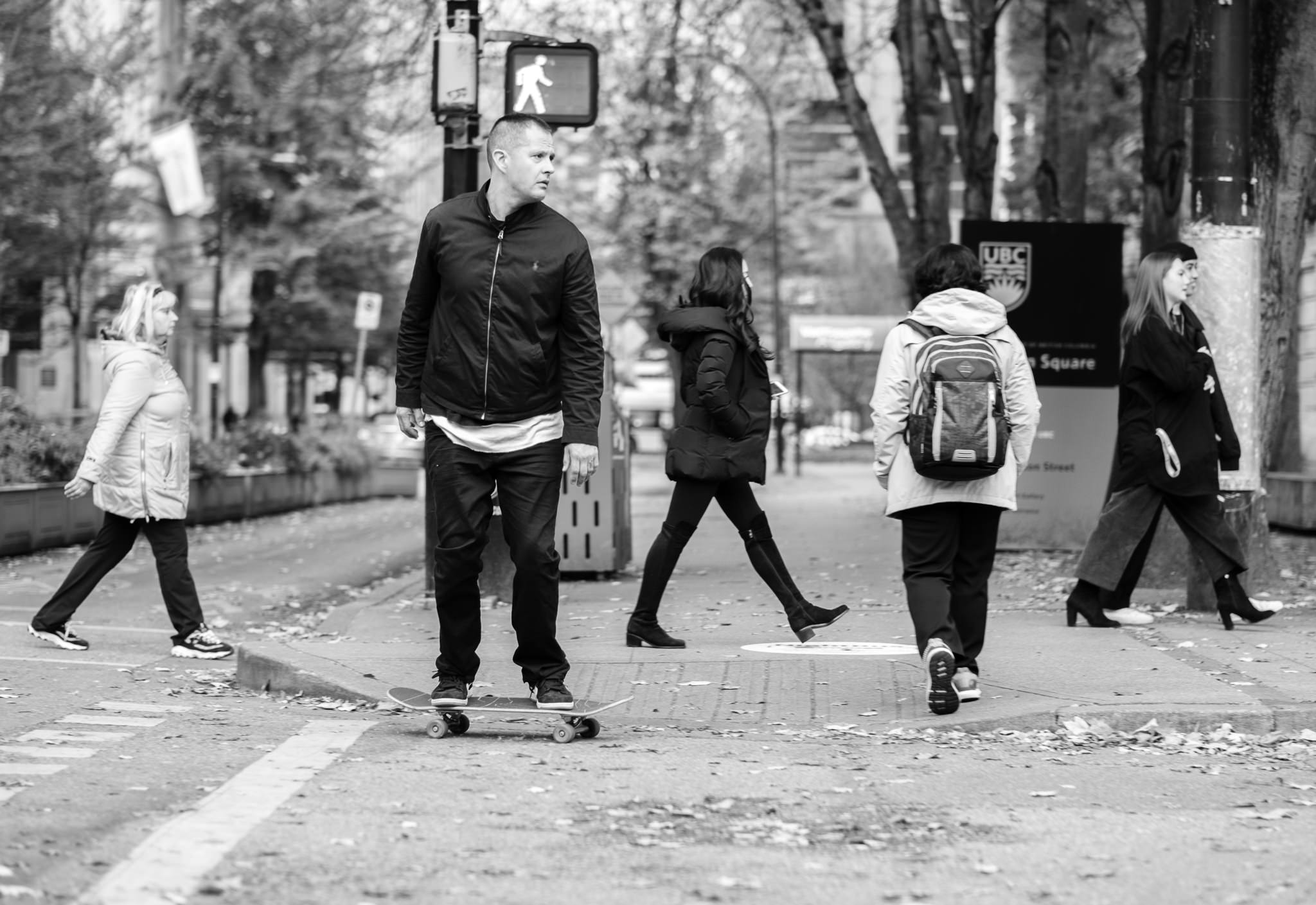 X-T3 + XF56mm f/1.2 R @ 56mm, ISO 160, 1/480, f/1.8
Take Pictures of Street Musicians (Buskers)
Buskers are used to having their picture taken. However, busking is how they earn a living!
So, before you start to shoot, drop a couple of bucks into their hat, making sure they notice you doing so. Now you can shoot away to your heart’s content. Take your time, shoot from different angles, and play with the light. If the entertainers have a card, take it and tell them you will send them some images when you are done.
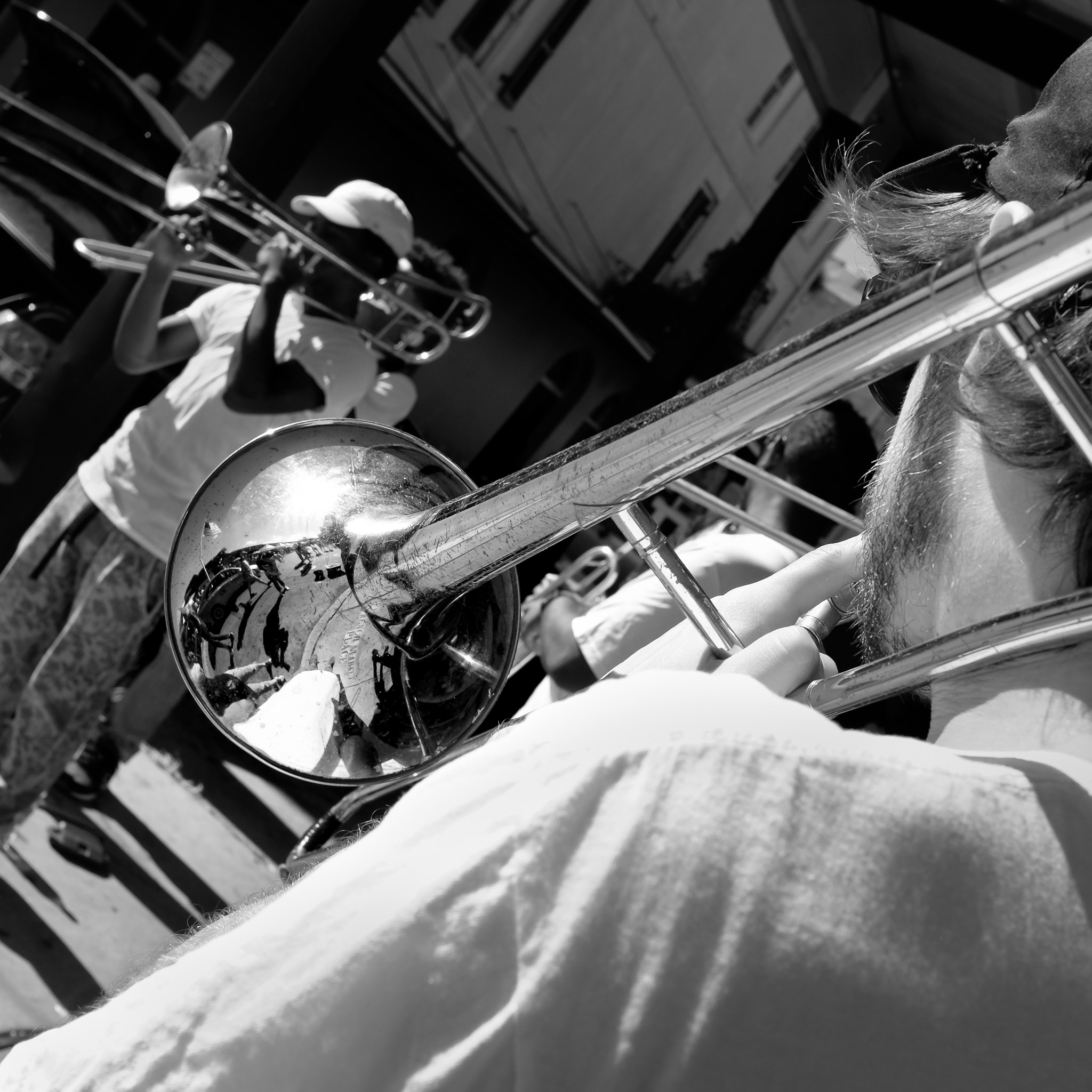 X100T @ 23mm, ISO 200, 1/320, f/8.0
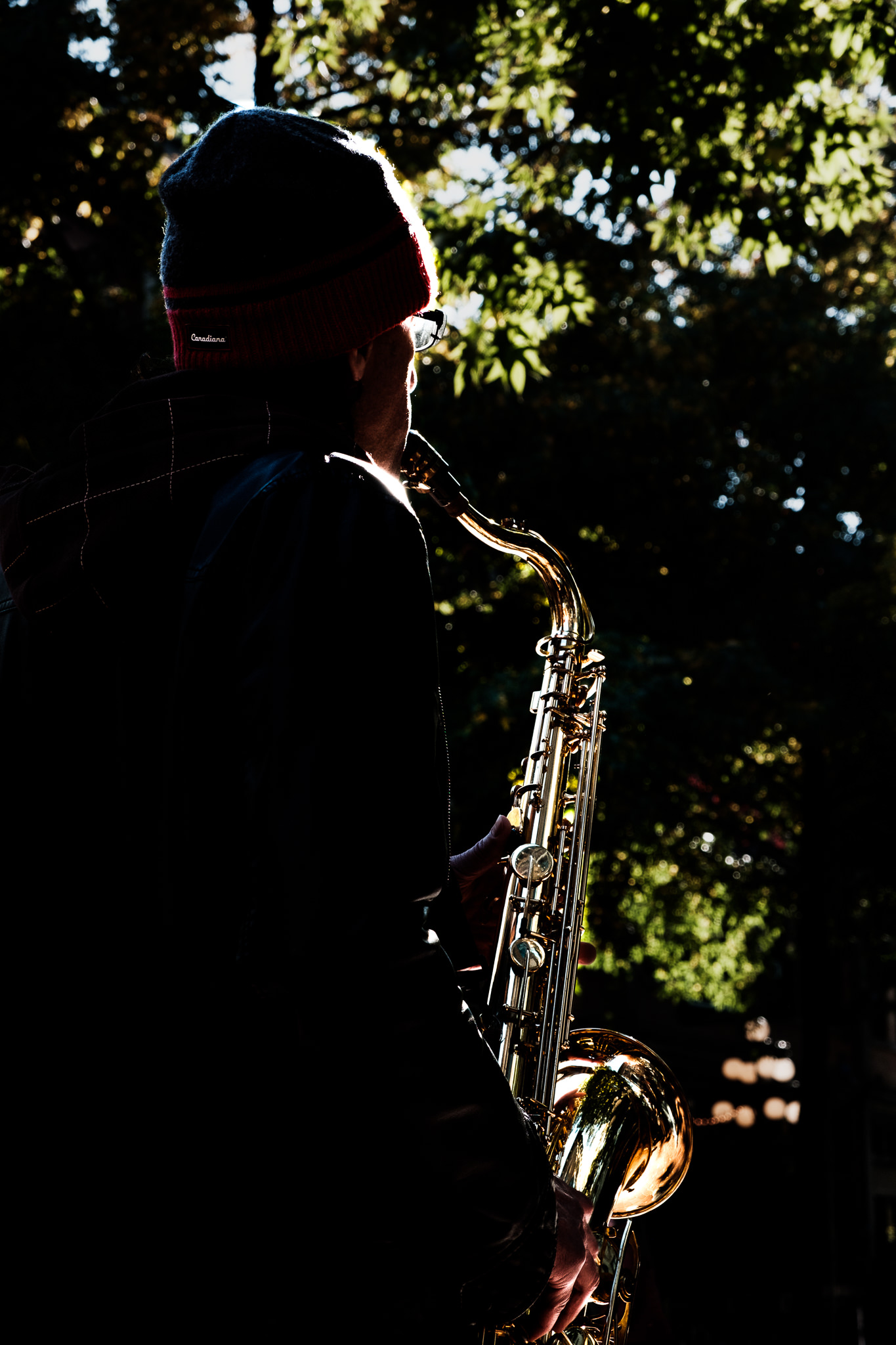 X-T2 + XF18-55mm f/2.8-4 R LM OIS @ 55mm, ISO 800, 1/250, f/8.0
Shoot From Behind Glass
Many novice street photographers have a fear of being confronted by their subjects. Try shooting into a building from the street. The safety of the window gives you a bit of perceived protection! Remember though, if you get caught, make sure to smile!
 X-T3 + XF56mm f/1.2 R @ 56mm, ISO 200, 1/125, f/1.2
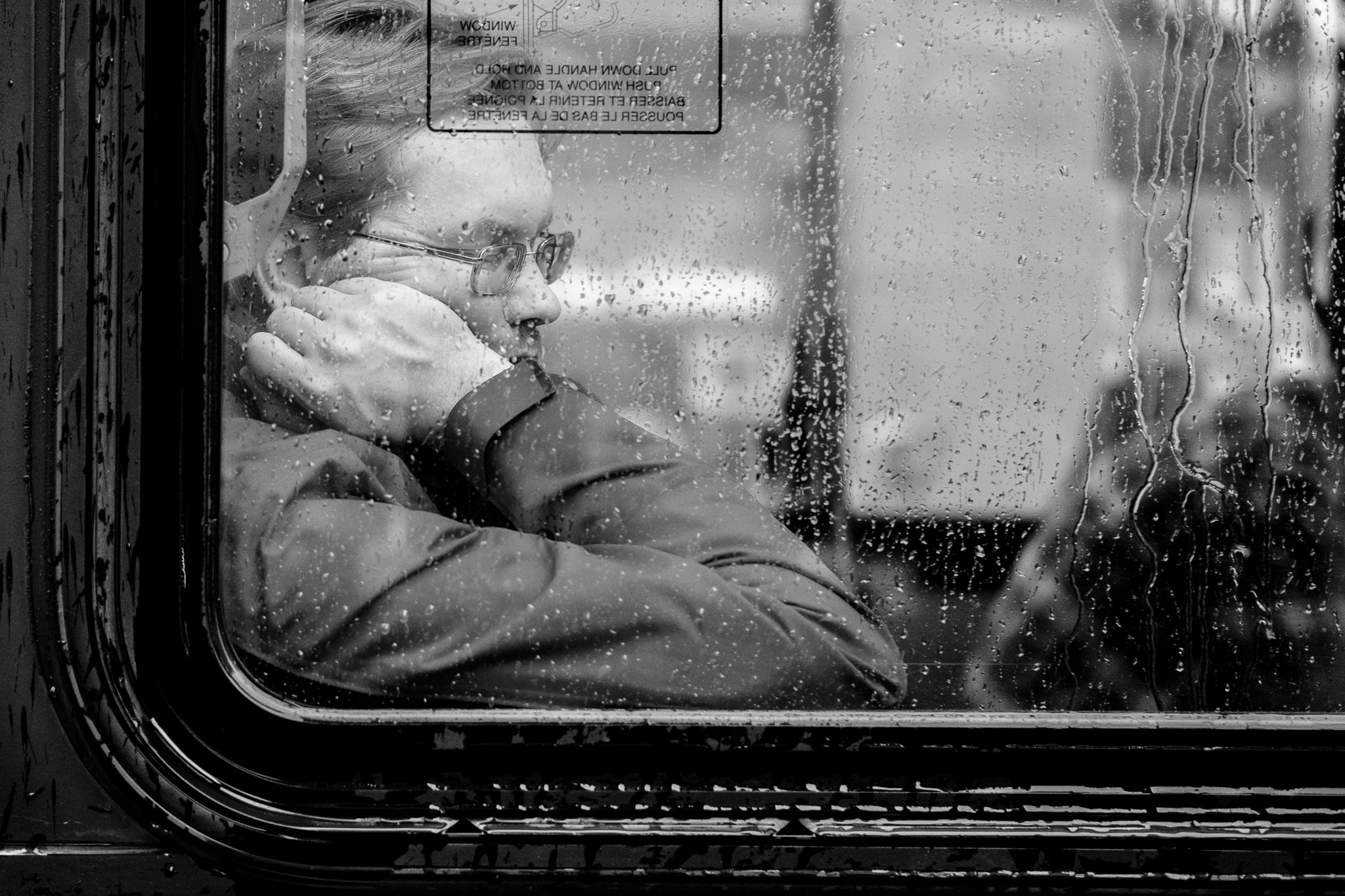 X-T2 + XF50mm f/2 R WR @ 50mm, ISO 2500, 1/125, f/2.0
Photograph the Backs of People
Who says that you need to see your subject’s face? Shooting from the back is a great way to photograph without being seen. Look for characters wearing interesting clothing and hats.
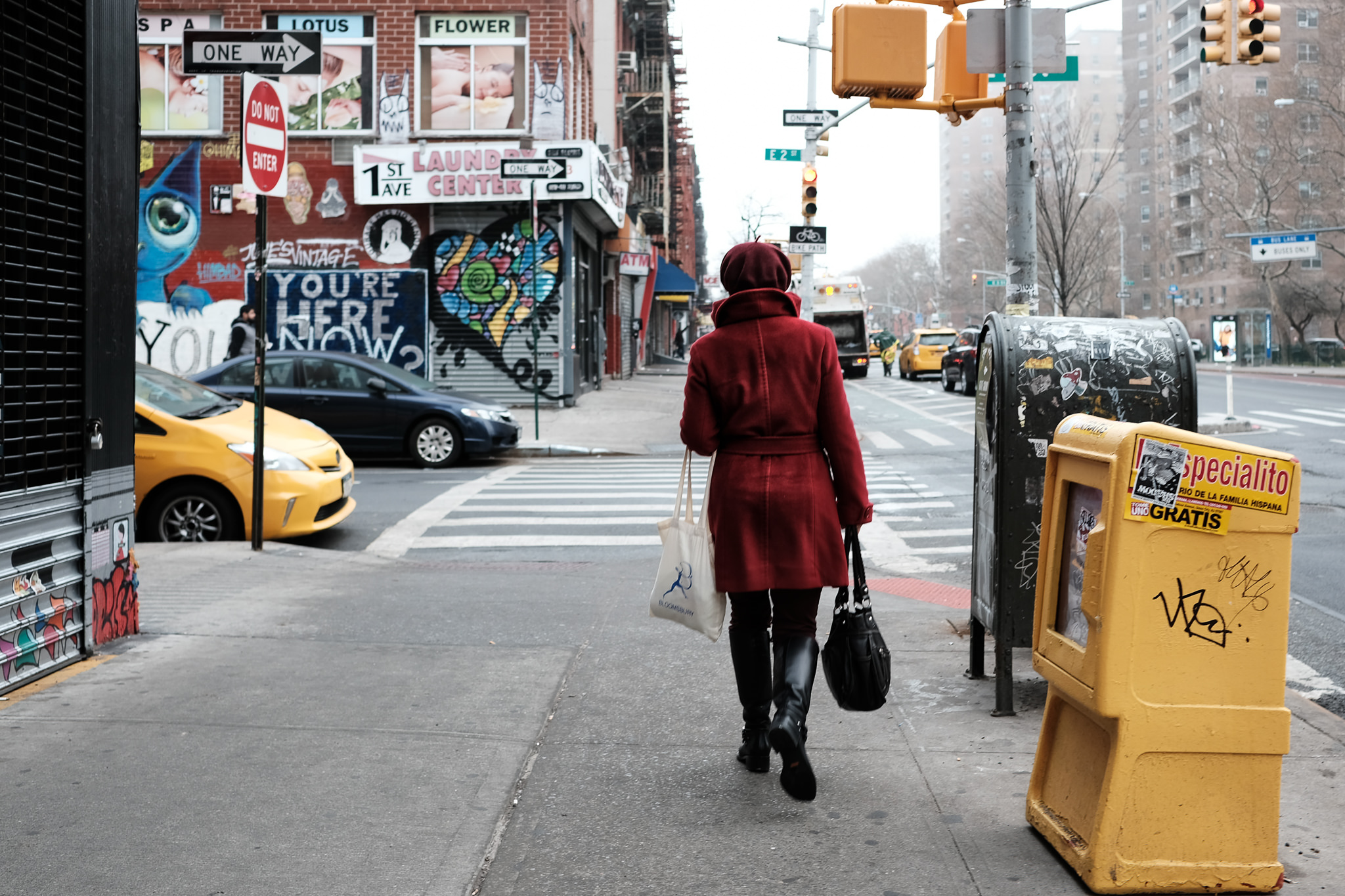 X-T2 + XF23mmF2 R WR @ 23mm, ISO 200, 1/160, f/2.8
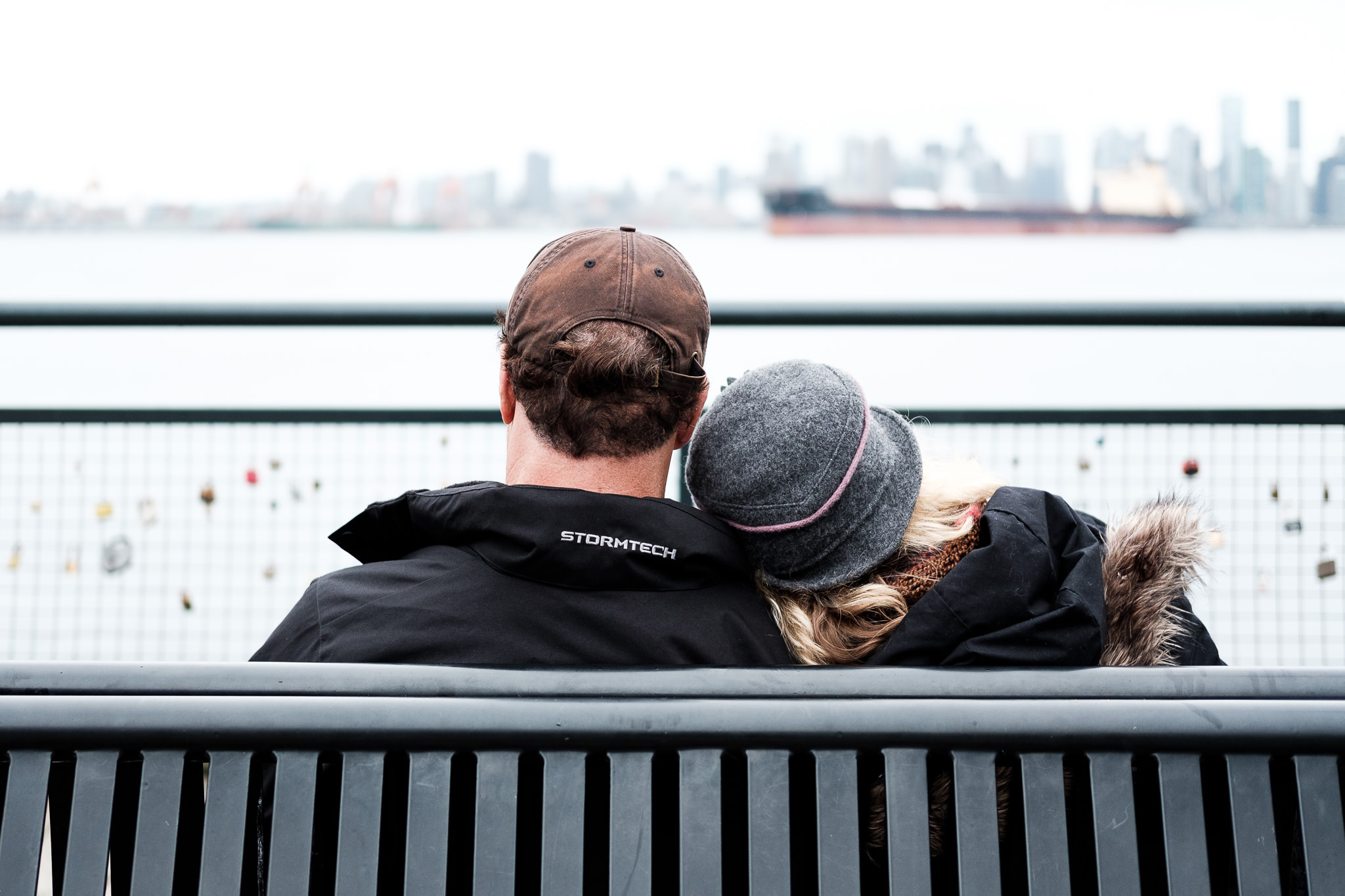 X-T2 + XF35mm f/2 R WR @ 35mm, ISO 400, 1/1700, f/2.0
Photograph Street Animals
Who doesn’t love a good shot of a dog or a cat? Furthermore, shooting street animals often leads to conversations with their owners, making an excellent segway into shooting a street portrait too! When photographing animals, don’t forget to get down low. A close, wide perspective makes for far more interesting shots.
 X-T3 + XF56mm f/1.2 R @ 56mm, ISO 2500, 1/125, f/1.2
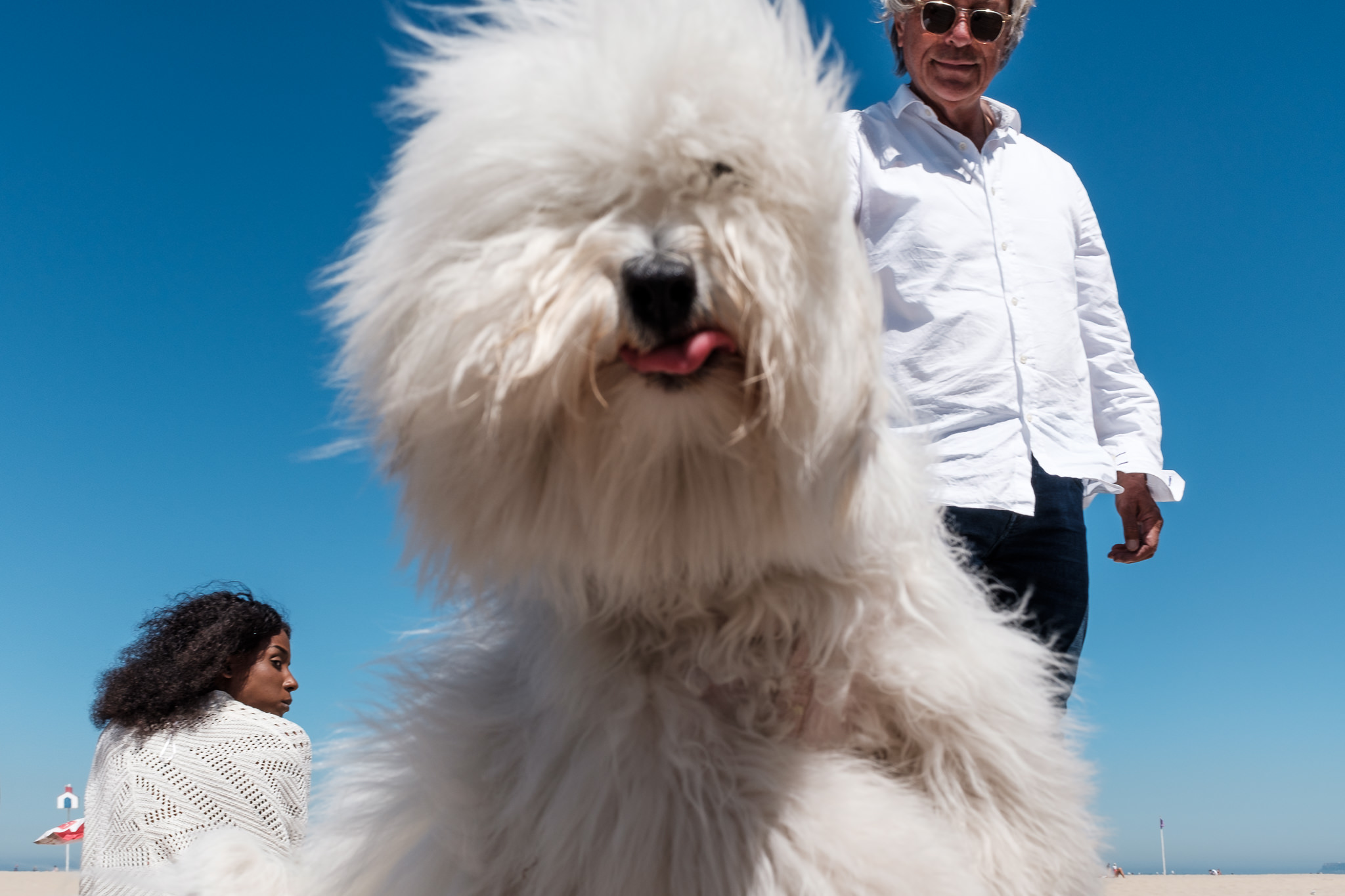 X100F @ 23mm, ISO 200, 1/500, f/10.0
Set the Stage
I use this technique when I find an interesting background and good light. I take the time to watch people come and go and observe how the light hits them, or how a certain background element interacts with them. Once I understand the scene and know what I want to capture, I frame up my image. I pre-focus where I want my subject to be, and then I wait for the right person to enter my stage.
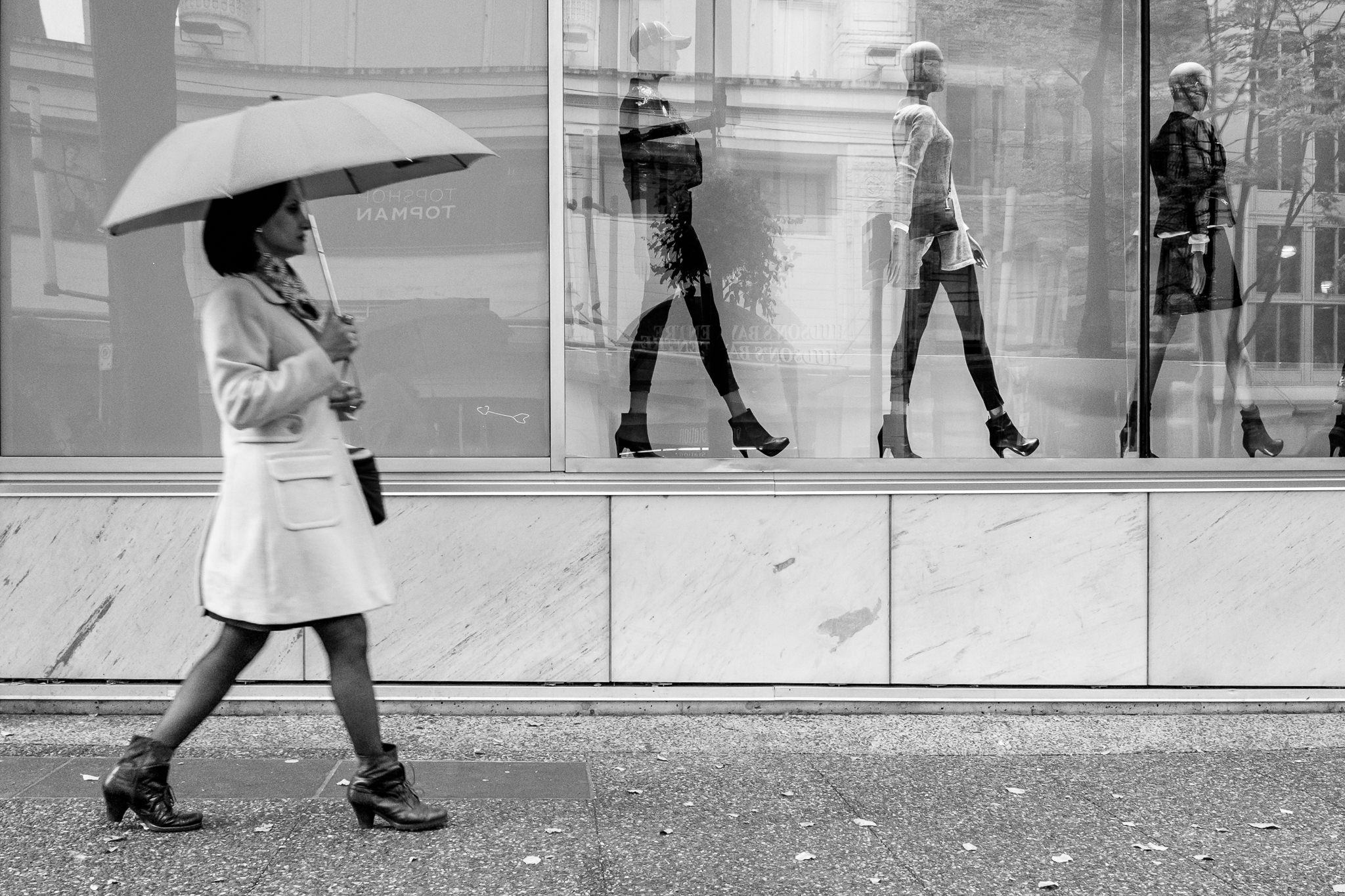 X100T @ 19mm, ISO 800, 1/100, f/8.0
Patience is key here. I don’t click the shutter button when just anyone walks by. I wait for the right person. Maybe they are wearing a fabulous hat, or their coat is flowing behind them. Resist the urge to fire at anything that moves. Be deliberate in what you capture.
 X100T @ 23mm, ISO 6400, 1/70, f/11.0
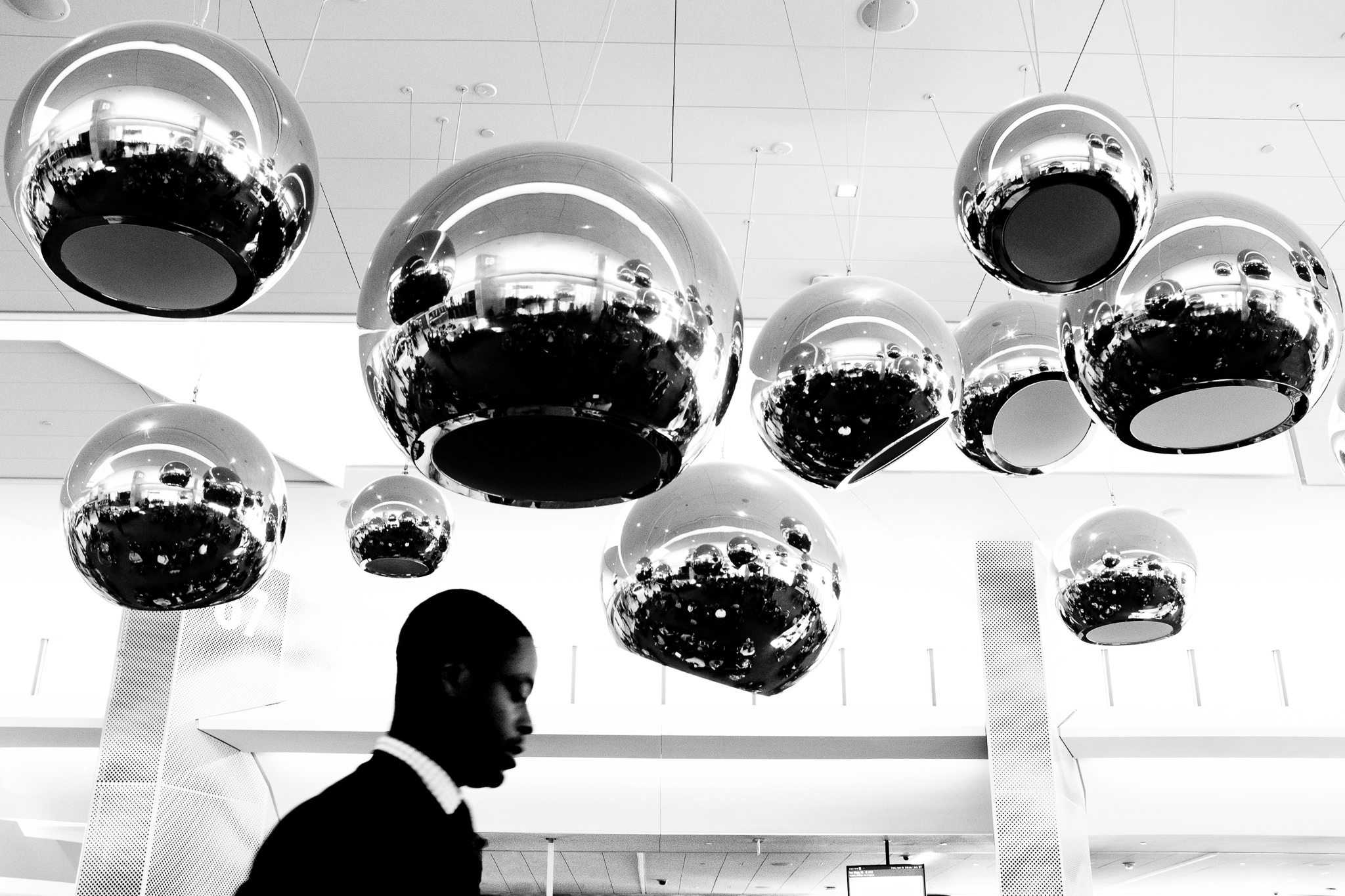 X100F @ 23mm, ISO 1250, 1/125, f/5.6
Capture Silhouettes
Capturing silhouettes in street photography is a great way to anonymously capture subjects. Look for strong backlighting or a bright window to act as a background and wait for a subject to pass in front of it. Use your exposure compensation to underexpose your image or spot meter on the light source.
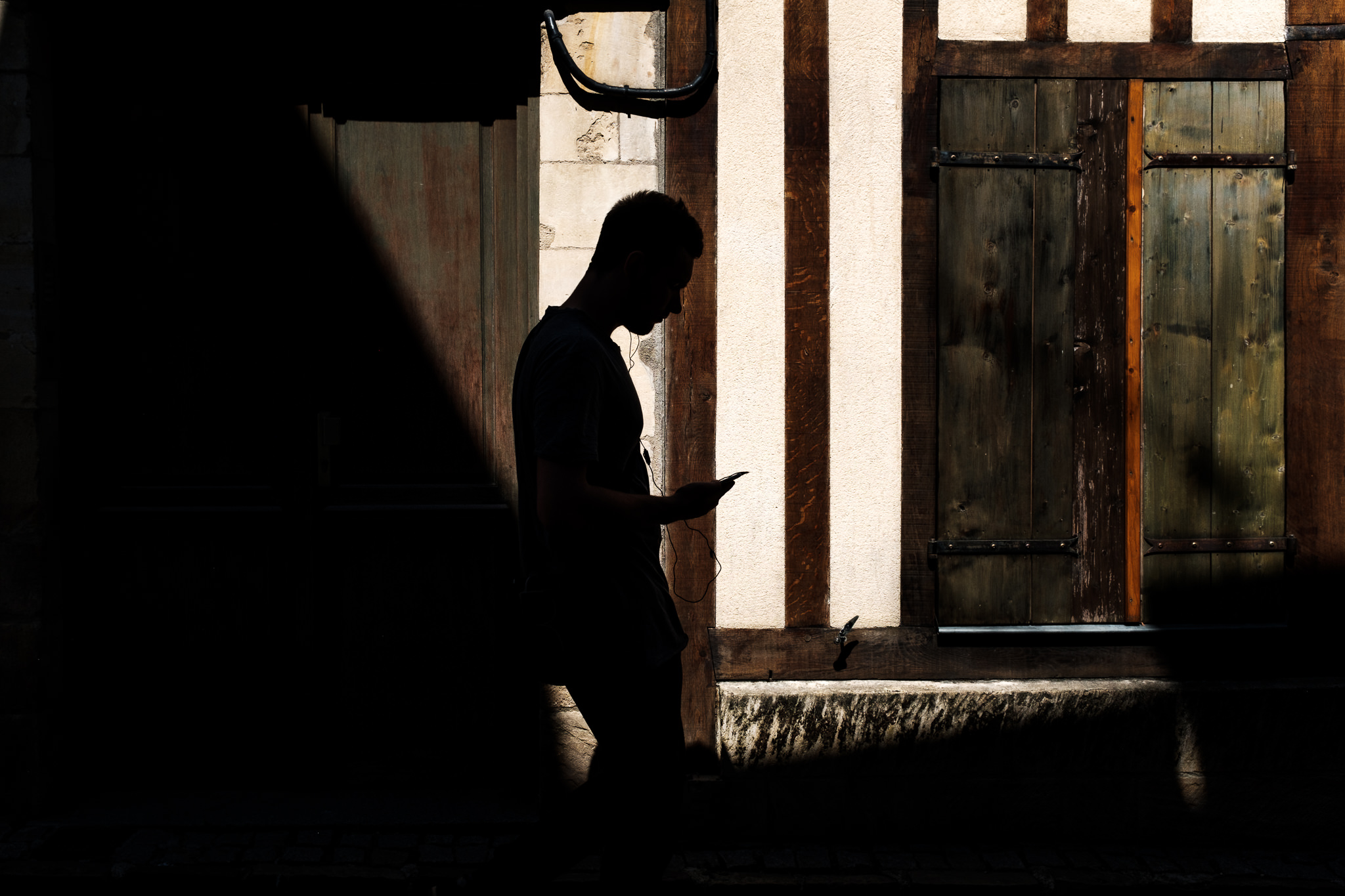 X100F @ 23mm, ISO 200, 1/1250, f/8.0
Both these techniques will throw your subject into shadow while correctly exposing your background. Take care not to overlap the silhouetted elements in your frame so that you capture clearly defined subjects. And once again, be patient. Wait for interesting characters to walk into your image. Silhouettes can be a lot of fun, so experiment with this technique.
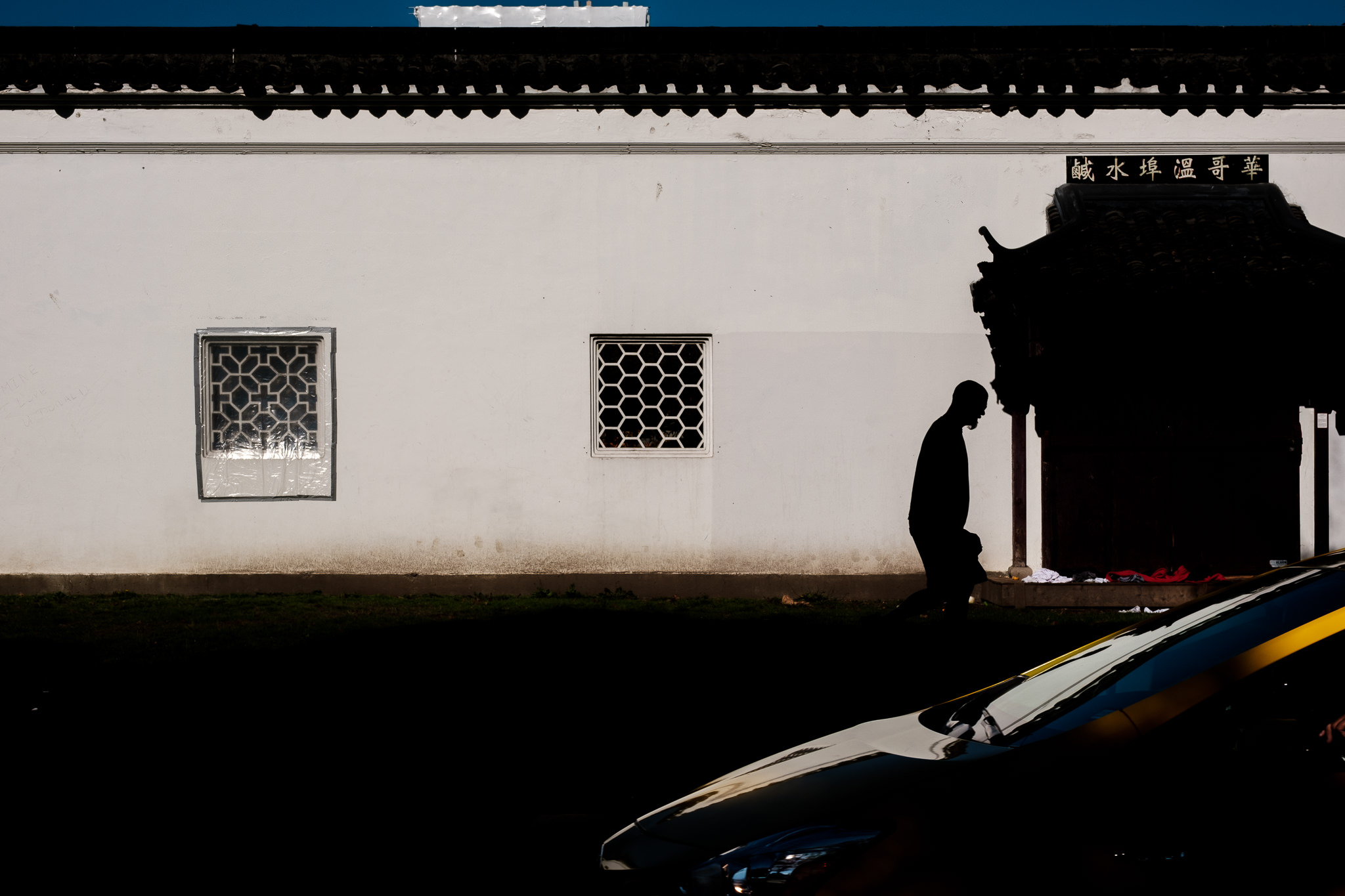 X-T3 + XF50mmF2 R WR @ 50mm, ISO 160, 1/600, f/11.0
Use Contrasty Light
Most photographers tend to hang up their gear when the light is harsh. However, this is a great time to play with light and shadow in street photography. Look for pockets of light and observe how the light plays off people walking in and out of it. Look for pops of color coming out of the darkness. When you are shooting in these conditions, pay careful attention to your exposure. Use your exposure compensation to dial back a stop or two to ensure that your subject is correctly exposed as they step into the light.
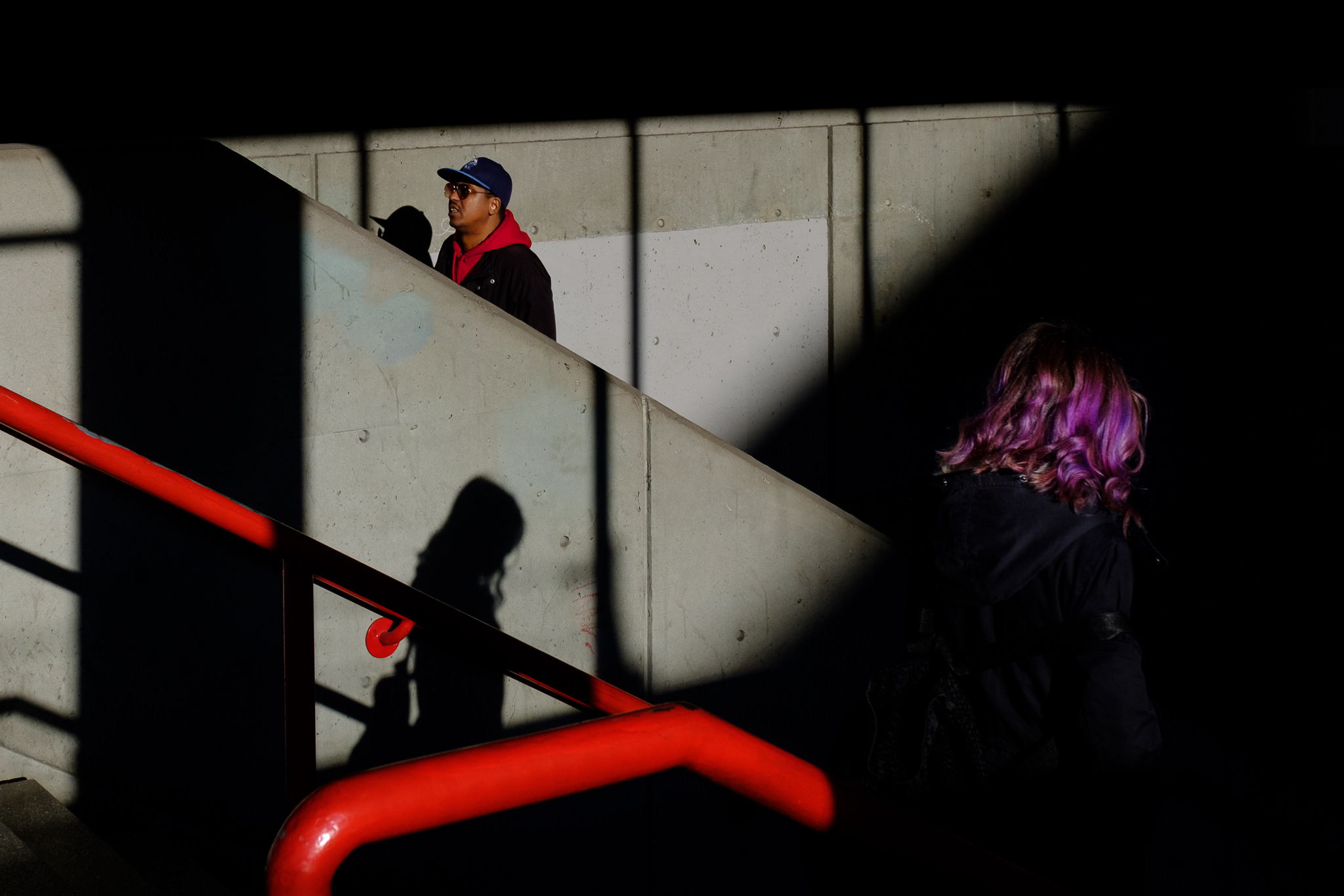 X100F @ 23mm, ISO 200, 1/350, f/8.0
 X100F @ 23mm, ISO 200, 1/550, f/8.0
Wait for the Decisive Moment
Henri Cartier-Bresson, the father of street photography, said in an interview with the Washington Post, “There is a creative fraction of a second when you are taking a picture. Your eye must see a composition or an expression that life itself offers you, and you must know with intuition when to click the camera. That is the moment the photographer is creative. Oop! The Moment! Once you miss it, it is gone forever.” Capturing the decisive moment takes a bit of luck, quick reaction time, and a good knowledge of your camera.
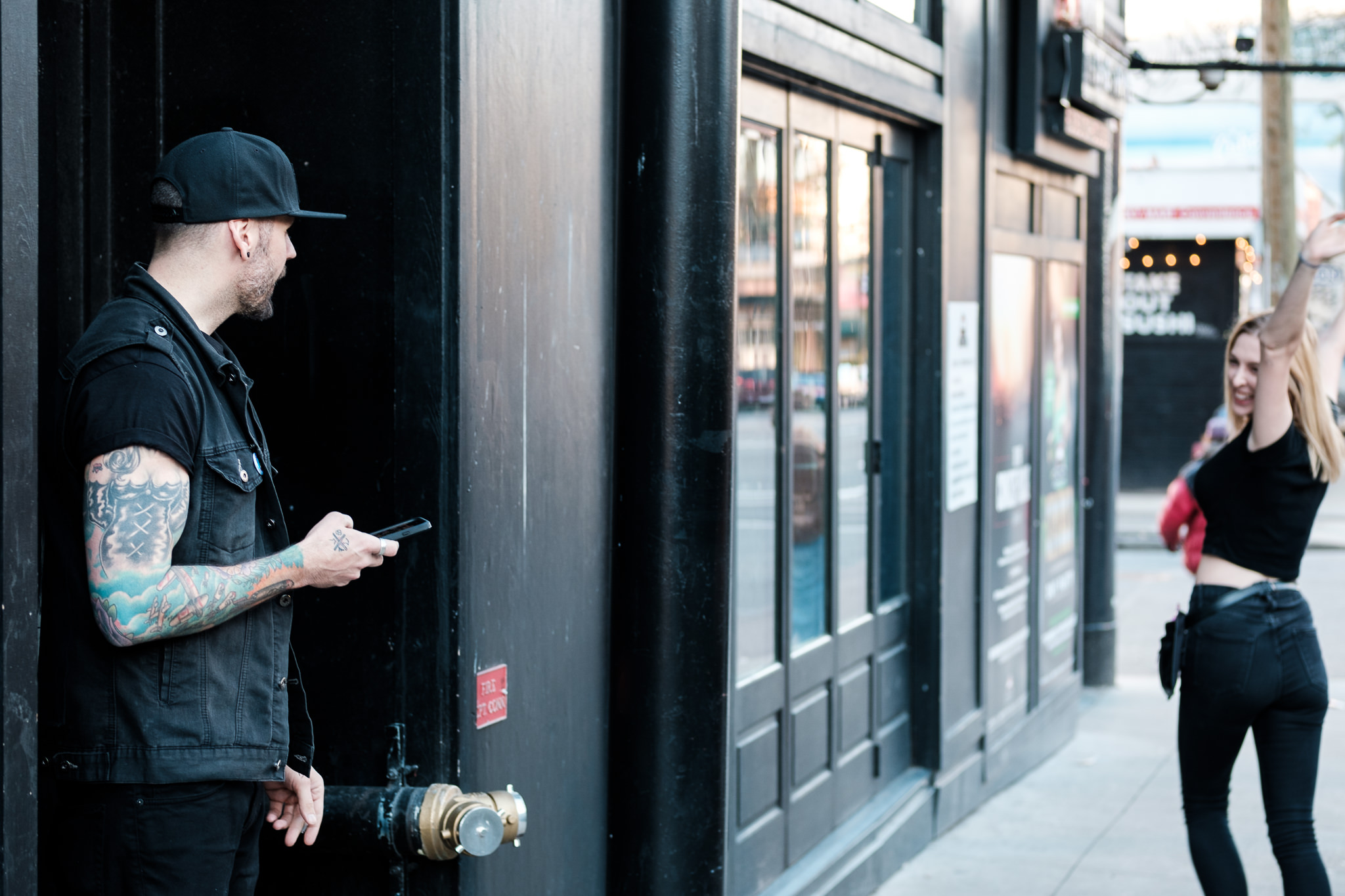 X-T2 + XF50mm f/2 R WR @ 50mm, ISO 200, 1/100, f/2.8
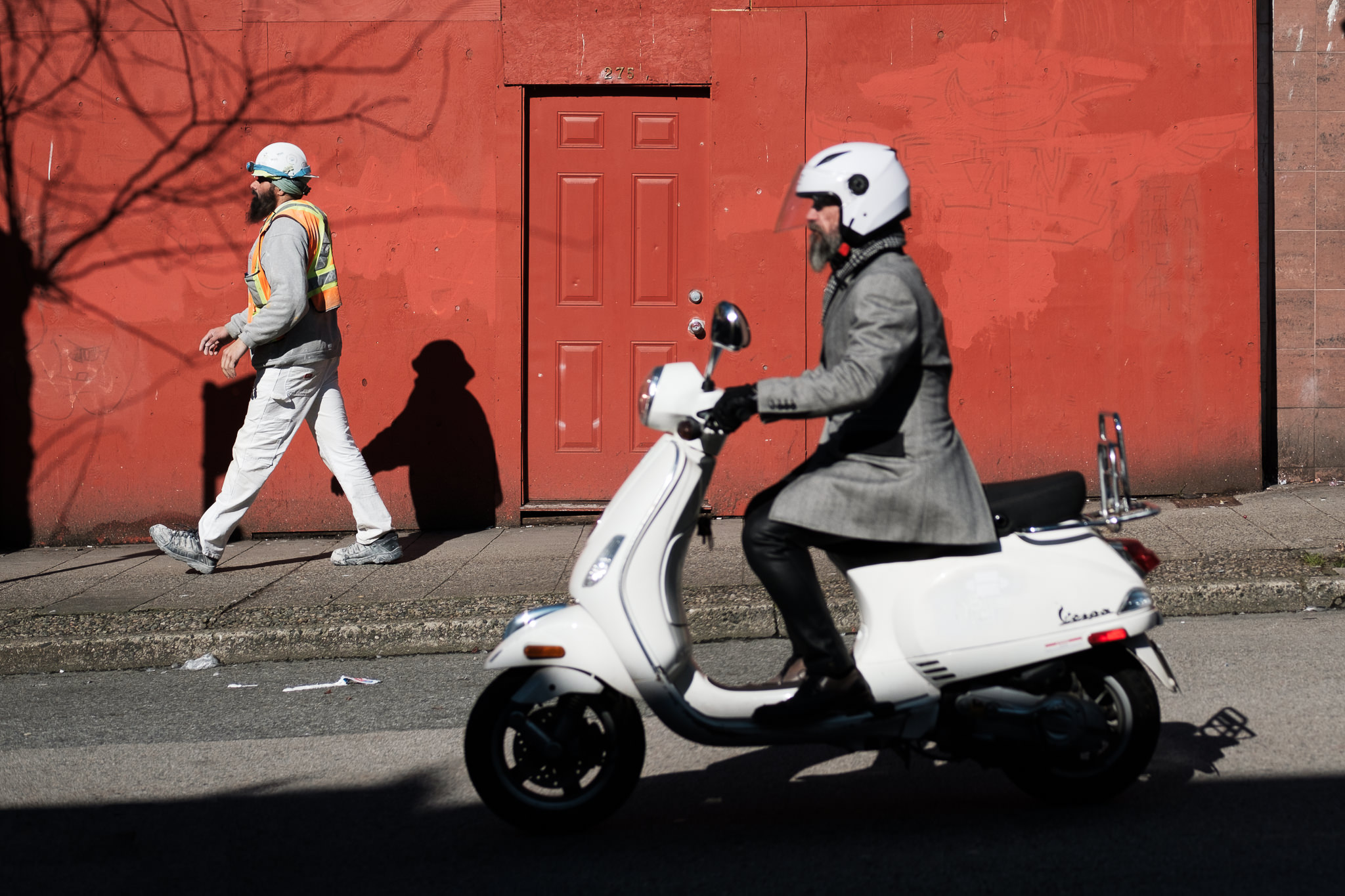 X-T2 + XF50mm f/2 R WR @ 50mm, ISO 200, 1/8000, f/2.8
Learn the Right Way to Approach Strangers
A word of warning, making street portraits is addictive! I remember being so nervous when I made my first portrait of a stranger. But once I had the image I was on a natural high! I think I asked another half dozen strangers that afternoon if I could make their portrait!
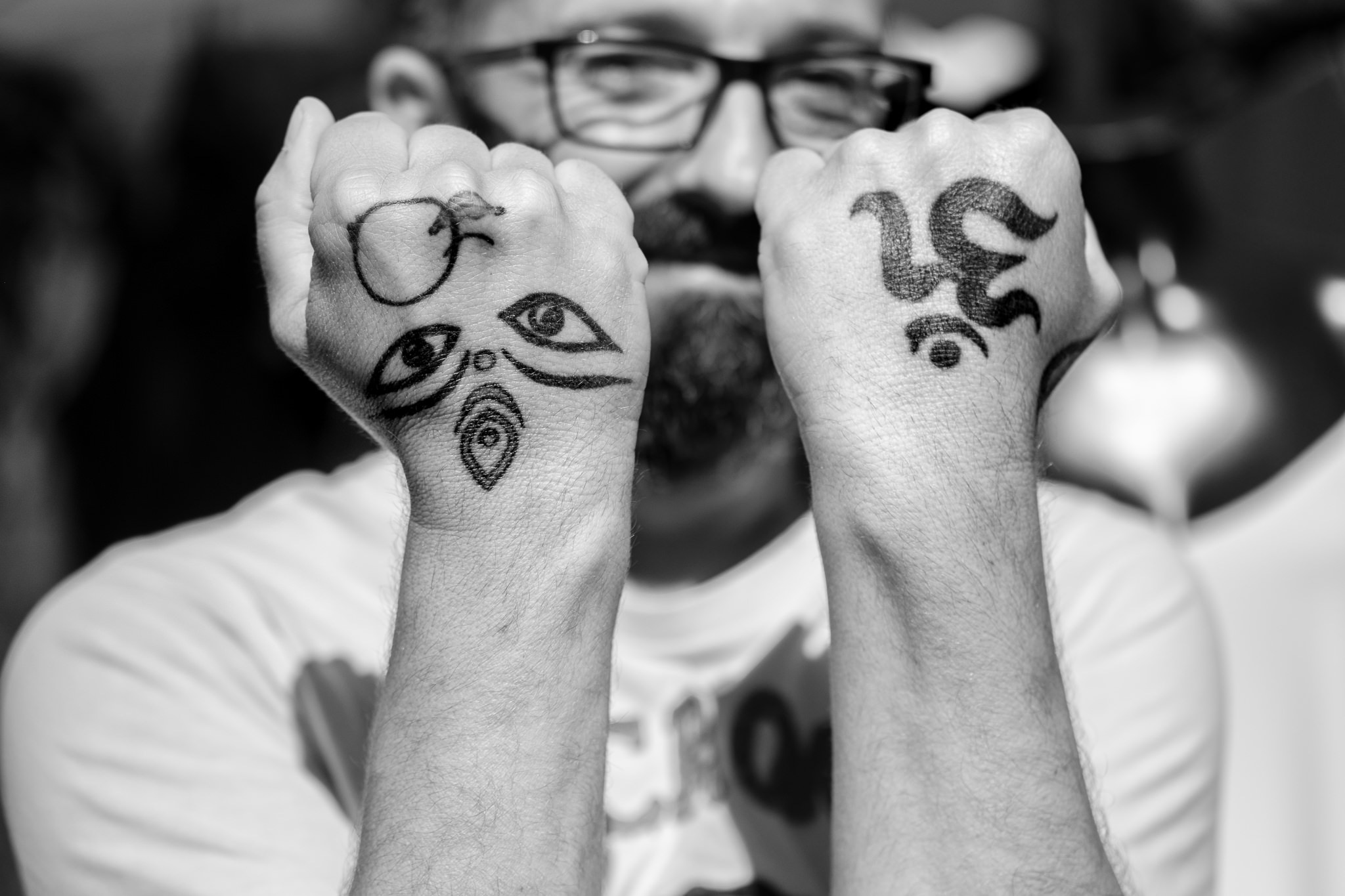 X-T2 + XF50mm f/2 R WR @ 50mm, ISO 200, 1/6400, f/2.2
The key to getting permission to take a stranger’s picture is flattery. Don’t go racing towards someone, camera waving, yelling, “Hey, can I take your picture?” No, approach them with your camera at your side. Tell them that you love their smile or the way their hair is being backlit in the afternoon sun. Talk to them and let them know that you are a street photographer documenting life in your town. Once you have established a rapport, then ask them, “Would you mind if I make your portrait?” I have found that by using this approach, nine times out of ten I get my shot.
Here are a couple of things to keep in mind when you are creating street portraits. Firstly, as I have already pointed out earlier, make sure to have your camera settings prepared before you approach someone. You do not want to be fumbling around with your camera when they say yes. Also, take your time.
Once someone has given you permission, they are usually open to having several shots taken. If the light isn’t right, ask if they would mind moving a bit. After you capture their image, show it to them on the back of the camera to get their feedback and reaction. Many will be psyched to see themselves captured with a nice camera, and will be willing to pose for more shots if needed. And lastly, offer to send them an image. I keep my business cards with me for just that reason.
 X-T2 + XF23mm f/2 R WR @ 23mm, ISO 200, 1/340, f/2.8
Show Gratitude
Don’t shy away from complimenting and thanking the person who agreed to be your subject. This is the least you can do. You can certainly walk away by thanking your subjects, but do give them an opportunity to see the photos you’ve taken by offering them your business card.
Some people will actually contact you to get the photos. And if the subject loves their photo, they might contact you in the future for their photography needs.
 X100F @ 23mm, ISO 1000, 1/125, f/2.0
Taking street portraits is extremely rewarding and a great way to meet wonderful people. Give it a try, but remember my warning!
Conclusion
When you first venture into street photography, don’t get too hung up on the definition. Instead, record street life from your own unique perspective. Experiment with different focal lengths, until you find one that resonates with you. Play with light and how it illuminates your subjects. But most of all, have fun.
If you want to hone your photographic skills and are up to the challenge of capturing emotions, gestures, and moments in time that tell a story, then give this genre of photography a try. If you do, you will find that capturing life on the streets in ways that make the everyday seem extraordinary is extremely rewarding. Additionally, you will find that your photographic skills improve! Consequently, the things that you learn shooting street can be applied across the other genres of photography that you like to shoot.

About Elizabeth
Elizabeth grew up in Vancouver, on the beautiful West Coast of Canada. In 2012 she relocated to Houston Texas for two years and then moved to Gautier, Mississippi in July of 2014 for another three years. Now back in Vancouver, Elizabeth runs photography workshops and teaches many aspects of photography. Her areas of interest are widespread and include street, wildlife, nature, architecture, macro and long exposures. She is particularly passionate about black and white images. You can see more of her work on her website at www.photographybyelizabethgray.com or on Instagram at photosbyelizabethgray
Comments
-
Your ways of aproaching people is very helpful and your perspective that would you like to be taken picture of during certain time if you are the subject is really nice
-
RICOH GR is mt choice for a street photo camera
-
Great Article!! I’m in a city with a great culture and great mix of rural and urban scenarios. I can wait to apply your knowledge in my photos.
-
Really appreciated !!!!
-
Wonderful article, congratulations! Thank you very much!
-
What a fantastic article breaking everything down that is easy to understand, I have been out shooting street photography, a few good shots, all in manual mode, I am off out tomorrow to Plymouth U.K. with the settings that was recommended I know this will definitely make my life a lot easier, I can not wait to get back out on the street now.
-
Great article. This will help with raising my confidence when approaching people. I do believe however that a model release is necessary if you plan on selling any photos taken with a persons face shown.
Thanks again for this well written article.
-
Nice article! OK the guy with the mannequin and hat is screaming out for a sequence where as he walks by the hat ends up on his head. Yes, I love Charlie Chaplin.
-
Thank you for giving ideas on how to approach people.
-
Thank you so much for an informative article. Reading your article opened my eyes to see other ways of doing street photography
-
Thank
-
Great through post on the art of Street Photography. Love the street.
-
It is a nice post . As a beginner , I have a clear idea as well as guidence about street photography after going through this article . Thanks a lot .
-
I took my camera went to the street of Lagos and I wasn’t very comfortable my aim was 1000 I only got 94 you really have to be patient I agree
-
Thank you
Good article and simple read
I love street and urban photography – but seem to have lost a bit of motivation over the last year
This mat kick start things again
-
Excellent and inspirational, thank you.
-
Inspiring well worth the read
-
Great article. Where can I see more from this author?
-
An item I’d like to see addressed is the issue of the significance and effect of different cultures on street photography. Travellers especially are prone to wanting to grab candid shots in international locations where local customs may be extremely different. When should you ask? When should you be expected to make a small payment? When should you just refrain entirely?
-
It surely helps beginners to go out and shoot. This really helps gain a newer and better perspective. Loved it.
-
Great photos and an inspiring article. One question: Given how much is written about the need for model releases if people are identifiable, do you ever get a model release from any of the people you photograph? Is it needed in street photography?
- For commercial use – definitely. For editorial use, not. Other uses are a grey zone and I would go get a release if I think I may use that photo (e.g. art show, sell prints etc.). I believe there are apps for model releases so it can go quickly.
Reply 22. One of the best articles I’ve read in a while! Oh, and did I mention that the photographs are amazing. Thanks for these insights! :D:D
-
This article is one of the very best I’ve read regarding street photography. I got into street last year after retiring as an environmental journalist. Fortunately I already had perfect equipment, a pair of Leica M4-P black bodies and VC 25mm f4, and Leitz 40mm f2 and 90mm f4 lenses. Add a small light meter and my black Domke bag and I’m good to go. I see you mention ‘blending in.’ This is what Joel Meyerovitz advocates in his short films about shooting on the streets of NYC. ‘Make yourself invisible.’ So I’ve put together an outfit to do just that. Black boots, clothes including a black biker jacket and beanie hat. The idea is to appear bigger than I am to deter anyone taking liberties with me. The ex-British Army boots add nearly 3” to my height. The black Belstaff biker jacket gives me padded shoulders. I use Ilford XP2 @ 400 iso to enable me to shoot at 500 shutter speed and ‘freeze’ the action. This film is very forgiving of exposure errors too so estimating exposure is easier without having to bracket. Am really looking forward to better weather coming and getting out and about in the UK.
- do u always talk so much about yourself in a review / reaction? Get a blog of your own….
Reply 24. Thank you Elizabeth… One of the best articles I have read on Street Photography. I have the good fortune to live near New York City, but have been shooting “street” here in suburbs, and all over the world as we travel. I can always find photos of interesting buildings online or in books… It is the people that always fascinate me.
I have a short You Tube tutorial on street photography, but may add a few suggestions from your article. This was linked for our 52 Frames challenge this week. I hope our members give it a good read.
-
Hi Elizabeth,
I am a photography student in Malta and we have a task to brainstorm images and then ask the photographer what the true meaning of the image was . I would love to ask why did you take the photo with the women walking past the manikins what was the true meaning behind the photo . My analysis was that you wanted to portray today’s society with the manicans influencing us and how we are listening and doing what they truly want , but the umbrella is a sign of hope and that not everyone is following this direction .
Would love to hear back from you .
Andrea
-
Thank you Sir for the article. It add to my knowledge of doing photography. Appreciate it very much.
-
Very nice article and images. I have a question regarding the fact that most photo contests require a waiver from persons in an image. If I am not required to get this when taking the photo, particularly from street photography, can a photo with partial face or only the back be submitted without the waiver? Or what has been your experience with this? Is there instance I could get by without the waiver when submitting to a contest?
- Hi Becky,
This is a very good question. Unfortunately, I don’t think I can give you a definitive answer. I have not run into any instances where I have had to provide a signed waiver from subjects when submitting to a contest. However, I think it really depends on the contest. If the contest has a street or documentary theme, I can’t see a waiver being required.
The issues with waivers usually means that the work will be used for commercial purposes, and not artistic use. I think I would be leary about submitting to a contest where a waiver is required. You may be unknowingly giving the promoter images that they intent to use/sell for commercial gain.
Sorry I am not much more help. Maybe one of our readers can provide more insight.
-
I can only speak about the United Kingdom. Some time ago street photography was in crisis. The law was being grossly misrepresented and that was one ingredient of the cake. Add 8 ounces of terrorism fears, 10 ounces of paedophilic hysteria, 4 ounces of data protection crap and a sprinkling of privacy/human rights seasoning. Now, you’re out on the streets with your Fuji X100 (great camera, by the way, I’ve just bought a 5 year old one) and a silly old bag with a mobile phone rings the police. ‘There’s a man on the High Street using a camera, I think he’s taking photos for terrorists or he might be a paedophile, can you send a policeman please.’ Now the police tell me (I’m a journalist) that when someone makes a complaint they are bound to investigate. But, I say, why do you not tell the woman that unless there’s clear evidence of a criminal offence being committed, you have no right to interfere with the person complained about. No, they insist they have to turn out. So PC 3004 approach’s the man and asks his name, address and date of birth. If the man gives this information then he is told to go. If, however, he declines, as is his right {at the moment} (cannot do italics), he is arrested and taken to a police station. One chap, a Paramedic, refused and spent 8 hours in a cell before relenting and giving the information. He was released. He went to a London-based firm of solicitors specialising in civil actions against the police. After weeks of increasingly acrimonious exchanges of letters, the police agreed to pay him £6500 plus his solicitor’ s fees. Nice work if you can get it. I wish it would happen to me. That would be a month in Corfu for me. While sitting in the cell I would close my eyes and think of the sun, the tavernas, the street photography, oh yes, that’s what got me there in the first place. Please let me know if anyone wishes me to clarify anything. Tobe.
Reply 28. Love this piece Elizabeth. You confirm so many of my photography values. I am a coffeehouse photographer with over 1500 coffee shops photographed worldwide – mainly people in conversation and who be come One with their social media device but nothing ever compromising however ALWAYS interesting and expressive facial portraits. Perhaps my most fun Street Coffee shoot was earlier this year in Hanoi Vietnam in The Note coffeehouse (every square centimeter of the four level cafe was pasted with postie notes for which you received a blank one with your coffee. I use small inconspicuous cameras Sony RX100 and Lumix ZS200 type cameras but sometimes shot with a Fuji XT3+fisheye lens for extreme closeups of baristas as they create their coffee art. Anyway – your work inspires us all!! Thank you again.
- I really appreciate your feedback, Ralph. I have a friend who just finished a coffee shop series, and it is fantastic. Such great photo opportunities.
Reply 29. Great article Elizabeth! I found your comment about photographing marginalized people (e.g the homeless) interesting. I tend to agree that it can be seen as exploitative but then if you are not selling the photos and instead using them to raise awareness of the plight of the less fortunate isn’t that justified?
- Thanks, Julian. I’m glad you enjoyed the article.
I mentioned to Paul in a comment above that I feel that there are situations where it is OK to photograph the marginalized. And as you said, if you are doing a story to help raise awareness of the less fortunate, then I feel this is fine. However, if I am going to photograph the homeless, I make it a point to get to know them first. I always buy them a sandwich and talk to them first. But most importantly, I listen to them. Most of the time these folks are very lonely. Once we establish a relationship, then I photograph them.
Cheers!
-
Most important not to give them cash. It will go on drugs or alcohol. A sandwich is a good idea or a couple of Mars bars. If they have a dog, buy a couple of tins of good quality dog food.
Reply 30. Great article. I’m just starting to try my hand at street photography and appreciated the tips. Thanks!
- Your welcome, Rivki. Have fun, street photography is very addictive!
Reply 31. Great article as usual Elizabeth. It is always refreshing to hear the balanced pragmatic approach of an aware person. One point that I have always felt uncomfortable about that is rarely mentioned is, that in my opinion, in some regards street photography, in respect of photographing people, is easier for a woman than a middle aged or older man. Certainly in the UK there is less suspicion as to why you are taking the photograph if you are a woman rather than an older man.
- Hi James, thanks for your comments. I couldn’t agree more. As a female street photographer, I feel I have a much easier time than my male colleagues. While a man standing on a corner with a camera may appear a bit creepy, not many folks think twice about a woman in the same scenario. I have had this conversation with many of my female colleagues, and they are all in agreement. Not long ago I wrote a blog post on just this subject. If you are interested, you can find it over on my website here.
-
Thanks Elizabeth, I’ll take a look.
Reply 32. MOST impressed – very thorough and detailed article, very helpful content. Another great author in “Photography Life”!
- Thank you so much, Jean Pierre, for your kind words.
Reply 33. Very good article and very good pictures Elisabeth (as usual) I like very much your posts.
There is however a side of the matter that is not covered in your post: there are some countries or cultures where people don’t like to be photographed, and at the same time they are often very interesting subjects. It has arrived to me in Bolivia and in Morocco.
Sometimes, asking them their permission with a smile is enough, a bit more commercial minded people will ask you some money, but you will end with a more “commercial” picture. Sometimes they will deny politely their permission and sometimes they will be just angry.
As you pointed out, it is possible to shoot from the back and it is also possible to shoot literally “from the hip” thanks to the autofocus system.
What do you think about that?
- Thank you for your comments and question, Rolando.
I have only been in one situation where a subject asked me for money before I could take their picture. I walked away! As you said, if you give in to this, you loose the spontaneity of the shot, and it becomes much more staged.
I think in the situation that you talk about, building a rapport and getting to know the locals is so important. By taking the time get to know them, asking them about their work or what they are selling, showing them pictures of other people you have taken pictures of, and by going back to the same area repeatedly (if you have that luxury), they will become more comfortable with you. This will allow you to become more invisible on the streets.
Let me know if this answers your question. Cheers!
-
Hello Elisabeth:
Thank you for your time, your answer confirm what I think, to become invisible or to create a connection are the best ways to successful street photography, but to built something with people is not easy if you don’t speak their language, don’t understand their culture and you look like what you really are: another annoying tourist.
If you are lucky, they will more or less tolerate you, if not, you have to give up or try a less direct approach…
Rolando
Reply - Rolando: Interesting shots can be obtained in countries very similar to the pair you mention by using a wide angle lens. This gives the setting, including street furniture, buildings, pavement hoardings, vehicles and yes, people as well. So, you have gone to a third world country with a Leica MD (film camera) that has no viewfinder or rangefinder and it’s got a VC 25mm f4 lens with the 25mm viewfinder plugged atop in the accessories shoe. The light is bright so you can set 125 on the shutter speed dial as you’re using Kodak Ektar 100 iso film . Aperture is F11. So you use the hyperfocal distance method and move the focus ring so infinity 00 is aligned with F11 on the right-hand depth of field scale. Now, flirt over to the left-hand scale and you’ll see that everything from 1 metre forward of your lens is in focus to infinity. (You look at F11 on the scale). This is far quicker than autofocus as it’s not focus at all, it’s pre-set. One can aim the camera at people without raising it to ones eye. You see, they notice the viewfinder atop and think your just fiddling with the camera as you hold it and look down at it. This is what I’ve done for more than 15 years!
Anyone speaks to you (assuming they speak English) ? Simply say: ‘films run out’.
All this is far easier than people imagine. Far more difficult with a DSLR with 18-400mm lens that’s 12” long!
Reply 34. An excellent article, Elizabeth, particularly the supporting photos.
Too many ‘street photos’ seem to be just photos of streets or show nothing in particular, so it’s refreshing to see a set of images which are coherent and have a sense of having been consciously designed.
They all either tell a story, invoke a mood, capture a moment or play with juxtapositions of light and colour.
Congratulations and thank you.
- Thanks so much, Betty! I think now that everyone has a camera with them, and take photos of just about everything, the pot of good photos gets so diluted. I have many friends that do excellent street photography, but their work gets lost in all those images you are speaking of. Thanks again for your comments.
Cheers!
Reply 35. Elizabeth, congratulations with some amazing images. Loved the essay and the pictures, keep up the good work!
- Thanks so much, Joshua, for your kind words. I’m glad you enjoyed the post.
Reply 36. Excellent article and loved the guidelines and advices laid out. The pictures are truly nice indeed, as everyone pointed out.
One thing in which I disagree is regarding erasing pictures. I would never ever do that. If someone doesn’t like me pointing my camera at them, I move on. I can’t stand people who think of themselves as the centre of the universe. Nobody owns my pictures except me. I guess having lived in Germany for so long has made me touchy about this subject.
- Thanks for your comments, Martín. Do you find the privacy rules in Germany make it tough to do street photography? I was also wondering if you have been asked to delete a photo before? I have yet to run into someone where that has happened.
Cheers!
Reply 37. For me street photography is about capturing the mood, or essence, or mystery of place ànd people are necessary but incidental to that at the same time. This is where we live and how we live at this time in this place. And to turn that goal or vision into a gentle, compelling, non judgmental photograph is the darndest, hardest thing you will ever do with a camera. I don’t think anyone masters the art, but we maybe get better at it slowly.
- Well said, Ron! And I couldn’t agree more. Thanks so much for your comment.
Reply 38. Great photos Elizabeth, and super tips.
The colours are really natural and the B&W nice and smooth. Are you doing much work in post, or are these the in-built JPEG simulations mainly?
- Hi, Burghclerebilly. I don’t have to do much work in post. I usually shoot raw+jpg. I find that the Fuji jpg’s are so good that you really don’t have to do much post-processing. However, I usually have my shadows set to +1 or 2, and my highlights to +1 in-camera. These settings give the jpg’s nice clean blacks and whites, and a bit more punch. Occaciaonly I have to adjust the exposure of the image, and in those cases, I will play with the raw file a bit. All my BW’s are taken using the Acros+red film simulation, and the colour is shot with Classic Chrome. Thanks for your comments.
Cheers!
-
Absolut rigth. jpegs from fuji are awesome. Nice post by the way. I always like reading about this topics in photography and yors is by far one of the best explained. thanks.
Reply 39. Elizabeth, thank you for a good read. I am in complete agreement with you in regards to taking photos of those down on their luck.
- You are welcome, Paul. Everybody has a different take on where they draw the line. I should clarify that I have shot images of the homeless in the past. However, it is not candid work. I take the time to not only talk to the person I’m about to photograph but to listen to them too. I learn about them and buy them a coffee or sandwich first. Many of these people have simply run into some hard times and really appreciate the conversation. I make it a point to bring them prints the next time I’m downtown too. Most of them don’t have photos of themselves and are so appreciative of receiving them.
Reply 40. Great article and pictures, thanks for sharing those tips!
- Appreciated, Miguel. Glad you enjoyed the article.
Reply 41. I like this, reminiscent of Diane Arbus but not as extreme.
- Thanks for your comments, Frank. I hope you give some street photography a try!
Reply 42. Great article! Really enjoyed it and your “rules” which I will embrace! I recently took pics of the kids on my street and asked the parents if it was ok first, and they all said yes. So much fun since my “kids” are out of the house. You and your husband have a great resource for us in your website! Thanks!
- Glad you enjoyed the article, Roger. Don’t embrace the “rules” too tightly though! I’m so glad you are enjoying the articles on the website too. However, I can’t take any credit for the site. Nasim is the brainchild behind it. His wife has also written some articles.
Cheers!
Reply 43. Elizabeth, in my opinion, nothing reveals a photographer’s skills like street photography and your skills really shine through in the photos you shared here. (The tips are great too.)
- I’m flattered, Talha! Thank you so much for your very kind words.
Reply 44. Thank you so much! The best images I ever saw, the best piece I ever read, on street photography. How I wish I had a street to love. But I can’t photograph people here, like a beggar on the street, we lost everything. So I can’t photograph these people. I can only photograph the tears of our forefathers, because they had so much dignity. We spoiled our heritage, everything they gave to us. The beautiful urban village by the Lenaelva River, the meadows below the Totenåsen Hills, which were the highlights of the Lake Mjøsa Land, now lost, because we exposed them incorrectly, Hovdetoppen Hill, the sacred mountain in the middle of the town of Gjøvik, now desecrated. How can I photograph these poor people?
No, here I’m only the photographer of tears. Photographing the tears of our forefathers. And even the tears will soon vanish.
- Thanks for your comments Øyvind. Have you tried taking a documentary approach? Maybe you could use your images to draw attention to what has happened in your community.
Cheers,
Elizabeth
Reply 45. Thanks for this article, it certainly gave me plenty of ideas and showed me a lot more nuance than I’d previously seen in street photos. I think some things (especially on how to approach strangers) work much better for some people than for others but all in all there’s a lot of sound advice, in particular about people who don’t want to be photographed and children. Nicely written indeed.
Fun fact, the first time I ever tried street photography was with a Nikon D850 and a 105 f/1.4 (later swapped for a 70-200 f/2.8), not precisely the perfect image of stealth and looking inconspicuous (then again, I’m a bulky fellow to begin with). I hadn’t planned to do it either, I had a chance I hadn’t expected to try those body and lenses for a bit less than an hour and as I was in the city centre, the only thing I could realistically do was go do some street photography.
It was eerily easy, if I’m honest. And I say eerily because I’m extremely shy and introverted so I naturally avoid interacting with strangers and yet I found myself taking more pics of people in 50 minutes than I had in the previous years combined. Something of an eye-opening (and wrist-fatiguing) experience, I suppose the old adage “how can you say you don’t like it if you’ve never tried it” was particularly correct in this instance. I’m travelling to München and Prague in a tad less than two months and I certainly plan to do as much street photography as I’m able to in those days. Looking forward to it quite a bit, honestly, thanks for the tips!
- Thanks for your comments, Tomáš. I’m glad you are enjoying shooting some street. It is very addictive. And what you said is so true, “don’t know it unless you’ve tried it!”
Cheers!
- Hungarian? – I’ve always wanted to go there – I live in Australia and over the course of my life, I’ve met so many Hungarians – which is kind of weird, because until quite recently there have scarcely been any other French people that I could talk to, so although I can read it, I have great difficulty speaking my own language.
Reply 46. Amazing, simple amazing!
Thank you Elizabeth. :)
- Appreciated, Vladimir! I hope you decide to give some street photography a try.
Reply 47. Your article and photos are excellent —- keep writing and shooting/sharing.
One small critique, re., your comment that “I zoom with my feet, usually get close to my subjects and don’t think about “what if” I had a different lens with me.”
There is no “rule” that a photographer is not allowed to zoom with her/his feet, while using a zoom lens.
Sometimes it is an indispensable tool for me, on the street, especially my 16-80mm (crop sensor) zoom lens.
- Thanks for your feedback, Nick. I’m glad you enjoyed the article.
I agree that there is no reason you can’t zoom with your feet when you are using a zoom lens. I’ve just found that many folks that shoot with a zoom tend to stand in one spot! They may take several images at different focal lengths, but all with the same point of view. I am guilty of this sometimes too. With a prime, you are forced to change your perspective.
Cheers, and keep shooting!
Reply 48. Very well done article, thank you.
- Thanks, John. Appreciate your feedback.
Reply 49. Lovely photos and a nice, nuanced set of definitions and guidelines—avoiding the shrill dogma that some the do “street” fall into. You both reinforced some of what I am trying to do in my home city, and gave it some tweaks to think about. Thanks!
- Thanks for your kind words, Chris. I think that “definitions” and “rules” should only be used as rough guidelines. The most important thing is to enjoy what you do!
Reply 50. Great photos, thank you for an eye-sweet interlude!
- You’re welcome, George! Glad you enjoyed the article.
Comment Policy: Although our team at Photography Life encourages all readers to actively participate in discussions, we reserve the right to delete / modify any content that does not comply with our Code of Conduct, or do not meet the high editorial standards of the published material.
Leave a Reply Cancel reply
Your email address will not be published.Required fields are marked *
Comment *
Name *
Email *
Δ