The subject of sensor crop factors and equivalence has become rather controversial between photographers, sparking heated debates on photography sites and forums. So much has been posted on this topic, that it almost feels redundant to write about it again. Sadly, with all the great and not-so-great information out there on equivalence, many photographers are only left more puzzled and confused. Thanks to so many different formats available today, including 1″/CX, Micro Four Thirds, APS-C, 35mm/Full Frame, Medium Format (in different sizes), photographers are comparing these systems by calculating their equivalent focal lengths, apertures, depth of field, camera to subject distances, hyperfocal distances and other technical jargon, to prove the inferiority or the superiority of one system over another. In this article, I want to bring up some of these points and express my subjective opinion on the matter. Recognizing that this topic is one of the never-ending debates with strong arguments from all sides, I do realize that some of our readers may disagree with my statements and arguments. So if you do disagree with what I say, please provide your opinion in a civilized manner in the comments section below.
Before we get started, let’s first go over some of the history of sensor formats to get a better understanding of the past events and to be able to digest the material that will follow more easily.
Table of Contents
1) The Birth of the APS-C Format
When I first started my journey as a photographer, the term “equivalent” was very foreign to me. The first lens I bought was a kit lens that came with my Nikon D80 – it was the Nikkor 18-135mm DX lens, a pretty good lens that served as a learning tool for a beginner like me. When I researched about the camera and the lens, references to 35mm film did not bother me, since I had not shot film (and thus did not use a larger format than APS-C). At the time, Nikon had not yet released a full-frame camera and few could afford the high-end Canon full-frame DSLRs, so the term “equivalent” was mostly targeted at 35mm film shooters. But why did the first DSLR cameras have sensors that were smaller than the classic 135 film frame? Why do we even have the question of equivalence that’s on the minds of so many photographers?
Today, APS-C (or any other smaller-than-full-frame format for that matter) is marketed as the compact and inexpensive choice, and the market is filled with DSLRs and other compact / interchangeable lens cameras. With smaller sensors come potentially smaller, lighter camera bodies and lenses. But it wasn’t always like that, and it certainly was not the reason why APS-C took off as a popular format. Due to technical issues with designing large sensors and their high cost of manufacturing, it was challenging for camera manufacturers to make full-frame digital cameras at the time. So smaller sensors were not only cheaper to make, but were also much easier to sell. More than that, the APS-C / DX format was not originally intended to be “small and compact”, as it is seen today. In fact, the very first APS-C cameras by both Nikon and Canon were as big as the high-end DSLRs today and certainly not cheap: Nikon’s D1 with a 2.7 MP APS-C sensor was sold at a whopping $5,500, while Canon was selling a lower-end EOS D30 with a 3.1 MP APS-C sensor for $3K.
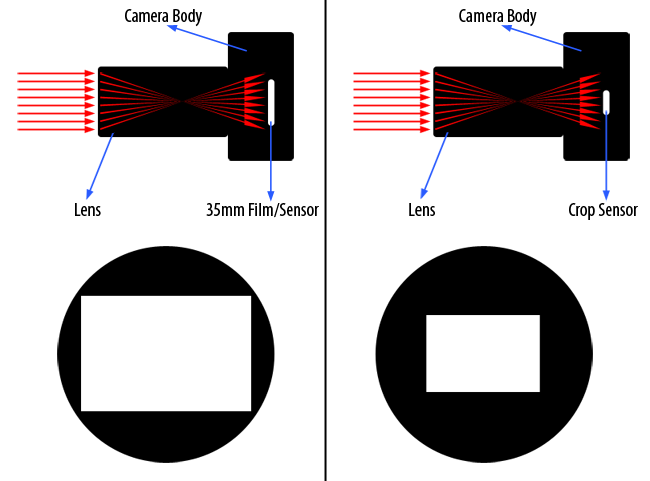 35mm Film / Full Frame vs APS-C / Crop Sensor Comparison
As a result of introducing this new format, manufacturers had to find a way to explain that the smaller format does impact a few things. For example, looking through a 50mm lens on an APS-C sensor camera did not provide the same field of view as when using that same lens on a 35mm film or a full-frame digital camera. How do you explain that to the customer? And so manufacturers started using such terms as “equivalent” and “comparable” in reference to 35mm, mostly targeting existing film shooters and letting them know what converting to digital really meant. Once full-frame cameras became more popular and manufacturers produced more cheaper and smaller lenses for the APS-C format, then we started seeing “advantages” of the smaller format when compared to full-frame. Marketers quickly moved in to tell the masses that a smaller format was a great choice for many, because it was (or, actually, has become) both cheaper and lighter.
To summarize, the APS-C format was only born because it was more economical to make and easier to sell – it was never meant to be a format that competes with larger formats in terms of weight or size advantages as it does today.
2) The Birth of APS-C / DX / EF-S Lenses
Although the first APS-C cameras were used with 35mm lenses that were designed for film cameras, manufacturers knew that APS-C / crop sensors did not utilize the full image circle. In addition, there was a problem with using film lenses on APS-C sensors – they were not wide enough! Due to the change in field of view, using truly wide angle lenses for 35mm film was rather expensive, choices were limited and heavy. Why not make smaller lenses with a smaller image circle that can cover wider angles without the heft and size? That’s how the first APS-C / DX / EF-S lenses were born. Nikon’s first DX lens was the Nikkor 12-24mm f/4G lens to cover wide angles and Canon’s first lenses were the EF-S 18-55mm f/3.5–5.6 and EF-S 10-22mm f/4.5–5.6, which were also released to address similar needs, but for more budget-conscious consumers. Interestingly, despite the efforts by both manufacturers to make smaller and more affordable lenses, neither DX, nor EF-S lines really took off. To date, Nikon has only made 23 DX lenses in total, only two of which can be considered of “professional” grade, while Canon’s EF-S lens line is limited to 21 lenses, 8 of which are variations of the same 18-55mm lens. Canon does not have any professional grade EF-S “L” lenses in its line. So the idea of providing lightweight and smaller lens options of high grade was not something Nikon or Canon truly wanted to do, when they could crank out lenses for full-frame cameras.
3) The Need for Lens Equivalence and Crop Factor
Since the APS-C format was relatively new and the adoption rate of 35mm film cameras was very high in the industry, field of view equivalence often expressed as “equivalent focal length” made sense. It was important to let people know that a 50mm lens gave a narrower field of view on APS-C, similar to a 75mm lens on a 35mm film / full-frame camera. Manufacturers also came up with a formula to compute the equivalent field of view in the form of a “ crop factor” – the ratio of 35mm film diagonal to the APS-C sensor diagonal. Nikon’s APS-C sensors measuring 24x16mm have a diagonal of 29mm, while full-frame sensors measuring 36×24 have a diagonal of 43mm, so the ratio difference between the two is approximately 1.5x. Canon’s APS-C sensors are slightly smaller and have a crop factor of 1.6x. So calculating the equivalent field of view got rather simple – take the focal length of a lens and multiply it by the crop factor. Hence, one could easily calculate that a 24mm lens on a Nikon DX / APS-C camera was similar to a 36mm lens on a full-frame camera in terms of field of view.
However, over time, the crop factor created a lot of confusion among beginners. People started to say things like “Image was captured at 450mm focal length”, when in fact they shot with a 300mm lens on an APS-C camera. They felt like they could say such things, thinking their setup was giving them longer “reach” (meaning, allowing to get closer to action), while all it did was give them narrower field of view due to sensor cropping the image frame. So let’s establish the very first fact: the focal length of a lens never changes no matter what camera it is attached to.
4) Lens Focal Length vs Equivalent Focal Length
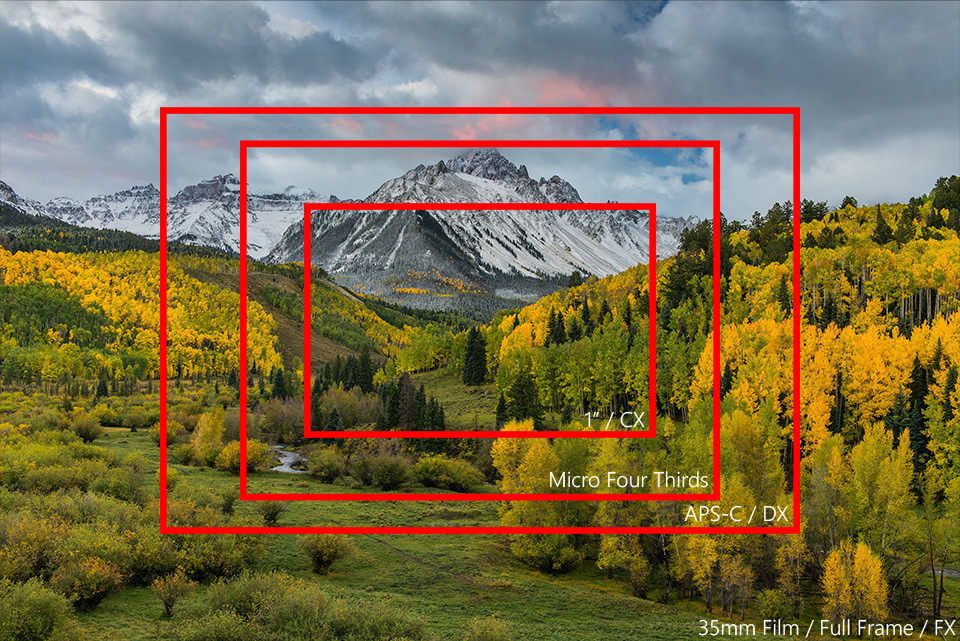
Whether you mount a full-frame lens on a full-frame, APS-C, Micro Four Thirds or 1″ CX camera, the physical properties of the same lens never change – its focal length and aperture stay constant. This makes sense, as the only variable that is changing is the sensor. So, those that say that “a 50mm f/1.4 lens is a 50mm f/1.4 lens no matter what camera body it is attached to” are right, but with one condition – it must be the same lens (more on this below). The only thing that can change the physical properties of a lens is another lens, such as a teleconverter. Remember, focal length is the distance from the optical center of the lens focused at infinity to the camera sensor / film, measured in millimeters. All that happens as a result of a smaller image format / sensor is cropping, as illustrated in the below image:
 35mm / Full-Frame vs APS-C vs Micro Four Thirds vs 1″ / CX
If I were to mount a 24mm full-frame lens on an APS-C camera to capture the above shot, I would only be cutting off the corners of the image – not getting any closer physically. My focal length does not change in any way. It is still a 24mm lens. In terms of equivalent focal length, the resulting crop would give me a narrower field of view that is equivalent to what a 36mm lens would give on a full-frame camera. However, the key word here is “field of view”, as that’s the only thing that differs. This is why I prefer to use the term “equivalent field of view”, rather than “equivalent focal length”, as there is no change in focal length.
If you were to try a quick experiment by taking a full-frame lens and mounting it on a full-frame camera, then mounting the same lens on different camera bodies with smaller sensors using adapters (without moving or changing any variables), you would get a similar result as the above image. Aside from differences in resolution (topic discussed further down below), everything else would be the same, including perspective and depth of field (actually DoF can be different between sensor sizes, see references to DoF below). So the background and foreground objects would not appear any closer or further away, or look more or less in focus. What you would see is in-camera cropping taking place, nothing more.
The above is a rather simplified case, where we are taking a full-frame lens with a large image circle and mounting it on different cameras with smaller sensors using adapters. Without a doubt, the results will always be the same with the exception of field of view. However, that’s not a practical case today, since smaller sensor cameras now have smaller lenses proprietary to their camera systems and mounts. Few people use large lenses with smaller formats than APS-C, because mount sizes are different and they must rely on various “smart” or “dummy” adapters, which unnecessarily complicate everything and potentially introduce optical problems. Again, there is no point in making large lenses for all formats when the larger image circle is unused. When manufacturers make lenses for smaller systems, they want to produce lenses as small and as lightweight as possible. So when new interchangeable lens camera systems were introduced from manufacturers like Sony, Fuji, Olympus, Panasonic and Samsung, they all came with their “native” compact and lightweight lenses, proprietary to their lens mounts.
5) ISO and Exposure / Brightness
In film days, ISO stood for the sensitivity of film. If you shot with ISO 100 film during daylight and had to move to low light conditions, you had to change out film to a higher sensitivity type, say ISO 400 or 800. So traditionally, ISO was defined as “the level of sensitivity of film to available light”, as explained in my article on ISO for beginners. However, digital sensors act very differently than film, as there is no varying sensitivity to different light. In fact, digital sensors only have one sensitivity level. Changing ISO simply amplifies the image signal, so the sensor itself is not getting any more or less sensitive. This results in shorter exposure time / more brightness, but with the penalty of added noise, similar to what you see with film.
To make it easier for film shooters to switch to digital, it was decided to use the same sensitivity in digital sensors as in film, so standards were written such as the ISO 12232:2006, which guide manufacturers on how exposure should be determined and ISO speed ratings should be set on all camera systems. After-all, ISO 100 film was the same no matter what camera you attached that film to, so it made sense to continue this trend with digital. These standards are not perfect though, as the way “brightness” is determined can depend on a number of factors, including noise. So there is a potential for deviations in brightness between different camera systems (although usually not by more than a full stop).
However, once different sensor sizes came into play, things got a bit more complex. Since the overall brightness of a scene depends on the exposure triangle comprised of ISO, Aperture and Shutter Speed, there are only two variables that can change between systems to “match” brightness: ISO and Aperture (Shutter Speed cannot change, as it affects the length of exposure). As you will see below, the physical size of aperture when looking at “equivalent lenses” in terms of field of view between different formats varies greatly, due to the drastic change in focal length. In addition, sensor performance can also be drastically different, especially when you look at the first generation CCD sensors versus the latest generation CMOS sensors. This means that while the overall brightness is similar between systems, image quality at different ISO values could differ greatly.
Today, if you were to take an image with a full-frame camera at say ISO 100, f/2.8 and 1/500 shutter speed, and took a shot with a smaller sensor camera using identical settings, the overall exposure or “brightness” of the scene would look very similar in both cases. The Nikon D810 (full-frame) at ISO 100, f/2.8, 1/500 would yield similar exposure as the Nikon 1 V3 (1″ CX) at ISO 100, f/2.8, 1/500. On one hand this makes sense, as it makes it easy for one to reference exposure settings. But on the other hand, the way brightness is yielded is different – and that brings a lot of confusion to the already confusing topic. Yes, exposure values might be the same, but the amount of transmitted light might not! The big variable that differs quite a bit across systems is the lens aperture, specifically its physical size. Although the term aperture can mean a number of different things (diaphragm, entrance pupil, f-ratio), in this particular case I am referring to the physical size, or the aperture diameter of a lens as seen from the front of the lens, also known as the “entrance pupil”. The thing is, a full frame lens will have a significantly larger aperture diameter than an equivalent lens from a smaller system. For example, if you compare the Nikkor 50mm f/1.4G lens with say the Olympus 25mm f/1.4 (50mm equivalent field of view relative to full-frame), both will yield similar brightness at f/1.4. However, does it mean that the much smaller Olympus lens is capable of transmitting the same amount of light? No, absolutely not. It just physically cannot, due to the visibly smaller aperture diameter. Let’s take a look at the math here.
6) Aperture and Depth of Field
Since the f number (in this case f/1.4) represents the ratio between the focal length of the lens and the physical diameter of the entrance pupil, it is easy to calculate the size of the aperture diameter on the Nikkor 50mm f/1.4G. We simply take the focal length (50mm) and divide it by its maximum aperture of f/1.4. The resulting number is roughly 35.7mm, which is the physical size of the aperture diameter, or the entrance pupil. Now if we look at the Olympus 25mm f/1.4 lens and apply the same math, the aperture diameter turns out to be only 17.8mm, exactly twice less! So despite the fact that the two lenses have the same f-number and cover similar fields of view, their aperture sizes are drastically different – one transmits four times more light than the other.
Let’s take this a step back and understand why we are comparing a 50mm to a 25mm lens in the first place. What if we were to mount the Nikkor 50mm f/1.4G lens on a Micro Four Thirds camera with an adapter – would the light transmission of the lens be the same? Yes, of course! Again, sensor size has no impact on light transmission capabilities of a lens. In this case, the 50mm f/1.4 lens remains a 50mm f/1.4 lens whether it is used on a full-frame camera or a Micro Four Thirds camera. However, what would the image look like? With a drastic “crop”, thanks to the much smaller Micro Four Thirds camera that has a 2.0x crop factor, the field of view of the 50mm lens would make the subject appear twice closer, as if we were using a 100mm lens, as illustrated in the below image:
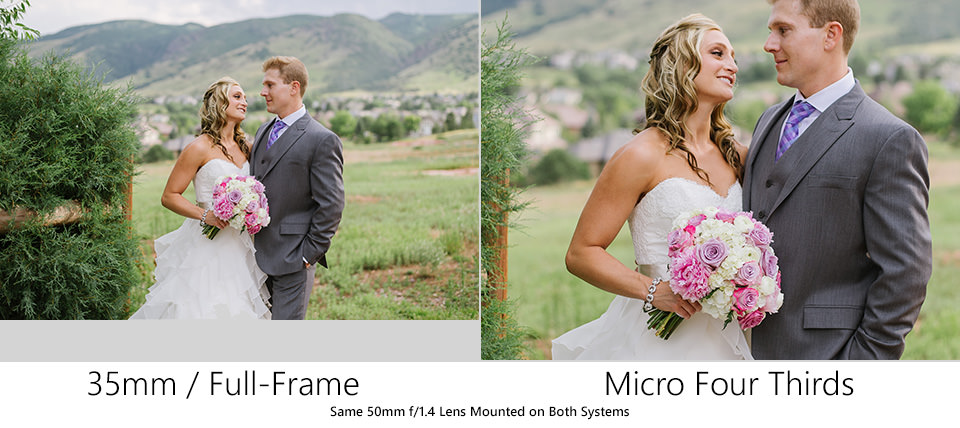
As you can see, the depth of field and the perspective we get from such a shot would be identical on both cameras, given that the distance to our subjects is the same. However, the resulting images look drastically different in terms of field of view – the Micro Four Thirds image appears “closer”, although it is really not, as it is just a crop of the full-frame image ( a quick note: there is also a difference in aspect ratio of 3/2 vs 4/3, which is why the image on the right is taller).
Well, such tight framing as seen on the image to the right is typically not desirable to photographers, which is why we tend to compare two different systems with an equivalent field of view and camera to subject distance. In this case, we pick a 50mm full-frame lens versus a 25mm Micro Four Thirds lens for a proper comparison. But the moment you do that, two changes take place immediately: depth of field is increased due to change in focal length, and background objects will appear less blurred due to not being as enlarged anymore. Do not associate the latter with bokeh though – objects will appear less enlarged because of physically smaller aperture diameter. If you have a hard time understanding why, just do quick math with a 70-200mm f/2.8 lens. Did you ever wonder why at 200mm the background appears more enlarged compared to 70mm? No, it is not depth of field to blame for this, not if you frame the subject the same way! If you stand 10 feet away from your subject and shoot at 100mm @ f/2.8, the aperture diameter equals 35.7mm (100mm / 2.8). Now if you double the distance from your subject by moving back 20 feet and shoot at 200mm @ f/2.8, your aperture diameter / entrance pupil is now significantly bigger, it is 71.4mm (200mm / 2.8). As a result of this, the larger aperture diameter at 200mm will actually enlarge the background more, although depth of field remains exactly the same. That’s why shooting with a 70-200mm f/2.8 lens yields aesthetically more pleasing images at 200mm than at 70mm! Some people refer to this as compression, others call it background enlargement – both mean the same thing here.
A quick note on compression and perspective: it seems like people confuse the two terms quite a bit. In the above example, we are changing the focal length of the lens from 70mm to 200mm, while keeping the framing the same and the f-stop the same (f/2.8). When we do this, we are actually moving away from the subject that we are focusing on, which triggers a change in perspective. Perspective defines how a foreground element appears in relation to other elements in the scene. Perspective changes not because of a change in focal length, but because of a change of camera to subject distance. If you do not move away from your subject and simply zoom in more, you are not changing the perspective at all! And what about compression? The term “compression” has been historically wrongly associated with focal length. There is no such thing as “telephoto compression”, implying that shooting with a longer lens will somehow magically make your subject appear more isolated from the background. When one changes the focal length of a lens without moving, all they are doing is changing the field of view – the perspective will remain identical.
In this particular case, how closely background objects appear relative to our subject has nothing to do with how blurry they appear. Here, blur is the attribute of the aperture diameter. If you are shooting a subject at 200mm f/2.8 and then stop the lens down to f/5.6, the background elements will appear smaller, because you have changed the physical size of the aperture diameter. Your depth of field calculator might say that your DoF starts at point X and ends at point Y and yet the background that is located at infinity will still appear less blurry. Why? Again, because of change in aperture diameter. So going back to our previous example where we are moving from 70mm f/2.8 to 200mm f/2.8, by keeping the framing identical and moving away from the subject, we are changing the perspective of the scene. However, that’s not the reason why the background is blurred more! The objects in the background appear larger due to change in perspective, however, how blurry they appear is because I am shooting with a large aperture diameter. Now the quality of blur, specifically of highlights (a.k.a. “Bokeh”) is a whole different subject and that one hugely depends on the design of the lens.
Going back to our example, because of the change in aperture diameter and focal length, you will find things appearing more in-focus or less blurry than you might like, including objects in the foreground and background. Therefore, it is the shorter focal length, coupled with the smaller aperture diameter that make things appear less aesthetically pleasing on smaller format systems.
At this point, there are three ways one could effectively decrease depth of field and enlarge the out of focus areas in the background:
- Get physically closer to the subject
- Increase the focal length while maintaining the same f-stop
- Use a faster lens
Getting physically closer to the subject alters the perspective, resulting in “ perspective distortion“, and increasing focal length translates to the same narrow field of view issue as illustrated in the earlier example, where you are too close to the subject.
It is important to note that any comparisons of camera systems at different camera to subject distances and focal lengths are meaningless. The moment you or your subject move and the focal lengths differ, it causes a change in perspective, depth of field and background rendering. This is why this article excludes any comparisons of different formats at varying distances.
Neither of the two options above are usually workable solutions, so the last option is to get a faster lens. Well, that’s where things can get quite expensive, impractical or simply impossible. Fast aperture lenses are very expensive. For example, the excellent Panasonic 42.5mm f/1.2 Micro Four Thirds lens costs a whopping $1,600 and behaves like an 85mm f/2.5 lens in terms of field of view and depth of field on a full-frame camera, whereas one could buy a full-frame 85mm f/1.8 lens for one third of that. Manual focus f/0.95 Micro Four Thirds lenses from a number of manufacturers produce similar depth of field as an f/1.9 lens, so even those could not get close to f/1.4 aperture on full-frame (if you find the aperture math confusing, it will be discussed further down below).
You have probably heard people say things like “to get the same depth of field as a 50mm f/1.4 lens on a full-frame camera, you would need a 25mm f/0.7 lens on Micro Four Thirds camera”. Some even question why there is no such lens. Well, if they knew much about optics, they would understand that designing an f/0.7 lens that is optically good and can properly autofocus is practically an impossible job. That’s why such fast lenses with AF capabilities will most likely never exist for any system. Can you imagine how big such a lens would look like?
This all leads to the next topic – Aperture Equivalence.
7) Aperture Equivalence
In my previous example, I mentioned that the Panasonic 42.5mm f/1.2 Micro Four Thirds lens is equivalent to an 85mm f/2.5 full-frame lens in terms of light transmission capabilities. Well, it makes sense if one is to look at the aperture diameter / entrance pupil of both lenses, which roughly measure between 34mm and 35mm. Because such lenses would transmit roughly the same amount of light, yield similar depth of field and have similar field of view, some would consider them to be “equivalent”.
As a result of the above, we now we have people that are saying that we should be computing equivalence in terms of f-stops between different systems, just like we compute equivalence in field of view. Some even argue that manufacturers should be specifying equivalent aperture figures in their product manuals and marketing materials, since giving the native aperture ranges is lying to customers. What they do not seem to get, is that the manufacturers are providing the actual physical properties of lenses – the equivalent focal lengths are there only as a reference for the same old reasons that existed since film days, basically to guide potential 35mm / full-frame converts. Another key fact, is that altering the f-stop results in differences in exposure / brightness. The same Panasonic 42.5mm f/1.2 at f/1.2 will yield a brighter exposure when compared to an 85mm f/2.5 full-frame lens, because we are changing one of the three exposure variables.
So let’s get another fact straight: smaller format lenses have exactly the same light gathering capabilities as larger format lenses at the same f-stop, for their native sensor sizes. Yes, larger aperture diameter lenses do transmit more light, but more light is needed for the larger sensor, because the volume and the spread of light also must be large enough to cover the bigger sensor area. The Panasonic 42.5mm f/1.2 may behave similarly to an 85mm f/2.5 lens in terms of aperture diameter / total light transmission, field of view and depth of field, but the intensity of light that reaches the Micro Four Thirds sensor at f/1.2 is very different than it is for an f/2.5 lens on a full-frame camera – the image from the latter will be underexposed by two full stops. In other words, the intensity of light that reaches a sensor for one format is identical to the intensity of light that reaches a sensor of a different format at the same aperture. It makes no sense to make a Micro Four Thirds lens that covers as big of an image circle as a full-frame lens, if all that extra light is wasted. Plus, such lenses would look ridiculously big on small cameras.
It is important to note that although the comparison above is valid technically, a larger sensor would yield cleaner images and would allow for faster and less expensive lenses, as pointed out earlier.
8) Total Light
“Equivalence” created another ugly child: total light. Basically, the idea of total light is that smaller sensors get less total light than larger sensors just because they are physically smaller, which translates to worse noise performance / overall image quality. For example, a full-frame sensor looks two stops cleaner at higher ISOs than say Micro Four Thirds, just because its sensor area is four times larger. I personally find the idea of “Total Light” and its relevance to ISO flawed. Explaining why one sensor has a cleaner output when compared to a smaller one just because it is physically larger has one major problem – it is actually not entirely true once you factor in a couple of variables: sensor technology, image processing pipeline and sensor generation. While one cannot argue that larger sensors do physically receive more light than their smaller counterparts, how the camera reads and transforms the light into an image is extremely important. If we assume that the physical size of a sensor is the only important factor in cameras, because it receives more total light, then every full-frame sensor made to date would beat every APS-C sensor, including the latest and greatest. Consequently, every medium format sensor would beat every full-frame sensor made to date. And we know it is not true – just compare the output of the first generation Canon 1DS full-frame camera at ISO 800 to a modern Sony APS-C sensor (have a peek at this review from Luminous Landscape) and you will see that the the latter looks better. Newer sensor technologies, better image processing pipelines and other factors make modern sensors shine when compared to old ones. Simply put, newer is better when it comes to sensor technology. APS-C has come far along in terms of noise performance, easily beating first generation full-frame sensors in terms of colors, dynamic range and high ISO performance. CMOS is cleaner at high ISO than old generation CCD that struggled even at ISO 400! Until recently, medium format cameras used to be terrible at high ISOs due to use of CCD sensors (which have other strengths). But if we look at “total light” only from the perspective of “bigger is better”, then medium format sensors are supposed to be much better than full-frame just because their sensor sizes are bigger. Looking at high ISO performance and dynamic range of medium format CCD sensors, it turns out that it is actually not the case. Only the latest CMOS sensors from Sony made it possible for medium format to finally catch up with modern cameras in handling noise at high ISOs.
My problem with “total light” is that it is based on the assumption that one is comparing sensors of the same technology, generation, analog to digital conversion (ADC), pixel size / pitch / resolution, RAW file output, print size, etc. And if we look at the state of the camera industry today, that’s almost never the case – sensors differ quite a bit, with varying levels of pixel size and resolution. In addition, cameras with the same sensors could potentially have different SNR and dynamic range performance. The noise we see on the Nikon D4s looks different than on the Nikon D810, the Canon 5D Mark III or the Sony A7s, even when all three are normalized to the same resolution…
So how can one rely on a formula that assumes so much when comparing cameras? The results might be mostly accurate given the state of the camera industry today (with a few exceptions), so it is one’s individual choice if “mostly good enough” is acceptable or not. Total light is only true if you are looking at cameras like Nikon D800 and D7000, which have the same generation processors and same pixel-level performance. In all other cases, it is not 100% safe to assume that a sensor is going to perform relative to its physical size. Smaller sensors are getting more efficient than larger sensors and bigger is not always better when you factor in size, weight, cost and other factors. In my opinion, it is better to skip such concepts when comparing systems, as they can potentially create a lot of confusion, especially among beginners.
9) Circle of Confusion, Print Size, Diffraction, Pixel Density and Sensor Resolution
Here are some more topics that will give you headache quickly: circle of confusion, print size, diffraction, pixel density and sensor resolution. These five bring up additional points that make the subject of “equivalence” truly a never-ending debate. I won’t spend a whole lot of time on this, as I believe it is not directly relevant to my article here, so I just want to throw a couple of things at you to make you want to stop reading this section. And if your head hurts already, just move on and skip all this junk, since it really does not matter (actually, none of the above really matters at the end of the day, as explained in the Summary section of this article).
9.1) Circle of Confusion
Every image is made out of many dots and circles, because light rays reaching the film / sensor are always in circular shape. These circular shapes or “blur spots” can be very small or very large. The smaller these blur spots are, the more “dot-like” they appear to our eyes. Basically, circle of confusion is better defined by Wikipedia as “the largest blur spot that will still be perceived by the human eye as a point”. Any part of an image, whether printed or viewed on a computer monitor that appears blurry to our eyes is only blurry because we can tell that it is not sufficiently sharp. When you get frustrated with taking blurry pictures, it happens because your eyes are not seeing enough details, so your brain triggers a response “blurry”, “out of focus”, etc. If you had bad vision and could not tell a difference between a sharp photo and a soft / blurry one, you might not see what others can. That’s why the subject of circle of confusion is so confusing – it does not take into account that your vision could be below “good”, with the ability to resolve or distinguish 5 line pairs per millimeter when viewing an image at a 60° angle and viewing distance of 10 inches (25 cm). So the basic assumption is that the size of the circle of confusion, or the largest circular shape that you still perceive as a dot, is going to be approximately 0.2mm based on the above-mentioned 5 lines per millimeter assumption (a line every fifth of a millimeter equals 0.2mm). What does this have to do with equivalence, you might ask? Well, it affects it indirectly, because it is closely tied to print size and a few other things.
9.2) Print Size and Sensor Resolution
Believe it or not, but most camera and sensor comparisons we see today directly relate to print size, as strange as it may sound! Why? Because it is automatically assumed that we take pictures in order to produce prints, the final end point of every photograph. Now the big question that comes up today, which probably sparks as many heated debates as the subject of equivalence, is “how large can you print”. This is where circle of confusion creates more confusion, because how big one can print hugely depends on what they deem “acceptable” in terms of sharpness perception at different viewing distances. If you listen to some old timers that used to or still shoot 35mm film, you will often hear them say that resolution or sharpness are not important for prints at all and that they used to print huge 24×36″ or 30×40″ prints (or larger) using 35mm film, which looked great. You will probably hear a similar story from early digital camera adopters, who will be keen to show you large prints in their living rooms from cameras that only had 6-8 megapixels. At the same time, you will also come across those, that will be telling you all about their super high resolution gigapixel prints that are more detailed than what your eyes can distinguish, telling you how life-like and detailed their prints look.
Who is right and who is wrong? Well, that’s also a very subjective opinion that will create heated debates. Old timers will laugh at the high resolution prints, telling you that you would never be looking at them that close anyway, while others will argue that a print must be very detailed and should look good at any distance to be considered worthy of occupying your precious wall space. And successful photographers like Laura Murray, who almost exclusively shoot with film will be selling prints of scanned film like this at any size their clients want, while some of us will still be debating about which camera has the best signal to noise ratio:
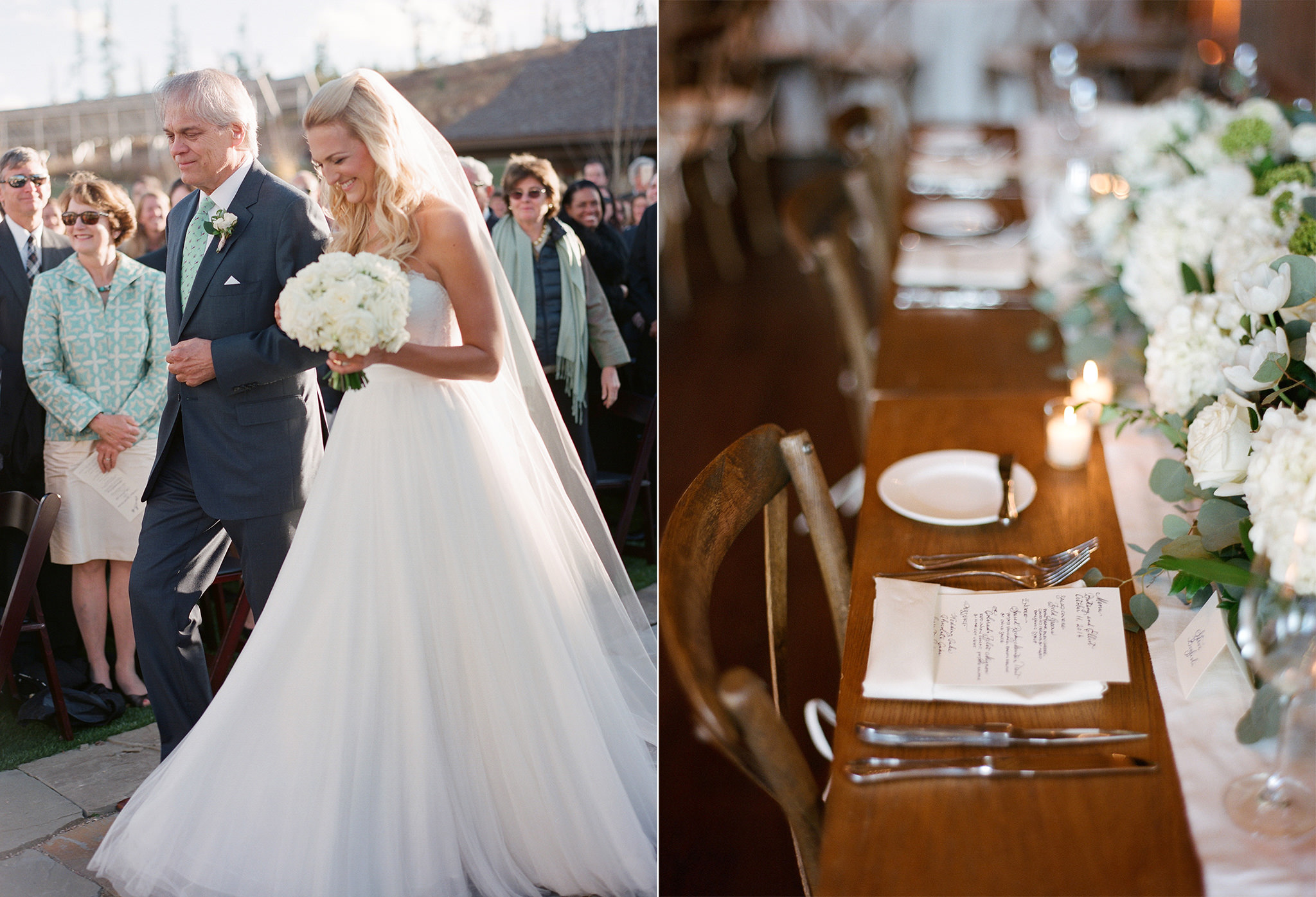 Contax MF Film by Laura Murray Photography
A big spoiler for pixel-peepers – there is not a whole lot in terms of details in such photographs. Film shooters working in fast-paced environments like weddings rarely care about making sure that the bride’s closest eye looks perfectly sharp – they are there to capture the moment, the mood, the environment. Very few film shooters will be busy giving you a lecture on circle of confusion, resolution, diffraction or other non-relevant, unimportant (for them) topics. So who is right?
No matter which side you are on, by now you probably do recognize the fact that the world is moving towards more resolution, larger prints and more details. In fact, manufacturers are spending a lot of their marketing dollars on convincing you that more resolution is better with all the “retina” displays, 4K TVs and monitors. Whether you like it or not, you are most likely already sold on it. If you are not, then you represent a small percentage of the modern population that does not craze after more megapixels and gigapixels.
In fact, if you have been on the web long enough, you probably remember how the early days of the web used to look like, with tiny thumbnail-size images that looked big on our 256 color VGA screens. We at Photography Life do recognize that the world is moving towards high resolution and many of our readers are now reading the site with their “retina” grade or 4K monitors, expecting larger photographs for their enjoyment. So even if some of us here at PL hate the idea of showing you more pixels and how the new 36 MP sensor is better at ISO 25,600 than the previous generation 36 MP sensor, the world is moving in that direction anyway and there is not much we can do about it.
Let’s get back to our super technical, not-so-important discussion about why print size is dictating our comparisons. Well, considering that printers are limited at how many dots per inch they can print (and that limitation bar is also being raised year after year), the math that is currently applied at how big you should print for an image to look “acceptably sharp” at comfortable viewing distances is anywhere between 240 dots per inch (dpi) and 300 dpi, sometimes accepting certain prints to go down to 150 dpi. Well, if you correlate pixels and dots to 1:1 ratio, how big you can print with say a 16 MP resolution image versus a 36 MP resolution image (assuming that both contain enough detail and sharpness) without enlarging or reducing prints will be simple math – divide horizontal and vertical resolution by the dpi resolution you are aiming for, and you get the size. In the case of a 36 MP resolution image from the Nikon D800/D810, which produces files of 7,360×4,912 resolution, that translates to 24.53×16.37 inches (7360/300 = 24.53, 4912/300 = 16.37). So if you want a good quality print, the maximum you can produce out of a D800/D810 sensor is a 24×16″ print. Now what if we look at the Nikon D4s, which produces only 16 MP files with image resolution of 4,928 x 3,280. Applying the same math, the maximum print size you would get is 16×11″! Oh what a heck, that’s a $6500 camera that can only give you 16×11 versus a $3000 camera that can print much larger? What’s up with that? Well, this is when things get messy, bringing the whole print size debate into big question. But wait a minute, if all that matters for a print size is the damn pixel resolution, what about comparing the Nikon D4s with the Nikon D7000 or Fuji X-T1 that have the same 16 MP sensor / pixel resolution? Ouch, that’s when things get even more painful and confusing, as it is hard for someone to wrap their brain around the concept that a smaller sensor can produce images as big as a large sensor camera. And this is where we get into another can of worms, pixel density.
9.3) Pixel Density
So, we ended the last section with how a print from two different size sensors could yield the same size, as long as their pixel resolution was the same. Well, this is where it all comes together…hopefully. After manufacturers started making smaller sensors (initially for cost reasons as explained in the beginning of this article), they started to realize that there were other benefits to smaller sensors and formats that they could capitalize on. Well, it was basically the same story as Large Format vs Medium Format, or Medium Format vs 35mm Film – the larger you go, the more expensive it gets to manufacture gear. There was a reason why 35mm became a “standard” in the film industry, as not many were willing to spend the money to go Medium Format or larger due to development and print costs, gear, etc. So when APS-C became a widespread format, a number of manufacturers jumped in the mirrorless bandwagon and started to market the idea of going light, versus the big and bulky DSLRs. Within a few years, this “go light” became a trend, almost a movement. Companies like Fuji and Sony even started their anti-DSLR campaigns, trying to educate people not to buy DSLRs and buy smaller and lighter mirrorless cameras instead. It made sense and the campaign is slowly gaining traction, with more and more people switching to mirrorless.
Well, manufacturers realized that if they used the same pixel density on sensors (i.e. how many pixels there are per inch square of sensor surface) it would make the small sensor cameras look inferior, since their sensor surface area is obviously noticeably smaller. So they started pushing more and more resolution on smaller sensors by increasing pixel pitch, which made these smaller sensors appear “equivalent” (by now I hate this term!) to bigger formats. Same old Megapixel wars, except now we are confusing people with specifications that seem to be awfully similar: a $6500 Nikon D4s DSLR camera with 16 MP that is big, heavy and bulky vs a $1700 Fuji X-T1 mirrorless camera with the same 16 MP resolution. Or a camera phone with 41 megapixels on a tiny sensor…
However, despite what may sound like a bad idea, there was actually one big advantage to doing this – at relatively low sensitivities, smaller pixels did not suffer badly in terms of noise and manufacturers were able to find ways to “massage” high ISO images by applying various noise suppression algorithms that made these sensors look quite impressive. So more focus was put on making smaller sensors more efficient than their larger counterparts.
As I have explained in my “ the benefits of high resolution sensors” article, cramming more pixels tighter together might sound like a bad idea when you are looking at the image at pixel level, but once you compare the output to a smaller sized print from the same sized sensor camera with less pixels, the down-sampled / resized / normalized image will contain roughly the same amount of noise and its overall image quality will look similar. The biggest advantage in such a situation, is the pixel-level efficiency of the sensor at low ISOs. If a 36 MP camera can produce stunning-looking images at ISO 100 (and it does), people that shoot at low ISOs would get the benefit of larger prints, while those that shoot at high ISOs are not losing a lot in terms of image quality once they resize the image to lower resolution. In a way, it became a win-win situation.
What this means, is that when we deal with modern small sensor cameras, despite having a smaller physical sensor surface area, the large number of smaller pixels essentially “enlarges” images. Yes, once “normalized” to the same print size, smaller sensors will show more noise than their full-frame counterparts, but due to better sensor efficiency and more aggressive noise suppression algorithms, they look quite decent and more than “acceptable” for many photographers.
So if cramming more pixels together has its benefits, why not cram more? Well, that’s essentially what we are seeing with smaller sensor formats – they are cramming more pixels into their sensors. APS-C quickly went from 12 MP to 16 MP, then from 16 MP to 24 MP within the past 2 years and if we look at the pixel efficiency of the Nikon CX and Micro Four Thirds systems, DX could be pushing beyond 24 MP fairly soon (Samsung NX1 is already at 28 MP, thanks to EnPassant for reminding). With such small pixel size, we might be pushing beyond 50 MP on full-frame sensors soon too, so it is all a matter of time.
9.4) Pixel Density, Sensor Size and Diffraction
Now here is an interesting twist to this what-seems-like-a-never-ending debacle: since smaller sensors are essentially “magnified” with smaller pixels, that same circular form in the shape of circle of confusion is also…magnified. So this gave photography geeks yet another variable to add to the sensor “equivalence” – circle of confusion variance. Yikes! People even made up something called a “ Zeiss formula” (which as it turns out actually has nothing to do with Zeiss), that allows one to calculate the size of circle of confusion based on the physical sensor size. This has become so common, that such calculations have now been integrated into most depth of field calculators. So if you find yourself using one, look for “circle of confusion” and you will probably find that size for the format you selected. Given that all small sensors do pack more pixels per inch, it is actually safe to assume that the circle of confusion will be smaller for smaller systems, but the actual number might vary, since the calculation is still debated on what it is supposed to be. Plus, “magnification” is relative to the pixel size today – if in a few years we will be using twice smaller pixels on all sensors, those numbers will have to be revised and the formulas will have to be rewritten… Now in regards to diffraction, since diffraction is directly tied to the circle of confusion, if the latter is more “magnified”, then it is also safe to assume that smaller sensors exhibit diffraction at larger apertures. That’s why when you shoot with small format camera systems like Nikon CX, you might start seeing the effect of diffraction at f/5.6, rather than f/8 and above in camera systems with larger sensors.
9.5) High Speed APS-C Cameras
Once photographers started realizing these benefits, the field of view equivalency that we’ve talked about earlier started literally translating to the ability to magnify the subject more and potentially resolve more details. Since the barrier for entry into full-frame is still at around $1500, the introduction of high-resolution APS-C sensor cameras like the Canon 7D Mark II was greeted with a lot of fanfare, sparking heated discussions on advantages and disadvantages of high-speed APS-C DSLR cameras vs full-frame (in fact, many Nikon shooters are still waiting for a direct competitor to the 7D Mark II for this reason). Sadly though, just like the topic of equivalence, these discussions on APS-C vs full-frame lead nowhere, as both parties will happily defend their choices till their death.
You have probably heard someone say that they prefer shooting with cropped sensor cameras due to their “reach” before. The argument that is presented does make sense – a sensor with a higher pixel pitch (or more pixels per inch) results in more resolution and therefore translates to more details in an image (provided that the lens used is of high quality, capable of resolving those details). And higher resolution obviously translates to bigger prints, since digital images are printed at dots per inch – the more the dots, the larger the prints, as I have already explained before. Lastly, higher resolution also allows for more aggressive cropping, which is something that wildlife photographers always need.
If you are interested in finding out what I personally think about all this, here is my take: there are three factors to consider in this particular situation: Cost, Pixel Density and Speed. Take the D800/D810 cameras – 36 MP sensors with similar pixel density as 16 MP APS-C/DX cameras. If the D800/810 cameras offered the same speed as a high-end DX camera (say 8 fps or more) and cost the same as a high-end DX, the high-end DX market would be dead, no argument about it. And if you are to state that the newest generation 24 MP DX cameras have a higher pixel density, well, the moment manufacturers release an FX camera with the same pixel density (50+ MP), that argument will be dead again. Keep in mind, that at the time Nikon produced the D800, it had the same pixel density as the then current Nikon D7000 – so taking a 1.5x crop from the D800 produced a 16 MP image. One could state that the D800 was a D7000 + D800 in one camera body in terms of sensor technology and they would be right. But not in terms of speed – 6 fps vs 4 fps does make a difference for capturing fast action. If Nikon could make a 50+ MP full-frame camera that shoots 10 fps and costs $1800, high-end DX would make no sense whatsoever. But we know that such a camera would be impossible to produce with the current technology, which is why high-end DX is still desired. Now let’s look at the cost reason more closely. Not everyone is willing to drop $7K on a Nikon D4 or a Canon 1D X. But what if a full-frame camera with the same speed as the D4 was sold at $1800? Yup, high-end DX would again be dead. Why do people still want a high-end DX today? Well, looking at the above arguments, it is mostly about cost. All other arguments are secondary.
10) Equivalence is Absurd: CX vs DX vs FX vs MF vs LF
I bet by now you are thinking why in the world you even started to read this article. I don’t blame you, that’s how I felt, except my thought was “why am I even writing this article?” To be honest, I really thought about not publishing it for a while. But after seeing comments and questions come up more and more from our readers, I thought it would be good to put all of my thoughts on this matter in one article. In all honesty, I personally consider the subject of equivalence as absurd as it being confusing. Why are we still talking about equivalent focal lengths, apertures, depth of field, background blur and all other mumbo jumbo, when the whole point of “equivalence” was originally created for 35mm film shooters as a reference anyway? Who cares that 35mm film was popular – why are we still using it as the “bible” of standards? When Medium Format moves into the “affordable” range (which is already kind of happening with MF CMOS sensors and Pentax 645Z), are we going to go backwards in equivalence? By then, we might start seeing Large Format digital!
Let’s get the last fact right: at the end of the day, it all boils down to what works for you. If you only care about image quality, larger will always be better. It will come with weight and bulk, but it will give you the largest prints, the best image quality, paper-thin DoF, beautiful subject isolation, etc. But if your back cannot take it anymore and you want to go lightweight and compact, smaller systems are getting to the point where they are good enough for probably 90% of photographers out there. And if you want to go really small, just take a look at Thomas Stirr’s work on Nikon CX – perhaps it will make you reconsider what your next travel camera should be.
I love how our Bob Vishneski modified Fuji’s “ Evolution of the Photographer“, where Fuji wanted to show how nice it is to go lightweight with Fuji’s mirrorless system. Take a look at his version, it will crack you up (sorry Bob, I just could not resist!):
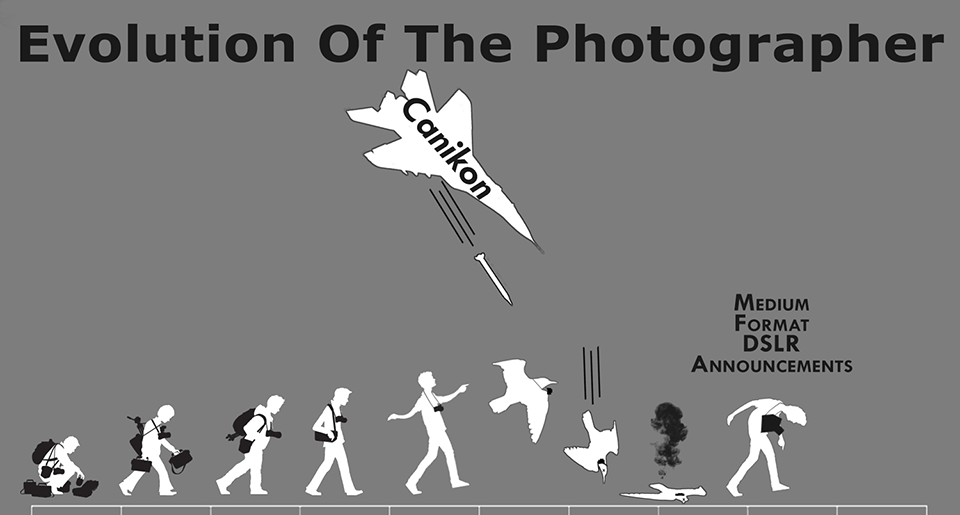 Evolution of the Photographer
And I loved this quote by our reader Betty, who summed up a lot of what I have said in this article: “As soon as you start using different cameras (!), with different processing engines (!), different sensors (!) and different pixel densities (!), and then start zooming a lens (!) to achieve or compensate for different crops, all bets are off. Your ‘results’ are meaningless”. What a great way to describe what a lot of us are sadly doing.
11) Summary: Everyone is Right, Everyone is Wrong
In all seriousness, let’s just drop this equivalence silliness. It is too confusing, overly technical and unnecessarily overrated. Keep in mind, that as the mirrorless format takes off, we will have a lot more people moving up from point and shoot / phone cameras. They don’t need to know all this junk – their time is better off learning how to use the tools they already have.
Just get over this stupid debate. Everyone is right, everyone is wrong. Time to move on and take some great pictures!

About Nasim Mansurov
Nasim Mansurov is the author and founder of Photography Life, based out of Denver, Colorado. He is recognized as one of the leading educators in the photography industry, conducting workshops, producing educational videos and frequently writing content for Photography Life. You can follow him on Instagram and Facebook. Read more about Nasim here.
Comments
-
“Therefore, it is the shorter focal length, coupled with the smaller aperture diameter that make things appear less aesthetically pleasing on smaller format systems.”
Whether greater DOF is “less pleasing” is entirely dependent on the subject and the photographer’s vision. Shallow DOF is not appropriate nor ideal for every subject.
-
A 3mp Samsung compact joke of a camera produced a huge 4ft x 3ft image that has graced my wall for decades and produced admiring comments, but it’s NOT sharp, DOESN’T have a high resolution, but is MASSIVELY atmospheric. If the image truly touches you, then it works.
-
Not confusing (for me)
I even want to write about subjects that go deeper into the conceptual side of things.
This is also not as absurd of a topic as the writer wants to suggest.
I talked recently with a young man who will be starting to work as a dentist and wants to also take macro shots of teeth and related items, for educational purposes.
He is someone who has used a camera before, who can understand math, and who asked me for advice on what to buy for his work.
I found myself talking about depth of field (which we want deeper, in this case) and how that relates to cropping / cropp-sized sensors, pixel density and all the concepts that many photographers are afraid of perusing.
Anyone who is thinking of investing in a camera system wants their money to go as far as possible (in the direction in which they intend to use the gear)
We need expertise to dispell marketing jargon and educate users to make better buying decisions.
I think that is the phase where we need this the most: before buying.
If you already own equipment, then use it and try to maximise its potential for the kind of work you are doing.
Before buying, you need to understand what a 1:1 magnification ratio means on different sensor sizes.
Yes, it means the same thing regardless of sensor size; a milimiter in real life will be projected onto a milimiter on the sensor, but an object that takes up 40% of the width of the sensor (and therfor the frame) when using a full-frame camera, will take up about 80% of the frame when using a micro-four-thirds camera and a lens with the same magnification.
Somebody needs to explain this to those starting out and that is why we, nerdy minds, are here.
- See Everything You Need to Know About Macro Photography by Spencer Cox, particularly the section What Is Magnification?.
photographylife.com/macro…y-tutorial
-
Cool! Thank you.
I will read that as well.
Reply - Thank you for your elaborate article. The sensor size APS-C was based on the new film size APS in the late 80’s- early 90’s. Even Leica made a nice and tiny camera for it. For a short while it was seen as the successor of 35, as it was more versatile.One could choose different formats for instance, it had a very nice possibility for panoramic pictures.
Helaas, it was short lived.
And, don’t forget that MFT is practically the equivalent of 110 film cassettes.
Most of the lenses used today are based on age-old film formats.
Some things just never fade away.
Reply 004. Not confused at all, thank you for taking the time to write this all down. Excellent.
I’ve used 35mm film in the past (Pentax user), Nikon DX (latest the D500), Nikon 1, (J2/J5), MFT (Olympus OM-D EM-1 MKII) and each has it’s benefits. I was really sad Nikon dropped the 1 range, it deserved better, they are great cameras. One day I may move to a larger format sensor, who knows. And who knows, I may even invest in a second hand Nikon film camera and use some the the lenses I have that can be used on it to get that “full frame” experience.
-
Nasim, I always appreciate your sense of humor. It balances your frustration with this crunchy topic while still clearly communicating your love of photography, which is what makes even a dense article a delight for readers. Thank you!
-
Before I read this article, I was confused. Now, I’m confused and my head hurts. Thank you?
Seriously, though, thank you for an in-depth article that has convinced me to stop thinking about equivalence. Even if I could determine it exactly, it’s not worth the effort.
-
love to learn more topics.
-
This is by far one of the most comprehensive and well articulated articles for a beginning photographer looking to learn their equipment, that I’ve ever read. There is such a natural flow to the way you lay out each point and then connect them together and subsequently differentiate them. For someone new to photography, I’d like to tell you why I’m so appreciative of the research and effort that went into this body of work.
When you are “new the game” or what some people call a Johnny-come-lately LOL, a lot of these terms or perhaps even none of these terms make a ton of sense isolated or in relation to one another. This article did a phenomenal job at helping me understand what it is that I have, how to best utilize it, how to understand what it is that I’m looking at when I’m purchasing items, and what not to get hung up on so that I can just get out there and shoot!
It’s been a while since I’ve felt like a forum earned my subscription to their content, whatever it may be so bravo to you, well done!
And as I’m writing this I’m just realizing that you’re located in Denver Colorado where I am! That’s awesome! I’ll have to see if you have any upcoming classes! Cant wait to take a look around the site!
This was just what I needed, Thanks Nasim!
-
Sensors should be interchangeable like old film rolls. We should be able to try the sensor we want. Whichever sensor we like, we get its top models so
-
It is almost 2019 now and I have these thoughts:
1. Nobody prints anymore
2. Video is more engaging
3. Any camera even a cell phone camera can take 8 or more megapixels
Because of those factors, I don’t think advances in megapixels matters much.
Also, with 4K video, technically you can grab an 8MP frame anytime you want.
With Olympus cameras having sensor shift to create a multiple shot merged higher megapixel image, you don’t even need a better sensor.
You can even do that with a much lower resolution sensor: stack and merge them in Photoshop for less noise, higher detail and potentially use 4K frame grabs, too.
The argument against this is that there will be movement in the frames, but you can counter it with shots taken at maximal fps.
Besides, most high resolution images are mostly static, either landscape or for art/advertisement.
We are in the golden age of photography (because equipment is so good) yet nobody knows it.
All that being said, I have an A7r MkI with awesome resolution, but also have a GX85 with 14-140 lens for 4k video and stacked 16MP images that comes close. And I print 30×40, too.
-
Hi. I have some doubts. I understood that ISO number tells you the light that reaches the sensor “per inch square”, so if FF has 3 times more surface than m4/3, then the equivalent ISO is two steps of difference. So you can achieve the same image at 90mm f5.6 ISO800 with FF than at 45mm f2.8 ISO200 with m4/3.
What are your thoughts. I’m I right? Thanks!!!
-
Adding second reply here to correct typo:
“Exactly same focal length, apature and color, but it with a a little less and is a bit cheaper to build. ”
Should have read as:
“Exactly same focal length, apature and color, but it weighs a little less and is a bit cheaper to build.”
-
Just out of interest, what two Nikkor DX lenses did you have in mind when you stated:
“To date, Nikon has only made 23 DX lenses in total, only two of which can be considered of “professional” grade, …”
-
Hello Nasim,
nice article which proves your in depth knowledge of photography, but I have some problems with some conclusions. I might be totally wrong, and would be happy if you could point me to the flaws in my chain of thoughts.
You say, that all the equivalence thing is only complicated without helping anywhere, but how can you than state that “If you only care about image quality, larger will always be better.” (Section 10). For this you need to somehow create comparable pictures and need to know with which equipment to take them. So I think it is a closed argumentation that you should not compare different camera systems (because it is very complicated… ), but then you should stick to it and do not compare at all! And then you also should ask yourself why you compare cameras with different pixel count… there you also use “complicated” equivalence (e.g. the d850 and the d810).
For me, I do not care about any physics, or anything, but only about the pictures (including image quality,..) in a given situation I can take and at which costs (including weight,…). If it was for me they could sell magic unicorns conjuring the picture file onto my computer ;-D.
So I need somehow to compare all systems, manufacturers,… (and unicorns ;-D) and see what kind of pictures I can take with these at which costs. For this question is equivalence interesting for me. Yes I agree with you that it is complicated and confusing, but ideally there would be a site like dxomark which would really show graphs/number of equivalence which tells an not so experienced photographer like you what are the capabilities of a system/…. camera/…. . The same is already true for dxomark/… on another level, because no one has to understand the physics e.g. on the sensor level,…. and I really appreciate that.
For this comparison I want to take the same pictures with different systems. What does “same picture” means? It means for me that the print size, the perspective/compression/distanceToSubject and the depth of field, the brightness and the exposure time are the same. The math to do this can be mostly found in this article… .
The interesting thing I found with this is that e.g. the D500 and the D5 have almost the same performance (SNR, dynamic range, tonal range, color sensitivity //because you have to reduce the ISO by approximately 1 stop on the dx system, as implied in 8). I can no longer find a static difference in sensor performance depending on its size, worth mentioning, if the numbers are compensated.
There are still differences between models, manufacturers, technologies,… . If you try to select a camera system or sensor size, it is even more important that there are big differences in the existing lenses (compared with their equivalence values). But these differences are what tell you, what the pros and cons you have for a system/model/… and now you can see the tradeoffs. I do not see a systematic trade off in image quality (if the needed lenses exist). But the possible choices of lenses do greatly differ and their compression and their equivalent aperture (influencing depth of field and possible brightness/image quality).
For me forgetting about the physics and concentrating on the ability to do the “job” is a great benefit. Is there a flaw in this idea?
(I imagine that you role your eyes when you see that this article never dies, so I thank you for your kind patience!)
-
Wow! It’s great to articles like this with comments going back quite a few years. I think it shows how relevant it is.
Anyway, I’m in the camp of, “If it’s a good picture, it is a good picture”. I really don’t care what camera a good picture was taken with.
-
I came across this fantastic article when I was looking for information about APS-C / DX / EF-S lenses. After reading it I still have one doubt. If I mount a 50mm f/1.8 (full-frame) lens on a APS-C body, will I have exactly the same FoV, perspective and total light as if I had mounted a 50mm f/1.8 (APS-C / DX / EF-S) lens?
- Yes. The same. I like to think of it like this. Imagine a full frame sensor is the size if an A4 page (or letter – depending which side is the Atlantic you are on) The “full frame” lens produces a circular image the size of a 12 in. pizza. It need to be that big to ensure the whole (A4/letter) sensor is covered. Now image an APS-C sensor. It’s only the size on an envelope. Same 12 in pizza image is cast over it..and most of it gone to waste. So now replace the lens with a DX instead. Exactly same focal length, apature and color, but it with a a little less and is a bit cheaper to build. It casts an image about the size of an 8in pizza. Still plenty big enough to cover the size of an envelope..which is all it’s designed to to.. but it wouldn’t be big enough to cover a full A4 page. You’d end up with black vignette in the corners of the page.
-
Adding secod reply here to correct above typo.
“Exactly same focal length, apature and color, but it with a a little less and is a bit cheaper to build.”
Should have read as:
“Exactly same focal length, apature and color, but it weighs a little less and is a bit cheaper to build.”
Reply 017. What a fantastic article – thank you! Admittedly, I only read the parts that particularly interested me.
While one could argue equivalency has no merit, it does. People need to understand that f1.8 on an iPhone is not the same as f1.8 on a full frame camera. You can get gorgeous shallow depth of field with latter, while you’re limited to photographing coffee mugs and xmas ornaments with the first one if your goal is shallow DOF. It’s convenient to camera manufacturers to convert focal length to 35mm equivalent (that makes zoom sound more impressive – and powerful zoom sells) while not converting aperture – no one wants a f8-f15 35mm equivalent zoom, it just sounds bad for someone who udnerstand anything about aperture. Those who care will learn at least the basics of these to predict the results they will get.
But I agree – everyone’s goal should be to put efforts into taking better photos. I remind myself all the time that I am the weakest link of the photography chain, not my cameras.
-
In most situations yes but sometimes it is needed to get similar effects. If you know what caused the differences you can easily adjust to make corrections.
-
Hi, thanks for the article.
My question relates to the focal length of a lens on cameras with different sensor sizes and its reach and this paragraph in particular:
“However, over time, the crop factor created a lot of confusion among beginners. People started to say things like “Image was captured at 450mm focal length”, when in fact they shot with a 300mm lens on an APS-C camera. They felt like they could say such things, thinking their setup was giving them longer “reach” (meaning, allowing to get closer to action), while all it did was give them narrower field of view due to sensor cropping the image frame. So let’s establish the very first fact: the focal length of a lens never changes no matter what camera it is attached to.”
Let me see if I can explain clearly. I did the following experiment.
1. I put a Minolta 50mm 1.7 lens on a Panasonic GH2 with a “dumb” Fotodiox MD to MFT adapter. If I understand correctly, the “crop factor” usually associated with the MFT format relative to FF is 2x.
2. Using the same camera and lens, I replaced the Fotodiox adapter with a Metabones Speedbooster (focal reducer) that is MD to MFT as well. The focal reduction from the Speedbooster is 0.71x so now the crop factor relative to FF is 1.42.
I don’t have 2 cameras but switching the adapters essentially created two different cameras. Call my first setup a standard MFT camera and the second with the Speedbooster something close to an APS-C camera.
I took pictures with both setups from the same distance.
Both pictures have a resolution of 4608 x 3456. I think that’s the GH2 max resolution.
I took a picture of a ceramic squirrel on my desk (again, from the same distance). In the picture taken with the dumb Fotodiox adapter (my “standard” MFT setup), the squirrel is clearly larger and the FOV narrower. Put another way, the camera used more of the 4608 x 3456 resolution on the squirrel.
My question: how is this NOT an extension of reach with this lens??? The lens on the MFT setup zoomed in more. The squirrel is bigger on the first picture compared to the second picture which has the same resolution. Is not the 50mm lens on the first setup behaving like a longer lens than it does on the second setup?
Thanks for any light you can shed on this, esp. as it has been a long time since the article was written. I’m sure I’m missing something here.
-
Not sure if we can ignore total light and equivalence completely? Olympus Stylus 1 has 28-300 f2.8 as advertised but I doubt if this is something that I can take to a indoor sports event and get decent photos.
-
Very nice summary. Could not agree more, talking about equivalence is futile other than FOV. Back in the film days these things seemed self evident, the current confusement is created by the fact that so many people are using interchangeable lens cameras with so many choices, plus digital imaging sensor technology, which ads to complexity.
Of course, the problem with even very good explanations is that most people just can’t go through them with enough thought, so the confusement will continue.
But anyways, thanks a lot, enjoyed reading.
-
Thanks a million helped me greatly to begin to understand everything. Three things I find wrong here.
1. To those who are crying about this or that is wrong – than you do it better. Please don’t criticize anything unless you can do better and it takes devotion to spend time and energy to write this in first place let alone knowledge and skill involved.
2. I got a Nikon d3200 and a week later Nikon emailed me about an $11,700.00 dollar lens and that was the sale price. Point of this statement is that if I had tens of thousands of dollars for a d4 and pro glass would have not got dx camera to start so most of us get Dx cameras and lenses because of cost factor and we just want to take pictures.
3. You can compare my Chevy to a rolls Royce but in the end who cares if you want the best and have unlimited funds go with the rolls but if you are like the rest of us than get the Chevy and don’t worry that the Chevy uses contact paper on dash and rolls uses real oak wood. Because in the end who cares unless you sold your sole to get a rolls and are bragging and rubbing it in to the rest of the world that we drive a Chevy. In the end both go from point a to point b period.
Again great article and thank you for taking the time and effort.
AJ
-
hi
Im trying to explain the basics of movie photography to my film student son. Ive told him that when filming headshots , or other shots where he wants to isolate the subject from the background, he should either get really close and take avantage of shallower depth of field at closer distances , or alternatively step back and use a longer lens then might otherwise be required to get the framing he wants. Now, having aways thought it was the change in focal length that had the desired effect of throwing the bgd out of focus when using a longer lens , thanks to your article (I think !!) I now understand why strictly speaking that is not correct and that in fact it is the change in aperture size (for a given f.stop but with a longer focal length lens) that throws the background out of focus. However, isn’t it just simpler to say “using a longer lens has the effect of throwing the bgd out of focus” – because in practical terms that is what in fact happens ?
-
Thank you. Nice article. I agree with all you have written. I think a great photo is taken by the photographer who understands the equipment he is using, regardless of the format. An excellent photo has less to do with the equipment than the photographer’s eye. Perfection can be obtained by being in the right place at the right time. Look back at so many of the Pulitzer prize photos and they were taken with an M6 35mm and a photographer that got off a couple good shots at the right time. Nothing else matters or will make you a better photographer. Cheers.
-
hi. Im a little bit confiused about the apertue . if a nikkor 50mm f1,4 has a physical diamètre of 35.7 in this case the nikkor 85mm f1,4 has a physical diamètre of 60.7 that is mean that the 85mm f1.4 transmit more light than 50mm f1.4.
thanks to clear up.
-
“I bet by now you are thinking why in the world you even started to read this article.”
Hahaaa! I was indeed wondering that!
I only came across this article when I was trying to figure out how to convert Micro Four Thirds to Nikon APS-C. I was trying to help a friend pick out lenses, but I only own MFT ones and they have a Nikon camera, so I couldn’t quite wrap my head around what the lengths of the lenses should be. The answer is: MFT length multiplied by approximately 1.34 equals APS-C length. Thanks for the help!
-
When you trust your eyes, you know what to use. It’s very simple / Artist, London
-
Wow! I can’t believe I read the whole thing! In spite of the hugely competent and highly detailed technical analysis I think I now have a much broader understanding of the BIG digital picture. Many kudos Nasim!! Like so many other photographers, I’ve grappled with the megapixel/sensor size questions for a few years now. About ten years ago, after shooting Nikon 35mm for 25 years, I gave up film and chose Canon for my first DSLR and now have a small investment in Canon lenses. Two years ago I moved up to a full frame 6D from a few different APS-C bodies. I am totally satisfied with the 6D. Yet, in spite of knowing about the megapixel myth, I recently bought the new EOS T6s, mostly out of out of curiosity. So far, I can say that it is more than adequate except at high ISO values where there is still some noticeable noise, unfortunate when high ISO is absolutely necessary. Otherwise the images are quite superb in almost every other respect. But, regardless of the increased pixel count and the faster processor, I still prefer the ergonomics and other advantages of my 6D. Pixels and processing power aren’t everything.
One thing I think is clear from this article is what I’ve been teaching my students all along: chose the camera that suits your needs. If you’re only going to post photos on Farcebook, then an iPhone is more than adequate. If you’re going to shoot weddings, a couple APSs with video capabilities should be all you need. If you’re shooting sports and have budget constraints, then the new 7D Mk II is your best bet. Going for large brick and mortar gallery prints? Get a full-frame with as many megapixels as you can afford. But the bottom bottom line is maybe simpler still: learn how to take better photos and even an 8-12MP camera will suffice for almost anything.
Many, many thanks to Nasim and to all who have added to this discussion. What a great forum!
-
loved this post techical approch
know, i think a functionnal approch will be as usefull, form a practical point of view,
Everyone is Right, Everyone is Wrong :yes but who for what ! differences are big and choice have stong consequences,so options (pros/cons) for each precise usage may help alot of confused people
(ie : nature photography from hide in lowlight vs bif far away in full sunlight !)
-
Thanks for taking such time and effort to produce a very helpful article.
-
Superb article that sums up all of my thoughts on the subject(s). Been shooting for 43 years now, have been on different camera formats back in the Film & Paper days, i own one FF body, and one M 4/3rd. Both fill my needs and my 4/3rd saves my old back and gives me an interesting video option (in 4k if i want to, but i am content at 1080p) I don’t even use a light or flashmeter anymore when doing studio work relying mostly on histogram evaluation and i modestly think i’m doing the best photography of my life doing things we old photogs didn’t even dream about just a few decades ago. Yet the best technology both in cameras and post process software are still to come. At the end of the day all that matters is the ability to make our personal vision come to life no matter what equipment we may have. Thank you very much for this brilliant article that really puts things into perspective (no pun intended). Now lets all go shoot the best shots of our lives :-)
-
Sorry Nasim, you have your facts wrong.
“So let’s get another fact straight: smaller format lenses have
exactly the same light gathering capabilities as larger format lenses at
the same f-stop, for their native sensor sizes.”
No. Smaller formats gather the same amount of light only if the physical aperture size are equivalent. For m43 vs. FF it means that f-number is half in m43 system vs. FF (1/2.8f @m43 == 1/5.6f @FF). Where you get it wrong is that you assume that camera’s ISO-value is somehow an absolute measure for camera system’s light-gathering capability, but it is not. ISO is a _relative_ parameter. With equivalent/same sensor technology ISO 800 in m43 provides same _image_-level noise as ISO 3200 in FF.
Yes, smaller sensor systems such as m43 have in general newer sensor tech vs. larger formats (FF, medium format) due to the economics of silicon manufacturing (manufacturing defects are roughly relative to chip/sensor area making larger sensor sizes substantially more expensive to manufacture). However, the Signal-to-noise (S/N) improvements of sensors (pixels) are getting smaller and smaller, so m43 is not catching up FF in terms of low-light imaging capabilities.
DPreview got the facts right, so why to write such a long misleading article? Why not to fix the article to reflect the reality?
www.dpreview.com/artic…d-i-care/4
- Oh No!
Someone on the internet is wrong – again!
Even though you might even be right, (although I doubt it but cannot be bothered to get my head around the convoluted reasoning), please give it a rest.
This subject has been nit picked to death.
-
If you do not understand, then it is better to be silent.
- I understand pretty well – see my posts, but this is so long after the event that it just looks like someone is trying to have a pop at Nasim on some semantic point which no one really gives a toss about.
After 198 comments, it’s just pointless nitpicking.
Nobody cares.
Reply 033. Very good article. It won’t help take better pictures only practice and learning my equipment will do that. Keep up the good work.
-
The final paragraph is the best part of the article!
-
A great article to exercise the mind although I have to say that sometimes people take these technicalities way too seriously. I am fortunate enough to run a modest photography business and have a D810, D300 with lens that match their sensor size and a X100T “fixed lens” as well as some other photography thingies. And I must say, I’ve never thought about all the stuff mentioned here as I take photos. Nice to know, but not really necessary to take a photo. I don’t need to know exactly how a TV works to watch one or how a car really works to drive one. So, why trip over all these “noise”? Took the image below with an LG G3 camera phone. No idea what the focal length or the lens f-number is…
-
A great article to exercise the mind although I have to say that sometimes people take these technicalities way too seriously. I am fortunate enough to run a modest photography business and have a D810, D300 with lens that match their sensor size and a X100T “fixed lens” as well as some other photography thingies. And I must say, I’ve never thought about all the stuff mentioned here as I take photos. Nice to know, but not really necessary to take a photo. I don’t need to know exactly how a TV works to watch one or how a car really works to drive one. So, why trip over all these “noise”? Took the image below with an LG G3 camera phone. No idea what the equivalent focal length or the lens f-number is… Didn’t actually stop me from taking a photo nevertheless.
-
Truly amazingly thoughtful, precise and clear writing style on a very complex evolving subject. You’ve added a lot to debate I had not encountered before.
Thank you.
logam
-
This is a classic article, thank you very much, Nasim.
It will help a person who plans to buy a digital camera system to make a objective decision based on the factual information rather than on the marketing cliches. Of course, photography in an art but it never hurts to know the science behind that art.
A lot great artists of the past knew their chemistry well and mixed their paints by themselves.
-
“There is no such thing as “telephoto compression”, implying that shooting with a longer lens will somehow magically make your subject
appear more isolated from the background. When one changes the focal length of a lens without moving, all they are doing is changing the
field of view – the perspective will remain identical.”
Telephoto compression does not mean your subject will “appear more isolated form the background.” That is shallow depth of field, another effect of telephoto lenses and large apertures. Telephoto and wide angle distortion are real and based on focal length to sensor size ratio. When a 50mm (equiv.) lens is said to be “honest” to the human eye, it means that the apparent relationships of near and far within the image match our human perceptions. Try this experiment. With full sensor, take a photo down a line of equally spaced telephone poles using 28mm lens. The perspective will “lie” and make the posts seem farther apart than they are. Wide angle distortion. Now attach a 135mm lens and shoot down the same line of poles. The telephoto distortion will make them appear very close together. Now attach the 50mm lens. They will appear the same distances apart at each distance away from you as your eyes see. Another fun area to investigate perspective distortion is wide angle portraits.
en.wikipedia.org/wiki/…ography%29
- Jan, perspective distortion is indeed real and it results from these two primary causes:
1. The difference between the angle of view captured by the camera and the angle of view that the print (or any other means of displaying the image) subtends at the eye of the viewer.
Suppose I’m in a room sized 3×3 metres. I stand with my back against one wall and use a wide-angle rectilinear lens to just contain the whole width of the opposite wall. I make a print from my image that is 3 meters wide and specify that viewers must stand approximately 3 metres away from the print to view it correctly: viewers will perceive an undistorted image. If a viewer ignores my specification and views my print from, say, 30 metres, they will indeed perceive highly unpleasant distortion in my print. The perceived distortion is perhaps best described as increasing stretching towards the corners of the image.
2. The difference between our 3-D stereoscopic visual perception of our world and the monoscopic limitation of 2-D photography. Here’s a fun tests to perform in private: Look at your face in a mirror when your nose is six to ten inches away from the mirror. Repeatedly cover and uncover one of your eyes with your hand until you have observed the perspective distortion that occurs with close-range monoscopic vision. Hint: pay particular attention to how you perceive the size of your nose relative to the size of your ears.
The distance between our eyes, their angle of view, and the hugely complex image processing performed by our visual cortex, all combine to allow us to perceive the 3-D object space that surrounds us in a form that minimizes close- and far-range perspective distortions. This enables us to make informed estimates of the sizes of objects and their distance away from us. This visual ability is geared towards ensuring the survival of our species rather than to provide an aesthetically pleasing perception of our world.
Photographers and artists who fail to take into account the difference between their captured angle of view and their presented image angle of view will frequently find themselves guilty of delivering a distorted perspective of their captured scenes.
-
Pete, you right a remarkable load of BS and clearly didn’t read my post. I guess you like to hear yourself mansplain. The first paragraph I have is a quote from the article. See the quotation marks? The author claims there is no perspective distortion. My post explain that there is and how it works in practical terms.
Your notion of telling people to view your prints form 3 meters is pretentious BS and not relevant to distortions caused by the lenses.
- Jan, please read my reply above.
- My apologies to you, Jan, I had assumed that you would be able to work out that viewing a 3m wide print from 3m subtends the same angle of view as viewing a 30 cm wide print from 30 cm etc. etc. because they subtend the same angle of view as captured by the camera in my example above. If the print subtends a substantially narrower angle of view then the perspective will appear to be increasingly distorted towards the corners of the print. This distortion is not caused by the lens per se, it is caused by simple geometry. Trigonometry does have practical uses in understanding photography — and in determining whether or not someone has written BS.
Going back to my example of photographing the room… We have a print 30 cm wide and 20 cm high (circa 12×8 inches) and view it from a distance of 30 cm. The centre of the print is 30 cm away, but the corners will be 35 cm away therefore the linear magnification in the corners is 86% of that in the centre. The image will not look distorted because it is being rendered in exactly the same manner in which it was captured and exactly how the photographer saw the room. As we move away from the print the corner magnification increasingly approaches that of the central magnification therefore the perspective looks distorted (stretching towards the sides and particularly stretched corners). The only way to compensate for this is to use special software to remap the image to a designated viewing angle. Obviously, if the remapped image is viewed too closely then it will look heavily distorted.
Note: This type of perspective distortion has nothing to do with lens pincushion/barrel distortion, which can be corrected automatically in-camera or by editing software.
Our stereoscopic vision, at near and very close ranges in 3-D object space, is geometrically similar to having a single lens with its entrance pupil located far behind the back of our head. You would be able to figure this out if you had bothered to perform the mirror test I suggested. Draw some simple ray diagrams, using the distance between your pupils, to fully understand why taking portraits at close distance produces apparent perspective distortion that is absent from our stereoscopic vision. There are some very good reasons for telecentric lenses being used in cinematography — they are rarely used in photography due to their cost.
The two separate effects that I have highlighted combine in various proportions and overall intensity depending on the viewing conditions of the displayed image. Furthermore, for very narrow-angle captured images (aka extreme telephoto) large prints viewed at close distance may similarly exhibit signs of unpleasant or unintended perspective distortion.
The reason that I spend time writing my comments is to debunk some of the endless BS propagated by people who voice their opinions based on urban myths rather than bothering to learn the science and mathematics of photography. Nasim has not only taken the time to learn, he passes on his knowledge to the readers, which in my opinion are gifts that we should all treasure. In my small way, I try to follow his example.
-
Hurrah.
Someone who understands what they are talking about and not afraid to fight their corner.
Reply - Jan, please re-read that paragraph where I talk about perspective. I clearly define what perspective is: “Perspective defines how a foreground element appears in relation to other elements in the scene. Perspective changes not because of a change in focal length, but because of a change of camera to subject distance.”
The first sentence defines perspective, while the second sentence states that perspective has nothing to do with focal length – it has to do with how close you move to a subject. This can be easily proven with an experiment. Mount a zoom lens, like a 24-70mm, then frame a scene where there are multiple objects in the scene at varying distances. Focus on one of them at 24mm and take a picture. Next, without moving anything, zoom in to 70mm and take another picture. Now take the wide angle shot at 24mm and crop it to match the FoV of the 70mm shot. Both will look identical. I have images that prove this on my PC, but I am currently traveling, so in the interest of time I found an article on the Internet that demonstrates this. There is no such thing as “telephoto compression” or “wide angle distortion”, implying that there is a change in perspective due to using different focal lengths. Perspective only changes when you physically move towards or away from the subject!
In fact, the very article you linked to at Wikipedia disproves your argument. The first three images shown demonstrate a change at focal length without changing distance and you can clearly see that the perspective remains identical. Only when distance is changed and the framing is matched on the second set of photos is when you see a change in perspective…
And yes, perspective distortion is real!
Reply 040. Hi Naseem,
One thing is still not clear to me. I totally agree with you that focal length of a lens will not change whether it is mounted on a Full Frame Camera or a APS-C Camera.
Take the image you gave as an example. Let’s say above shot is taken at 24 mm focal length on a full frame and cropped sensor camera from exact same location. When same size prints are taken, say 8*10 – for sure the cropped one is going to look ‘zoomed’ in and in order for similar picture from a full frame camera we will need to use a longer focal length or physically move in towards the subject. Am I not correct ?
Regards,
-DS
-
7 illustrated:
-
Why the hell compare (it is not a negative point of view to this great article) do we have to compare? Why to give a superiority complex to one and the inferiority to the other one? The more the technology is moving forward, the compared scale is not an important point. The sensors development is so much better then 5 years ago. With the APSC if I want a portrait lens, I’ll chose a +/- 45mm thats all! But not to compare with an 80mm. I hope someone understand my two cents point of view!
-
I’d say let’s stop comparing crop sensors to 35mm film format and start comparing them to 4×5 inch format, no, let’s use 8×10″. What is this fascination with “equivalence” whatever that may mean. Although in the end you say “Just get over this stupid debate” you participate and stoke the debate. In a way, this subject has somewhat turned into “who can explain the nonsense better” race. The way to stop it is, well, to stop talking abo…
- The fascination is for 2 reasons. 1) Vast majority of photographers used 35mm and all the legacy lenses were organized around them 28mm, 35mm, 50mm, 85mm, 105mm, 135mm and wide and tele zooms. So, why keep it when only some old farts who shot film ages ago remember? Well, we did not migrate to a single new format size. We have a huge variety of sensor sizes now in wide usage, and yet we still need to discuss objective effects of perspective and deal with legacy lenses. So “35mm equiv.” remains useful.
Reply 044. Yes, (sensor) noise would be increased but probably not in the way that many think.
Setting a higher ISO does not of itself create more noise.
It is the fact that a higher ISO allows a narrower aperture and/or faster shutter speed for a given scene luminance which results in less light reaching the sensor and so generates more noise.
The sensitivity of the sensor is fixed so increasing ISO just cranks up the gain to produce a brighter image (either in camera or at a subsequent stage) – but at the expense of an increase in noise.
But if you are comparing different sensors in different cameras with different processing engines, meaningful equivalence is out of the window.
Whether the subsequent processing stages compensate enough to render the two formats equivalent in print is then endlessly debatable.
Maybe just make the prints and see?
-
Just a minor observation: Talking about aperture equivalence, the article correctly states “but the intensity of light that reaches the Micro Four Thirds sensor at f/1.2 is very different than it is for an f/2.5 lens on a full-frame camera – the image from the latter will be underexposed by two full stops”.
By increasing the ISO on the FF camera by two stops, the apparent exposure will be restored to that of the m4/3 camera.
But would this increase noise? Only when you measure per-pixel noise, which is not meaningful when considering equal physical output size, e.g., A4 prints.
Once we include the effects of print magnification (and the attendant reduction in noise because of the averaging taking place when downsampling the images to the ~11 MP required for a 350 DPI print), we see that the noise in the printed photo will be virtually identical (compare, say, E-M1 vs D810).
So ISO200 on m4/3 at f/1.2 gives the same noise as ISO800 on FF at f/2.5 (for matching FOV and identical shutter speed) when looking at the printed A4 — and of course the apparent DOF is the same.
Of course, this comparison only makes sense when one is comparing two different formats with respect to their suitability for a specific task, e.g., for producing a printed A4 wedding album.
-
this subject already been put to bed www.dpreview.com/artic…uld-i-care
-
Thank you so much for the article. You really made me thing and helped me understand several factors that confused me!
I love shooting with the supposedly lowely 1″ Nikon v2. I love this little beast. I got a killer deal, used off eBay so the price was a non-factor. The images are stunning! I love the size, the film grain look, and frankly the AF system is simply amazing.
I had to laugh at all the folks, who never used the Nikon 1″ series talking about the equivilant values for the Nikon 1 systems, from f stops to ISO to depth of field and overall IQ. I just read and laugh. Not sure why they are just happy with their system, and let me be happy with mine?
Thanks again – great educational article from someone who knows what they are talking about!
-
I have read your article with pleasure, and you are so right, DX is being phased out, at least by me: I mainly use my CX cameras, with anything from 8mm to 400mm, but in low light, or for portraits, I prefer using my FX camera.
The DX cameras I have (from Sony, Pentax, & Ricoh) certainly are on the back burner, with the DX DSLR/MILC cameras getting almost no use.
The Ricoh GR is small enough, and noise-free enough (in both senses) to pass muster, but the others do not. I am sure that DX soon is a passed technology, even Pentax have eventually seen the light.
-
Well, let me sum up:
Devellopment : a tl;dr speak with an lot of technical unaccuracy and flawed exemple
Conclusion : i don’t really care but in 1000 signs
-
Question. What if the four thirds design that Olympus came up with from ‘scratch’ had become the defacto replacement for 35mm film cameras …and, how would it change all this confusion?
I mean …they were the one that made a digital system from the ground up. If I recall, everyone else approached the market with real handicaps trying to use film lenses.
I think it is very interesting what marketing and brand loyalty will do, and has done. Now it seems that things have come full circle, or are doing do …with mirrorless m4/3 and apsc cameras. Smaller lenses (esp. in the m4/3 camp) and bodies seem to have brought us to the true digital replacement for 35mm.
The IQ of these small marvels far outpace what a 35mm film camera could do, and it will only get better. Amazing too that Nikon and Canon are still holding to their positions so long.
I mean, really! How much chest thumping do I need as in regarding resolutions and such …when most photo situations today do not require what these ‘large format’ digital behemoths (that is actually what “full frame” is) can do.
I guess I reveal by bias, but it is so easy to see that most of what we aspire to is overkill!
- My words! But the consumer is an animal, wants the best for cheap, stupid at times, farmed by marketing. Thats why I would prefer a blog about what we need for best output for printing fotobooks or sizes that are convenient. Mybe thats too much of an expectation…
- Yes that is broadly true – except that some of us aspire to what these full frame behemoths can give us!
Reply 051. So long and thanks for all shoes.
-
Equivalence for understanding field of view based on different lenses is still very useful. Photography happens to have chosen 35mm as the reference point because of its popularity historically. I see no reason why we should stray away from that as it normalizes and helps us compare what we will see when we look through our camera. I own m43’s… but I look and talk about my lenses in their 35mm equivalent because we’ve all been trained to understand what a 50mm lens field of view looks like, etc.
-
It is easy to verify the “Total Light”.
Use a D800 or D810 and take 2 identical photos one each in
DX mode and FX mode (same Aperture, ISO, Speed, Subject Distance, and Framing). The FX focal length will have 1.5X of the DX focal length
to compensate for the smaller DX sensor area.
Then, down sample the FX photo to
match the resolution of the DX photo.
The advantage of the FX will be obvious, especially in higher ISO, such
as ISO 1600 and above.
-
It is easy to verify the “Total Light”.
Use a D800 or D810 and take 2 identical photos one each in
DX mode and FX mode (same Aperture, ISO, Speed, Subject Distance, and Framing). The FX focal length is set to 1.5X of the DX focal length
to compensate for the smaller DX sensor area. Then, down sample the FX photo to match the resolution of the DX photo.
The advantage of the FX will be obvious, especially in higher ISO, such as ISO 1600 and above. The FX photo will have about 1 stop advantage in noise level
-
I wish you had just started at #10 and left it at that. “Crop factor,” “aperture equivalence,” and all the other silly prejudices that assume (implicitly or explicitly) that the dimensions of 36x24mm are some kind of magical standard are just moronic. You don’t say that your new car’s mileage is the “horse equivalent” of so many bushels of feed per furlong because everyone realizes that would be ridiculous, and yet photography discussions are still rooted in this.
Ironically, old-timers of the film era understood these concepts much better than most photographers do now. Many people used various kinds and sizes of camera, and everybody understood that a lens of about 50mm, for example, was a tele on your Bolex, a normal on your Contax, a wide on your Hasselblad, and a super-wide on your Linhof. Nobody talked about “crop factors” because everybody understood that cropping was something you did in the darkroom. We’re just making things more confusing than they need to be because people are starting with obsolete notions instead of understanding the fundamentals of angle of view and relative aperture, which actually are quite easy to understand if you flush all the “equivalences” out of your thinking.
- Ranger, I also wish I could have done that. But you know how it goes, the moment you say anything on the Internet, thousands of others come to tell you how stupid you are, that you do not know or get anything, that they are right and you are wrong. I had to explain what I can in the easiest way I can for our readers, so that some people can actually understand things before deciding whether it is important for them or not – that’s the part I leave for each person to decide.
I agree with everything you’ve said, I could not have said it better!
- Thank you so much, Ranger 9!
(Of course another big thank you to the author of this exceptionally informative article!)
The ‘magical standard’ implication has always bothered me.
Aren’t people spending thousands of dollars on a so-called ‘full frame’ camera just getting a
silly little ‘crop factor’ camera compared to an 8×10? ( :
- Well said. Equivalence is sometimes important, often interesting and almost endlessly complex as an intellectual exercise, but I do agree that people get overly obsessive about it – so yes, it is better for one’s sanity to get a good grasp of the essentials and put that to good use taking good photos than get entangled in convoluted arguments where the participants barely understand each other let alone the subject.
Reply 056. Lots of good info there, and I may have missed it as being an important factor …skimming the article asi did – but the one thing I see as an almost bottom line condition regarding choice of brand or system …is to choose & BUY THE LENSES first. Factors such as lineup; availability of different focal lengths; primes; quality; weight and size are most importent to me. The sensors are going to change, and they are going to do nothing but get better. So invest in good glass. The rest will take care of itself..
- Totally agree with you sir! Glass > Cameras, always!
Reply 057. Interesting article. I’m not sure how well all the info checks out, but the overall point rings true. Get out there and start shooting!
One thing I’d like to throw into the mix is yield. Graphics chip companies create lesser models than the flagship due to yield. Yield on a wafer consisting of smaller chips can overall be better than larger chips. I assume the same goes for sensors. Areas with errors can be “cropped” to generate smaller sensors. Is this true? If so then smaller, more complex sensors could possibly yield better than full frame and make it to market whereas full may not.
Eg. A full frame sensor with defects in one of the corners can be made into three MFT sensors minus the defective portion. If yields are really bad, only MFT sensors based on that technology will make it to market and not Full Frame.
This is just a mental note and not confirmed of course. Perhaps someone with more knowledge of the fabrication can chime in.
- Thank you for your feedback, I really appreciate it! Please keep in mind that I wrote this for our readers without going into too many technical aspects, so some things might sound oversimplified…
In regards to comparing sensors to graphics cards, I am not sure if the analogy would be the same. I think many would agree that smaller sensors are getting more efficient than their larger counterparts. Whether it is achieved by cooking RAW images more, or using better sensor technology, if we are to take a Micro Four Thirds sensor and blow it up to full-frame size, it would result in a 50+ MP sensor that would look quite impressive. It would be hard to push so much data through though and cameras would need faster processors than what we have today.
Reply 058. > Aside from differences in resolution (topic discussed further down below), everything else would be the same, including perspective and depth of field.
This is not true, the depth of field even gets narrowed for the smaller format – as the circle of confusion should be recalculated to match the smaller image diagonal.
This thing doesn’t change your point but it should be specified for the sake of correctness.
- Please see section #9, specifically on pixel density. Depth of field gets narrower with sensor size only because we are assuming that smaller sensors always have smaller pixels, so they are making things look more magnified. If you look at D800 and D7000, which have exactly the same pixel size, the depth of field is identical on both at pixel level, despite what the DoF calculator shows. Also please see the section on print size – again, we are assuming that one image has to be “enlarged” to the same size, but we are not looking at a scenario, where full-frame can be down-sampled to the same size. The math that is applied to DoF calculators has the same assumption, which is not always true! Too many variables and assumptions.
- But you are right on the sake of correctness, so I will reference the points made below in regards to DoF.
Reply 059. Thank you Nasim for an excellent article…
The biggest take away for me, correct me if I am wrong, is that the perspective of a 20mm lens is the same regardless of sensor size. We [I] often think of a 17mm lens for street on m4/3 as the correct lens. However, it will make foreground objects huge compared to background objects just like a 17mm lens on a FF camera…….. I need to digest this….. Thanks for spinning up some of my retired brain cells..
Dogbert
- Dogbert, perspective never changes with focal length, it is your feet that do :) When you go wider, you are simply moving closer to the subject, which changes the perspective.
Reply 060. Much of the confusion about equivalence stems from the misunderstanding of commonly used terms and using terms (which are actually different) interchangeably, as if they meant the same thing.
With regard to lenses, it is important to remember that F-stop/F-ratio and aperture are not the same thing.
The effective aperture is the diameter of the entrance pupil.
The F-ratio/F-stop is the ratio of the lens’ focal length to the diameter of the entrance pupil.
The entrance pupil has a dimension, the F-stop does not, – it is a dimensionless number that is simply a quantitive measure of lens speed.
Also, neither the focal length nor the F-ratio (f stop) change as a function of format – a 50mm F1.4 lens is a 50mm F1.4 lens regardless of the format it is used on.
However, the effect of the focal length and F stop do change as the format changes.
For example, A 100 mm focal length f/4 lens has an entrance pupil diameter of 25 mm. A 200 mm focal length f/4 lens has an entrance pupil diameter of 50 mm. The 200 mm lens’s entrance pupil has four times the area of the 100 mm lens’s entrance pupil, and thus collects four times as much light from each object in the lens’s field of view. But compared to the 100 mm lens, the 200 mm lens projects an image twice as high and twice as wide, covering four times the area, and so both lenses produce the same illuminance at the focal plane when imaging a scene of a given luminance.
Also, exposure is not the same thing as the total amount of light falling on a sensor.
Exposure is the amount of light/photons falling on the sensor per unit area i.e. the ‘density’ of the light.
The only factors in exposure are the scene luminance, f-ratio, shutter speed, and transmissivity of the lens.
The Total Light (the total amount of light falling on the sensor) = Exposure x effective Sensor Area
For equivalent photos, the same total amount of light will fall on the sensor but for different formats, this will result in a different exposure on each format, since the same total light distributed over sensors with different areas will result in a lower density of light on the larger sensor.
Within the same format, the same exposure results in the same total light and it is the total light that is relevant in equivalence because it is the total light combined with sensor efficiency which determines the quality of the image in terms of noise and dynamic range.
The sensor size and ISO are irrelevant in this context.
Combining the above concepts, equivalent lenses are lenses that have the same AOV (angle of view) and virtual aperture (entrance pupil).
The same virtual aperture (entrance pupil) will result in the same total amount of light falling on the sensor for a given shutter speed (as well as same DOF for a given perspective, framing, and display size) whereas the same relative aperture (f-ratio) will result in the same density of light falling on the sensor (exposure) for a given scene luminance and shutter speed for all systems.
This stuff is confusing enough to understand when the underlying facts and assumptions are correct, but when one starts out with a basic misunderstanding or false assumption, then all bets are off and the result is all sorts of nonsensical argument and counter argument without end.
Best just go out and take some pictures eh?
- Betty, great points! Too much confusion on the matter and too much heat. Time to move on and take great pictures!
P.S. Still waiting for an article from you on capturing wildlife in Africa :) Your photos are inspiring and should be shared!
-
Article? What article? Where did that come from?
Reply - “….But compared to the 100 mm lens, the 200 mm lens projects an image twice as high and twice as wide, covering four times the area….”
but the FF sensor does not change it´s size.
and the image projected on the FF sensor from the lenses has the same dimensions.
if you collect more light at the front element you should have more light at the sensor too?
but that should change the exposure if a photosite receives more photons.
and if the photosites on the sensor receive the same amount of photons but the 200mm f2.8 collects more photons at it´s front element than the 100mm f2.8 …. what happens to the other photons?
really im confused….
i could understand when you say the 200mm needs a bigger opening to collect the SAME amount of light (photons) from a smaller AOV than a 100mm with a bigger AOV.
but that´s not what you are saying, right?
i always read the 400mm f2.8 collects MORE light (photons).
-
The area of light hitting the film or sensor plain is known as coverage. It’s a specification we usually only see on large format lenses. A good example in the Nikon line comes from the tilt/shift lenses. All those have greater coverage than the same fixed focal length lenses. A tilt/shift needs more coverage, because it needs to project a wider circle of light in order to go through a greater movement off center. So an 85mm tilt/shift from Nikon has a larger area of coverage than a fixed focal 85mm lens. Light that does not fall upon the sensor is not used.
Reply 061. Saw this on 43rumors, and wanted to transfer over my comment on the Total Light section, because I have specific numbers.
In summary, based on measurements and math, Total Light explains about 90-95% of the image difference between different recent sensors, and sensor technology explains about 5-10%.
If you were to crop a D810 sensor to the size of an E-M1, the E-M1 would have 1/12th of a stop better noise. The most extreme example I have (compared to the D810) is the a6000: which has 1/6th of a stop better noise when the D810 is cropped to the same size.
Sensors get better over time, but most manufacturers keep up with each other pretty well (Canon aside, until the 7D Mk II). Yes, new sensors are better than old sensors, and eventually new smaller sensor will produce the same quality as an older larger sensors. Nobody ever argued against this; few buyers are considering either a modern MFT camera or an old full-frame camera.
Comparing the top-rated MFT GH4 to the full-frame D810, the total light gathered would predict that the D810 is 3.8 stops better than the GH4. Measuring the sensors, the D810 is only 3.6 stops better. So (using greater precision than shown here) total light explains 94.1% of the difference, and sensor technology explains 5.9% of the difference.
Note that the total light gathered factor (3.8) isn’t exactly equal to the crop factor squared (4) in this example because MFT has a more square sensor, thus getting more surface area out of a given diagonal measurement. I calculated total light gathered based on the surface area of the sensor, height x width.
P.S. If you want to exaggerate the differences, you’ll use full-frame Canon sensors in your comparison, because Canon has fallen WAY behind. If you want to see more fair comparisons, use just about any other manufacturer, or even the new 7D Mk II.
- Tony, thanks for your comment. My point regarding the whole “total light” theory, is that it has too many problems and pitfalls and relies on the assumption that one should be comparing sensors of “the same generation”, “the same type”, etc. Sensors technology is not identical between different manufacturers. Sony’s sensors are different than Toshiba’s, Nikon’s or Canon’s, even if they are considered to be from the same “generation”. Image processing pipelines are completely different across the board. RAW file output is different. When one assumes that Sony A7R has exactly the same SNR as the same generation Nikon D800, you are already opening up a big can of worms. If you were to take a picture with both at ISO 25600, the output would not look identical, although the underlying sensors are. Why? Because Nikon “cooks” their RAW files differently than Sony. 11+7-bit RAW compression on Sony vs true 14-bit RAW on Nikon. One sensor will show better pixel-level handling of noise than the other. Colors will be different, dynamic range will be different. And if Canon releases their high-resolution sensor, I bet its performance will be very different as well. So why are we assuming that all these will produce the same output? Also, your assumption today relies on the fact that 99% of cameras on the market are using the same bayer interpolation and sensor technology and you are assuming that it will stay that way in the future. Take a look at Faveon and think about what newer technology might come out tomorrow. Are you going to rewrite the “total light” theory then to accommodate those changes? I have a friend that works in a sensor lab. He told me that there is sensor technology that is available today, which can stomp anything you see on the market in terms of SNR and dynamic range, by at least 3-4 stops. I have been told that their APS-C sized sensors are noticeably more efficient than modern CMOS full-frame.This sensor technology is too expensive to make available to the general public, but tests have already shown the proof of concept and that this technology is a huge breakthrough in comparison to what we see today. Now imagine some new company evolving that will patent this technology and use it on its sensors. Say a camera with an APS-C sized sensor that will be better than full-frame. How is the “total light” theory going to hold then? All of a sudden, the assumption that larger sensors receive more light will be false. What then?
In addition, have you actually looked at the sensor output from Medium Format? If the total light theory was true, would not you be seeing the same SNR between medium format and full-frame? Until recently, all medium format sensors were CCD and they were poor at handling high ISO above ISO 400. And yet if we assume that larger sensors are better at SNR, then this does not hold true for CCD MF? That’s why this is all too confusing. That’s why I recommend that we stay out of these assumptions that only make matters more complex to understand. Equivalence is fine when you consider field of view equivalence for someone that is used to 35mm film or full-frame, just so that they know that their 24mm lens is not going to be as wide when they go smaller. But doing all other math is irrelevant and unnecessary. Look at how many people are confused by these things. Look at how much negative reaction these discussions are creating – whether it is your video or DPReview’s article on equivalence that touches on similar topics. At the end of the day, none of these discussions are important. In fact, I consider them more harmful, because people are spending their time trying to digest all this data, rather than taking pictures.
Your math numbers are showing that your assumption is true for 90-95% of the cases, which in your opinion is “good enough” to standardize on (and your math relies on DxO’s numbers, which I do not consider to be 100% reliable anyway). And my response to that, unless it is 100% true, you cannot claim that it is. Once you go into math and science, you cannot get away that you are “mostly right”. A fact can only stay a fact when it has evidence and data to back it up. The total light theory relies on assumptions and is open to interpretations, so my suggestion is to ditch it completely. Let’s stop confusing people with all the “math” – they do not need it. A person who just picked up a Micro Four Thirds camera does not need to know what their “equivalent” numbers are if he/she were to switch to APS-C or full-frame…
-
“All of a sudden, the assumption that larger sensors receive more light will be false”
the assumption that larger sensors have better image quality because they receive more light.
a bigger sensor will always receive more light… simply because it has a bigger surface area.
the sensor you talk about is not better because it receives more light it´s better because it “makes more” out of the light it receives.
Reply 062. a 50mm f1.4 lens on a FF may transfer more light than 25mm f1.4 on a M43.
but the intensity (light per square inch is the same).
mounting that FF 50mm f1.4 to the M43 camera may seems like you now gather more light (bigger aperture) but some of the light is wasted because it will not get onto the smaller sensor. because you CROP some of the light away. it would reach a FF sensor but on M43 there is no photosites where the light hits.
so over the whole sensor the FF gathers more light… but per square inch it´s the same.
so per pixel noise should be the same when the pixel size is the same on FF an M43.
so on the FF and the m43 each pixel should receive the same amount of light (same pixel size).
for the same pixel size on both sensors the poison noise should be the same.
SNR is a basically a function of the pixel size not the sensor size.
when we look at per pixel noise, not an averaged noise over the whole sensor.
not?
-
As far as i know there is also ISO equivalence. Every camera has a different “amplification” to meet up to the official standard.
If a new sensor would be more efficient at ISO 200 vs the older sensor, it would not suddenly produce brighter pictures. Instead there is a lower amplification, and thus less apparent noise (you magnify the small difference between pixels)
So iso 800 on full frame would be about iso 200 on MFT. (if they would have the same efficientcy, in real life the MFT sensors are a little more efficient.)
-
Great article! The best I have read about this topic! Thank you :)
-
So, what is the best camera? Lol…
-
Nasim, in your article about the 7d m2, you showed a photo of a hawk in which the distal feathers were blurred. Looking at that, depth of field comes to mind but at 400mm f 5.6 and a cropped frame camera, that does not seem to be the problem, I was thinking maybe the distal feathers were moving faster then the shutter speed of the camera. Can you share your thoughts on the photo?
- Muhammad, no, those feathers were outside the DoF, which is why they appeared blurry (I was too close to the bird). I was shooting at 1/1600, so the feathers are not blurred due to motion.
Reply 067. Hello. Indeed, as far as bodies are considered, cost is the main reason to go for APS-sized sensor.
But when we look at lenses, cost would suggest to buy FF.
-
Great article Nasim – do you also take photographs? :)
Seriously I do appreciate it.
- Martin, that’s a good point :) Time to go out and take some pictures!
Reply 069. OMG! Just go take your pictures with whatever equipment you have and stop analyzing yourselves to death. The results are either good or bad and nobody else really cares
- Fully agreed!
- Right and wrong. People like me – coming from the analogue era – still have very mixed feelings about this all. Did the digital wave really improve in anything we were doing? I still don’t know, in some areas, yes, in others: a clear NO! We have more resolution, we see better colors, likely the dynamic range has gone up… and yet, I own so many great pictures made in a completely other time and century and that were really a lot better than what I see now. Where I come from anything less than 35mm was crap. Low budget leisure stuff for moms and pops at family parties looking so much forward to put a few dozens of bad composed and exposed frames in some kind of album. Yes, we have improved, but like I’m still missing something in the digital era, and unfortunately I’m missing even more in those APS/C crop camera systems, even the DSLR budget systems that originate from both technical and budget constraints of about a decade ago. I know that some claim it’s about the same quality now, but I’m not at all convinced and if I have the choice, I’ll still pick my FF DSLR over any MLIC-system being hyped in so many blogs. Making pictures is a story about your heart and soul and like Henry Cartier Bresson said, you have to believe in what you’re doing. For me, it’s clear what that means and really, my gear has costed me an arm and a leg, but it has been worth everything to go that direction. Anything else is about tight budgets and the maximum result you can get out of it, the silly discussion about weight and size, well looking at the long term and the total cost of ownership, it’s just like in the past a silly motivation to buy into any cheaper looking camera system. 35mm is the least to come to a decent photography giving you the right DOF-management, sensitivity and still, after more than 40 years, IQ.
-
EJPB, all your point are more then valid, yet other pro photographers also say something like … “the best camera is the one you have with you”. My Leica D-Lux Typ 109 can produce near FF (with kit lenses) results … and I easily and happily carry it with me. Coming from a world like you do (my SLRs with awesome lenses) I know what you mean though … I still ‘like’ (like in “like to take pictures with”) my Nikon bodies and lenses so much more than *any* small system will ever do.
Reply - Well yee har billy bob, cain’t say better then that.
It’s all a bunch of fangled nonsense ain’t that the truth.
Reply 070. Hi Nasim, well done, but I’m slow, would mind going over that just one more time for me?
- LOL Tom, you are welcome in my home any time, so come on over :)
Reply 071. A difficult subject. I find most MLIC-camera en lenses seriously overhyped, there is a very powerful internet marketing machine behind it. Even the weight and size arguments are a kind of exaggeration. Is a Nikon D3300 really so much different than a Fuji X-T1? Or the OM-Ds? What is true, both Nikon & Canon did do everything to make the crop-factor market as cheap as possible. And that effects most of all in the offer of quite a bit of cheaper ‘kit’ kind of DX-glass, super-range zooms with evidently not very compelling properties (but there is a very wide range of HQ glass available as well and replace the word ‘zoom’ by ‘prime’, you’ll be entering a completely different world). Fuji, Olympus & Sony were wise enough to commercialize their (in fact also cheap) MLIC-stuff into a kind of ‘toys for boys’ outfit, looking expensive but it’s all a bit ‘chic et pas cher’. All ‘very electronic’ stuff having an extremely short life, quite a few of the MLIC-adopters really made a cult out of hopping from model to model, no legacy approach here. My feeling is still that if you invest in a credible FF-solution it will be a lot cheaper than anything in the MLIC-realm in the longer term, the glass can serve and you will own a much more flexible and reliable solution. Beyond anything written on top of it, you’re working overall with a much higher quality and rugged type of product. My well-used Fuji X-Pro1 is only 2 years old but it looks at least as having three times that age and I really experienced a lot of technical issues that even the cheapest DSLR will never have.
- LCN, it is not so much about the weight and size about mirrorless, but about its underlying technology using EVF and dropping that mirror, which allows for more compact body design. There is a big difference between the D3200 and a Sony A6000 – the flange distance on the Nikon is much longer. But when it comes to quality, there is very little difference between APS-C sensors, so the D3200 could make as good images as other APS-C mirrorless cameras.
However, putting a full-frame mirrorless (Sony A7 series) against full-frame DSLR is a different story. Both have their pros and cons…
-
Dear Nasim, about this I’m still a bit confused. The reality is different from what most people think. I’ve put a 1972 Nikon F2 equipped with a native 50mm F2.0 side by side with my 2012 X-Pro1, XF35mm. The one is in theory having the longest flange distance, the other I thought the shortest on the market. In actual size…well, the X-Pro1 is not at all looking to be a ‘small lightweight camera’. It’s not fully bigger, but bigger in some directions, lens is even longer. The one is a fully mechanic, film-era icon originating from a time a camera was about the same kind of precision as a Swiss watch, the other is a RF imitation based on fly by wire computer stuff, pretty expensive looking but in fact using compact camera trim and manufacturing. I admit the F2 is weighing a bit more, but not that much I’m losing my arm with it carrying this gem for a day. Btw, I don’t have difficulty even in my own collection to find a 70’s SLR that is smaller an lighter than the X-Pro1. What have we gained over more than 30-40 years? Lots of quirky electronics, silly discussions about the size of the sensor (while 35mm has always been the standard and half frame only saw its life due to both technical & cost limitations), an effective camera life now of about 2-3 years – at least, nothing is built to live as long as the F2? The present DSLRs should look back to that golden age, make their stuff back smaller, leaner and meaner. The F2 has f.i. a brighter and bigger VF than my D800. Why are all lenses now so awfully big? Despite that, many of the 70’s lenses are still being referenced to as the best ever made – and they had in 35mm a smaller size as the current APS/C lenses. We were maybe caring a bit less for vignetting and corner sharpness, but looking at Leica, there must be more possible than what we see now even taking in account the AF-stuff centered around the glass. Is there maybe just a ‘secret’ factor that Pro-DSLRs are having this size… just because a certain crowd of photographers – and I suspect not the professional ones – like so much to impress the people around them? On the other side, in the MLIC-world, we see a bit the opposite movement to make it ‘somewhat smaller’ (again compared to the 70’s, I’m not at all impressed, seeing most of the (better) stuff here). Give me back a digital Nikon F2, as little quirky and battery-eating electronics as possible, using the same kind of glass. I don’t care it has a tad more vignetting (who does after all?) and a slight less corner sharpness (pixel peepers will notice it, but those like me printing pictures won’t). Maybe I even lend you a kidney for it ;-) . And no, the Df is not the right answer to my question!
Reply 072. Hi Nasim,
Nice article. You cleared some of confusions, confirmed some of my assumptions/opinions are true and also created some new confusions for me. Especially the compression part in relation to a f-stop. Honestly I am not going to dig deep into it.
This is my first comment. But i have been following your blog for almost 3 years now. I learned to use lightroom from here. But i have been looking a lot for composition articles. There are only few. When i started photography many of my pictures looked good because i didnt know about composition. I went with my feel, now after reading all the compositional rules, i am using my mind more than the feelings and now i am so bad in capturing a good photo. Please cover more topics on composition.
Whenever we talk abt a rule, we always finish saying break the rule if necessary. So there is more than just rules in a composition and i am still searching for an answer. I am looking towards PL for some articles. Please cover more areas in composition and lets have more articles coming.
Sorry if there was any errors in my writing. English is not my first language.
- Prem, please re-read that section – I added a couple of paragraphs, which will hopefully clarify things for you.
And thank you for your feedback and being a long time reader. We have added quite a bit of articles on composition and we will continue to do so!
Reply 073. Nice article. People keep forgetting that focal length, aperture, depth of field, bokeh, distortion – they all are property of the lens, regardless of the sensor size behind. The only real impact of the sensor size is field of view.
Distagon 50/4 is a 50mm lens, but it will produce wider field of view on Hasselblad than on 35mm and much wider than on APS-C (if the picture is taken from the same distance from the object). But distortion, depth of field are identical on all three cameras.
- Thank you!
- Not true with respect to depth of field, and the article errs in this respect. Along with things like focal length, aperture, and focus distance, DOF is also dependent upon the physical size of the recording format (sensor, film). The reason for this is that DOF is based upon what appears acceptably sharp in a print of a specific size when viewed from a specific distance. That print is essentially a magnification of the recording media up to the print size. Smaller formats will require more magnification to produce the print than larger formats, and this will impact what people perceive as acceptably sharp while viewing the print.
If what you said was true, no depth of field calculator would need to know what format (eg. camera, film, sensor size) you are using. That isn’t the case, though, because every single decent DOF calculator does need to know it. For example, from a DOF calculator: 50mm @ f/1.4 focused @ 10 feet. On 35mm film (or full frame digital): about 1.02 feet of DOF. On 4×5 film: about 3.49 feet of DOF. On 8×10 film: about 7.67 feet of DOF.
-
John, I addressed the DoF aspect between different sensors in the article…
Reply 074. I’m so pleased that you decided to publish this article because (for readers who take the time to read every word) it is, I think, the most in-depth and profound article on this subject that is freely available to the public.
Those who use cameras as a means to earn a living and/or a step in the production of artistic works already know the advantages, disadvantages, capabilities, and limitations of each format (film/sensor size). For those who don’t have this knowledge, the available choices combined with marketing hype must be bewildering. Your final statement is a perfect antidote to this hype-induced bewilderment:
“Just get over this stupid debate. Everyone is right, everyone is wrong. Time to move on and take some great pictures!”
It has taken me three decades to properly learn all the aspects of physics that apply to exacting film and digital photography. That knowledge is mostly useless because being in the right place, at the right time, being able to use the equipment intuitively, and knowing precisely the intended audience of each image, are all far more important than being able to accurately describe the science that went into producing each image.
Nearly all of the greatest and most memorable photos that have ever been taken were not captured by a 2014 state-of-the-art 135 format DSLR!
Although pixel peeping and using a loupe are useful production aids, I have to ask those who obsess over resolution: How on earth do you manage to enjoy watching well-produced HD television programmes at only 2 megapixels per frame on a 30 to 60 inch television screen?
- Pete, I wholeheartedly agree with you, especially regarding all that knowledge. We spend so much time arguing about stupid things, while the real photographers are out there shooting with whatever they have and making killer images!
Reply 075. Thank you once again, Nasim, for an excellent and extremely informative article. What I particularly appreciate about is your style of writing is the way you distinguish between facts and your personal view, something which is especially valuable when treating a topic like this
one.
There is one detail, however, which caught my eyes. Not an important one and perhaps
even a bit off topic, but under all circumstances the following wording in your article puzzled me: ”In film days, ISO stood for the sensitivity of film”. Let me explain why:
When I started my modest “career” as an amateur photographer back in the mid 50’ies at
an age of about 10, the film sensitivity (or film speed, as it was commonly referred
to at that time) was certainly not measured in ISO but rather in ASA (an abbreviation for American Standards Association) or here in Europe (except the UK, where they always tend to do it their own way) more commonly in DIN (an abbreviation for something like Deutche Industri Norm). The same was true when I bought my first SLR camera in the early 60’ies, and the first serious Photo book I had, dated 1973, did not mention ISO at all. Not until I acquired my first digital camera in the 90’ies, I met the ISO unit.
So to me at least, film speed was measured in DIN (ASA for you folks in the US and probably most of the world outside Europe), while ISO first became widely used among (amateur) photographers with the advent of digital cameras.
- Per, thank you for your feedback! You are completely right about ASA / DIN vs ISO – I was aware of that, but did not want to bring up yet another term, which could potentially confuse our readers. I think the more common term ISO is easier to understand, since that’s what manufacturers have been commonly referring to for many years now.
Reply 076. Very good article, Thanks
Nasim.
One
thing, which is troubling me in this long years going FX-DX debate, is viewfinder.
Given the same, let say 300mm lens, and shot distance, does bird’s eye APPEAR equal size in both viewfinders (say D750 vs D7100), or one see this eye larger
in DX (aka thru more powerful “binocular”) ? If not equal, how
much it’s valuable for wildlife shooters? I just think that it would be nice to add a picture with explanation of viewfinders/mirrors (FX-DX) on top of picture w/ cameras/sensors explanation.
- Yuri, viewfinder is yet another cropping taking place in camera. An APS-C camera viewfinder would be physically smaller than one on a full-frame camera at approximately the same ratio as the sensors. So when you are looking into the D7100 vs D750 viewfinders, you are not looking at anything bigger or smaller, it is just chopped off in the corners. So a bird’s eye would not appear more magnified on the D7100. The only thing that is magnifying the bird is the sensor, and only because the smaller sensor packs more resolution.
-
Nasim, first, thanks again for a nice article and site, which I follow for a few years already.
I’m still in doubt as there are some controversial ideas. I start from vendor’ viewfinder magnification spec and definition. And add on top sensor/crop explanation, which says that with same lens we are getting on DX sensor (mirror) the part of the same picture (as on FX). It already leads to the conclusion that by definition, we see in viewfinder the object 0.94x in DX (vs 0.7x in FX, in our camera example). And here is the point, which I don’t understand clear. Why we “normalize” magnification with crop factor (when we have same scale picture (part of same picture) on both mirrors)? Another idea is about eye piece size (roughly same on both cameras). It’s why I’m looking for the good, kind optical picture of viewfinder (as “binocular” tool) may be competed with quality photos of same size/scale of what we see in both viewfinders.
Appreciate your feedback!
Reply 077. F stop? It’s just a mechanical thing which doesn’t take into account things like coating and glass transmission. T stop, as used in cinematography, is more meaningful. Saying that though the same f stop, shutter speed and ISO through the same lens (and filter) on different sized sensors will give the same level of exposure. That’s all I need to know!!
- RIT, I agree, t-stop is more meaningful than f-stop. But it can be confusing, since that term is lens-specific, while f-stop is generic.
- RIT, a T-stop is an f-stop adjusted for light transmission efficiency (including any attached filters) and it is used to determine exposure. Through-the-lens metering uses the actual T-stop rather than the f-stop to save the photographer from performing the calculations.
The f-stop determines both the depth-of-field and the level of diffraction; the T-stop has no bearing on these parameters.
Reply 078. Now you done it! This article made my brain so worked up I couldn’t sleep. So I got up and commented on the rest of it as well.
Chapter 7: Here we go again with the same misconception about light transmisson.
I repeat: The F-stop is the theoretical light transmission number! f/1.2 is always f/1.2!
f/1.2 on M4/3 having about the same depth of field as f/2.4 (or f/2.5, which is close enough) on full frame has nothing to do with light transmisson. An f/1.2 opening transmit four times (or two stops) as much light as an f/2.4 opening.
Chapter 8: Here claiming total light doesn’t matter without giving another explanation why bigger sensors generally have less noise at higher ISO. It only make sense comparing sensors with similar technology and same generation. Otherwise it will be an apples versus oranges argument. SIZE matters!
Chapter 9.2: Not so much a criticism but a reflection; How many pixels are there in famous paintings, like say Mona Lisa? Do we appreciate them less because we now can produce photos with our cameras with much higher level of detail showing every thread in the clothing?
300 dpi may be a good measure for an A4 print one is looking at holding in the hands. But not quite needed for a photo that is supposed to be watched from 1m or farther away.
Chapter 9.4: Samsung already have the NX1 camera with a 28MP APS-C (DX in the Nikon world) sensor.
Chapter 9.5: The more detail we see the more obvious unsharp parts will be. Or the bigger we print the flaws get more visiable. Simply put: More MP = Less DOF. That is why not only sensor size but also number of mega pixels are used in more advanced depth of field calculators.
Chapter 9.6: I mainly agree with this. One reason Canon released the 7DII is they have no high MP full frame camera like Nikon D810. Another factor is that Canon is the dominant brand for long lenses and therefore have a bigger market than Nikon.
Nikon on the other hand have had the D800/E and D810 cameras for more than two years by now. That as said are a kind of Semi-Pro full frame and DX two-in-one solution. While 6fps for D800 and 7fps for D810 (with grip) in DX-mode is not state of the art it is also not that bad compared to the 8fps (with grip) on D300s. And while 24MP may be better a 15MP crop in D810 is quite a lot already. It is also possible Nikon is already working on the D810 replacement that will use a 50+MP sensor. And why would Nikon sell a sub $2000,- Semi-Pro camera that may steal sales from their $3000,- D810?
There is also the question if Nikon can get to 10fps for a 24MP sensor with their current EXPEED processor? Canon 7DII use a 20MP sensor, which means 200MP/s. Nikons D4s only use 16MP at 11fps, 176MP/s and D810 36Mp at 5fps, 180MP/s. 180 divided with 24 gives 7.5fps. Maybe Nikon can tweak the processing a bit and reach 8fps. But for more speed it seems a new processor is needed.
The above are some of the reasons I think we will see a D7100 replacement as it soon reaches its usual 2 year cycle replacement. Nikon representatives themselves are also saying the market for a D300s replacement is too small. Nikon will propably present a DX sibling of D750 and use same marketing talk that it got a lot from cameras above it using that as a reason to raise the introduction price compared to D7100. While D7200 would be the logical name it is possible it will be named D7500 to relate it to the well received D750.
Chapter 10: Equivalence is a double edge sword used by format fanboys in verbal wars on internet!
Chapter 11: I know one thing or sure: I AM RIGHT! :D
- f/1.2 vs. f/2.4. Do you have the focal length set constant? Because if you do they don’t have the same DOF, a DOF-calculator shows this. DOF is dependent on f and f-stop. You seem to set light transmission equal to light intensity. Where is your source for that. Because otherwise the article should just define terms first, to prevent misunderstandings?
-
The accepted norm is that the difference between M4/3 and full frame with equvalent angle of view roughly is 2 stops. 1.2×2=2.4 Simple as that. Actual values can of course differ depending on focal length and lens design.
This is a photography site not one for physicists! Here Transmission-stops are the measured values of the theoretical F-stops.
Reply - EnPassant, sorry that I caused so much brain damage!
Chapter 7: f/1.2 is always f/1.2 as far as exposure is concerned, but it is not the same when you factor in differences in focal lengths between formats. Please refer to my answer earlier, hopefully it makes more sense now.
Chapter 8: yes, size does matter. However, one cannot always assume that size is proportional to quality. Full-frame transmits 4 times more light than Micro Four Thirds and yet if you look at SNR numbers (refer to DxO, or image samples from our reviews), you will see that the latter is not that much worse. Smaller sensors are usually optimized for noise more than larger sensors. Small sensor cameras is where manufacturers experiment the most. In addition, two sensors could be of the same generation, but of different technology. For example, CMOS vs CCD vs Foveon. Who knows what comes out tomorrow. The “total light” transmission theory is confusing as hell and that’s why I recommend not to go there.
Chapter 9.4: Good point, forgot about that and updated the article.
Chapter 9.5: Agreed.
Chapter 9.6: I think your assumption on Nikon not being able to push more than 8 fps on a 24 MP camera is correct, although I do not know the technical limitations of the current EXPEED 4 processor. It would still be nice to see a high-end DX from Nikon, I am sure it will satisfy the need of many current D7100 and D300s owners.
Reply 079. Hi. Why always talking about “paper-thin DoF” as an advantage? I use a
combination of an Olympus MFT camera and a full frame camera. Getting
more DoF for the same FOV with my Olympus is mostly an advantage. Using
“paper-thin DoF” is more like a special artistic effect and too critical for the autofocus.
Shooting at 2.8 with my Olympus and still having a reasonable DoF is
great for general photography (and nice for low light situations).
Especially using telelenses or for close-up photography the DoF of a full
frame camera is often too small in my experience. Having a bigger DoF is also a big
advantage for landscapes.
- Max, because people love shooting “bokelicious” subjects :) Bokeh is overrated as hell, but it is a marketing machine for newbies!
You can achieve beautiful backgrounds with any modern system. Look at some of the sample images from Thomas Stirr using CX cameras on this site…
Reply 080. Hi. I read that early morning before breakfast. And I am NOT GOOD at math!
- Why change if you like what you have? Mirrorless is great for a lot of things, but it is not where DSLRs are in terms of autofocus performance and reliability. Give it a few years and hopefully things will change for the better :)
-
As of now I love what I have. But oh my back and elbows!
Reply 081. wonderfull explanation nasim,
but i think all off it is not important at all, just buy the cam according my budget allowed,
one thing is much more important to me is just the supertele lens with the best IQ but minimum budget for tiny bird shooting.
i don’t have cash for nikon 800mm but i’m really need lens with that focal lenght, just waiting and waiting for 3rd party lens is play on that focal lenght with the reasonable price and very good IQ.
just wondering when you will reviewing sigma 300-800mm and 800mm lens?
that is much more interesting topic than dx, fx, sensor tech talk.
- Lie, have you had a chance to look at the Tamron 150-600mm? That’s a great lens if you factor in its price – we have done a review here at PL. The Sigma 300-800mm is a monster of a lens…should review it some day, would be curious to see how it fares against the Nikon 800mm f/5.6. I know it will be worse (zoom vs prime), but by how much is the question. I bet it is of great value compared to the super expensive Nikkor though.
-
I struggle with the “if you factor in the price”argument on lens quality.
The bottom of a Coke bottle is a great lens as well – if you factor in the price.
Would it not be more useful to ask what the intended use is rather than concentrate on the price?
If making A2 prints of BIF at wide apertures, a particular lens may not hack it, but if the intended output is the web or a home computer screen at 800 pixels, it might be just great.
Also, if the reader is genuinely concerned with quality then he will not be happy with anything less than a prime from one of the major manufacturers and spending smaller sums on lesser lenses will simply waste money and result in disappointment.
- Betty, LOL, that’s a good perspective on the matter :)
Reply 082. I read quite peacefully until the end of chaper five and beginning of chapter six until I spotted the first large error.
The claim that the full frame 50mm f/1.4 lens transmit more light than a 25mm f/1.4 lens because of its lager opening versus the 25mm lens is completely false and a misunderstanding of the aperature function in a lens.
Rather than use f/1.4 I use f/2.0 as an exemple as it is much easier to calculate. For a 50mm lens we then get an opening/aperature of 50mm/2 = 25mm. 25mm/2 = 12.5mm. And for a 100mm f/2.0 lens we get a 50mm opening.
Assuming all of these are full frame lenses (Ignoring the fact that there are no 25mm f/2.0 full frame lenses I know of.) covering a 24x36mm they all transmit the SAME amount of light to the sensor/film!
How can it be so when the openings are such different in size? The answer is simple; the 100mm lens only get light from a very narrow angle and therefore need a twice as big diameter opening than the normal lens. Same with the wide angle lens that receive light from a very wide angle and therefore need a much smaller opening.
The F in F-stop comes from the Latin word Fenstra which means window or opening. Many other European languages uses variations of the latin word for window like Fenster in German. (The English window comes from old Nordic vindauga meaning windeye the opening at the end of the roof top for smoke ventilation in the long houses common during viking age.)
The F-stop is the calculated light transmission value. For video T-stops considering also the effect of light loss through the glass elements are being used, where T stands for transmission.
An f/2.0 aperature is (in theory) transmitting the same amount of light on any lens no matter if it is on a wide angle or tele lens or for a smaller or bigger sensor. That is why we also can adapt a full frame lens to a smaller sensor and get the same exposure as a lens made for the smaller sensor if we use the same aperature. At least in theory as the T-stop can be different.
Also the theoretical F-stop size of the aperature is the SAME for the SAME focal length, no matter if the lens is for full frame , APS-C or M4/3! f/2.0 on a 25mm lens must be 12.5mm on both M4/3 and full frame!
Quite another thing is the fact that a full frame sensor receives about four times as much light, or two stops, than an M4/3 sensor because it is bigger. That is the reason the bigger sensor is more sensitive and better at high ISO values. The theoretical light transmisson using same focal length and aperature remains the same for the same size area (or per square mm) no matter the size of the sensor. At least if we ignore vignetting that is more of a problem on full frame sensors.
The main difference between a full frame and M4/3 lens with same focal lenght, using the same aperature is that the former cover a larger image circle and therefore, while the transmisson remains the same for both lenses, can distribute a larger amount of total light because of the greater image circle, which a larger sensor can benefit from. That however is a function of the optical construction, NOT the aperature.
Now I must go to bed and continue the reading another day, giving the chance fixing this and mayby other errors in later chapters! ;o)
- Another way to look at this is through the final exposure.
All else being equal, if you use lenses with different focal lengths at f 2.0, you should get the same exposure. If a longer lens was “letting more light in” because its “hole” is larger, this would not be the case.
My understanding is that the entrance pupil alone can not be used to measure how much light is passing through, as the actual amount of light will be a ratio between the opening diameter and the focal length – thus the physical size of the hole will vary across focal lengths to give the same f number/”amount of light”.
It also implies that f2 should be f2 no matter what lens, mount, focal length etc. All else being equal, a lens at f2 should give you the same exposure if used on FF or 1” sensor. The only difference is that if it is made for a 1′ sensor, it will not cover the whole area of a bigger sensor, but the area that is covered should be properly exposed/receive the same “amount of light”.
In this sense, the FF lens would throw in more “total light” than the 1” one, but for a given area they should let in the exact same quantity of light.
Right?
@Nasim, I don’t understand this from section 6:
“and background objects will appear less blurred due to not being as enlarged anymore. Do not associate the latter with bokeh though – objects will appear less enlarged because of physically smaller aperture diameter. (…) and shoot at 200mm @ f/2.8, your aperture diameter / entrance pupil is now significantly bigger, it is 71.4mm (200mm / 2.8). As a result of this, the larger aperture diameter at 200mm will actually enlarge the background more, although depth of field remains exactly the same”
I don’t see how “compression” has anything to do with aperture. I always thought a 200mm would give the same compression no matter what, whereas aperture would change the depth of field. However you’re claiming that “the aperture diameter at 200mm will actually enlarge the background more”. If that’s the case, a 70-200 at 200mm f2.8 will change it’s compression rate if compared to the same lens at f4?? Doesn’t make sense to me to throw in aperture and “background enlargement” in the same pot.
Appreciate it if you can clarify on that, because I’m now as confused as one can get!
Best regards,
Pedro
-
Completely agree for your comment directed at me! And very well written!
-
Pedro, please see the responses above, I hope they will clear things up. I think there is a confusion between f-stop and physical aperture diameter – they are not the same. A 25mm f/2 lens is concentrated on a larger portion of a scene than a 50mm f/2 lens, so the amount of light it needs to gather is not the same. That’s why the aperture diameter of the 50mm f/2 is twice larger than on the 25mm f/2 for the same sensor size, although the f-number is the same.
Now regarding section 6, I have added a couple of paragraphs that will hopefully clarify things better. If we use the same 70-200mm f/2.8 lens, but shoot at 200mm f/2.8 vs f/4, the reason why the background gets smaller when you stop down, is because the entrance pupil gets smaller. At 200mm, f/2.8 equals 71.4mm in terms of entrance pupil size, whereas at f/4, it gets reduced to 50mm. Perspective in this case is irrelevant, since you are not moving away from the subject and hence you are not “compressing” anything more – your camera to subject distance is the same, and subject to background distance remains the same. By stopping down, you are essentially reducing the physical size of the entrance pupil, which reduces the size of light rays. That’s why at f/4, you are not only increasing your depth of field, but you are also reducing the background blur. Your depth of field calculator might tell you that your depth of field starts at point X and ends at point Y, but the distant objects at infinity will still look less blurry when you stop down, although they do not fall in the DoF range at all. Smaller entrance pupil = smaller projected light rays. Please re-read that section and hopefully it makes more sense now.
- when you say amount of light gathered is not the same you mean the 400mm has to gather more light on the front so that the amount of light at the sensor plane is the same?
i could agree to that.
but i can not agree that a 400mm f2.8 delivers more photons TO THE SENSOR than a 50mm f2.8… because when it would do so the 400mm f2.8 would make the pixel brighter.
-
Whether you agree or not, the fact remains, you are wrong.
- care to explain?
so you say a 400 f2.8 delivers more photons to a FF sensor then a 50mm f2.8 but the resulting exposure is the same?
how is that possible?
if a pixel needs 1000 photons to reach a RGB value of 128,128,128 it needs 1000 photons… not?
no matter if a 400mm or a 50mm is mounted to the sensor.
the sensor size does not change, the pixel size does not change.
but suddenly when you mount a 400mm there are more photons reaching the sensor (each pixel) but the exposure stays the same?
i don´t get this….. please explain. :)
-
Hmmmmm….
It’s a bit over simplified but look at it this way.
A 400mm lens has a ‘smaller’ angle of view and so is looking at a ‘smaller picture’ and so is also ‘receiving’ less light.
BUT (for a given F-stop) the long lens has a larger entrance pupil/aperture which lets in more light.
Remember 1. F-stop = focal length in mm divided by entrance pupil diameter/relative aperture in mm
Remember 2. F-stop is not the aperture!
A 35mm lens has a ‘bigger’ angle of view and so is looking at a ‘bigger’ picture and so is also ‘receiving’ more light.
BUT (for a given F-stop) the wide lens has a smaller entrance pupil/aperture which lets in less light.
The competing effects ‘cancel each other out’ with the result that the same amount of light ends up on the sensor.
In other words, a big focal length divided by a big entrance pupil diameter produces the same F-stop as a small focal length divided by a small entrance pupil diameter.
The sensor stays the same.
The long lens takes a narrow ‘small’ image and magnifies it to fill the sensor area.
The wide lens takes a wide ‘big’ view and reduces it to fill the same sensor area.
I hope that helps.
- you wrote the 400mm gathers MORE light… now you are saying it needs the greater entrance pupil to gather the SAME amount of light. thats completely different to what you wrote before.. it´s what i wrote the whole time. :)
-
you see what i think happens is:
the 400mm needs to gather more light from a smaller angle of view… but overall the same amount of light.
while the 24mm gathers less light from the AOV the 400mm covers but as it has a greater AOV as the 400mm it compensates that way.
but when i read this article and some commenst it always sounds as the 400mm needs to gather overall more light.
but then the photon examples amkes no real sense.
because the more photons need to end somehere and they don´t end up at the sensors (or the exposure would change).
- Neither I, nor Nasim, said that the 400mm gathers more light per se.
You put your own interpretation on what was said and then ascribed it to others.
Never mind, you are on the right track now and all is well with the world again.
Amen.
- ah… ok then i misunderstood you.
but this was said:
“….A 25mm f/2 lens is concentrated on a larger portion of a scene than a 50mm f/2 lens, so the amount of light it needs to gather is not the same…”
“……. However, despite the resulting exposure, a longer lens needs to gather more light, since it is concentrated on a smaller area of the frame……”
in both sentence it is said that the amount of light is NOT the same for the same exposure.
and that is not correct in my opinion.
the amount of light gathered PER square inch of the entrance pupil is not the same on a 400mm f2.8 and 24mm f2.8.
but the overall amount of light gathered by the lenses is the same.
- I think the confusion came from the slightly awkward use of English in the example above combined perhaps with your misunderstanding what the writer was trying to convey.
But the bottom line is that the overall amount of light gathered for a given exposure on a given sensor is the same. - betty when you quote a wikipedia article quote it correctly.. the wikipedia sentence makes more sense:
“A 100 mm focal length f/4 lens has an entrance pupil diameter of 25 mm. A 200 mm focal length f/4 lens has an entrance pupil diameter of 50 mm. The 200 mm lens’s entrance pupil has four times the area of the 100 mm lens’s entrance pupil, and thus collects four times as much light from each object in the lens’s field of view. But compared to the 100 mm lens, the 200 mm lens projects an image of each object twice as high and twice as wide, covering four times the area, and so both lenses produce the same illuminance at the focal plane when imaging a scene of a given luminance.
en.wikipedia.org/wiki/F-number
you removed the part about the “object twice as big”… you make it sound like the projected image size is twice as big.
maybe im still mislead but that sounds to me (as non native english guy) as if 4 times more light is collected from a OBJECT in the AOV of the lens as compared to a 100mm lens with a greater AOV …..
but not as if 4 times more light overall is collected. so the amount of photons entering the front element is the same for 100mm and 200mm.
only the AOV from which these photons are collected is smaller.
please someone correct me if im wrong im not here to make a point or win a fight….im here to get my head around this. :)
-
I did not quote from Wiki but from my own notes from a long time ago when I was studying, but admit that those notes, which were drawn from many sources, could at the time have included Wikipedia.
Nothing wrong in that I hope?
It is a nice simple explanation that is easy to follow.
As I understand it, the amount of light gathered by a lens is governed by the size of the entrance pupil not the AOV of the lens.
You need not get hung up on the word ‘object’ – ‘object’ here simply means the scene the lens is ‘seeing’
So yes, the ‘narrow 100mm AOV’ image is magnified twice as much as the ‘wider AOV’ 50mm image to produce an image of equivalent luminance and size on the sensor.
I think your confusion may go back to an assumption that F-stop and relative aperture or entrance pupil are the same or equivalent.
- i guess you are wrong because otherwise the photon example makes no sense.
you did not explain what happens to the MORE photons you say a 400mm f2.8 lens gathers (compared to a 24mm f2.8 lens) at the front.
when at the sensor both exposures are the same you need to have the same amount of photons (photons per square inch are the same for the same exposure).
you say the 400mm lens gathers MORE photons to th greater entrance pupil than the 24mm.
but at the sensor both deliver the same number of photons or the exposure would be different.
so what happens to the photond that does not reach the sensor?
i asked this question a few times but no answer. ;)
-
No, I did not say that a 400mm F2.8 lens gathers more photons at the front compared to a 24mm F2.8 lens.
I said that a 400mm F2.8 lens gathers the same amount of light as a 24mm F2.8 lens.
A 400mm puts light from a narrow AOV through a large hole (entrance pupil) while the 24mm puts light from a wide AOV through a small hole (entrance pupil).
The result on the sensor is the same.
I believe you are continuing to think that the F-stop (F2.8) is the aperture/entrance pupil.
It isn’t.
- no i don´t think that aperture and f-stop are the same…. and i think my examples make that pretty clear. :)
if you say that the amount of light is the same, then we even agree.
but it was said that a 400mm has to gather more light:
“…. However, despite the resulting exposure, a longer lens needs to gather more light, since it is concentrated on a smaller area of the frame….” - You interchange light intensity (described by f-stop) with the total amount of light entering a lens. A larger opening lets in more light. Intensity on the other hand is described by fstop (Power/area). If both sensors are exposed to the same intensity, the FF sensor will receive more light power due to the larger area (Intensity times sensor area).
-
Who mentioned light intensity? And what kind of light intensity are you talking about?
Such expressions are for physical experts and should not be used to confuse ordinary people!
The only thing that matters for photographers is how much light reaches the sensor, that determines the Exposure Value, EV.
The discussion was about transmission where it in the article was claimed a f/1.4 lens with a larger opening transmitted more light than another f/1.4 lens with a smaller opening.
Quote: “So despite the fact that the two lenses have the same f-number and cover similar fields of view, their aperture sizes are drastically different – one transmits four times more light than the other.”
This is an obvious contradiction as transmitted light is described by f-stops as theoretical values and by T-stops as measured values.
Please read Pedro Simoes answer below if you find my explanation too hard to understand.
- First, for me light transmission refers to the total amount of photons entering the lens. f-stop measures power per area = Intensity. Assume AOV is the same (because this is from your quote, therefore he thinks of equivalent focal lengths to produce the same AOV). The total amount of photons entering the lens is restricted by the aperture size. So if the same number of photons per unit time and unit area enter the lens, a larger aperture diameter lets in more photons. As these are distributed over a larger sensor area for a larger sensor, the intensity determining the exposure is the same, if these areas are connected be the crop factor. There is no contradiction.
-
I see where you are getting. But this is irrelevent for a photographer as the same amount of light despite the difference in aperature diameter is reaching areas with same size, or intensity as you prefer to call it.
But how do you explain that same format lenses with different focal length and different size for the same f-stop produces the same exposure?
Or rather, where do all those extra photons passing through the larger diameter aperature disappear?
They can obviously not spread over a larger area as both lenses cover the same image circle.
- Because light is gathered from a differently sized object area. A larger focal length indicates smaller AOV and therefore object area. A larger opening is needed to get enough light (photons) to produce the same power/area=intensity. The same f-stop guarantees that the Intensity is the same and therefore the exposure.
Reply - Spot on.
-
isn´t transmission the ratio between incoming light and ligth reaching the sensor (outgoing light)
- At a certain f. stop, the same amount of light reaches the sensor per square mm, with any lens, regardless of system or sensor size.
I hope my thoughts about this is right.
Reply - Zeiss has 25 f2
- Thank you for your comment and feedback EnPassant, I appreciate it. Looks like you have already had some responses from other participants, so I won’t spend much time repeating what they have already said. Basically, there is a clear difference between f-stop and aperture diameter (entrance pupil). F-stops might be the same between different systems, but the physical size of the aperture diameters are not. A lens with a larger aperture diameter transmits more light, but when mounted on a smaller system, the light on the sides is simply wasted / chopped off.
Going back to your quote, that a 25mm f/2, 50mm f/2 and 100mm f/2 lenses transmit exactly the same amount of light, that’s certainly true for a given f-stop in terms of “brightness” of exposure when compared for the same sensor size. However, despite the resulting exposure, a longer lens needs to gather more light, since it is concentrated on a smaller area of the frame. There is a reason why lenses like 400mm f/2.8 cannot be made smaller – the aperture diameter of the 400mm f/2.8 is a whopping 143mm! So assuming that a 400mm f/2.8 transmits the same amount of light as a 24mm f/2.8 lens is incorrect…
-
there are two ways to see it and i don´t know which is correct:
1)
a longer lens does not need to gather more light… it needs to gater the SAME amount of light for a given F-stop.
but to gather the same amount it needs a bigger aperture. because it can only gather photons from a narrower entrance angle.
imagine you are inside a sphere and each square inch of surface emits 10 photons.
when your lens sees half the sphere it gathers more photons as when it only sees a small part of the sphere.
ps: the lens will not gather all photons from the field of view it covers.
assume you need 1000 photons to get a certain brightness value from a pixel (RGB 128,128,128).
you say when i mount a 400mm f2.8 to a FF sensor and then a 24mm f2.8 they will not deliver the same amount of photons to the pixel?
but if i don´t get the same amount of photons per pixel, the brighntess of the pixel will change? agree?
the 400mm needs a greater aperture because the 1000 photons come in from a smaller field of view (smaller angle).. it sees less of the sphere from our example.
while the 24mm can gather the 1000 photons from a much greater field of view.
2)
the telephoto lens will gather MORE than 1000 photons but somehow at the end (the sensor plane) only 1000 will reach the sensor.
the later (2) would mean the transmission (ratio of incoming light to light reaching the sensor) of a telephoto is worse than a wideangle.
anyway in both cases the amount of light (number of photons) reaching the photosite on the sensor need to be the same or brightness of the pixel will change.
now for NOISE i don´t care how much photons a lens has to gather at the front element.
i care about the amount of photons REACHING my photosite.
-
“…..However, despite the resulting exposure, a longer lens needs to gather more light, since it is concentrated on a smaller area of the frame. There is a reason why lenses like 400mm f/2.8 cannot be made smaller – the aperture diameter of the 400mm f/2.8 is a whopping 143mm! So assuming that a 400mm f/2.8 transmits the same amount of light as a 24mm f/2.8 lens is incorrect…””
“a longer lens needs to gather more light, since it is concentrated on asmaller area of the frame “…. i don´t get that?
a telephoto covers the same FF sensor as a wideangle.
to have the same exposure on the sensor the tele or wideangle have to deliever the same amount of photons to the sensor.
- No, you need to stop comparing photos taken in different size sensor with same zoom ratio, instead use relative zoom ratio as the sensors are.
Reply - It transit same amount of light, but light rays from different surfaces….
It is about magnification, 400mm vs 24mm is huge difference in magnification, 16.66 to be direct.
The 400mm transmit 16.66 more light rays from the tight small area, while 24mm transmit 16.66 times less light rays from the same area, because it transmits all other rays from around that tight area the 400mm isn’t capturing.
A magnification is the key word to everything.
A flash lighting a subject is about magnification. If we place flash 4m from the statue and we adjust it to be correctly exposed with lighting meter to ISO 200, 1/125, f/8. Then we can go ANYWHERE with the camera and we ALWAYS get a correct exposure from the statue, it doesn’t matter are we from 1m of it or 1000m from it. Always same identical exposure.
If we move flash to 2m distance, statue overexpose now one stop, from anywhere we are at any distance.
If we move flash to 8m range, it gets one stop less light and is underexposured. But again we can be ANYWHERE and we get identical exposure.
Why is that? Why doesn’t camera distance to subject change exposure value like flash distance to subject?
Doesn’t camera follow inverse square law like flash does?
It does…..
Magnification…
When we move camera around the statue, we change our distance to the statue. With a prime lens we always have same focal length and same aperture (aperture f means focal length, / means divide and the value means the ratio. F/x == focal length / diameter of opening. If focal length is 100mm, and opening is 25mm, then aperture ratio is 4 (100/25=4)) and no matter at what distance we go, the subject magnification ratio gets naturally change.
At begin the aperture was constant. Photographers changed focal length (prime lenses) to change magnification, but they needed to change the aperture plate correspond wanted exposure with magnification.
A 46° is pretty close angle of view for human eyes so we can naturally estimate sizes and distances. To get that it means we need different focal length on different film size. And when we change the focal length, we change magnification and bigger magnification we want, more light we need, smaller magnification we want, less light we require.
How many have shot with a pinhole camera?
We can make a pinhole (constant) to box and set different size film or paper at same distance and we get same exposure every time. But the ratio between center from film to pinhole and edge of film is different, inverse square law rules when distance is doubled…. You know that. Why pinhole cameras photos have a heavy vignetting (it is negative, more light = darker, less light = transparent = lighter.).
But if we move the film distance in pinhole camera depending the film size, a smaller piece of film gets densier light than bigger paper further, relative diml size ratio to rario at diatance to pinhole, and both gets same angle of view (framing). But because film ISO is same, exposure time is same, why bigger film gets less light? Because the magnification is bigger. The aperture is same on both.
To get both size of film get same exposure time, the pinhole for bigger film needs to be bigger. By the ratio of the distance and size. And yet they both cover same angle of view, same exposure time, same ISO and different aperture. AND if someone is now clever, he or she can find out that the subject size is different on both physical films and the relarive size of the silver dioxides in the film are different sizes relative to subject. Smaller has less pieces for small detail, bigger film has more silver pieces to same detail but it is just larger.
And now if we go and develop the film, we can make bigger print from big film with same quality as smaller print from small film, relative to the film size magnification (physical size).
A same thing is with digital cameras, exactly. A smaller sensor gets densier light, needs a smaller pinhole (aperture) and can be closer to focal point (shorter focal length) for same angle of view and exposure than larger sensor, that needs to be further and have a bigger pinhole (aperture).
Hence the aperture is a value of ratio, not value of opening. Because focal length rules the magnification, and bigger the magnification, bigger the aperture needs to be.
A 200mm focal length is 2x magnification when compared to 100mm. That means 200mm needs four times more densier light than 100mm (inverse square law) and that’s why the aperture is ratio as f/2 means diameter of opening and in both focal lengths it is same as ratio, but physically different sizes relative to magnification = 2x. Meaning f/2 on 100mm is 50mm and f/2 on 200mm is 100mm. That is two times wider diameter, meaning it let’s trough dour times more or less light depending which focal length we have.
That’s why we get same exposure from different distances, we can see with naked eye far and close under sun with same exposure, instead everything would go dark further the distance is. We do not live in a cave with a torch, as the sun is so far away that difference distance between earth sides is non-existing.
If we use binoculars, we magnify the objects, so we need bigger lenses, bigger opening to capture more light from enlarged object.
When we take photo with m4/3 and FF with same angle of view, same aperture and same ISO number, we get SAME QUALITY for noise when we make same magnification size prints. If we make 2x1meter print from FF, we get identical noise quality if we make m4/3 print to be 1x50cm.
Digital photo doesn’t have a physical size, but our displays do have physical pixels and viewing digital photos at 100% zooming, we lie to ourselves and everyone else. A 16Mpix FF sensor and 16Mpix m4/3 sensor images can’t be compared with 100% zoom on display. Other needs to be 100% and other 25%, or 200% and 50%. Which one do you guess is which? Or we can take a displays that has twice difference in pixel density so when we view on both 100% zooming the files, we have physically two different size views to files and we have identical NOISE from IDENTICAL ISO.
Reply 083. Hi Nasim,
I enjoy Photography Life and the articles, including this one. You have a lot of good points in the article. On the other hand, I think you are overlooking a few things. Some of us have been longtime 35mm users. I got my first SLR in the 1950’s. At the same time, I also enjoyed medium format. Back in those days I couldn’t afford Nikons so I bought Pentax cameras, good quality equipment. While I used primarily 35mm, I also had a Pentax 6×7, and I could use lenses interchangeably between them with an adapter. Thus arises the need for focal length equivalency figures, or more accurately what I called EOV, equivalent angle of view. This was highly useful to me when determining what lens to use.
So, actually this idea is certainly nothing new. It has long been used by film camera users, and many have found it to be very helpful. So you are asking for the disappearance of a longstanding tool for lens used by many when using multiple formats. It is as useful today with digital as it was for us back in film days. Why? I still use different formats, such as FX, DX and CX. I use the same lenses for all three formats. When I want to decide on what lens to make use of the ‘equivalency factor’ is very useful to me. I see nothing about it that is silly or misleading. When one understands all the technical facts and doesn’t try to do the impossible, why should they stop using something that is useful? And as I mentioned, it has been useful to scores of photographers who laid the groundwork for what makes photography easy today. We used to have to figure things out on our own. The cameras didn’t do anything for us. My first camera had neither on board meter or automation of any kind. And many photographers besides myself used multiple formats, and lots of lenses could be used interchangeably. Having some sort of gauge for measurement between formats made lens interchageability more understandable and workable.
Personally, I think many photographers of today who may use multiple formats would benefit from ‘equivalency factor’, AOV factor or whatever you want to call it. Doesn’t matter what it is called. It is a way to compare lenses between formats. After all, the basic change between lenses is angle of view. You can crop a picture taken with a 35mm camera to the size of DX format file and have pretty much the same result.
So don’t ask us to get rid of this tool. Not something I will do. Just view it as a way to pick lenses to get similar results between formats. That’s what I use it for.
Again, I appreciate all the work that you went to, and the good job you did with it. I just don’t agree that we should get rid of it. It’s older than you are! LOL
By the way, how is your switch to pro coming along?
Sincerely,
Vern (fotabug)
- Thank you Vern for your feedback! You have valid points – equivalence can be of interest to 35mm / full-frame shooters to see what they will be losing by going smaller. In that sense, I do not mind leaving the term “equivalent field of view” to describe what the image will look like. Where I have problems, is when we start over-complicating equivalence by adding aperture, total light and other things that are very confusing. My recommendation is to keep equivalence for understanding field of view for 35mm / full-frame folks, but ditch everything else. For someone who is just getting into photography and looking at CX or DX, equivalence should not be even mentioned. It only confuses and frustrates beginners, who are already faced with picking a camera in the over-saturated market with way too many choices.
As for the switch, it is going very well, thank you :) I am very happy emotionally and the family is loving it too!
Reply 084. fotabug
-
I must disagree with the “total light” section. The same ISO settings on crop and full-frame sensors will results in very different signal-to-noise ratios (SNR) in the final print. Let’s assume we’re comparing two pictures taken at the same ISO, aperture and shutter speeds and framed to yield the same composition
Case 1: two cameras – crop and full frame – with sensors that have the same pixel size and same sensitivity (e.g., same generation sensors). The full frame will have higher MP’s, because it’s physically larger. When the both pictures are printed at the same size and ppi, the full frame will be less nosier because of the higher MP’s – downsizing to the crop resolution will improve SNR.
Case 2: two cameras that have the same resolution but the crop sensor has smaller pixels (same sensitivity per um^2, e.g., same sensor generation). The print from the full frame will be less nosier because of the larger sensor pixels.
This is all really because the total amount of light that reaches the sensor, and which is eventually used to print the picture, is less on the crop sensor. So ISO 400 on a 1″ sensor is really ISO 1600 on a full frame in terms of the signal-to-noise ratio (if the sensors are from the same generation)
- Alex, again, SNR is not something we can just assume that it will be the same for every square inch of sensor – that is just not the case. Smaller sensors are generally more efficient than larger sensors if you compare them based on the sensor size. Just head on over to DxOMark and put something like the Olympus OM-D E-M1 versus Canon 5D Mark III. Its SNR will NOT be proportional to its sensor size! So if smaller sensors generally yield better performance, the assumption that a larger sensor is going to be X times better because it is X times larger goes out of the window. Also, like I have mentioned in the article, there are different sensor technologies that are available today: CCD, CMOS, Foveon, etc. If some company releases a sensor that is far more efficient than current technology, what happens with the “Total Light” theory? Then people will have to assume that we are comparing sensors of not only different sizes and generations, but also of different types. Why go through all this mess?
-
I agree that the total light argument is flawed, but so as the assumption that the same ISO level on different formats will yield the same SNR. The problem with the DxOMark tests is that they measure SNR at 1:1 pixel level and not at a certain and constant viewing area (e.g., print size). So in their tests, the latest 16mp MFT can show similar SNR as the aging full frame in 5dm3; but when printed at the same ppi and size, 5dm3 will still show better SNR because of the higher resolution.
I just don’t understand why the camera makers are not reporting SNR at different ISO in raw, it’s very easy to measure…
- Alex, I never said that ISO across different formats yields the same SNR. In regards to DxO, you are actually wrong about their test methodology – they do resize images to the same resolution (I believe it is 8 MP) when they assess sensor performance for dynamic range and ISO. In fact, that is my biggest criticism with DxO, because resizing to 8 MP when you are dealing with say 24 MP and 36 MP sensors is not giving us very good data. DxO’s testing back in the day considered 8 MP to be a good average resolution, but looking at sensor resolutions today, it is more like 16 MP now. So the test data that is provided does not have as much value as before in my opinion.
Reply - Why write an article about is if it’s “all this mess”?
The point of equivalence is that you can do an approximate estimate of systems with different the sensor size and f-stop. Of course it won’t be exact, that is not the point! The equivalence always have the prerequisite given the same sensor technology (and same optical qualities like CA, bokeh, transmission, etc).
The camera system with the “best” sensor technology will change as time passes, but it roughly correlates to sensor size. Looking av Nikon cameras at DxoMark shows that the DX sensors are little more than one EV behind the FX sensors in terms of ISO. If fact the ISO scores correlates well with the 1,5 crop factor (for example FX ISO 450 = DX ISO 200 ( 200 * (1,5*1,5) ). This is because the sensor uses approximately the same sensor technology.
Using the adjusted ISO relative to SNR makes it all fit together!! For example FX 105mm f/4 ISO 450 = DX 70mm f/2.7 ISO 200 gives the same exposure, the same angle of view, the same depth of field, the same SNR; given the same sensor technology.
Another example: In terms of low light capability: should I go for the RX100 with an f/1.8 lens (at wide angle) or The Coolpix A with an f/2.8 lens? Within seconds, from a simple calculation I can expect the Coolpix A to be all little better since total light collected is about 1 EV better. But yes, there are many more factors in a camera.
Final note: I do not use full frame cameras myself, but I still accept that bigger sensors is better (all else equal).
- Because it is a topic that is brought up very often and confuses a lot of people – that’s why I wanted to clarify the situation and give it a different perspective.
The biggest pitfall of equivalence is the assumption that sensor technologies are the same between formats. They are not. Smaller sensors are more efficient at pixel level than larger sensors. And I doubt that this will change in the future – manufacturers always experiment more with smaller compact systems before they bring the same technology to larger formats. So why assume that all things are equal when they are really not? Nikon’s CX is more efficient at pixel level performance than both DX and FX. The same with Micro 4/3 vs full-frame.
Lastly, why complicate this so much? A Micro Four Thirds user that never shot with full-frame does not need to know what his system would be “equivalent” to. Let him take his pictures – it is too much unnecessary information. The only case where equivalence could be relevant is for someone who shoots full-frame and looks at a smaller system to see what he would gain and lose. And even then, a simple math on field of view equivalence is sufficient for most. A person who is well versed in photography should understand that with smaller sensors come their own disadvantages, just like switching from large format to medium format or from medium format to full-frame. That’s enough information. Everything else including aperture, ISO or total light equivalence is just not needed. Why introduce all these concepts and math to people? You can see that it only leaves them more confused!
-
No, the CX isn’t more efficient per square area than DX or FX. DX isn’t more efficient that FX per square area.
Long answer:
Comparing the latest “prosumer” cameras from Nikon in the CX, DX and FX formats ISO score from dxomark shows that they scale pretty well due to sensor size. ISO scores adjusted for sensor size are more or less the same:
FX D750 ISO 2956.
DX D7100 ISO 1256 * 1.5^2 = 2826
CX V3 ISO 384 * 2.7^2 = 2800.
- Eraz, we cannot always assume that the sensor size will dictate its SNR. Nikon “cooks” their RAW files differently than other manufacturers and it even cooks RAW files differently across their own systems. We cannot truly compare Sony’s 11+7 bit RAW file to Nikon’s 14-bit, etc. Don’t look at DxO numbers – take pictures and compare noise output. There won’t always be the same math that applies to everything you see. Even same exact sensors can yield different output! I have seen a D4s that was cleaner than another D4s.
-
but basic pixel SNR is independend from sensor size.
we should not speak about sensor size but pixel size.
if the pixel has the same size it does not matter for it´s SNR if he is on a FF or M43 sensor.
but when you shrink the pixel (same sensor techology .. full well capacity) the SNR will get worse.
so while we can´t compare differnet sensors directly, we can compare the influenc of pixel size for the same kind of sensor technology.
- Well, now you are going into a whole different realm of things, comparing pixel sizes vs print sizes. Is the D800 noisier than D4s? At pixel level, absolutely, since the pixel size is smaller. But down-sample D800 to 16 MP and compare the output and we are dealing with similar SNR..
-
i only care about per pixel noise.. not normalized noise to a given print size.
- In that case there is no difference between Nikon D800 and D7000 for you, as both share the same pixel noise. - Same physical pixel dimensions should have nearly the same fill factor. Other variables are pixel depth, sensor thickness, microlens structure, and physical properties of the Bayer pattern filter. However, it is a fairly accurate way to compare sensors. Then we can look at the processing chips within the camera, and as pixel sizes have decreased some manufacturers add processing correction.
There is a physical sensor sweet spot in sensor design that is in the 6 µm to 8 µm (microns) size. Above that and below that adds some noise issues. Processing has helped move under 6 µm pixels, though sensor physical design has also been an improvement.
The physical pixel size also gives us a useful way to determine diffraction. There is a handy on-line calculator over at www.cambridgeincolour.com/tutor…r-size.htm
Reply - The so called total light term using equivalent aperture is to make things simpler, not more complicated!
The other “theory” stating that you can compare DOF, but you cannot compare SNR (with different sensor sizes, given same sensor technology) makes no sense.
How do you measure DOF? In inches/cm? What is considered in focus vs out of focus? Will an cropped image change DOF? etc. The perceived DOF (in the same manner as for SNR) will depend on a lot of factors: bokeh, field curvature, resolution, CA, print size, viewing distance in the final print etc.
It all boils down to make simplifications. Even if smaller sensors for the time being are more effective per square area, you still will get an idea of what can be expected in terms of low light capabilities given a camera and a lens.
Dpreview is using equivalent aperture for a reason. The reason is to simplify!
Reply - Hello Nasim. I just read this article with some care and, on the whole, I cannot personally find any errors (other than some fine detail description). Obviously, you well understand Equivalence and Total Light. It is a good general article with appropriate cases made.
However, the issue with I do have is your “discouragement” of an interested person to pursue both Equivalence and Total Light when a sensor surface and the associated downstream circuitry. In other words, how does a sensor system “actually work”. Both Equivalence and Total Light are very applicable and correct for “contemporary” sensors – in particular for the generation of images in which there is decent light gathering that results in darkish mid-tones to highlights (i.e. dominant photon statistical noise). Very many modern cameras are surprisingly “equivalent” (not identical but extremely similar) and this is demonstrable.
In other words, I would have hoped that the article would have suggested that a person interested in the real technical under-pinnings of photography should explore excellent documents regarding Equivalence and Total Light to understand “why” a camera and lens system really works. The theory is quite simple, precise and correct … and, as you indicate in your article, some judgement must be used to infer why “practice” might somewhat diverge from “theory”.
Reply - YOU compare different sensor technologys.
you have to compare the SAME technology or it makes no sense, makes everything even more complex.
SNR is depending on poison noise and that is related to pixel size.
you cant just say ignore SNR because it will change from camera to camera… then your article is pretty useless.
to be usefull as example you have to assume that SNR IS in fact the same for every square inch of the sensor.
an aps-c sensor with the same pixel size as a FF sensor will have the exact same noise characteristics as an FF sensor with that pixel size.
i does not matter that the FF sensor gathers overall more light because it is bigger, EACH PIXEL on aps-c and FF will gather the SAME amount of light and that is important. and it will gather the same amount of light because the PIXEL SIZE is the same for both.
only when you shrink the pixels on the aps-c sensor you will gather less light per pixel (total amount of light will not change when shrinking pixels) and that´s why SNR will be worse and you will see more per pixel noise
- No, what makes it all complex is actually assuming that things are the same. They are really not. Like I said, smaller sensors are more efficient than larger sensors. You cannot always assume that you are looking at a Nikon D800 vs D7000 (which have the same pixel-level performance). Plus, why complicate things more that are already complex and hard to grasp for photographers? The fact is, sensors are NOT equivalent for every square inch of the sensor. And they should not be. In addition, you are completely ignoring the image processing pipeline. If you compare Nikon’s RAW output from the D800 and compare it to Sony A7R, the two will yield different SNR levels. Sensors are the same, but the output is different. Why? Because Nikon does different processing of data that is coming out of the sensor. This results in slightly different colors, slightly different SNR, dynamic range, etc. If your theory that sensors measure the same SNR for every inch of the sensor was true, we would not be dealing with different SNR with the same sensor technology. The fact is, things are different and they should be different. And we should not try to “equalize” it – that’s just unnecessary and has too many pitfalls and problems.
-
imo it´s way more complex when you introduce another variable.. different sensor technology.
to explain how things depend on eachother (pixelsize, sensor size, aperture etc.) you should not include different sensor technology too. it´s just another variable that can turn everything upside down.
then you don´t have to explain it… you could just say… to know how good a sensor is you have to measure it.
but what many people are interested in is how does these different variables efffect EACHOTHER when the sensor technology is the same. how does a sensor performs if you shrink him?
how much more light will the small sensor need to have the same image quality (SNR) as the bigger sensor.
what if sensor size differs but pixel size is the same?
instead of making it all more complex (even including the signal pipeline) you should try to give people a better basic understanding of the fundamental math and how things depends on eachother.
photons per pixel… SNR
aperture… light gathering ability… light intensity
sensor size…. overall amount of light collected per sensor
pixel size….. amount of light gathered per pixel.
then you can go into QE, signal processing and stuff that depends on the sensor.
but first people need to understand the things that happen BEFORE the light hits the photosite..
-
i did not say EVERY SENSOR has the SAME SNR… what i said is that for BASIC EXAMPLES we should ASSUME that the SNR is not depending on sensor technology. that it is only depending on SNR= P / sqr(P).
that makes it easyer to understand everything that happens BEFORE the sensor and signal processing happens.
- But why are we making unrealistic assumptions? Total light only makes sense if we compare D800 to D7000. It does not make sense to compare manufacturer A to manufacturer B, system A to system B. We are assuming that everything should be equal, when in reality it is never truly equal.
-
i don´t compare sensor technology i want to understand how different sensors sizes and light quantities effect sensor performance. :)
im not interested to know if fuji is better than sony or vice versa.
i want to understand how sensor size, pixel size, aperture size, focal length influence the noise i get from a sensor.
and how to compensate for a smaller sensor with more light.
a 20MP FF sensor need less photons per square inch to reach the same SNR ratio as a 20 MP m43 sensor.
because the smaller pixels on the m43 sensor gather less photons …. snr = p/ sqr(p).
so a FF sensor needs less light intensity (less photons per square inch).
when i mount a 400mm f2.8 to a FF sensor the light intensity at the end of the lens does not change when i switch to a m43 sensor. but the total light gathered by the m43 sensor is less than the total amout of light gathered by the FF sensor. smaller pixel on the m43 sensor get less photons than bigger pixel on a FF sensor.
to get the same amount of photons per pixel on the M43 sensor i need to increase the intensity of the light
when i mount a 24mm f2.8 to a FF sensor i have the same intensity of light and the FF sensor will gather the same amount of light as with a 400mm f2.8 lens.
that´s how i understand it.. but it seems you disagree.
- Then for your particular case, equivalence might make sense. But many of us end up comparing M43 to APS-C, or APS-C to 35mm, across different manufacturers and that’s where it all falls through the cracks…
Reply - For equivalent photos, the same total amount of light will fall on the sensor but for different formats, this will result in a different exposure on each format, since the same total light distributed over sensors with different areas will result in a lower density of light on the larger sensor.
Within the same format, the same exposure results in the same total light and it is the total light that is relevant in equivalence because it is the total light combined with sensor efficiency which determines the quality of the image in terms of noise and dynamic range.
The sensor size and ISO are irrelevant in this context.
Reply 086. very good article… thanks
the pictures by Laura Murray were very nice also
- Thank you Joshua! Laura Murray is an amazing photographer, you should check out her website: lauramurrayphotography.com/
Reply 087. Where have I heard this before? Oh, yea, when we went from 4×5 to roll film; and again when 35mm was introduced! LOL
Nasim, Thanks for a great and thorough article.
Seems everyone forgets that cameras, and lenses, and flash… are all tools. Use the right tool for the job. Luckily, photography gives us a lot of ‘right tool’ choices.
- Dale, thank you!
Reply 088. I am not worry about all these confusion about this discussion. I just need to apply those photography skill the same way to produce the same result.
- Kim, that’s great – focus on making great pictures and forget all this stuff as quickly as you can :)
Reply 089. Great article Nasim. I have had many discussions with people who don’t seem to understand the importance of comparing apples to apples in this area. I have some comparison shots on my website that show the reach benefits of the crop sensor when all other factors are the same.
I find that looking at the evidence is better than describing it.
- Steve, thank you for sharing!
Reply 090. Nasim
Hi Nasim,
Great article, I thoroughly enjoyed reading it. However, I think I located two inaccuracies in section 6 – Aperture and Depth of Field:
1) “… one transmits twice more light than the other.”
should have read
“… one transmits four times more light than the other.”: Doubling the (linear) aperture will result in 2*2 times as much light (the square law)
and
2) “… objects will appear less enlarged because of physically smaller aperture diameter.”
should have read
“… objects will appear less enlarged because of physically shorter focal length.”: Imho, the enlargement of the (remote) background seen in your example is not caused by changing the entrance pupil, it is due to the focal length increase.
Pls. let me know what you think.
- Lasse, thank you so much! I wrote this at 5 AM and my brain was already fried. I fixed the first mistake.
In regards to #2, background changes because of aperture diameter size and change in camera to subject distance (perspective). Focal length has nothing to do with it…
-
Hi Nasim, thanks for your reply.
Re #2, I’m still reluctant to concede to your point. But then, I’m a subborn person.
You write: “The objects in the background appear larger due to change in perspective, …” I couldn’t agree more.
When you zoom in from 70mm to 200mm to preserve subject size, the background will be enlarged correspondingly (~ (200/70)^2 ~ 8.2 times more pixels on the sensor), whereas your model will appear much the same except for the altered perspective. This is what I meant by my previous comment.
I’ll need to do some field testing to see/understand how a change of aperture will affect this significantly before I fry my brain trying to understand how it works, other than in terms of Bokeh.
Thanks for your patience with me :-).
Reply 091. Hi, Nasim,
Thank you for the great article, and I am impressed how patiently you are explaining the subject. Excellent job.
I agree with what you have said about the “equivalent aperture.” I would recommend those people who get lost with “equivalent aperture” and different different sensor sizes to revisit the fundamentals of photography and laws of optics and find out how exactly the f-stop is calculated. Once that is done, there will be no such a thing as “equivalent aperture.”
Equivalent focal length is a slightly different subject for me. From my 35 mm film experience, I know that if I have a camera with a 50 mm lens (5 cm) and I am 5 meters away from my subject, then the field of view would be 3.5 meters wide and 2.4 meters high. (You can easily see the correlation).
With the example above in mind, I can easily estimate how much my 35 mm film camera will see through a 75 mm lens, or 135 mm lens, etc.
If I took a digital camera into my hands and I did not know the sensor size, I would have a hard time to estimate field of view of that particular sensor size and that particular lens. Knowing an equivalent focal distance would make the estimation much easier.
Historically, the mankind uses some old measuring systems as a reference for the new ones.
Some examples:
1. engine power is still measured in horsepowers
2. 0 degree Celsius is the temperature of water freezing at the sea level
3. 100 degree Celsius is the temperature of water boiling at the sea level
4. MACH in aviation is the speed of the airplane divided by the speed of sound
I believe that there is nothing wrong to have 35 mm focal lens equivalent term when it is used as a reference point.
I would not use any “equivalent” criterion to measure what camera or lens is better or worse, as I would not use a statement that having a Honda Pilot is equivalent to having 250 horses.
Thank you, again, Nasim – agree with everything you’ve said.
Val
-
Nice read, but I need comment about some points I think are easily misunderstood. You write
“As you can see, the depth of field and the perspective we get from such a shot would be identical on both cameras, given that the distance to our subjects is the same. However, the resulting images look drastically different in terms of field of view …”. The formulas of DOF in theoretical optics include the COC amongst other parameters. Your example is only right, in my opinion, if you assume the COC to be the same (if the other factors don’t change, too). This means, the crop should stay a crop and not be magnified to the same viewing size, as is done in your pictures (could be that you implicitly mean that). Theoretical optics tells us that if the final images are to be the same size, the acceptable circles of confusion of the two formats are in proportion to the format size and DOF changes. There is a nice Zeiss manual on this topic discussing it nicely, too. This is reflected in the DOF calculators, which assume a similar output viewing or print size.
Furthermore, the “total light” thing is mostly used differently from what you write here. People like T. Northrup use it to refer to the same aperture diameter, which shows that the same amount of photons are entering the lens in case of equivalence, so shot noise is the same. Of course sensor performance is dependent on technology, that’s why it is important to compare under the assumption of equal sensor technology, this is not some excuse of these guys or just words added, as you claim. But as soon as read noise is eliminated hypothetically, shot noise is dominant and larger sensors will always produce higher S/N ratio than crop sensors at the same f-stop (where noise is usually compared at). This is why high ISO performance of larger sensors using the same technology will (in my opinion) always be better at the same f-stop.
From physics I know that light gathering capability for telescopes is referring to aperture diameter. You seem to relate it to intensity, is there a reason for that (of course, at the same f-stop you always have the same light intensity)? For me equivalence is important as I use different formats and it helps me to understand what lenses and setting to use at different formats to get equivalent pictures and I agree with most of what you write.
- HF, please see #9.1 in regards to and #9.5 in regards to the relationship between CoC and sensor size. It is assumed that small sensors have smaller pixels and the image is more “magnified”, which is not always true – take the D800 vs D7000, which have the same pixel size. The assumption that CoC changes with format is mostly correct, but like I said, the size of CoC per format depends on a number of factors, including how big the actual pixel is in terms of how much it actually “magnifies”. The D7000 cannot be compared with Nikon 1 V3 in this regard, as the CoC will clearly be quite different between the two. I talked about magnification quite a bit lower down, perhaps you did not get a chance to read that part…
In regards to total light, again, please see my references to this. You cannot assume that the sensor size is everything. Even between the same generation sensors, there is quite a bit of difference in performance (i.e. MF vs full-frame or Canon vs Nikon). So the assumption that every sensor is supposed to be “equivalent” in performance is already false to begin with. How do you do the math for Bayer vs Foveon then? What if tomorrow some company releases a 3x more efficient sensor and makes it proprietary technology that noone else will be able to use for its patented life? Then we again have the same problem with assuming that sensors are of same generation and performance. These assumptions and new theories are making things unnecessarily complex and my suggestion is not even to go there. If one uses equivalence just to compute field of view, that’s OK, but everything else is simply irrelevant…
Lastly, by “intensity”, I don’t mean that one light ray is particularly more intense than the other – I simply mean that sensors receive the same amount of light for their corresponding sizes given the f-number and exposure length.
Reply 093. Point #11 says it all for me. Thank you!
-
Thanks Nassim. Great article indeed which clarifies some of the misconceptions that still seem to exist among some photographers on focal length vs field of view when putting a lens on APS-C sensor cameras. That said, I think your first figure is technically incorrect though. Parallel light rays hitting the lens implies an object in infinity and the rays would only converge on the focal plane which, unlike what is shown in your diagram, would actually coincide with the image/sensor plane. Remember the conjugate equation 1/p+1/q=1/f, and with parallel rays you are showing, you are assuming p=inf, and thus q=f. So to depict how APS-C vs full-frame sensor will receive the light rays, you may actually want to show a near object where diverging light rays would hit the lens and would form the image on the sensor/image plane which would be a bit behind the focal point.
- Cambyses, that particular image is probably as old as this website :) Just need to find time to go back and redo it, but please keep in mind that it was made oversimplified just to understand the cropping process that happens in camera when the sensor size is reduced. Technically, there should be one point that starts in front of the lens, which gets spread out on the front part of the lens (as one source of light enters the lens in multiple angles, then it should become a point again at the sensor plane. But again, please keep in mind that the illustration is there only for understanding the cropping process, not for understanding how light reaches the sensor…
Reply 095. THank you for (another) article on this subject. I just don’t understand why some of you need to question the need of “equivalence”.. You said it simple and clear.. The Lenses’s caracteristics (focal and aperture) are independant of the sensor.. Until there is only ONE sensor size, we’ll need Focal equivalence (or if you prefer, field of view equivalence).
Most things that occur in a large scale, most of the time, have some good reaons for them…
Greetings
-
Well done Nasim and well worth the effort to write and read. Thanks!
-
I think it’s important to include cos in this equation. I have spent thousands on FX bodies and lenses just to watch the value plummet. I have a d5300 that gives my fx bodies a real run for the money in terms of value. Unless you require fx for some reason I think most people are best served with dx because that’s where the value is. Heck you can get a d3300 for $499 right now. And in a few years replace it without losing your shirt. Hard to argue with that.
-
Thanks for (again) a very good article!
You have such a nice writing style and are a great inspirator :)
I recently upgraded from a D90 to a D610, mainly for the FF sensor and the bigger viewfinder. Having both bodies gave the opportunity to made a ‘real life’ viewfinder comparison. Just to show what the difference is.
www.youtube.com/watch…58Mo7jlKFQ
I love my D90 and now love my D610 as well, so I cannot agree with you more on that last paragraph!
BR,
Peter
- This makes no sense. You should adjust the focal lengths so the angle of view becomes equal on the D610 and the D90.
-
Hi Eraz,
The purpose of this test was to compare the viewfinder SIZE of a APS-C and a Full Frame camera. (not the field of view)
Just look at the borders of the viewfinder and see the difference in FF / APS-C!
This difference was one of the main reasons (for me) to update to FF (to be able to see more).
Of course I could also compare a 50mm on FF or on a APS-C sensor (which would become 75mm), but that was not the purpose of this video..
Reply 099. Thank you for this insightful article, Nasim Yes, it was quite challenge to read, but probably not as difficult as writing it. I managed to read the entire article and was surprised that I understood a majority of the topics and terminology discussed. The daunting part is the idea of having to read it another few times to understand it in its entirety. One point that kept playing over and over in my head after reading this article, is another saying that ‘you shouldn’t waste your money upgrading your camera bodies, but rather spend the money on better glass’. If you happen to have all the best Nikon lenses that you’d need (and not want), surely the improvements in sensor and software technology will have a positive impact on the quality of your images. Not so? Maybe I’ve not articulated my thoughts correctly, but can you blame me after reading this article? Believe me…It made sense in my head.
-
Great and accurate article. Great primer for those who need it. My only point is I believe you should have included FX and 645 crop lines, also. Happy Thanksgiving. PS: Oh, and I would love to see a large format digital camera. Something faster than the Better Light” scanning backs of old.
-
Hi Nasim,
Thank you for the incredible work. It’s heavy to read so the writing must have been a real challenge. That said, your article is both comprehensive and clear to understand, two characteristics more commonly found in opposition.
At the risk of incurring a flurry of inbound fireballs, I have been a photographer for forty years and a photographic educator for a lot less (closer to 10) and there are always folks who get incredibly wound up in the tech, some to the extent that arguing about tech has become more important to them than actually going out to make photographs.
Your explanations are very clear, and I think very valuable. But I like your ending best. Stop fighting and go out and shoot. Repetition is the mother of skill. Cartier-Bresson, Eisenstadt and photographers of the late 1800s made wonderful compelling images that stand today because of the artistic investment made. Would these great people make better photographs with today’s tech? Perhaps, but I believe that our cameras are tools. Very good tools, but any tool is only so useful as the craftsperson who builds the skill to use it.
Cheers man, and thank you again.
Ross
-
Nasim, Outstanding article, I read @ 85% of text and began to wonder if the article was ever going to end.
very complex subject that you have broken down to a understandable subject. I think the majority of the terms and data is created by the camera manufactures as a marking tools, that is designed to confuse the masses and sell their latest and greatest cameras.
Happy Thanksgiving!
Patrick Kelley
-
Nasim,
Love the last image, Evolution of photographers.
-
Nasim,
An excellent, if lengthy, article. The very first diagram showing the “lost” light around the smaller sensors speaks volumes and settles many arguments about the crop sensor effect. Whatever sensor is used, the light is passing through the same glass.
-
Finally someone else besides me believes that all this equivalence is nonsense. If you understand the physics of photography you do not need it.
- How can you understand the “physics” of photography without understanding equivalence? It’s simple optics and therefore physics.
-
With respect, equivalence is neither nonsense nor simple.
It can get very complicated – especially for people who think it is simple.
And in many cases true equivalence is simply impossible.
Compris?
- Bien sur. But then I wouldn’t call all that nonsense, that’s why I answered. True equivalence is impossible, but we can model/idealize it giving us a high degree of accuracy in predicting the basic behaviour of lenses on different sensors. And that is not very difficult to derive.
Reply 106. Hi Nasim,
Thanks for taking the time to write this article! You have done a masterful job bringing perspective and clarity to this issue.
Another interesting factor that comes into play in all of this is how software has been developing and improving over the years. I firmly believe that we need to not only look at a camera body and related lenses as a ‘system’, but also the software that we use with it. Advances in software are enabling higher levels of imaging performance that we ever thought possible, regardless of the gear a photographer chooses to use.
Tom
- Tom, thank you and great point on software! Should have mentioned that in the article as well!
Reply 107. I don’t disagree with this post at all, but I just wanted to point that, within a given system, let’s take Nikon as an example : most lenses are designed with FX sensors in mind, not DX, or CX. That inevitably has an impact on the versatility/adequation one can get from a given combination of pieces of equipment. For example, 50mm on a DX gives a weird “75mm efov”, which is definitely not as useful as a “real 50mm”.
In the end it shouldn’t be used as a “hard limit” for anything, but still, it does kind of make sense to use equivalences in certain contexts.
On another note, I was wondering some time ago whether there exists a graph of Focal Length vs. Compression ? Isn’t the curve logarithmic ? How much difference is there between, say a 400mm/DX pair vs. a 600mm/FX pair ; compared to, let’s say 55mm/DX vs. ~85mm/FX ?
- Pierre, agreed! If one is to compare full-frame with DX or CX within Nikon’s system, then I do not mind referring to equivalent field of view, as long as it is understood properly. But trying to compute equivalent aperture and all other “equivalencies” is where things break down and I hope people will stop doing that.
In regards to focal length vs compression, I have not seen a graph that you are referring to…
Reply 108. Dear Nasim, what a comprehensive article! And the last
illustration is just gorgeous!
I have to admit I managed to read only some
70% of the text. And in the end I also ask myself why I read it at all…I
think the trouble for me is that when I write e-books about photographing,
people want to know how the pictures were made and I actually point out focal
length as one of the major creative tools. So how shall I communicate that 10mm
on my DX camera is not the same 10mm on Nikon 1 or Nikon FX? Angle of view
would be the universal scale, but nobody is used to it…I have no answer, I
still stick to using 35mm equivalence.
- Vaclav, I don’t mind using the original intent of both crop factor and equivalent field of view for those that need to understand differences between full-frame and crop sensors. However, it all the other stuff that I feel strongly against about that does not matter :)
Comment Policy: Although our team at Photography Life encourages all readers to actively participate in discussions, we reserve the right to delete / modify any content that does not comply with our Code of Conduct, or do not meet the high editorial standards of the published material.
Leave a Reply Cancel reply
Your email address will not be published.Required fields are marked *
Comment *
Name *
Email *
Δ